AdTech CollectiveCollectif AdTech
Actualités, tendances et informations en matière de publicité numérique
For a long time, contextual advertising worked like a matching game. A recipe page showed a cookware ad. A marathon training guide showed running shoes. It was relevant, privacy-safe, and it worked at scale.
But people don’t experience a web page as a list of keywords.
They read a recipe differently on a rushed Tuesday night than on a slow Saturday morning. They feel something when they watch a tense final quarter or a quiet documentary. And what they feel shapes what they notice, remember, and decide.
That’s where relevance reaches its ceiling. An ad can sit next to the right topic and still miss the moment. And as the signals the industry once used to track users fade, that gap matters more than ever.
Most contextual advertising services still stop at classifying content. The next step is understanding the moment: what people are interested in, how they feel, and what they’re ready to do next. At Seedtag, we call it Neuro-Contextual Advertising. Here’s how contextual got here, and what comes next for brands and agencies.
Key Takeaways
- Contextual advertising services place ads based on the content people engage with, not on who they are.
- Unlike behavioral advertising, contextual targeting doesn’t need to track users or rely on third-party data.
- Relevance has a ceiling: an ad can match the topic and still miss the moment.
- Contextual advertising has evolved from keyword matching to natural language processing, and Neuro-Contextual Advertising is the next step: understanding the moment.
- Liz, our Neuro-Contextual AI, reads interest, emotion, and intent to align ads with how a moment feels, without personal data.
What Are Contextual Advertising Services?
Contextual advertising services help brands serve ads based on the content of a web page, video, or stream, rather than on a person's browsing history. The ad follows the context. If someone is reading about a weekend camping trip, an outdoor gear brand can appear in that same environment.
It's a simple principle, and one of the oldest in advertising.
Long before digital, brands chose magazines, TV shows, and radio programs because the content matched their products or services. Contextual ads bring that same logic to the open web, video, and CTV, at scale and in real time.
So how does contextual advertising work in practice? Each time content loads, the technology analyzes it and decides whether it's a good fit for a campaign. If it is, the ad is served. If it isn't, the impression is skipped. The quality of that decision depends on how deeply the technology understands what it's reading.
That's where contextual advertising services start to differ.

Contextual vs. Behavioral Advertising: Context Over Identity
Behavioral advertising was built on a different question. Instead of asking what someone is looking at, it asked who they are. It tracked users across sites, built profiles from past clicks, visits, and purchases, and used those profiles to target ads, often relying heavily on third-party data.
For years, audience targeting meant exactly that. But profiles have limits.
A profile describes someone’s past. It says little about what they need right now. The same person who researched a new car last month may be planning a family dinner today. Nothing about them has changed. Only their context has.
Contextual targeting starts from the present instead. It reads the environment someone is in and the content they’ve chosen to engage with, which is often the clearest signal of current interest available. And because it doesn’t need to know who someone is, it respects privacy by design.
This shift isn’t about giving up on audiences. It’s about reaching them through what they’re experiencing, rather than through who a dataset says they were.
Context tells you where someone is. It doesn’t yet tell you how they feel there. That’s the gap the next stage of contextual is built to close.
Traditional Contextual Advertising Services: Keywords and Categories
Traditional contextual advertising typically works in one of two ways: matching keywords, or classifying a page by topic and category. Both have moved the industry forward. Both still stop at the page.
Here’s a closer look at how each one works
Keyword-Based Contextual Advertising
The first generation scanned a page for specific words and matched them to campaigns. Early tools like Google AdSense helped popularize this approach, displaying ads that matched the terms on a page.
It was a breakthrough at the time. But keywords miss nuance. “Apple” could be a fruit or a brand. A word like “shot” means something very different in a basketball recap than in a news report.
Keywords also miss tone, which makes brand safety harder. Picture an airline ad next to a news story about a plane crash. A keyword match might see “flight” and approve the placement, even though the context calls for the opposite.
Topic and Category Classification
A more advanced approach classifies content by topic and category, often using natural language processing. Instead of matching single words, it analyzes full sentences to understand what a page is actually about. Some systems can also assess sentiment across text, images, and video.
The result is more accurate targeting and stronger brand safety controls. Still, it understands the page, not the person reading it.
It can tell that an article is about family cars. It can’t tell whether the reader is daydreaming, comparing prices, or ready to book a test drive.

What Is Neuro-Contextual Advertising?
Here at Seedtag, we see Neuro-Contextual Advertising as the next evolution of contextual. Combining neuroscience and AI, it starts from a simple premise: the content people engage with reveals not just what they’re reading or watching, but how they feel.
Who someone is rarely changes from one hour to the next. How they feel, and what they’re focused on, can change in an instant. That’s why Neuro-Contextual Advertising looks at three signals that shape how people respond to advertising. Interest determines whether someone is engaged at all. Emotion affects how easily a new message connects with what they already know. Intent determines whether they’re in the right situation to act.
It’s also why viewability alone isn’t enough. An ad can be seen without ever being processed.
Liz, our Neuro-Contextual AI, reads these signals across the content people consume on the open web, video, and CTV. Where traditional approaches stop at what a page is about, it interprets the moment around it, all without personal data or identifiers. Brands and agencies can then align with that moment across the full funnel, from building awareness to driving action.
The difference is backed by science. In our neuroscience research, developed with Prof. Moran Cerf of Columbia University, Neuro-Contextual ads drove 3.5x higher neural engagement than non-contextual ads, and a 26% stronger emotional response than standard contextual ads.
What This Shift Means for Brands, Agencies, and Publishers
- For brands, the question changes. It’s no longer just where an ad should appear, but what someone is experiencing when they see it.
- For agencies, measurement changes too. Clicks and viewability show that an ad could be seen. They say little about whether it was noticed, felt, or remembered. Planning needs signals that reflect how people actually respond, and audiences they can look inside, rather than segments they have to take on trust.
- For publishers, quality content gains new value. When advertising responds to how content makes people feel, the stories that hold attention and spark emotion become the most valuable environments, not just the ones with the most traffic.
And across the open web, video, and CTV, that understanding can move from screen to screen, without following the people themselves.
From Context to the Moment
Contextual advertising began as a way to decide where an ad should appear. Neuro-Contextual Advertising takes it further, helping brands understand the people on the other side of the screen without needing to know who they are.
Keywords told us what a page said. Classification told us what it meant. Neuro-Contextual Advertising helps us understand how it feels.
That’s the next shift for every marketing strategy. Brands that win won’t just reach audiences. They’ll resonate with people, one moment at a time.

For most of digital advertising’s history, discovery and purchase lived in different places. People found a product in one channel, researched it in another, and bought it somewhere else, often after a long chain of clicks, forms, and checkout pages. Every step in between was a chance to lose them.
Social platforms are closing that gap. On TikTok, a single moment can hold the whole journey: people discover a product, watch a creator explain it, and buy it without leaving the app. A platform once seen mainly as a place to build awareness has become a place where brands drive real business results.
Two forces are making that possible. Creators give products a voice audiences already trust. And AI in digital advertising is removing friction from nearly every step in between, from producing creative to finding the right audience to measuring what worked.
In this episode of AdTech Heroes, our host Jon Wallett sat down with David Kaufman, VP of Product Management and Head of Monetization Product Solutions & Operations at TikTok, to explore how those forces come together.
They talked about integrated commerce, how brands of every size are using TikTok Shop, and how automation and agentic AI are reshaping creative production, media buying, and measurement. At the center of it all is the goal that shapes Kaufman’s work: removing every bit of friction between a client’s investment and the business result it’s meant to drive.
Key Takeaways
- When discovery and purchase happen in the same place, the hard part of selling online shifts from building a storefront to finding the right audience.
- Brands use TikTok Shop in different ways: as a primary channel for small businesses, a category accelerator for retailers, and a product testing ground for large CPG companies.
- On creator-led platforms, creative increasingly does the work of targeting by letting the message find its audience.
- Agentic AI for media buying gives marketers a choice between full automation and precise, hands-on control.
- Measurement credibility depends on third-party validation and on letting the client define what value means.
How TikTok Shop Turns Discovery Into Commerce
TikTok’s roots are in short-form video, and early on, brands saw it mainly as a way to build brand equity. Today, the platform supports a much wider range of business objectives, and more of them are about performance.
TikTok Shop has made social commerce part of everyday shopping.
Kaufman walked through the traditional online journey: see an ad, click it, visit a website, create an account, enter payment details, add to cart, check out. Every one of those steps is friction. Every step also loses people along the way, which weighs on engagement and conversion rates. On TikTok Shop, most of those steps disappear. People see a product, like it, tap it, and buy it.
The power of commerce at the point of discovery, he said, can’t be overstated.
It also changes what’s hard about selling online. Earlier in his career, as an entrepreneur, Kaufman worked in distributed e-commerce, sharing product data across the social web. Many of his clients believed building the website was the hardest part. It wasn’t. On TikTok Shop, the platform, its users, and its creator ecosystem do much of that work, helping brands find their audience faster and see results sooner.
“Finding your audience is the hard part.”
How CPG Brands and Retailers Use TikTok Shop to Test and Grow
Not every brand comes to TikTok Shop for the same reason. Kaufman described three distinct patterns, each shaped by the size and mechanics of the business.
Small and medium-sized businesses often treat it as another sales channel, and sometimes the main one. Around seven and a half million SMBs in the US use TikTok solutions. Some run their own websites, and some don’t. Either way, integrated commerce is easy to set up, and sales happen naturally as people discover products in their feed.
Established retailers tend to enter one category at a time. Health and beauty has been especially strong, which fits how much of the platform’s content already lives there. “Get ready with me” videos and hair and makeup tutorials create a natural home for products people want to see in action.
The third pattern may be the most surprising.
Large CPG (consumer packaged goods) companies without a direct-to-consumer presence are using TikTok Shop as a product testing ground. How do people respond to a new snack flavor? What kind of engagement does a new beverage concept earn? Instead of waiting on traditional research, these brands get real-time insights from real buyers. Fulfillment is the main challenge on the back end, and brands can either manage it themselves or work with TikTok.
The result is a hybrid of sales and market research, and it isn’t limited to large companies. For emerging brands, a low barrier to entry makes it easier to test an idea before committing to a bigger launch.

Why Creators Power Integrated Commerce on TikTok
If TikTok Shop is where the sale happens, creators are often what make it happen.
Kaufman pointed to TikTok’s creator ecosystem as one of its biggest strengths. Through the TikTok One platform, brands can work directly with creators who have already built trusted voices and the audiences brands want to reach.
That authenticity is changing performance advertising too. With Smart+, TikTok’s automated performance solution, a brand can bring a large product catalog and let the system match the right product to the right person in the right format.
The creative is evolving as well. Five or ten years ago, a product ad might have been a static image against a white background. Now, brands can bring in creators to explain and enrich the product, and TikTok Shop sellers can work with affiliate creators who make content specifically around what they sell.
On a platform like TikTok, creative has become the targeting. Rather than defining every audience in advance, brands can let their message find the people who respond to it. Personalizing content becomes less about who someone is and more about what they choose to engage with.
What Is AI in Digital Advertising and How Has It Evolved?
Behind the creators and the commerce sits a lot of AI. Kaufman’s view of it is a calm one: AI in advertising is not scary at all.
The industry has relied on ranking for years. What we used to call machine learning, we now call AI, and AI models have long decided which ad appears in front of which person. Kaufman called it maybe the most established and valuable use case for AI anywhere.
He remembers when that work was manual. As an entrepreneur, he found those kinds of insights through hands-on data analysis. Today, they live inside AI algorithms, built into how ads are delivered.
What’s new is where AI shows up next. Some use cases are small but practical: fixing aspect ratios, correcting color, or adding promotional overlays across a catalog of hundreds of thousands of assets. These are repetitive tasks that would be nearly impossible to do by hand at scale. Others are more ambitious. Through TikTok’s Symphony platform, AI enables brands to generate scripts and video from a prompt, or to create a digital avatar that explains a product.
What Is the Difference Between Traditional AI and Agentic AI in Digital Advertising?
Traditional AI works in the background. It ranks, predicts, and optimizes within rules a team has already set. Agentic AI goes a step further. It can understand a goal, plan the work, and act on it.
Kaufman sees TikTok’s role as offering both paths.
A marketer can upload a CRM file of their highest-value customers for a retargeting campaign, or turn on automation and let the system find those customers on its own. Teams that want a deterministic setup can program their business logic against the campaign management API (application programming interface). Others are testing the MCP (Model Context Protocol) offering TikTok announced at TikTok World in May. It lets an agent trained on a brand’s business logic connect directly to the ads platform and manage campaigns.
According to Kaufman, the most sophisticated advertisers are doing a little of everything to learn what works. That’s the real promise of agentic AI for media buying: giving teams the freedom to decide where automation helps and where precision matters more.

How Can Marketers Use Agentic AI in Digital Advertising to Streamline Creator Briefs and Targeting?
Creator marketing has long been one of the most manual parts of social media advertising. Finding the right partner meant researching profiles, scrolling through social media posts, and reaching out directly or tracking down a business manager.
This is where agentic AI in marketing starts to change the work. With natural language processing, a marketer can describe a goal in plain words and get back a shortlist of relevant creators, suggested outreach, and draft briefs. On TikTok, that happens through the Symphony agent, part of what Kaufman calls an agentic buying flow.
What doesn’t change is the need for judgment. An agent can surface options, but teams still decide which creators genuinely fit the brand and which messages will feel authentic to their audience.
AI avatars have a role too, but a different one. If a brand has already defined its audience and wants to test many versions of a message quickly, generative AI makes that possible without a camera crew or a long production timeline. When it comes to authenticity, though, most of the excitement Kaufman hears from advertisers is still about creators.
Why AI-Powered Digital Advertising Campaigns Need Independent Measurement
As commerce and automation grow, so does the need for proof. Sophisticated brands build marketing strategies across every channel, so measurement can’t stop at one platform’s walls.
Measurement was one of the defining topics at Cannes Lions this year, and the message from brands was consistent: they want partners that aren’t checking their own homework. That’s why third-party validation and multi-touch attribution matter as much as the numbers a platform reports on its own.
Kaufman added a principle worth remembering: the client owns the definition of value. For some brands, that means brand lift surveys. For others, it’s media mix models or in-house business intelligence teams. Either way, the platform’s job is to understand how each advertiser defines success and deliver against it.
Premium Formats and the Power of the Moment
Not every outcome is a sale. Some brands need to own a moment.
TopView, the ad people see when they first open the app, is built for advertisers who want a high share of voice around a moment that matters to their business. Pulse Premier lets brands appear alongside content tied to major events such as the World Cup, often to extend sponsorships they run on other channels.
Timing matters too. During the Super Bowl, TikTok found clear spikes in engagement during game breaks, a strong signal for sponsors to run complementary content on the platform. The exception was Bad Bunny’s halftime show, when engagement dipped. Some moments simply command full attention.
It’s an idea we come back to often. Attention clusters around moments, and the brands that understand those moments as they happen are the ones that earn real engagement.
Future Trends: Where Commerce, Creators, and AI Meet
The future trends Kaufman described point in one direction: less friction between discovery and purchase. Creators give products a trusted voice. Integrated commerce turns interest into action in a few taps. And AI adoption is speeding up everything around it, from creative production to buying and measurement.
The brands that grow fastest will treat discovery, creative, and commerce as one connected experience, built around the people they want to reach.

Automated media buying has changed almost every part of how campaigns get planned, priced, and delivered. Programmatic advertising and real-time bidding now move faster than any human could, and machine learning models decide which ad space and ad inventory fit a brand in milliseconds.
Will AI replace media buyers and turn paid advertising automation into the whole job? Not at all, because the parts of this job that actually move a client's business rarely show up in a dashboard.
In this episode of AdTech Heroes, I sat down with Sascha Lock, Executive Director, SVP of Integrated Investment at Hearts & Science, to talk about what automation has genuinely changed in media buying, what it hasn't touched, and why the agencies that win are the ones who treat data-driven tools as a starting point rather than the whole answer.
Key Takeaways
- Automated media buying has made the buying process faster, but it hasn't replaced the relationship-driven work that determines whether a campaign succeeds.
- AI in advertising is following the same path mobile did: it will keep growing until it stops being a separate conversation and simply becomes how digital advertising works.
- Programmatic advertising and first-party data give agencies more signal, but clients still need a human point of view to translate that signal into a decision.
- Real-time bidding has automated pricing, shifting negotiation from "what's the best price" to "what's the best strategic partnership."
- The most valuable habit in media buying right now is filtering. There's more data and more platforms than any one person can track.
Why Automated Media Buying Still Needs a Human at the Center
Ask most people what an "investment" role in media buying actually involves, and they'll picture spreadsheets and numbers moving between columns. Lock pushed back on that idea early in our conversation. His role, he explained, is much more about relationship capital than transaction management.
That distinction matters more as automation takes over the mechanical parts of the buying process. When machine learning and buying platforms handle pricing and placement, the value an agency brings shifts toward judgment: knowing which of the thousands of available options actually fits a client's goals, and being willing to say so.
Lock compared it to any real relationship, built on direct but kind communication and consistency. Automated media buying can optimize an auction. It can't build that trust on its own.
"The actual product isn't everything. You're buying service, and you're buying commitment, and you're buying this mutual strive to do better and to grow together."
Will AI Replace Media Buyers? Not Anytime Soon, Because Context Still Matters
Lock drew a comparison that's hard to argue with. Mobile advertising, he pointed out, used to get its own line item on every media plan. Eventually it stopped being a special category and simply became how advertising works.
He believes artificial intelligence is on the same track. Right now, AI in advertising gets a dedicated conversation on nearly every panel and podcast. Eventually, it will stop being a separate topic and just become the infrastructure underneath everything, the same way connectivity and speed are for the internet today.
That's a useful way to think about whether AI replaces media buyers and paid advertising automation makes the role obsolete. History in this industry tends to be cyclical. Each wave feels revolutionary in the moment, but what people actually need from a partner changes far more slowly than the tools do.

How Programmatic Advertising and First-Party Data Are Reshaping Client Conversations
With hundreds of CTV platforms and thousands of potential partners now available in the US alone, no single person can be an expert on everything. Lock described his role as a connector: someone who listens to every new product release, filters out what's genuinely relevant, and brings a clear point of view to the client.
That filtering depends on data, but the decision itself still depends on people. Clients see the same headlines about programmatic advertising and first-party data that agencies do. What they need isn't more information. It's a trusted read on what that information means for their business, and someone willing to make a recommendation rather than just present options.
From Transactional to Strategic: How Real-Time Bidding Changed Negotiation
Real-time bidding automated a huge part of what negotiation used to mean. Ask a newcomer to define negotiation, Lock said, and they'll usually describe getting the best price. That's still true, and it still matters.
But once pricing and inventory decisions run through an algorithm, the conversation left for humans is a different one. It's less about the number on a line item and more about building something together: better flexibility, stronger strategic terms, and closer collaboration between everyone at the table.
Some of the most productive moments, Lock noted, still come from putting the right minds from a media partner, a client, and an agency in the same room to work through a problem together.

What a Strong, Data-Driven Buying Process Actually Looks Like
When I asked Lock what a strong modern media partnership requires, he didn't point to a platform. He pointed to three habits: transparency, accountability, and speed.
Transparency means being upfront when something goes wrong, not just when it goes right. Accountability means showing up when you say you will, and explaining clearly when you can't. Speed means pivoting quickly once the data shows something isn't working, rather than over-analyzing a decision that's already clear.
The Two Questions Every Agency Should Be Asking Clients Right Now
Lock narrowed the most important client conversations down to two questions. The first is simple to ask and hard to answer well: what does success actually look like, and what sources of truth will we agree to measure it by?
The second is about risk tolerance. Our guest described a rough 70/20/10 framework many teams use: most investment into what's already proven, a portion into promising opportunities, and a smaller share for bolder tests. That last bucket should expand or shrink with how much risk a client can absorb, and it's worth revisiting often.
Getting clear on goals and risk tolerance matters more than any new platform. It's the foundation everything else in the buying process gets built on.
Toward the end of our conversation, I asked Lock what superpower he'd want in ad tech. His answer was "Mr. Transparency": the ability to see exactly what an algorithm is doing and why, not to fight the technology, but to bring that insight back into planning. It's a fitting note to end on. The tools keep getting faster. What agencies bring to the table is still deciding what that speed should be used for.
You can watch the full conversation with Sascha Lock above.

Publishers, agencies, and brands don't always sit on the same side of the table. But at the end of the day, they're facing the same challenge.
For publishers, the question is how to create content relevant enough that brands and agencies want to advertise within it. For agencies, it's where to place their clients and which environments are truly brand safe. For brands, it's where to invest to build a closer connection with their customers. The perspectives are different, and so are the priorities. But the challenge is shared: as the way people discover information keeps evolving, quality content needs to keep being found, valued, and sustained.
That challenge was one of many conversations we brought to Barcelona. From September 15 to 17, the Seedtag Innovation Summit gathered clients and partners from the United States, Latin America, and Europe, opening at the Joan Miró Foundation.
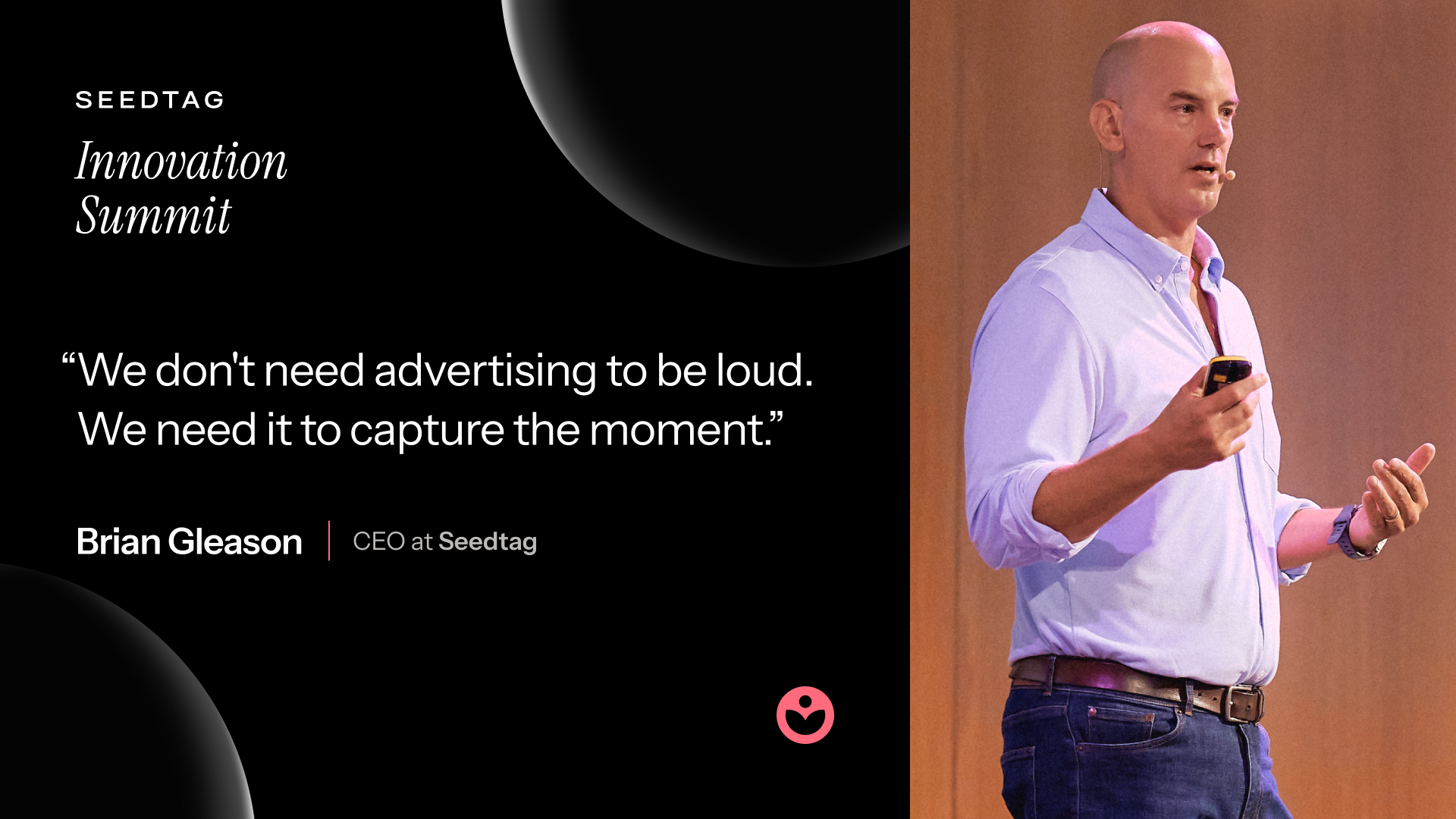
During the Summit, Brian Gleason, our CEO, added another layer: "We're more connected than we've ever been, but we're more distracted than we've ever been." For Brian, finding out how to connect in that moment is the most important thing, whether you're a brand, an agency, or a publisher.
The agenda combined dedicated sessions for the supply side and the demand side with joint sessions that put both in the same room. Topics ranged from the agentic shift and AI search to attention measurement, brand safety, CTV, creative, and life after the traffic. At lunches and dinners, the conversations kept going.
Across all of them, one thing became clear. The challenges facing the adtech ecosystem aren't local. They're global. And they become easier to solve when both sides look at them together.
Key Takeaways
- Consumers are more connected and more distracted than ever, and connecting with them in the moment matters for brands, agencies, and publishers alike.
- The same person makes different decisions in different situations, shaped by signals like time of day, screen, weather, and place.
- Fewer impressions carry identifiers, but audiences haven't gone anywhere, and reaching them requires a new structure.
- Interest, emotion, and intent shape how people process advertising, while viewability alone says nothing about that processing.
- Publishers, agencies, and brands face the same challenges from different perspectives, and the conversation is global, spanning the United States, Latin America, and Europe.
What Are the Biggest Challenges Facing the Digital Advertising Landscape?
Throughout the Summit, Brian Gleason put the consumer at the center of the conversation. For him, it's the one thing the industry doesn't focus on enough. We talk about acronyms, LLMs, and chats, but rarely about what consumers are doing every day or what their world is like.
And that world is full of noise. Attention is fleeting, and capturing it is hard. At the same time, clients are under pressure to grow and differentiate, and Brian raised an open question about what happens to them as products become commoditized in AI chat environments.
Grego Martínez, our Chief Product Officer, pointed to another challenge: media buying itself.
In CTV, most buying happens at the platform level, yet streaming services rarely have exclusive content. To illustrate the point, Grego shared a simple example: in Spain, Harry Potter is available on eight different platforms. So when a brand buys one of them, it's buying the service, not the moment. It learns nothing about the show being watched, the emotion it creates, or the hour and day it's being seen.
Buying through demand side platforms (DSPs) has a similar limitation. Brands and agencies can target IAB categories, keywords, domains, geography, or day part, but combining all of those signals to build moments manually is very complicated. The signals exist, but programmatic fragmentation keeps them apart.
Why the Adtech Ecosystem Is Moving From Understanding the Who to the Moment
For Grego, solving that fragmentation starts with a simple idea: the same person can make very different decisions depending on the situation they're in.
Picture someone commuting to work on a rainy Monday morning, phone in one hand, about to lose connection in five or six minutes. Any message has to be fast. Now picture the same person on a sunny Sunday morning, planning the week ahead with Monday off. They might spend 90 seconds on a powerful long video, one that takes them to the next step.
Nothing about them has changed. Only the moment has.
The same happens with a recipe. On a Tuesday evening after work, someone looking one up wants something fast. On a Saturday morning, with family and friends coming over, they're far more open to a message tied to that interest. The article is exactly the same. The moment is not.
That's why content is only one piece of context. The hour, the day of the week, and the season all matter. So do the type of screen someone is using, the weather, and the place they're in. On their own, these signals won't massively improve advertising. Combined, they create a scenario where advertising works much better.
Moments also change across environments. On mobile, things happen faster. On desktop, people are usually sitting down and paying more attention. CTV is often watched in a group rather than alone.
"We've spent more than 20 years understanding the who. Now, I think the future will be won by those who understand the moment much better," Grego said as he closed his session.
Audiences Were Never Identifiers
Hannes Sieling, our VP of Data & AI, started from programmatic advertising's long reliance on identifiers. They gave data teams structure, plus the reach to find people again. Today, fewer impressions carry them, but the reality hasn't changed. The same people are consuming the same content. And audiences were never identifiers in the first place.
What the industry needs is a new structure, built around the content people consume. That's the idea behind vector-based targeting: grouping similar content together so brands and agencies can find the environments closest to their goals, while balancing reach and precision.
Hannes also pointed to the technology that makes this possible: "Embedders are a little bit the hidden champions, the unsung heroes of the whole rise of large-language models."
The real question is what counts as similar. For him, the answer needs to go beyond clicks or categories and help find the right environment at the right moment. Understanding how people actually process what they see is a key part of that answer.
The Science Behind Attention, Emotion, and Intent
Professor Tino Meitz from the University of Münster explained how people process advertising. Who we are stays fairly stable, but how we feel and what we're focused on can change in milliseconds. When people consume media or advertising, that state of mind matters most.
That's also why viewability isn't enough. It shows that an ad could be seen, but says nothing about whether it was actually processed.
Three contextual signals shape that processing:
- Interest: If people aren't motivated to watch a show, they're unlikely to engage with the advertising within it.
- Emotion and affect: The brain relates new situations to past experiences, so a context that connects to familiar feelings makes new information easier to process.
- Intent: People need to be in the right situation for a message. If you want to buy a mid-sized SUV, you probably won't walk into a Ferrari dealership.
Tino was careful to separate affect from emotion: "Affect is something you can't govern. It's something that's happening, it's also, to a certain extent unconscious. Emotion is an evaluation of your affect afterwards."
How Can Supply and Demand Collaborate Across the Adtech Ecosystem?
Rob Beeler, who led the Two Sides, One Signal working session, explained why collaboration and supply and demand alignment matter. “Both sides are trying to solve the same things. This is a relationship-driven industry, and relationships are built by talking to each other in person. When both sides start working together, he said, they can be more effective for advertisers”, he said.
Kevin Donker, Head of Programmatic & Media Automation at Omnicom Media, brought that same spirit to the agentic conversation. For Kevin, agentic buying is still in its infancy, and the industry will have to come together to adopt protocols that make it reliable. When that happens, the productivity gains from AI should be reinvested in people.
In his view, the winners will be organizations that use AI to boost creativity, leadership, and judgment. The ones left behind will simply put an AI layer on top of an already fragmented workflow.
Brian Gleason echoed that idea in his closing remarks. He pointed to the feedback shared over the three days on different ways of working, ad inventory sources, and ways to measure. He also stressed the importance of trust: when you know you can trust someone, you know they'll do what they say they're going to do.
"There are a lot of pressures and challenges we think about in the world, and the things we shared over the last few days were brilliant. That's what we love to do: share information. It's an ecosystem that works together, and that's what we're trying to create", Brian Gleason.

How Does Neuro-Contextual Advertising Bridge the Gap Between Supply and Demand?
If both sides face the same challenge, they also need a shared way to understand the moment. That's what Neuro-Contextual Advertising offers.
Liz, our Neuro-Contextual AI, reads signals of interest, emotion, and intent to understand the moment behind each impression, without personal data or identifiers. For brands and agencies, that means reaching people when it matters most. For publishers, it means their content is valued for the moments it creates.
And it goes beyond advertising. Bringing value back to the open web helps keep quality content alive, and that's a responsibility the whole industry shares.
From Barcelona to the Next Conversation
Over three days, publishers, agencies, and brands from the United States, Latin America, and Europe approached the same questions from different perspectives. How do we capture attention? How do we reach audiences without identifiers? How do we make sure quality content keeps being found and valued as the way people discover information changes?
For us, at Seedtag, those conversations reinforce the vision behind Neuro-Contextual Advertising: understanding people's interest, emotion, and intent in the moment they're in.
It's not about knowing who. It's about understanding the moment.
Thank you to everyone who joined us in Barcelona. If you'd like to keep the conversation going, our team is here.
.png)
Notre blog

Video marketing solutions are changing as Connected TV reshapes how video advertising is planned, activated, and measured. With televisions now operating as connected, addressable environments, brands have access to digital-style capabilities within an ecosystem historically defined by reach and frequency.
In Episode 29 of The Pub Way Podcast, Tina and I sat down with Mike Brooks, Global Head of Business Development and Partnerships at LG Ad Solutions, to unpack what is really happening inside the CTV advertising ecosystem. We focused on three areas in particular: ecosystem structure, measurement integration, and the emergence of new formats within OEM operating systems.
One theme became clear as we talked. CTV is not behaving like traditional linear television, and it is not simply an extension of digital video. It is becoming a foundational video marketing solution, one that starts with environment and scale, then layers in measurement through a growing network of integrations rather than relying on a single tracking model.
Below are the core insights from the episode that help explain why CTV is playing a larger role in modern video marketing strategies.
Key Takeaways
- CTV advertising operates in a fundamentally different ecosystem than digital video, favoring concentration and scale over fragmentation.
- OEM platforms approach video advertising from the screen outward, starting with environment and reach rather than content libraries.
- Measurement in CTV is built through multiple one-to-one integrations, not a shared tracking language.
- Native advertising on TV home screens is a newer format that has only recently become accessible to the broader advertising market, expanding and maturing what video advertising can look like inside the TV experience.
- CTV is increasingly capable of supporting both reach and performance as measurement and attribution continue to mature.

How Does CTV Advertising Enhance Video Marketing Solutions Strategy?
One of the biggest differences between open-web video advertising and CTV advertising is how the ecosystem is structured. Digital video lives across thousands of websites and apps. CTV, by contrast, is concentrated across a much smaller number of platforms that each operate at a massive scale.
That concentration changes how video marketing solutions are deployed. Instead of managing campaigns across fragmented inventory, brands can activate video advertising within a limited set of environments that reach millions of screens. The result is greater focus, consistency, and access to high-quality video placements designed to capture attention.
What also stood out to me is how CTV has begun to adopt a more performance-aware mindset. Linear TV historically offered limited flexibility when it came to targeting and measurement. Connected TV now supports attribution and clearer insight into video performance that simply did not exist before. This shift is still unfolding, but it is already influencing how TV inventory is bought, evaluated, and optimized.
Why Choose CTV Advertising for Video Marketing Solutions?
For years, video marketing strategies forced a clear tradeoff. Linear TV delivered reach. Digital video delivered measurable performance. CTV is narrowing that divide.
Much of today’s CTV demand still originates from linear budgets built around reach and frequency. What has changed is what can now be layered on top. Measurement partners, attribution frameworks, and intelligent video solutions are expanding what CTV can deliver beyond awareness alone.
Scale remains central to this story. OEM platforms control the operating systems of connected televisions, which gives them direct access to hundreds of millions of screens globally. That scale allows brands to launch campaigns efficiently across regions.
For advertisers looking to Advertise on CTV, the combination of scale, environment control, and integrated measurement makes CTV difficult to replicate with other video marketing tools.
Learn More about CTV Advertising
- How to Measure Connected TV Ad Performance
- How Demand Side Platforms (DSPs) Are Reshaping CTV And What Publishers Need To Know
- Closing the CTV Measurement Gap: Data Quality & Performance Talks
How to Improve Video Marketing Solutions Using CTV
Improving video marketing solutions using CTV starts with how measurement is structured. In the episode, one of the defining characteristics of the CTV ecosystem is that it does not operate on a single, shared tracking system. Unlike mobile and web environments that rely on unified identifiers, CTV measurement is built through a network of one-to-one integrations.
OEM platforms work with multiple attribution and reporting partners, allowing campaigns to be evaluated using familiar performance frameworks. This integration model makes it possible to connect CTV advertising with broader media measurement strategies rather than isolating it as a separate channel.
What stood out to me is that this approach improves video marketing solutions by aligning television with existing reporting structures. Measurement is layered onto the TV environment in a way that reflects how it actually functions. For brands, that creates clearer performance visibility while preserving the scale and environment advantages that make CTV distinct.

Intelligent Video Solutions and Native CTV Formats
One of the most distinctive parts of the CTV ecosystem is native advertising on TV home screens. These placements live inside the operating system itself and appear the moment a viewer turns on their TV.
What makes these formats different is timing. Native placements show up before content selection, which sets them apart from traditional pre-roll video ads. They create a new entry point for brand visibility, product discovery, and navigation to landing pages or video hosting environments.
As discussed in the episode, this inventory has only recently become available to the broader advertising market and is now reaching wider programmatic access. That shift marks an important moment in how video advertising can show up within the TV experience.
Why Connected TV Advertising Is Better Than Other Video Marketing Solutions
So, What is CTV Advertising delivering that other video channels do not? To answer that, it helps to compare structural models.
Linear television delivers massive scale but historically operates with limited integration into digital attribution systems. Social video platforms and environments like YouTube offer targeting flexibility and performance signals, but function within closed ecosystems where optimization occurs at the platform level. Open-web video operates across fragmented placements.
CTV sits between these models.
It preserves the scale and shared viewing environment of television while introducing integration-based measurement through OEM platforms. Instead of relying on a single tracking system, CTV connects to multiple attribution and reporting partners. That allows campaigns to align more directly with broader media evaluation frameworks.
OEM environments also operate across fewer, larger platforms compared to the open web. That concentration reduces fragmentation while maintaining reach and placement control.
For brands evaluating video marketing solutions, this structural balance is what makes CTV better. It allows marketers to combine scale, environment integrity, and measurable performance within a single channel. While measurement continues to mature, CTV is no longer limited to awareness alone.
Looking Ahead: The Role of CTV in Video Marketing Solutions
Video marketing is no longer defined by a strict choice between linear TV and digital video. As Connected TV continues to mature, it is becoming a central part of how brands plan, execute, and evaluate video advertising.
CTV advertising allows marketers to start with environment and scale, then layer in measurement through partnerships and integrations. For brands evaluating the next generation of video marketing tools, CTV is not simply an extension of television. It is a distinct and increasingly essential part of the video marketing landscape.
For deeper insights into CTV advertising, OEM platforms, and the evolution of video measurement, listen to Episode 29 of The Pub Way Podcast.

The future of digital marketing is no longer defined by who consumers are, where they have been, or what they clicked yesterday. It is defined by something far more immediate and human: the moment they are in right now.
For more than a decade, the marketing industry relied on identity-based signals and increasingly fragile behavioral signals to drive personalization and performance. That approach shaped an entire era of digital marketing, adtech, and marketing technologies.
Today, however, the industry faces a deeper structural challenge: signal loss and declining addressability. As privacy expectations rise and media consumption fragments across platforms and screens, brands are losing reliable ways to understand people and deliver relevance at scale.
What is emerging in their place is not a return to the past, but an evolution. One that reflects how people actually experience content in real time. This shift is redefining the future of advertising, and it is why Neuro-Contextual advertising is becoming central to the future of digital marketing.
Key Takeaways
- The future of digital marketing is shifting away from identity-based targeting toward understanding the moment or mood people are in.
- Relevance alone is no longer enough. Real impact comes from resonance, when advertising aligns with interest, emotion, and intent.
- Adtech innovation is redefining digital marketing strategies by using AI to interpret content rather than track people.
- Neuro-Contextual advertising enables privacy-first relevance by decoding how a moment feels, not who the user is.
- Brands, agencies, and publishers gain a competitive advantage when advertising feels welcome, natural, and emotionally aligned.
- As signal loss accelerates and addressability declines, understanding the moment is becoming the foundation of modern marketing.
Why relevance alone is no longer enough
Traditional contextual advertising focused on relevance. Match an ad to a topic. Place a message next to related content. Avoid unsafe environments. It worked, especially at scale, and it provided a privacy-safe alternative to behavioral targeting.
But relevance has a ceiling. An ad can be contextually relevant and still feel out of place. It can appear next to the right topic and still fail to connect.
The reason is simple. People do not consume content in a neutral state. Every article, video, or stream activates a mindset shaped by interest, emotion, and intent.
The future of digital marketing depends on understanding that difference.
Relevance answers where an ad appears. Resonance determines how it is experienced. That distinction is becoming one of the most important marketing trends shaping the industry.

Adtech innovation is shifting the foundation of digital marketing
How will the future of digital marketing change with adtech innovation?
Adtech innovation is moving away from surveillance and toward understanding. Instead of tracking individuals across the open web or social media, new AI-powered systems are learning to interpret the meaning of content itself.
This is where technological advancements in artificial intelligence are reshaping the marketing industry.
Modern AI-driven platforms can analyze content at scale across formats such as articles, video, CTV, and immersive experiences. They understand not just what content is about, but how it feels. Tone, emotion, and environment all matter.
This evolution allows digital marketing strategies to shift from prediction to presence. From guessing what consumers might want next to understanding what they are experiencing now.
In the future of digital marketing trends 2026 and beyond, this real-time understanding will be more valuable than any historical customer profile.
From targeting people to understanding moments
For years, marketing strategies centered on the “who.”
- Who is this person?
- What demographic box can they be placed in?
- What past behavior can predict their next move?
But the future of advertising is moving toward the “what” and the “how.”
- What is this person engaging with?
- How does this moment feel?
- What mindset does this content create?
This is where Neuro-Contextual thinking changes everything
Neuro-Contextual advertising starts with the premise that interest, emotion, and intent are expressed through content itself. These signals reflect how open someone is to receiving information, forming memory, and taking action in real time.
Instead of building campaigns around identity, Neuro-Contextual advertising aligns ads with moments that naturally invite connection. This approach bridges the gap between digital marketing performance and genuine customer engagement.
Why Neuro-Contextual advertising is central to the future of digital marketing
Can Neuro-Contextual improve relevance and performance in the future of digital marketing? Yes. And more importantly, it improves meaning
Neuro-Contextual advertising builds on contextual foundations but goes deeper. It uses AI-powered analysis to interpret content through a human lens, identifying emotional and cognitive signals in real time.
When ads align with these signals, the brain processes them more easily. Attention increases. Emotional response strengthens. Memory formation improves.
These are the core Neuro-Contextual advertising benefits. They move advertising beyond surface-level relevance and into resonance.
In a privacy-first world, this approach allows brands to gain deeper insights without relying on personal customer data. It respects user expectations while delivering actionable insights that improve performance across the funnel.
Learn more about Neuro-Contextual Advertising
- Neuro-Contextual Advertising: Winning Audiences Through Interests, Emotions and Intentions
- How Neuromarketing Is Redefining Ad Relevance Today
- How is Neuroscience Transforming the Digital Advertising Landscape
The neuroscience behind resonance
Understanding why resonance works requires looking at how the brain processes information.
Insights from neuroscience help explain why emotionally aligned advertising is processed more fluently, remembered more clearly, and trusted more instinctively by the brain. When content and advertising share the same emotional tone and intent, cognitive effort decreases, and the experience feels natural rather than disruptive.
This is exactly what our neuroscience research revealed. By measuring real-time brain responses, the study found that Neuro-Contextual advertising generates significantly stronger neural and emotional engagement when ads align with the interest, emotion, and intent expressed in the surrounding content. Compared with non-contextual advertising, Neuro-Contextual placements delivered up to 3.5x higher neural engagement, alongside a 26% stronger emotional response than standard contextual approaches.
Instead of interrupting attention, Neuro-Contextual advertising fits into the flow of the experience. It works with the brain’s natural processing patterns rather than against them. This distinction is critical for the future of digital marketing, especially as attention becomes harder to earn and competition for relevance intensifies.

A new role for AI in digital marketing
Artificial intelligence has played a role in digital marketing for years, from product recommendations to campaign optimization. Much of that use focused on automation rather than understanding.
The next phase of AI in digital marketing is different.
AI-powered, Neuro-Contextual systems are designed to interpret meaning. They analyze text, imagery, and video to understand the emotional environment surrounding content in real time.
This allows marketers to align creative with mindset, adapt messaging to emotional tone, and deliver immersive experiences without relying on identity-based tracking.
In the future of digital marketing, AI-driven understanding becomes a durable competitive advantage. Not because it knows more about the person behind the screen, but because it understands moments better.
What this shift means for brands, agencies, and publishers
For brands, Neuro-Contextual advertising enables emotional connection at scale without sacrificing reach or privacy. Campaigns align with moments of curiosity, inspiration, or intent across digital channels and CTV.
For agencies, Neuro-Contextual signals provide a smarter planning foundation. Instead of relying solely on historical behavior, planners can use human-like understanding of context to inform creative, placement, and optimization decisions.
For publishers, Neuro-Contextual advertising rewards quality content rather than clickbait. Performance reflects emotional resonance, not just clicks, helping publishers build sustainable value.
Why the future of digital marketing starts with understanding the moment
As privacy expectations evolve and addressability continues to decline, the marketing industry must find new ways to connect without relying on personal identifiers. Neuro-Contextual advertising answers that challenge by focusing on the most impactful variable in advertising: the moment someone is in.
Reaching people at the right moment drives stronger attention, deeper emotional connection, and greater recall because it aligns with how they are already thinking and feeling. By understanding interest, emotion, and intent as they emerge through content, brands can create advertising that feels relevant, respectful, and real.
The future of digital marketing will belong to those who stop chasing people around the internet and start showing up in the moments that spark their passions.
Relevance will always matter. But resonance is what drives connection, memory, and action. Neuro-Contextual advertising defines a more human, privacy-first future for the marketing industry.

Valentine’s Day is no longer just about flowers, chocolates, and last-minute gifts. In recent years, the holiday has evolved into a broader cultural moment shaped by emotion, self-expression, and shared experiences. For brands, this shift changes how Valentine’s Day ads should be planned, delivered, and measured.
Rather than focusing only on romantic clichés, today’s most effective Valentine’s Day marketing reflects how people actually feel, plan, and engage with content around the celebration. Understanding those behaviours is the foundation of a stronger valentine campaign.
Below, we explore what ads work best, the best Valentine’s day ads ideas to consider, and what’s trending this year in seasonal advertising.
Key takeaways
- The most effective Valentine’s Day ads align with emotional context, not just gifting moments.
- Successful Valentine campaign strategies reflect a wider range of relationships and celebrations.
- Relevance driven by context now matters more than interruption.
- Seasonal Valentine’s Day marketing is becoming more experience-led and less product-focused.
- Longer activation windows are shaping how day ads perform around St Valentine’s.
What Valentine’s Day ads work best for a campaign?
Ready to dive into what was buzzing in Las Vegas?
The Valentine’s Day ads that perform best align with emotional context rather than interrupt it. In the lead-up to the holiday, people are already immersed in emotionally charged content. They browse gift inspiration, plan shared experiences, read lifestyle stories, and engage with culture that reflects connection and anticipation.
What truly drives connection during this period is not who people are on paper, such as their age, gender, or past online behaviour, but what captures their interest, emotion, and intent in the moment. Valentine’s Day advertisement placements that appear alongside relevant content tend to feel more welcome because they align with how people are already thinking and feeling.
Instead of pushing promotional messages into unrelated environments, effective ads match the tone and emotional state of the moment. This alignment helps brands earn attention and a positive association without relying on pressure or urgency. As a result, the strongest Valentine's campaign strategies are defined by relevance, not volume.
When campaigns are built around a neuro-contextual approach, brands gain a deeper understanding of what truly matters to audiences in each moment. By aligning media placement with real-time signals of interest, emotion, and intent, advertising becomes more precise and more human. The result is smarter placement, creative that resonates emotionally, and messaging that feels natural rather than intrusive, driving stronger engagement, more meaningful connections, and measurable impact.

The best Valentine’s Day ads ideas for modern campaigns
The best Valentine’s Day ads ideas today reflect how diverse the holiday has become. While romance remains important, audiences increasingly respond to content that includes friendship, self-care, humour, and shared rituals. This broader emotional lens allows Valentine’s Day marketing to resonate with more people in more authentic ways.
Many effective Valentine’s Day advertisement strategies focus on experiences rather than transactions. Messaging that highlights moments, ideas, or inspiration tends to feel more supportive and relevant than purely product-led communication. When ads help people decide how to celebrate rather than what to buy, they add value to the experience.
Timing also plays a central role. Early in the season, audiences are in a discovery moment, seeking inspiration and planning ideas. As the day approaches, convenience and clarity become more important. A flexible Valentine’s Day marketing plan that adapts to these shifting needs performs far better than a single, static message.
What’s trending this year for Valentine’s Day ads?
This year, Valentine’s Day ads are trending towards a softer and more emotionally intelligent approach. Brands are moving away from exaggerated romantic tropes and embracing authenticity. Content that reflects real relationships, personal choice, and emotional nuance is seeing stronger engagement.
In online advertising, Neuro-Contextual placement is becoming increasingly important. Valentine’s Day ads are now appearing alongside food-related content, wellbeing stories, entertainment coverage, and lifestyle features. These environments reflect how people experience Valentine’s Day as part of daily life, rather than solely as a retail occasion.
Another key trend is timing. Valentine’s Day marketing is starting earlier and extending beyond 14 February. Longer activation windows allow brands to support planning, anticipation, and last-minute decisions in a way that feels natural rather than forced.
Building a Valentine’s Day marketing plan that connects
A successful Valentine’s Day marketing plan begins with empathy. Brands that understand emotional context and how people engage with content are better positioned to create Valentine’s Day ads that feel relevant and timely. For many teams, having a clear checklist for a valentine campaign helps ensure messaging, timing, and placements remain aligned with how people actually experience St Valentine’s.
This shift reflects a broader change in advertising, moving away from targeting individuals in isolation and towards understanding the environments and emotional states that shape real decisions. When context, emotion, and intent are considered together, media placement becomes smarter, and campaigns resonate more deeply.
Rather than asking how to stand out during the season, the more effective question is how to show up at the right moment. When Valentine’s Day advertising aligns with what people are already exploring, it becomes part of the experience rather than an interruption.
As the holiday continues to evolve, the brands that succeed will be those that focus less on formulas and more on connection. The future of Valentine’s Day ads is not about saying more. It is about understanding more and letting relevance do the work.

Super Bowl ads have always been a cultural event in their own right. Every year, brands compete for attention during the biggest game on the calendar, investing heavily in a single 30-second spot designed to entertain, surprise, or spark conversation. But the Super Bowl is no longer just a one-night advertising showdown. It has become a powerful window into how audiences engage with sports, culture, entertainment, and media throughout the year.
As Super Bowl LX approaches, the behaviors surrounding the big game reveal far more than which commercials people remember. They show how fans consume content across platforms, what drives emotional engagement, and how Super Bowl advertising influences broader marketing strategies well beyond game day. For marketers, these patterns provide essential insights into NFL sports that can help shape smarter Super Bowl advertising in 2026 and beyond.
Below, we break down what Super Bowl ads reveal about evolving NFL trends, how brands should plan beyond the 30-second spot, and why these signals are shaping Super Bowl advertising strategies throughout 2026.
Blog Post Highlights
- Super Bowl ads reflect broader audience behaviors, not just game-day viewing.
- NFL sports insights show that attention spans food, betting, entertainment, teams, and culture.
- The traditional 30-second spot is only one part of a much larger Super Bowl advertising ecosystem.
- NFL trends observed during the Super Bowl influence creative and media strategies year-round.
What NFL sports insights do Super Bowl ads reveal each year?
Each Super Bowl captures a snapshot of how audiences behave at a specific cultural moment. While the game itself remains central, the interests surrounding it reveal what truly holds attention. Seedtag’s Super Bowl LX Neuro-Contextual analysis shows that fan engagement consistently extends beyond football alone.
Five interest areas dominate Super Bowl engagement:
- Fantasy football and sports betting
- Football food and game-day recipes
- The halftime show and music culture
- Teams and players
- Watch parties and tailgating
These patterns reveal an important truth. Super Bowl ads are not competing only with other commercials. They are competing with bets being placed, recipes being searched, fantasy lineups being debated, and halftime performers being discussed. Each year, the Super Bowl highlights how fans experience the event as a cultural and social ritual, not just a sports broadcast.
For advertisers, this is a clear insight. Super Bowl advertising works best when it aligns with why people are watching, not just what they are watching. Ads that connect to these surrounding behaviors feel more relevant, while those that ignore them risk fading into the background.

Beyond the 30-second spot: planning Super Bowl ads across the NFL ecosystem
The iconic bowl ad still plays an important role, but its function has evolved. The Super Bowl is no longer a single-screen experience, and strategies built only around broadcast TV miss how audiences actually engage with the event.
Super Bowl fans now move fluidly across streaming platforms, sports networks, mobile devices, and second screens. At the same time, live behaviors such as sports betting, social commentary, and real-time analysis amplify engagement throughout the game. As a result, Super Bowl advertising must be designed for an ecosystem, not a single placement.
In this environment, the 30-second spot becomes a launch point rather than a conclusion. Effective Super Bowl ads extend into:
- Pre-game moments, as fans research teams, players, and matchups
- In-game moments, when attention spikes around key plays, betting updates, and halftime
- Post-game conversations, where commercials are replayed, shared, and discussed
Brands that plan for these moments can stay present without relying on interruption alone. The goal shifts from simply being seen to being contextually relevant across the fan journey.
How food, betting, and entertainment shape Super Bowl advertising
One of the clearest NFL sports insights from Super Bowl LX is the role non-sports content plays in driving engagement. Football food is a prime example. Searches and content around dips, soups, snacks, and drinks surge ahead of the big game, reinforcing the Super Bowl’s role as a shared social experience.
Fantasy football and sports betting also command sustained attention. Fans actively seek predictions, odds, and strategy content before and during the game, creating high-intent moments where focus is already strong. These behaviors indicate opportunities for brands to connect when audiences are especially receptive.
Entertainment adds a further layer. The halftime show consistently attracts audiences beyond traditional football fans, turning the Super Bowl into a crossover event that blends sports, music, and pop culture. This expansion reshapes Super Bowl advertising, increasing its reach while raising expectations for cultural relevance.
Together, these dynamics show that the most effective Super Bowl ads are grounded in alignment. When advertising reflects the rituals and interests surrounding the game, it feels natural rather than intrusive.

Teams, players, and narratives that extend beyond game day
Teams and players also play a central role in shaping engagement. Certain franchises dominate conversation due to performance, history, and cultural relevance, while star players generate attention that stretches well beyond the field.
Player-driven narratives often spill into entertainment and celebrity culture, connecting the NFL to broader media conversations. These storylines transform football coverage into lifestyle content, influencing what fans read, watch, and share throughout the season.
This is where NFL trends become especially valuable for marketers. The Super Bowl doesn’t just reflect current interest; it signals which narratives, personalities, and themes are likely to shape attention throughout the year. Brands that recognize these patterns can plan Super Bowl ads that remain relevant long after the final play.
How Super Bowl ads shape broader Super Bowl advertising trends
Super Bowl advertising has a lasting influence on the industry. The creative styles, tones, and messages that resonate during the big game often set expectations for advertising across the months that follow.
Each Super Bowl becomes a testing ground for what audiences respond to, whether that’s humor, nostalgia, cultural commentary, or emotional storytelling. These signals inform how brands approach campaigns throughout the year, not just during marquee moments.
Seedtag’s Neuro-contextual approach plays a defining role in this shift. Ads that appear alongside content aligned with fan interests, intents, and emotional states feel more welcome and less disruptive. Over time, this raises the standard for Super Bowl advertising and for sports marketing more broadly.
From visibility to relevance: why the Neuro-contextual approach matters more than ever
As the Super Bowl grows more complex, visibility alone is no longer enough. Fans are surrounded by content, commentary, and distractions. What cuts through is relevance, showing up in the right environment, at the right moment, with the right message.
Neuro-Contextual advertising supports this shift by aligning ads with content people are already engaging with. During the Super Bowl, that may include food content, betting analysis, team coverage, or halftime discussions. These placements complement the experience rather than interrupt it.
This approach allows Super Bowl advertising to extend beyond the broadcast and into the broader content ecosystem. It keeps messaging connected to how fans think, feel, and decide throughout the season.
What Super Bowl ads tell us about what comes next
Super Bowl ads are no longer just about winning the night. They are about understanding the audience. The NFL sports insights revealed each year offer a roadmap for smarter, more effective advertising strategies.
As Super Bowl LX approaches, the takeaway is clear. Brands that succeed in 2026 will be those that move beyond the standalone 30-second spot and treat Super Bowl advertising as an ongoing conversation. By aligning with the interests, narratives, and contexts that matter to fans, marketers can turn the big game into a year-long opportunity.
The future of Super Bowl advertising isn’t louder. It’s more connected and more attuned to how audiences actually experience the game.


In a digital advertising world that never stands still, success belongs to those who adapt, innovate, and rise to new challenges.
Seedtag has evolved tremendously since our inception more than a decade ago. Through continuous innovation and an unwavering belief in the power of context, we’ve built a company that leads brands, agencies, and publishers into a more intelligent, privacy-first future. And as we continue to grow, it’s only natural that our brand identity evolves too — to reflect who we’ve become and where we’re headed.
- The Next Chapter of Contextual: Neuro-Contextual
- A new look, the same soul
- Seeing the World Through a Human Lens
- Strengthening our commitments
- What this means for our partners
The Next Chapter of Contextual: Neuro-Contextual
In 2025, we launched Neuro-Contextual, the next evolution of contextual advertising. Powered by our AI, Liz, this technology goes beyond content — combining advanced embeddings with neuroscience principles to understand audiences with unprecedented precision. Liz defines the interests, emotions, and intents that drive engagement across the open web and CTV, creating connections that are both effective and deeply human.
A new look, the same soul
Our new brand identity is a reflection of this journey. For me, a brand has always been more than a logo or color palette; it’s the heartbeat of who we are. The best brands feel authentic — they mirror the people and purpose behind them.
This refreshed look embodies what Seedtag stands for today: sleek, intelligent, and modern, yet grounded in humanity and authenticity. Our logo remains untouched, honoring the legacy that brought us here and the innovative ideas still taking root and growing every day.
While our visual identity evolves, our essence remains unchanged. We’re still as passionate as ever about privacy, innovation, and making the digital world better for everyone.

Seeing the World Through a Human Lens
At the heart of our new design are the lenses — a powerful symbol of how we view the world. They represent our belief that what drives engagement isn’t found in demographics, but in how people feel in the moment.
This is the foundation of Neuro-Contextual advertising: understanding the context and environment that shape people’s experiences rather than targeting individuals in isolation. Your age, gender, or what you clicked on yesterday says little about who you are today. What truly matters is what captures your interest, emotion, and intent right now — that’s what drives meaningful connection.
Strengthening our commitments
Our mission is clear: to bring Liz to the world — helping brands and publishers create advertising rooted in human understanding, not surveillance.
A key step toward this is the upcoming Liz Agent, an intelligent interface designed to deliver deeper insights into audiences, competitors, and optimization opportunities for our clients.
Our vision is a future where advertising feels relevant, respectful, and real — engaging people in ways that inspire, not interrupt. Seedtag aims to be more than a partner that drives results; we want to help shape a digital universe where advertising truly adds value.
What this means for our partners
For our partners — brands, agencies, and publishers — this evolution strengthens what we’ve always stood for. Our focus remains the same: privacy, performance, and human connection.
By harnessing the power of Neuro-Contextual intelligence, our partners gain:
- Deeper audience understanding
- Smarter media placement
- Campaigns that resonate emotionally
The result is advertising that feels natural, not intrusive — delivering better engagement, stronger connections, and measurable impact.
We’re deeply grateful for your trust and partnership as we take this next step forward. Together, we’re building a future where advertising doesn’t just reach people — it connects with them.

The junk food advert ban, restrictions for less healthy food or drink on television (TV) and online, represent one of the most consequential changes to UK advertising regulation in recent years. Introduced to address rising levels of childhood obesity and better protect children from exposure to unhealthy foods, the legislation places strict limits on how HFSS products, defined as those high in fat, salt, or sugar, can be promoted across television and online environments.
For brands operating across food and drinks, fast food, and soft drinks, the impact of the junk food advertising ban goes far beyond compliance. The challenge is no longer whether these rules apply, but how to plan media effectively, remain visible, and stay compliant within a far more restricted advertising landscape. Traditional, product-led food adverts are being replaced by brand-led storytelling, contextual relevance, and a stronger focus on responsibility.
Crucially, this shift does not mean abandoning digital channels or the audiences brands have spent years building. Instead, it marks a transition in how those audiences are reached and what they are shown. The same people are still there, but the stories brands tell, and the environments they appear in, must evolve.
Understanding the junk food advert ban UK and its implications is now a strategic priority for marketers.
Below, we break down how the HFSS advertising rules work, what they mean for media planning in the UK, and the practical steps brands can take to stay compliant while continuing to build relevance and trust.
Key takeaways
- The junk food advert ban UK restricts HFSS food adverts on television before 9 pm and bans them online entirely.
- The regulation is designed to reduce childhood obesity and limit exposure to unhealthy foods from a young age.
- Compliance requires a shift away from product-led advertising towards brand, lifestyle, and contextual storytelling.
- Contextual media planning is essential for maintaining reach while respecting HFSS rules.
- Brands that align with public health goals are better positioned for long-term trust and growth.
What is the junk food advert ban?
The junk food ad ban forms part of the UK’s broader HFSS advertising rules, which came fully into force in January 2026. These regulations apply to paid advertising for food and drinks products classified as high in fat, salt, or sugar, based on government nutrient profiling models.
Under the rules:
- HFSS food advertising is banned on television before 9 pm.
- Paid-for online advertising of HFSS products is prohibited across social, display, video, search, and influencer channels.
- The restrictions apply regardless of audience demographics, including campaigns aimed primarily at adults.
Evidence shows that repeated exposure to junk food advertising influences eating habits from a young age, contributing to higher rates of children becoming overweight or obese. The policy is therefore designed to protect children and support wider public health objectives, rather than restrict the food industry outright.

Junk food advert ban implications for brands
One of the most immediate implications of the junk food advertising ban is a fundamental change in how brands communicate. Product imagery, pack shots, and direct promotional messaging are no longer viable across many television and online placements.
However, this does not signal the end of brand presence or performance-driven outcomes. Brands are adapting by shifting towards:
- Masterbrand storytelling rather than individual product promotion;
- Lifestyle and usage-led content that avoids direct product advertising;
- Highlighting healthier options within broader portfolios;
- Creative formats that focus on values, culture, and shared moments.
These constraints are not limiting creativity. They are accelerating it. Similar shifts have already taken place in other highly regulated categories, where success depends on finding the right balance between compliance, brand identity, and audience relevance.
How to plan media in the UK under HFSS restrictions
Planning media under HFSS rules requires moving away from audience-based targeting and towards a more Neuro-Contextual approach.
Instead of asking who the audience is, brands must consider:
- Where their ads appear
- The surrounding content and emotional tone
- Whether the message feels appropriate, supportive, and responsible.
Neuro-Contextual advertising allows brands to appear in relevant environments without promoting restricted products directly. Food advertising can focus on cooking inspiration, everyday rituals, or brand purpose, rather than fast food or junk food items themselves.
As Marko Johns, UK Managing Director at Seedtag, explains:
“In a more regulated advertising environment, success will belong to brands that stop chasing only visibility and start optimising for receptivity, grounded in emotional relevance.”
This approach ensures that food adverts feel welcome rather than disruptive, even as regulations tighten.

Creativity, brand identity, and adaptive optimisation
As creative strategies evolve under HFSS regulation, brand identity takes on greater importance. When products cannot take centre stage, distinctive brand assets, tone, and emotional cues carry more weight in driving recognition and recall.
By analysing how audiences respond to different creative elements across environments, Seedtag’s creative intelligence can identify which visual signals, narratives, and emotional cues perform best in each context. This enables creatives to be adapted dynamically, not replaced, helping even simple brand stories evolve into high-impact executions that drive attention, memory, and action.
This approach supports creativity rather than constraining it, allowing brands to refine how they show up while remaining aligned with both regulation and audience expectations.
How to stay compliant with HFSS advertising UK
Staying compliant with HFSS advertising UK rules requires close coordination between creative, media, and legal teams.
Best practice includes:
- Removing direct references to HFSS products from creative.
- Avoiding imagery or language associated with unhealthy foods.
- Ensuring online placements do not promote restricted items indirectly.
- Keeping clear documentation to demonstrate regulatory responsibility.
Compliance is not only about avoiding fines. It increasingly shapes brand trust. Consumers expect food brands to act responsibly, particularly when it comes to protecting children and supporting healthier choices.
Turning restriction into opportunity
While the junk food advert ban introduces clear limitations, it also creates space for brands to evolve how they show up in the market. As product-led promotion becomes less viable, creativity, Neuro-Contextual intelligence, and emotional understanding increasingly determine effectiveness, often more than reach alone.
Brands that focus on purpose, promote healthier options, and invest in meaningful storytelling can continue to build salience without relying on traditional junk food advertising. This shift encourages a move away from interruption and towards relevance, where messages feel appropriate to the moment and the environment in which they appear.
For brands looking to navigate this transition in practice, understanding how FMCG brands can win in a restricted ad landscape means rethinking media planning, creative strategy, and the role of context in building trust at scale.

Brand safety has always been one of the most persistent challenges for publishers. The issue has never been the concept itself. The real problem is that many tools shaping brand safety in advertising were not created with the publisher perspective in mind. When outdated blocklists, blunt keyword filters and legacy workflows decide what is safe, publishers lose access to revenue they should have earned. These systems cannot interpret nuance which is why so much valuable inventory is mislabeled and excluded from campaigns.
In this episode of The Pub Way Podcast Mike and I sat down with Heather Carver, Chief Customer Officer at tvScientific, formerly Chief Revenue Officer at Freestar, to talk about how AI and modern curation are transforming the way publishers protect and monetize their content. I speak with publishers every day and hear the same pattern. High quality content is being misread by tools that were never designed to understand context. Our conversation with Heather helped clarify why this happens and where real progress is finally taking place.
- Reframing Brand Safety for a New Era
- Why This Shift Matters for Publishers
- Curation With Intention
- Preparing for the Shifts in Search and AI Discovery
- How Freestar Uses AI to Support Publisher Growth
- What Publishers Should Expect From Curation Partners
- Looking Ahead
- Listen to the Full Episode
Reframing Brand Safety for a New Era
Heather has worked across multiple sides of the industry for more than fifteen years. She began on the publisher side, moved into the SSP world and later joined a major tech platform. That range gives her a rare understanding of how brand safety in advertising has evolved and where the blind spots remain.
One of the biggest issues she raised is how deeply legacy tools are embedded within agency workflows. Keyword blocklists once felt like the safest and simplest option, but today they often create more harm than protection. A single word can trigger a block even when the surrounding context is positive or neutral. Articles about sports get flagged because the word shoot appears. Entire news sections are treated as unsafe even when they are accurate and balanced.
This is particularly damaging for publishers because quality journalism still drives audience trust. It also supports the wider digital ecosystem. AI models, search engines and recommendation systems all rely on credible content. When brand safety tools over block the open web, they reduce the quality of the very signals powering modern information systems.
This is where AI creates opportunity. Modern suitability models can interpret tone, sentiment and meaning rather than relying on isolated terms. AI allows brand safety in advertising for publishers to be far more precise. Nuanced content is recognized for what it actually communicates. High quality reporting is not penalized simply for covering real events. Publishers gain access to demand that should have always been available to them.

Why This Shift Matters for Publishers
The shift from blocking to suitability is not only a technological improvement. It is a reset in how we understand publisher value. When legacy tools miscategorize content they erase context that is essential for advertisers. They also create a distorted picture of what publishers actually produce.
Heather emphasized that publishers should be part of the conversation. They have a unique understanding of their editorial standards, their audience and the true nature of their content. When these nuances are lost, publishers are pushed into a defensive posture even when their environments are completely suitable.
Suitability frameworks give publishers a way to demonstrate that their content is relevant, trustworthy and aligned with advertiser goals. They also create pathways to recover monetization that legacy systems have blocked.
Curation With Intention
Curation has existed in ssp advertising for years, but Heather explained that the latest evolution of curation is far more valuable for publishers. Older curation models grouped thousands of sites into broad categories and rarely adapted. They did not showcase what made each publisher unique and they did not help buyers understand the context behind impressions.
Modern curation is dynamic and intelligent. AI evaluates context, tone and performance signals in real time. Packages reflect quality rather than volume. Buyers can see how curated segments are built and which publishers contribute to them. This transparency makes it easier for advertisers to invest with confidence.
For publishers this matters because intentional curation helps correct misclassification. It brings premium inventory back into circulation and connects it with campaigns where it naturally performs well. It also gives publishers without large direct sales teams a meaningful way to reach premium budgets.
This shift in curation also highlights how much innovation is happening on the sell side. SSPs are no longer simply pipes for demand, they are becoming intelligence layers that help publishers surface the true value of their inventory. If you want to understand how this evolution is shaping monetization and ad quality, we covered it in more detail in an earlier episode about how supply side platforms are driving smarter ad experiences.
These changes in suitability and curation run parallel to shifts on the buy side. DSPs continue to refine how they evaluate context, quality signals and performance across formats like CTV, which ultimately shapes how publisher inventory is valued. For publishers who want a deeper look at what this means in practice, we explored it in a recent episode focused on how demand side platforms are reshaping CTV strategies.
Learn more about Brand Safety in Advertising
- How Publishers Can Future-Proof Brand Safety and Revenue with the Right Advertising Supply Side Platform
- How Publishers Can Use AI to Monetize Content and Audience Attention - AI for Publishers
- Digital Marketing Musts for Publishers: Locking in Monetization with Brand Safety
Preparing for the Shifts in Search and AI Discovery
Our conversation then moved to search traffic and the rise of AI generated results. Publishers are already seeing changes as users engage with zero click answers and LLM summaries. Heather’s view is that publishers cannot rely on a single traffic source. Instead they need to build editorial brands that readers return to directly.
That means investing in quality content, improving user experience and strengthening newsletters and owned channels. While these strategies take longer, they create dependable traffic patterns and reduce exposure to algorithmic shifts.
We also discussed upcoming models around AI scraping. Large publishers have begun negotiating deals with AI companies, but the mid and long tail need collective solutions. Ideas like pay per crawl or pay per query may emerge as sustainable models. What remains clear is that AI systems depend on publisher content. Publishers deserve to be compensated for the value they provide.
How Freestar Uses AI to Support Publisher Growth
Heather shared how Freestar uses AI inside their own stack. Their dynamic ad system processes billions of impressions and adjusts floors, timeouts and wrapper behavior automatically. The goal is to maximize monetization while protecting user experience.
Freestar also relies on AI agents across their teams to automate research, data ingestion and internal workflows. This allows teams to focus on strategic guidance rather than manual operations. For publishers without large technical resources these efficiencies create a real competitive advantage.

What Publishers Should Expect From Curation Partners
Before closing the episode I asked Heather what publishers should look for when evaluating partners. She highlighted transparency, performance and flexibility. Partners should explain how segments are curated, who is buying them and what results they drive. They should reflect the strengths of the publisher rather than grouping sites into generic categories. They should use real technology that enhances outcomes rather than relabeling existing inventory.
Looking Ahead: Brand safety in advertising
If there is one message to take from this conversation it is that publishers finally have a pathway forward. With better suitability models, more advanced curation and meaningful AI applications, the industry can move away from outdated systems and toward a model that truly recognizes and rewards quality content. Brand safety in advertising can become a tool that supports publishers, not a barrier that undermines them.
Listen to the Full Episode
For a deeper look at suitability models, curation frameworks, AI adoption and the future of monetization for publishers listen to the full conversation with Heather Carver on The Pub Way Podcast.

As the digital marketing industry moves beyond the volatility of recent years, one thing is clear: the marketing trends of 2025 set the stage for a much deeper transformation ahead. By 2026, brands and marketers will no longer be optimizing around isolated signals, legacy identifiers, or fragmented channels. Instead, the next era of advertising will be defined by intelligence, adaptability, and a more human understanding of audiences.
Economic pressure, regulatory change, and rapid advances in AI are forcing marketers to rethink how they plan, execute, and measure campaigns. These shifts are not incremental. They signal a fundamental change in how value is created across digital marketing, content marketing, and media activation.
Below, we explore the most important marketing trends shaping 2026 and what they mean for brands planning long-term growth.
Key Takeaways: Marketing Trends
- Marketing in 2026 moves beyond identity, as declining addressable signals push brands toward privacy-first, contextual, and emotion-driven approaches.
- Contextual advertising evolves into emotional understanding, enabling marketers to align messages with interest, emotion, and intent rather than demographics.
- CTV precision comes from content, not households, making contextual targeting essential for reducing waste and improving performance in streaming environments.
- Agentic AI reshapes how marketing decisions are made, shifting AI from execution support to strategic collaboration across creative, media, and measurement.
- Regulation accelerates better advertising, rewarding explainable, transparent, and privacy-first models rather than limiting innovation.
- The future of marketing is more human, combining AI-powered intelligence with a neuro-contextual approach to deliver relevance, efficiency, and long-term growth.
From the Marketing Trends of 2025 to a New Advertising Reality
The biggest marketing trends of 2025 were driven by constraints. Marketers faced tightening budgets, growing regulatory complexity, and the accelerating decline of third-party cookies and traditional identity signals. These pressures reshaped priorities across the industry.
Efficiency, automation, and measurable ROI became non-negotiable. At the same time, privacy regulations across Europe and beyond increased the cost and complexity of compliance for adtech platforms, agencies, and brands alike. Consolidation accelerated, as larger players acquired data and technology companies to gain scale, simplify operations, and control more of the marketing stack.
These trends in marketing exposed a deeper issue. Many of the systems advertisers relied on were no longer fit for purpose. Reach and impressions alone could not justify investment. What mattered was outcome, relevance, and the ability to adapt quickly in an increasingly complex ecosystem.
By 2026, those pressures will converge into a clear demand for smarter, more resilient marketing strategies.

The Biggest Marketing Trend: The Collapse of Traditional Addressability
One of the most significant advertising trends heading into 2026 is the erosion of addressable signals. Third-party cookies, household IDs, and IP-based targeting are no longer able to deliver reliable scale or accuracy, especially across premium environments like streaming and connected TV.
This shift is not just regulatory. It is structural. Signals designed to approximate people through devices or households were always inaccurate. As restrictions increase and signal quality declines, marketers are being forced to confront a new reality. Identity-based targeting cannot sustain the next phase of digital marketing.
As a result, brands are moving toward privacy-first alternatives that do not rely on personal data. First-party data, contextual signals, and consent-driven systems are becoming central to modern marketing strategy. Ownership and control of data infrastructure are now strategic advantages, not technical considerations.
For marketers planning for 2026, the question is no longer how to preserve legacy identifiers, but how to replace them with approaches that are durable, compliant, and effective in the long term.
Contextual Advertising Evolves Into Emotional Understanding
Among current marketing trends, contextual advertising is undergoing one of the most important transformations. Once viewed as a category-based or keyword-driven tactic, contextual targeting is evolving into a far more sophisticated approach, one that understands interest, emotion, and intent. It’s what we call here at Seedtag as the neuro-contextual approach.
Advances in AI now allow platforms to analyze content holistically, across text, visuals, video, and audio. By 2026, this capability will expand further, enabling marketers to decode how people feel as they engage with content, not just what they consume.
This emotional layer changes how audiences are understood. Instead of relying on demographic or behavioral proxies, brands can align their messaging with moments of curiosity, excitement, aspiration, or readiness to act. In this model, relevance is driven by context and emotion, not identity.
This evolution positions contextual advertising as both a privacy-first solution and a performance driver. Matching creative to the mood, genre, and narrative of content has been shown to lift attention, recall, and brand favorability. This makes it one of the most powerful digital marketing trends heading into 2026.
Learn More
- How Neuromarketing Is Redefining Ad Relevance Today
- What’s Powering Travel Marketing in 2026
- AI Agent Platforms and the Future of Agentic Commerce: Insights for Marketers
CTV and Video Content: From Household Targeting to True Precision
Video content remains central to top marketing strategies, but one of the most misunderstood advertising trends is the role of connected TV. Despite growing investment, CTV is still often treated as a person-level medium, when in reality most signals are aggregated at the household level.
This creates inefficiency. In a single home, viewers may have entirely different preferences, viewing habits, and interests. Targeting the household alone risks delivering impressions to the wrong viewer at the right time.
Contextual intelligence changes that equation. By targeting the content itself, rather than the household, marketers can reach viewers based on what they are watching in the moment. Sports fans, reality TV viewers, news audiences, and children’s programming viewers can each be addressed with relevance and precision.
As ad-supported streaming tiers expand, more households become accessible to advertisers. At the same time, years of investment in programmatic infrastructure are making CTV more transparent, more addressable, and more comparable to other digital channels.
In this environment, contextual CTV emerges as one of the most effective ways to extend reach, reduce waste, and improve performance across video advertising.
How Agentic AI Will Influence Marketing Trends in 2026
Perhaps the most transformative adtech trend for 2026 is the rise of agentic AI. While AI-powered tools have already improved optimization and efficiency, the next phase goes much further. AI agents will move from assisting marketers to actively executing and orchestrating strategy.
Instead of manually managing workflows, marketers will collaborate with intelligent agents capable of analyzing massive data sets, building audience frameworks, optimizing media in real time, and recommending next steps proactively. These agents will operate across creative generation, campaign execution, and measurement, reducing complexity while increasing speed and precision.
This shift fundamentally changes how marketing teams work. Strategy becomes conversational. Optimization becomes predictive. Decision-making moves from reactive to anticipatory.
In this new model, human creativity and machine intelligence work together. Marketers focus on vision, storytelling, and brand direction, while AI agents handle scale, adaptation, and execution. By 2026, this collaboration will define how high-quality digital marketing operates across channels.

Regulation as a Catalyst for Better Marketing
Regulation continues to shape digital marketing industry trends, but its role is evolving. Policies such as the EU AI Act, the Digital Markets Act, and the Digital Services Act are raising standards around transparency, explainability, and accountability, particularly for generative AI and automated systems.
While some adtech models struggle under these requirements, platforms built on explainable AI and privacy-first principles are better positioned to adapt. Mandatory labeling of AI-generated content, documentation of models, and clearer data practices will push the industry toward higher quality and greater trust.
For brands, this shift reinforces the importance of choosing partners that can operate responsibly at scale. In 2026, regulatory resilience becomes a competitive advantage, not just a compliance exercise.
Major Moments and Smarter Media Planning in 2026
Global events such as the FIFA World Cup, major elections, and large-scale sporting competitions will continue to drive spikes in attention. However, one of the emerging marketing trends is how brands activate around these moments.
Rather than competing solely for expensive sponsorships, marketers can use AI-powered neuro-contextual insights to identify adjacent content that attracts similarly engaged audiences. This approach allows brands to capture attention in relevant environments at a fraction of the cost, extending impact beyond the event itself.
For 2026 brands planning long-term strategies, this represents a smarter way to balance scale, efficiency, and relevance across media investments.
Looking Ahead: The Most Human Era of Marketing
The defining marketing trends of 2026 point toward a more intelligent, more adaptive, and more human advertising ecosystem. As traditional identifiers fade and complexity increases, success will depend on understanding people through context, interest, emotion, and intent, rather than outdated demographics.
Agentic AI, privacy-first design, and neuro-contextual intelligence are not separate trends. Together, they form the foundation of a new marketing strategy built for resilience and growth. Brands that embrace these shifts will be better equipped to create meaningful connections, deliver measurable outcomes, and navigate the digital marketing landscape for years to come.
2026 marks the beginning of advertising’s most transformative era: one where understanding feelings becomes the key to understanding audiences.

Digital advertising is entering a period of transformation. After years of optimizing for automation, reach, and performance metrics, the industry faces a challenging limitation. Efficient delivery does not guarantee meaningful engagement, and the signals that once guided traditional marketing and targeting are fading because of changes in consumer behavior and privacy regulations.
Our new neuroscience research, conducted with Prof. Moran Cerf of Columbia University, shows that the way people respond to advertising is shaped by the emotional and cognitive state activated by the content they consume in the moment. The results demonstrate that when an ad appears in an environment that aligns with a person’s interest, emotional tone, and intent, the brain produces stronger attention, emotional response, and neural activity.
Neuromarketing, also known as consumer neuroscience, offers a deeper understanding of these reactions. As a discipline, it uses neuromarketing techniques such as eye tracking, heart rate monitoring, pupil dilation, facial coding, brain scans, functional magnetic resonance imaging, and electroencephalogram (EEG) to measure brain activity to observe emotional reaction and attention. These methods reveal signals that traditional market research or focus groups cannot capture because they measure reactions that occur before conscious awareness.
Even with this strength, traditional neuromarketing usually examines the ad in isolation. It asks how a person responds to a specific creative asset. What it does not fully examine is the environment that shapes the emotional and cognitive state a person brings into the moment. People switch between devices, topics, and formats throughout the day. Their intentions, motivations, and emotions shift as they engage with different types of content. The moment before the ad appears plays a major role in determining how the brain receives it.
Using EEG brainwave technology, our neuroscience study measured how people responded to ads placed within different types of content environments. Participants viewed non-contextual ads, standard IAB contextual ads, and Neuro-Contextual ads while neural responses were recorded.
Our research found that Neuro-Contextual Advertising generates significantly stronger neural responses when it aligns with the interest, emotion, and intent expressed in the surrounding content. This insight reflects a core principle of neuromarketing and supports the neuromarketing definition that emphasizes how emotional engagement and attention shape consumer decisions.
Neuro-Contextual Advertising builds on this foundation. Neuromarketing explains how the brain reacts, while Neuro-Contextual Advertising identifies where those reactions can be amplified. It connects neuroscience with the role of AI to interpret the meaning of the content people choose to engage with. This includes the emotional tone, cognitive load, and motivational state reflected in that content. These insights support media planning decisions that reveal how people naturally think and feel.
- A New Perspective on Neuromarketing
- How Neuro-Contextual Advertising Works
- Deep dive into the Research
- What Brands Can Learn From the Study
Neuromarketing Highlights
- Advertising becomes more effective when it aligns with the interest, emotional tone, and intent expressed in the surrounding content.
- Neuro-Contextual Ads produce significantly stronger neural engagement, reaching up to 3.5x higher than non-contextual ads.
- Neuro-contextual ads offer 26% stronger emotional response than standard contextual ads.
- Mobile environments intensify attention and emotional resonance, which makes neuro-contextual alignment even more impactful on mobile devices.
- The strongest predictors of relevance come from Neuro-Contextual signals rather than identity-based data, supporting a more human and privacy-safe approach to advertising.
A New Perspective on Neuromarketing
Neuromarketing helps advertisers understand how people react to ads by measuring emotional response, attention, and cognitive load. The emotional state and motivation of the user are shaped by the content they choose to watch or read. These factors influence how open the brain is to the advertising that follows.
When an ad appears in an environment that matches their mindset, the brain responds more positively, processing becomes easier, emotional response increases, attention increases, and the ad feels more natural and less disruptive. This broadens the role of neuromarketing. Instead of evaluating only the creative, it now includes the context that surrounds it.
This shift also reflects the rise of AI in media planning. To capture real consumer behavior, neuromarketing must consider both the ad and the environment framing it. Neuro-Contextual Advertising brings these two elements together and creates a more human understanding of relevance.

How Neuro-Contextual Advertising Works
Neuro-Contextual Advertising aligns ads with the interest, emotion, and intent expressed by the surrounding content of an article or video. It reflects how the brain processes content in real time. This approach goes beyond traditional contextual advertising, which matches ads to topics or keywords. Instead, Neuro-Contextual Advertising takes into account emotional tone and intentions, which influence how open the brain is to receiving information.
People bring an emotional and motivational state into every moment of digital consumption. Some content evokes curiosity. Some build trust. Some sparks excitement. Some demand deeper cognitive effort. These states influence how receptive the brain is to new messages.
Our research shows that when ads align with these cues, the brain processes the message with less effort. Relevance becomes a function of the moment itself. AI supports this alignment by interpreting signals found directly in the content instead of relying on identity-based data. This protects privacy while supporting a more human understanding of attention and emotion. This is where the broader AI revolution is reshaping the planning phase for advertising.
Learn more about Neuro-Contextual
- How is Neuroscience Transforming the Digital Advertising Landscape
- Neuro-Contextual Advertising: Winning Audiences Through Interests, Emotions and Intentions
- Neuro-Contextual Advertising: From Industry Innovation to eMarketer’s Number One Trend
Deep dive into the Research
Three core signals were measured by using EEG brainwave technology: attention, emotional resonance, and neural engagement. Together, these indicators reveal how receptive and emotionally open people become when viewing different types of advertising.
Participants viewed non-contextual ads, standard IAB contextual ads, and neuro-contextual ads while their neural responses were analyzed. The results were clear:
Neuro-Contextual placements generated up to 3.5x higher neural engagement compared with non-contextual ads. This is meaningful because Cross-Brain Correlation is closely associated with memory formation and collective emotional processing.
The study also found a 26% stronger emotional response than standard contextual ads. This was shown through brain left side frontal activity linked to approach motivation. Signals related to trust, excitement, and approval appeared more strongly when the ad aligned with the emotional tone of the content.
Mobile environments amplified these effects. The research revealed that mobile consumption intensified both attention and emotional resonance, likely because mobile is a more personal and immersive setting. Across all indicators, the brain favored the moment that felt most coherent.
What Brands Can Learn From the Study
To build relevance, brands should consider how emotional tone, intention, and cognitive processing influence the moment in which an ad appears. When planning reflects these human signals, advertising becomes more intuitive and easier for the brain to receive.
AI systems that interpret interest, emotion, and intent without using personal data become valuable tools in this process. They help brands align with the mindset of the moment instead of the identity of the user. This reflects the brain’s natural processing style and supports a more privacy-safe understanding of relevance.
Liz, our proprietary neuro-contextual AI, interprets deeper signals of interest, emotion, and intent within content. This supports a more intuitive, privacy-first, and human-centered approach and reflects the promise of Artificial Intelligence Advertising for more human understanding.
If you want to explore the complete findings, including the full methodology and EEG framework, download the full research report here:

The travel industry is entering 2026 with a surge of renewed demand and a rapidly evolving set of traveller expectations. Across the UK, people are planning earlier, researching more deeply, and making decisions based on emotional context as much as practical needs. In this scenario, brands cannot rely on old patterns. They must understand what captures attention in the moments that matter.
Our Travel Insights Report for H1 2026 presents a clear view of how UK audiences behave across the open web during the first half of the year. This period is crucial because H1 is when most travellers begin thinking about where to go, how much to spend, and what experiences matter most.
The analysis outlines the motivations, seasonal dynamics, and neuro-contextual signals shaping travel behaviour, and these insights reveal what effective travel marketing must look like in 2026.
Keep reading to explore the most important travel trends for H1 2026, based solely on our report findings, and understand how advertisers, travel brands, tour operators, and travel businesses can transform these insights into stronger, more relevant travel advertising strategies.
- A Critical Shift: Travel Planning Starts Early in H1 2026.
- The Most Important Travel Trends for H1 2026.
- Where Neuro-Contextual Advertising Strengthens H1 Strategy.
- A Travel Marketing Future Built on Context and Timing.
Blog Post Highlights
- Understanding the marketing funnel reveals clear brand opportunities. Traveller behaviour in H1 maps directly to the full funnel, from inspiration to booking. Recognising these shifts helps brands build awareness early, support mid-journey decision making, and drive bookings when intent peaks.
- Travellers begin planning early in H1. In January and February, audiences start researching and budgeting for summer holidays, festivals, concerts, and key seasonal events, well before the season arrives. This early surge in inspiration and planning makes early-season awareness crucial for brands looking to influence decisions long before bookings peak.
- Local travel demand is shaped by convenience, culture, and food, with travellers seeking short breaks, mobility updates, and authentic regional experiences.
- International motivations shift from value to experiences. In Q1, travellers focus on saving money. By Q2, they turn their attention to the activities they plan to enjoy on arrival, from festivals to cultural experiences, driving a clear shift towards experience-led decision making.
- Cultural moments spark real travel movement throughout H1. Events such as Easter, St Patrick’s Day, and VE Day do more than influence mood. They create clear spikes in travel interest and mobility, with people actively planning trips, celebrations, and long-weekend getaways around these moments. These cultural pulses offer high-value opportunities for brands to reach audiences who are primed to travel.
A Critical Shift: Travel Planning Starts Early in H1 2026
Our report shows that travellers begin researching and planning long before peak holiday seasons. In early Q1, behaviours such as budget checking, inspiration gathering, and destination comparisons are already visible across the open web.
Travellers in H1 2026 are:
- Monitoring travel news, airport updates, and weather alerts,
- Exploring seasonal activities, including concerts, festivals, and sporting events,
- Gravitating towards either low-cost options or premium experiences,
- Planning around significant holidays such as Easter, St Patrick's Day, and VE Day.
This behaviour highlights an important shift. Travellers begin shaping their decisions much earlier in H1, which means brands should plan for earlier campaign activation that aligns with the topics people are already exploring. By connecting creative and messaging to the seasonal moments, events, and motivations shaping early research, brands can build awareness sooner and guide consideration more effectively throughout H1.

The Most Important Travel Trends for H1 2026
Below, we highlight the five biggest travel trends emerging from our analysis. These insights uncover how travellers think and act, and where the best opportunities lie for data-driven travel marketing.
1. Early Planning in H1 is Intent Led, Not Impulsive
Travellers begin preparing for summer as early as January. They start building lists, comparing destinations, and checking budget-friendly options. In Q1, the data shows that saving money is the top motivation and represents 44.8% of analysed visits.
H1 is a season of preparation. Travellers are aspirational, but also cautious, looking for practical guidance that supports better decision-making.
Why this matters for travel marketing
Brands should activate awareness early in H1 and appear in the contexts where planning takes place. These moments include deal content, seasonal previews, weather insights, and early inspiration pieces. By showing up early, brands increase the likelihood of becoming part of the traveller's long-term consideration set.
2. Local Travel is Motivated by Convenience, Culture, and Food
Domestic travel plays a major role throughout H1. UK audiences are influenced by:
- Rail and subway updates, especially changes, closures, or disruptions.
- Weekend city break content, often driven by geographic proximity.
- Culinary experiences, which remain a major pull factor.
- Strong interest in arts and cultural hubs across regions.
What this means for travel businesses
Campaigns should focus on short-form itineraries, cultural discovery, mobility ease, and food-led experiences. Local travel is rarely driven by price alone. It is shaped by what enhances time, enjoyment, and convenience.
Learn More about UK Insights
- Consumer Trends: What’s Driving Shopping Fever This Season
- Consumer Trends in the Automotive Industry: What’s Driving Change
- Revving Up Growth: Deep Audience Insights for Automotive Advertising Success
3. International Travel in H1 Splits into Two Distinct Motivations
Across outbound destinations, the report identifies four consistent drivers:
- Saving money, the strongest motivator across all countries analysed.
- Airport transfer convenience, a major mobility pain point.
- Luxury experiences, visible in select destinations.
- Sun and beach holidays, the most consistently preferred type.
Destinations shift across H1:
January to March
- Spain leads with affordable sun and beach options
- France attracts interest due to transport links and cruise demand
- Italy captures travellers seeking food, drink, and higher-end experiences
April to June
- France rises to the top with beaches, food, and cultural appeal
- Spain remains strong for budget-conscious travellers
- Ireland appeals to cultural explorers
Why this matters for your travel marketing strategy
Messaging must shift as the season progresses. Q1 requires value-led creative that supports budgeting and planning. Q2 requires experience-led storytelling focusing on culture, exploration, and outdoor activities.
H1 is not a uniform season. The audience mindset evolves quickly, and brands should adapt in real time.
4. Cultural and Emotional Moments Drive High Engagement
Our report also highlights several cultural pulses that shape attention in H1 2026:
- Easter
- St Patrick’s Day
- VE Day
- Chinese New Year
- Valentine’s Day
Not all moments carry equal impact. For example, St Patrick’s Day generates a 56% engagement rate and significantly outperforms Valentine’s Day because it reflects a stronger cultural connection.
Why this matters
Travel brands should align advertising with emotionally relevant cultural events. Contextually placed creative around these moments can strengthen brand association, improve attention, and help guide traveller decisions during H1.
5. Travellers Want Supportive Guidance, Not Disruptive Ads
Throughout H1, travellers consistently search for practical help such as:
- Travel advice
- Mobility guidance
- Curated cultural experiences
- Culinary tips
- Insight into the best seasonal activities
- Clear explanations of routes, logistics, and timing
What this means for travel advertising
Ads should provide clarity, value, and relevance. Creatives that support decision making outperform ads that interrupt or distract. This includes interactive formats, explorable visuals, and value-led storytelling that helps travellers make confident choices.

Where Neuro-Contextual Advertising Strengthens H1 Strategy
Liz, our proprietary neuro-contextual AI, plays a central role in helping brands connect with travellers throughout H1. Built to mirror the nuance of human thought, she interprets deeper signals of interest, emotion, and intent in real time. This allows brands to understand not only what people are reading, but why they are engaging with that content at that particular moment.
These capabilities ensure that travel campaigns reach audiences when they are most receptive and support them as they move from early inspiration to active research and, ultimately, booking. Liz brings together human-like understanding and real-time neuro-contextual insight, giving brands a measurable advantage throughout the H1 travel journey.
A Travel Marketing Future Built on Context and Timing
H1 2026 is a period defined by early planning, cultural influence, and shifting motivations. Brands that succeed will be those that: show up early, understand seasonal behaviour changes, align with emotional and cultural moments, use data-driven insights to shape communication, and activate creative that provides genuine value.
To explore all insights in depth, download the full H1 2026 Travel Insights Report and plan smarter for the year ahead.

Connected TV advertising now plays a central role in modern media planning, offering scale, premium content environments and measurable impact. As investment grows, the question advertisers need to answer with precision is: How do you measure the performance of connected TV advertising campaigns?
Unlike linear television, CTV delivers a broader and richer set of signals. But extracting value from those signals requires a structured measurement framework and consistent methodologies. The following approach reflects industry-standard practices applied by leading media owners, platforms and measurement providers across the CTV ecosystem.
Key Highlights: Connected TV advertising
- CTV needs a structured, consistent measurement framework to understand performance, optimize campaigns, and detect invalid activity.
- Key CTV KPIs include reach, impressions, viewability, completion rate, conversions, CPCV, VTR, and incrementality to assess goal alignment.
- Technology unifies fragmented signals, enriches metadata, detects suspicious activity, and links exposure to cross-device behavior for more accurate CTV measurement.
Understanding the Importance of Measuring CTV
A strong measurement foundation is essential for understanding how CTV campaigns perform and for generating insights that drive ongoing optimization.
Unlike traditional TV, where viewers can easily change channels during ad breaks, CTV environments typically reduce skipping and create more immersive ad experiences, often resulting in higher view-through rates.
Marketers plan their CTV initiatives around specific objectives. Clear definitions of measurement and ad exposure allow them to evaluate whether those objectives are being met. Accurate measurement helps determine if the investment is reaching the right audiences, quantifies the value of CTV as a format, and enables ROI analysis through metrics such as conversions and onsite engagement. It also plays a key role in identifying invalid activity and ensuring budgets reach real viewers.
CTV measurement involves tracking exposure across platforms, analyzing delivery accuracy, and assessing performance indicators at scale. It reveals incremental impact, highlights optimization opportunities, and ensures advertisers can benchmark results against campaign goals.

How CTV measurement differs from linear TV
Linear TV relies on panel-based estimates and broad demographic projections. By contrast, connected TV advertising provides:
- Impression-level data.
- Household-level reach and frequency.
- Precise completion and engagement indicators.
- Stronger attribution models linking exposure to digital outcomes.
This contrast is central to understanding the value of CTV measurement. It moves evaluation from estimated exposure to verifiable, behavior-based insight.
Key metrics to watch
To evaluate CTV campaign performance, advertisers typically rely on a set of core KPIs:
Reach: The number of unique viewers who were exposed to the ad.
- Impressions: The total count of times the ad was served on a screen.
- Viewability: The share of impressions that met standard viewability criteria. Given that CTV ads usually display full-screen, viewability tends to be high.
- Completion Rate: The percentage of viewers who watched the ad all the way through.
- Conversions: Actions taken after exposure, such as purchases or sign-ups.
- Cost per Completed View (CPCV): The average cost paid when a viewer finishes the full ad.
- View-Through Rate (VTR): The percentage of impressions that completed on screen. 100% complete pixels / impression pixels = VTR
Incrementality: The incremental reach or lift generated by the campaign.
These KPIs help determine whether performance aligns with campaign goals, whether messaging resonates, and where adjustments may be needed.
Learn More about Connected TV advertising
- CTV Ads and the New Standard for Smarter Audience Targeting
- How Streaming Viewers Broke the Old Rules of TV Measurement
- Closing the CTV Measurement Gap: Data Quality & Performance Talks
How is CTV advertising success measured?
Measuring CTV performance involves evaluating exposure, frequency, unique reach, and post-exposure actions. In addition to the core engagement KPIs, advertisers monitor the broader ripple effects that CTV campaigns create.
CTV activity often influences several downstream metrics, including website visits, time spent on site, bounce rate, lead generation, share of voice, and overall brand awareness. These indicators help demonstrate how CTV contributes to both short-term outcomes and long-term brand impact.
A comprehensive analysis of these KPIs provides visibility into who saw the ads, how frequently they were exposed, and what they did afterward. This allows advertisers to directly connect results to campaign objectives.
One of CTV’s biggest strengths is the ability to deliver video ads to precise audience segments at the most relevant moment. Unlike linear TV’s broad demographic assumptions, CTV supports real-time optimizations and delivers insights that help fine-tune targeting strategies.

How technology supports accurate CTV measurement
Within industry standards, technology plays a critical role by improving data consistency and strengthening attribution models. The most common applications include:
- Unifying signals across disparate apps, devices, and publishers.
- Generating richer content-level metadata, including tone and thematic classification.
- Detecting invalid or suspicious activity to protect media investment.
- Improving the linkage between ad exposure and cross-device behavior.
- Enabling near real-time adjustments based on observed performance.
These capabilities help advertisers address fragmentation and maintain a clear, consistent measurement structure at scale.
Strengthening CTV’s Role in a Measurable Media Future
Measuring the performance of connected TV advertising campaigns requires a disciplined framework that links delivery, engagement, and outcomes. When these components are combined with consistent data practices and reliable attribution, CTV becomes a channel that can be evaluated with clarity and optimized with confidence.
This approach allows advertisers to capture the full connected tv advertising benefits and integrate CTV as a measurable, performance-ready component of their broader marketing strategy.

Every November, Black Friday advertising takes the stage. A moment of excitement, anticipation, and exclusive, limited-time offers that signal the start of the holiday shopping season. Yet in 2025, it’s no longer just about discounts and doorbusters.
Black Friday has evolved into a full-scale retail experience where entertainment, technology, and emotion intersect. Shoppers aren’t only hunting for deals, they’re engaging with stories, content, and brands that feel relevant to their world.
For advertisers, this transformation has created a new era of retail media, one powered by context, emotion, and precision.
According to Seedtag’s latest insights, Black Friday advertising trends are now driven by the convergence of tech innovation, consumer intention, and neuro-contextual advertising. From streaming and gaming to sports and shopping, audiences are interacting across digital environments that reveal what captures their attention, inspires emotion, and motivates action.
The result? Unprecedented opportunities for brands to connect meaningfully and make every impression count.
- The Context Behind the Click: What People Really Do on Black Friday
- Beyond Discounts: Why Emotion and Context Drive Sales
- How Brands Use Black Friday Ads to Drive Sales
- The Rise of AI in Black Friday Advertising
- What Publishers Can Learn from Black Friday Advertising
- The Shift Toward Intentional Shopping
- The Emotional Economics of the Holiday Shopping Season
- Smarter Context, Stronger Impact
Black Friday Advertising Trends Takeaways
- Black Friday has evolved from discounts to discovery: It’s no longer just about price, it’s about emotional connection, entertainment, and contextual relevance across the holiday shopping season.
- Technology dominates consumer attention: Over 31% of Black Friday content revolves around technology and computing, with audiences engaging heavily in AI-powered deal trackers, gaming devices, and smart home tech.
- Emotion drives engagement and sales: Successful Black Friday ads go beyond “limited-time offers”. They align with consumer emotions such as excitement, nostalgia, and anticipation to build lasting brand affinity.
- Publishers can win through contextual intelligence: By matching content like reviews, streaming line-ups, or gaming guides with contextually aligned Black Friday ads, publishers can boost CPMs, monetise high-intent traffic, and even earn affiliate commissions.
- Early access defines success: The pre–Black Friday period is now crucial. Consumers research and plan weeks ahead, meaning early storytelling and contextual engagement are key to conversion.
- Black Friday and Cyber Monday form a connected ecosystem: While Black Friday triggers emotional, in-store, and lifestyle-led buying, Cyber Monday amplifies online conversions — both are powered by content-rich, AI-driven experiences.
The Context Behind the Click: What People Really Do on Black Friday
Black Friday advertising isn’t about offering the biggest discount anymore. It’s about understanding what people are doing, watching, and feeling when they shop. Our analysis of 8,655 articles and over 1.6 million total visits shows that conversations around Black Fridayextend far beyond e-commerce. They flow through entertainment, sports, and lifestyle, the digital equivalent of a buzzing shopping mall where every moment tells a story.
At the center sits technology and computing, representing 31.3% of all Black Friday-related content. Consumers are drawn to gaming laptops, consoles, smartphones, VR headsets, and TVs, but just as important are the price-tracking tools and AI-powered deal finders helping them make smarter choices. This year, AI isn’t just powering ads; it’s shaping how consumers compare, decide, and buy.
Engagement intensity also varies across categories, with technology and gaming articles generating the highest average visits per article, showing where consumer curiosity peaks during Black Friday.
Next comes shopping, accounting for 12.4% of the conversation. Audiences are diving into comparisons between Black Friday and Cyber Monday, tracking early access deals from major retailers like Walmart and Dyson, and planning purchases with precision.
The data shows that pre-Black Friday engagement spikes earlier each year, proving that timing and contextual presence drive conversion.
Sports also play an unexpected role. With 11% of content linked to sports gear, fan apparel, and NFL promotions, advertisers are aligning their Black Friday advertising with cultural events, turning fandom into commerce.

Beyond Discounts: Why Emotion and Context Drive Sales
The biggest Black Friday advertising wins aren’t necessarily the loudest. They’re the ones that tap into emotion, grabbing consumers' attention by the heart. This season’s data shows how brands like Sony, Fender, and Xiaomi leverage nostalgia and exclusivity with limited-edition guitars, collector devices, and premium bundles to turn products into experiences.
That emotional connection is what makes contextual advertising so powerful. Imagine a smart TV promotion appearing beside a Netflix review or a PS5 bundle ad within a gaming walkthrough. When the environment reflects the user’s mindset, engagement rises naturally.
In Seedtag’s data, entertainment and streaming categories, including Netflix, Disney+, and Paramount+, dominate attention during the holiday season, underscoring how Black Friday advertising thrives where people feel most inspired.
How Brands Use Black Friday Ads to Drive Sales
So how do brands translate interest, intent, and emotion into action? Through retail media, the new powerhouse of Black Friday advertising.
In 2025, retail media networks have become more than conversion platforms; they’re contextual ecosystems connecting audiences at the moment of consideration. During Black Friday and Cyber Monday, these ecosystems merge first-party retail data with AI-driven contextual signals, helping brands deliver ads that feel timely, relevant, and human.
For example:
- Microsoft, Samsung, and Apple lead with tech-focused campaigns tied to early-access launches.
- PlayStation and Alienware dominate gaming spaces, aligning Black Friday ads with entertainment content long before consumers reach retailer sites.
- Disney+ and Hulu use exclusive bundle promotions to merge content consumption with retail conversion.
The result: advertising that aligns emotion with availability, creating authentic connections during the most competitive retail moment of the year.
Learn More
- Consumer Trends: What’s Driving Shopping Fever This Season
- Consumer Trends in the Automotive Industry: What’s Driving Change
- How to Advertise on CTV: Streaming Into the Future for Brands and Publishers
- Digital Marketing Musts for Publishers: Locking in Monetization with Brand Safety
The Rise of AI in Black Friday Advertising
The next chapter in Black Friday advertising trends is powered by AI, not as a buzzword, but as a bridge between data and human behaviour.
From dynamic creative optimisation to neuro-contextual advertising, AI helps brands interpret not just what consumers read, but why they engage.
Our proprietary Neuro-Contextual AI, Liz, decodes interests, emotions, and intent in real time, ensuring Black Friday ads appear where users are most receptive. When a reader browses gaming setups or smart-home articles, Liz detects emotional cues like curiosity or anticipation; then it delivers matching creatives, such as a limited-time TV offer or early-access console deal.
This approach transforms advertising from interruption to interpretation. It’s not about pushing harder. It’s about understanding better.
What Publishers Can Learn from Black Friday Advertising
Publishers are essential to the success of Black Friday advertising. With audiences seeking inspiration, recommendations, and deal insights, content environments become prime retail media real estate.
By combining editorial content with AI-powered context, publishers can:
- Align Black Friday ads with high-intent moments.
- Increase CPMs through relevance and engagement.
- Turn review articles, gift guides, and product comparisons into interactive purchase journeys.
- Leverage affiliate programs to earn an affiliate commission from Black Friday sales, maximising the value of high-intent content.

The Shift Toward Intentional Shopping
One of the defining patterns of Black Friday advertising 2025 is the rise of intentional shoppers. Today’s consumers plan earlier, compare smarter, and buy faster once they identify the right deal.
Our data reveals that planning behaviour starts weeks before the Black Friday season, driven by curiosity around exclusive offers, free gifts, and early-access sales. Brands that engage during this pre-period, through emotional storytelling and contextual alignment, can build familiarity and trust that pay off once purchase decisions peak.
If you wanna know more about how brands are adapting, explore our blog article new marketing trends.
The Emotional Economics of the Holiday Shopping Season
Even as Cyber Monday extends the momentum online, the heart of Black Friday advertisingremains emotional. It’s about belonging, celebration, and the thrill of discovery. Categories such as music tech, streaming, and gaming consistently outperform because they offer participation, not just promotion.
Campaigns like Spotify Wrapped, Netflix holiday premieres, and Disney+ bundles show that the most successful Black Friday marketing campaigns combine storytelling with utility, a reflection of how modern retail media turns attention into intention.
While Cyber Monday drives significant online traffic, with 1,446 related articles and over 320,000 visits, its focus remains largely on tech and streaming deals, complementing the broader, more emotional narrative of Black Friday.
Smarter Context, Stronger Impact
Black Friday advertising is evolving into something far more sophisticated than a weekend of markdowns. It’s becoming the pulse of modern brand strategy — where interest, intent, emotion, data, and AI converge to drive measurable impact.
Seedtag’s neuro-contextual approach, powered by Liz, helps brands understand audiences more humanly, connecting messages to mindsets across every stage of the journey.
Because in 2025, the brands that win won’t be those shouting the loudest, but those that understand the moment best.
That’s the power (and promise!) of Black Friday advertising in the new era of contextual connection.

Season four of the AdTech Heroes podcast opens with a forward-looking conversation about the next phase of digital commerce (Episode 52: Reimagining Commerce for the Agentic Era). I sat down with Amie Owen, Global Chief Commerce Officer at IPG Mediabrands, to explore how AI agents, consumer behavior, and cultural signals are converging to reshape buying and selling in real time.
Before we started the conversation, one thing was already clear to me: the industry is entering a new phase of AI adoption, one that goes far beyond generative tools.
We are now working with AI agents, autonomous systems that can analyze data, plan actions, complete multi-step tasks, and adapt in real time. These agents do not wait for human instruction. They connect information across platforms, respond instantly to performance signals, and optimize campaigns as they learn.
For marketers, this shift marks a move from simple automation to intelligent decision-making that operates continuously and at scale. This is why I believe agentic AI represents the next meaningful step in AI-powered commerce.
It connects analytics, optimization, and execution in a way that removes friction and unlocks a level of speed and responsiveness that was not possible before.
With that context in mind, my conversation with Amie felt perfectly timed. This episode offers one of the clearest explanations I have heard of how agentic AI, intelligent automation, and retail transformation are evolving together.
AI Agent Platforms - Key takeaways
- AI agent platforms mark a major shift from traditional AI tools, moving commerce from isolated task execution to fully connected, intelligent systems that automate, analyse, and improve in real time.
- AI agent platforms help brands shift from reactive to proactive decision-making, bridging artificial intelligence, creative needs, retail signals, and human oversight
- Consumer adoption of AI varies significantly by generation, which means customer AI agents will need adaptive behaviors. Gen X and Millennials want visibility, Gen Z wants selective assistance, and Gen Alpha is already voice-first.
- Synchronized commerce is the new operating model, where brand campaigns, shoppable experiences, content, and data all work together through managed AI agents and automated orchestration.
- Agent platforms are central to the next phase of the AI revolution, acting as orchestrators that unify data, automation, and creativity into a single, intelligent commerce engine.
Commerce Has Been Here All Along, But It Has Entered a New Era
Amie Owen's career began with in-store media, selling signage placements that many now consider to be the earliest form of retail media. Although commerce feels newly elevated, its foundations stretch back decades. What has changed is the pace at which the space is accelerating.
COVID marked the turning point. Online grocery shopping, BOPIS behavior, and digital exploration pushed retailers and brands to rethink how products are discovered. Wider adoption of delivery services and marketplace shopping created an entirely new ecosystem for commercial strategy.
“Commerce used to be the extra. Now it is the centrepiece, and clients expect it”, Owen explains.
Today, I see commerce not as a channel, but an organisational strategy.

How AI Agent Platforms Reshape the Next Phase of Agentic AI
One of the strongest themes in the episode is the explanation of how an AI agent platform vs traditional AI tools has become a defining shift. Traditional AI tools tend to perform a single function, usually in isolation. An AI agent platform works very differently. It enables brands to:
- Connect systems that previously worked independently.
- Deploy and manage multiple AI agents inside one environment.
- Automate tasks that slow down teams.
- Expand agent capabilities based on real-time goals.
- Oversee and refine outcomes through a human-in-the-loop model.
This is the foundation of what is agentic AI, where autonomous systems can evaluate information, execute multi-step tasks, and learn from the results.
IPG Mediabrands already uses an internal platform that scans PDPs, detects seasonality shifts, compares competitors, evaluates reviews, and produces a complete optimization brief in a matter of seconds. Previously, teams executed all of this manually.
Our guest noted that these improvements are not simply productivity gains. They drive measurable revenue, since pre-built workflows and intelligent agents can optimize hundreds of pages far faster than any human team.
Generational Shifts in How Consumers Use AI
The episode also takes a deep look into the behavioral side of agentic commerce. According to Amie, Millennials and Gen X want to see the steps an agent takes because they grew up in both physical and digital worlds.
Gen Z, on the other hand, welcomes AI for utility tasks but wants more personal involvementin categories tied to identity, such as fashion or beauty. Gen Alpha views voice-driven interactions as normal, and they often use assistants to search or shop without hesitation.
This variation matters. A future customer AI agent will need to adjust its behavior depending on who it serves. For commerce leaders, these patterns are early signals of how artificial intelligence will shape long-term engagement.
Learn More
- What is Agentic AI And How is Transforming Digital Advertising
- Pushing the Boundaries of the AI Revolution in Advertising
- Passions Over Profiles: AI for Advertising
From Total Commerce to Synchronized Commerce, Enabled by Agent Platforms
Commerce strategy has expanded from simple media activation to a four-pillar model that includes retail readiness, data, technology, media, and content.
Amie believes we have now entered the phase of synchronized commerce, where everything works together through intelligent automation. In this model, brand campaigns must connect to retail outcomes; shoppable formats bridge media, store, and product pages; data informs creative decisions, and agent platforms help teams manage AI agents and coordinate all elements in real time
This shift positions commerce as the connective tissue between brand building and performance, rather than a siloed discipline.
The Emotional Layer of Commerce and the Rise of Cultural Signals
We also explored the emotional side of commerce. Amie described how IPG has experimented with emotion-tracking technology, eye-tracking, and sentiment tools that identify what customers feel before they make a choice.
At the cultural level, she explains how major pop-culture moments, such as Taylor Swift album releases, create immediate waves in online behavior. Intelligent agents can monitor these moments and highlight where brands can participate.
The opportunity lies in speed. Many brands want to react to culture but struggle with internal processes. Agent platforms can help teams automate tasks, filter signals, and surface strategic recommendations faster than traditional methods.

Do Brands Still Matter in an AI-Driven Commerce Environment?
The short answer is yes. Even with the rise of automation and intelligent agents, brands remain the source of emotional connection, trust, and cultural relevance.
Brand equity influences purchase decisions, social engagement, sustainability expectations, and consumer loyalty. AI can optimize the journey, but the story, identity, and value of the brand still drive meaning.
Industries That Benefit Most From AI Agent Platforms
Although agent platforms can support nearly any category, the industries primed for the greatest transformation include:
- Retail and e-commerce, where thousands of SKUs (Stock-Keeping Units) require constant optimization.
- Consumer packaged goods, because each retailer requires custom PDP alignment.
- Media and advertising, where creative, context, and placement can now be coordinated through agents.
- Travel and hospitality, where personalisation and automation go hand in hand.
- Financial services that depend on accuracy, compliance, and intelligent workflows.
These categories generate large volumes of data and require agility at scale. This makes them ideal environments for agentic AI and coordinated agent platforms.
Listen to the Full Episode about the Agentic Era
For a deeper look into agentic commerce, AI agent platforms, and the future of automated decision-making, I invite you to listen to the full conversation with Amie Owen on AdTech Heroes, Season 4, Episode 1.
The digital advertising landscape is at a crossroads. After years of optimizing for impressions, reach, and automation, the industry has drifted away from what matters most: human connection and understanding what drives people's motivations in the moments that matter most. An ad may have high visibility, yet fail to ignite the emotional or cognitive connection required to move someone to act.
This raises a critical question: What is the current digital advertising landscape really optimizing for, performance metrics or human relevance?
Our new research, developed in partnership with Prof. Moran Cerf, a leading neuroscientist at Columbia University, provides scientific evidence that the brain naturally prefers information that feels intuitive, emotionally aligned, and easy to process. When advertising aligns with the moment someone is in, how they think, feel, and intend to act, the ad resonates more naturally and becomes far more impactful.
This is the foundation of neuro-contextual advertising, a more human-centered approach that enables brands to build genuine connections in real-time.
Access The Report
- The Limits of Behavioral Targeting
- First Things First: What Is Contextual Advertising?
- Introducing the Neuro-Contextual Advertising Approach
- The Brain Sets the Standard for Real Relevance
- A Human-Centered Future Built on Neuro-Contextual Understanding
Key Takeaways: Digital Advetising Landscape
- Advertising focuses too heavily on automation and KPIs that don’t reflect real human impact, losing sight of the emotional and cognitive connection.
- Behavioral targeting is declining in accuracy and scale, capturing past behavior instead of present intent.
- The brain prefers information that feels intuitive, emotionally aligned, and easy to process, making people more receptive to advertising.
- Neuro-contextual advertising interprets the context of an article or video to decode deeper user signals of interest, emotion, and intent to match the cognitive and emotional state of the moment.
- Liz, our proprietary neuro-contextual AI, enables privacy-first, human-centered relevance, without using personal data.
The Limits of Behavioral Targeting
For more than a decade, behavioral targeting promised precision by tracking where people went and what they did online. What it captured were digital traces, not genuine human understanding. It relied on demographics and past behavior, placing people into fixed categories that did not reflect the real motivations or emotional context shaping their decisions.
It is not a small disruption. It is a structural failure that has revealed long-standing gaps in how audiences are understood, which has drained budgets and weakened performance across the funnel.
At the same time, people have changed. Loyalty is declining, attention is fragmented, and users are increasingly uncomfortable with the idea of their personal data being used without their permission. Decisions are shaped by emotional context rather than broad demographic labels. Someone’s age or gender cannot explain why they are searching, what motivates them, or how they're likely feeling in the moment an ad appears.
Neuroscience has validated what the industry is only now rediscovering. Human readiness is contextual. Emotion is what first signals relevance and opens the door. Interest is what draws attention and keeps someone engaged. Intention transforms that engagement into action, whether it’s a conversion or a purchase.
Our study reveals that these signals come from the content people are actively engaging with. Emotional tone, cognitive state, and intent expressed in the surrounding environment influence how the brain receives an ad. These patterns appear in the EEG brainwave technology results through stronger attention, emotional resonance, and neural engagement when ads align with the mindset activated by the content.
To connect in a privacy-first world, advertisers need to understand the moment itself. Our research shows that alignment with interest, emotion, and intent present in the content strongly impacts people's receptiveness to ads. These signals come from the context of the moment, not from personal identifiers or historical tracking.
In this sense, context is not a fallback. It is simply where the study recorded the strongest neural and emotional responses. When advertising matches the mindset a person is already in, the brain processes the message more fluently. This is the foundation of Neuro-Contextual advertising and the relevance observed in the research.

First Things First: What Is Contextual Advertising?
As behavioral data declines, many marketers are revisiting contextual advertising and rethinking how they can create relevance without personal data. This shift has renewed a long-running debate between behavioral and contextual approaches. Behavioral data looks backward, capturing what someone once did, while contextual aims to understand the environment a person is in right now. To understand why the landscape needed to evolve, it is helpful to start with a simple question: What is contextual advertising?
In practical terms, standard contextual targeting places ads based on page topics, usually identified through keywords or broad IAB categories. While this approach is privacy-safe, it often lacks the nuance needed to capture real human intent. Contextual systems may classify content correctly but still miss the motivation behind it. For example, a wellness retreat ad might appear on a fitness site simply because both are tagged as “health.” The match is technically correct, yet contextually off, because they do not share the same intent or emotional state.
This limitation becomes even more apparent as consumer behavior grows more fluid and emotionally driven. Traditional contextual targeting can recognize what someone is reading, but not why they are there, how they are likely feeling, or what they may be preparing to do after reading that content.
This is exactly where standard contextual advertising reaches its limit and where neuro-contextual advertising begins to set a new standard for human relevance.
Introducing the Neuro-Contextual Advertising Approach
Neuro-contextual advertising represents the next evolution of contextual advertising. Built at the intersection of neuroscience and artificial intelligence, it interprets deeper signals of interest, emotion, and intent from the content people are reading or watching
At the heart of this approach is Liz, our proprietary neuro-contextual AI. Liz mirrors the sophistication of human thought by interpreting these deeper signals in real time and delivering privacy-first,full-funnel advertising across premium CTV, video, and the open web.
The evidence is clear: the report confirmed that aligning ads to these cognitive and emotional signals produces significantly stronger effects:
- 3.5x higher neural engagement than non-contextual ads.
- 26% stronger emotional response than standard contextual ads.
Stronger neural responses indicate a higher likelihood of recall and downstream impact, meaning ads are not only noticed but also remembered and acted on.
Using EEG brainwave technology, the main outcomes demonstrate that neuro-contextual ads generate higher shared neural response, deeper emotional resonance, and stronger attention
Neuro-Contextual Advertising is a part of the experience rather than an interruption.

The Brain Sets the Standard for Real Relevance
Our neuroscience study explains that the brain instinctively prefers information that feels intuitive, emotionally aligned, and easy to process. This comes from our reliance on fast, automatic thinking to navigate daily decisions.
Three core signals shape how people respond to content:
- Emotion — signals immediate relevance
- Interest — sustains attention
- Intention — drives action
Together, they form the natural sequence that underpins effective advertising. When the environment aligns with the right emotional and cognitive tone, people become more open, more engaged, and more likely to connect with the message.
A Human-Centered Future Built on Neuro-Contextual Understanding
The research makes one insight clear: people process content emotionally, not only semantically. The emotional tone of the environment shapes how someone feels about the message they see, and how likely they are to remember it.
Neuro-contextual advertising is designed for this reality. It interprets why someone is consuming content and how the surrounding environment shapes their emotional and cognitive state. Neuro-Contextual AI, powered by embedding technology, analyzes the context of a piece of content to decode deeper user signals of interest, emotion, and intent in real time. It moves beyond simple content classification to create a more human-like understanding of how people think, feel, and decide.
This deeper alignment reduces cognitive effort, increases attention, and strengthens connection.
Download the full study to explore the scientific framework behind neuro-contextual advertising and learn how brands can build deeper relevance across today’s digital environments.

UK consumers are entering the shopping season with sharper expectations, stronger intent, and a smarter approach to spending. The traditional shopping calendar still matters, but the motivations behind every purchase are evolving.
From social commerce to sustainability, the way Britons discover, evaluate, and buy products has become more complex, yet more predictable.
Seedtag’s Shopping Season Insights 2025 reveals how understanding consumer behaviourthrough real-time signals of interest, emotion, and intent is key to connecting with audiences in moments that matter most. Between November and January, the UK’s most influential shopping season unfolds, where millions of digital interactions translate into long-term loyalty.
For marketers, success isn’t just about recognising consumer trends. It’s about understanding how UK consumers are shopping in 2025, when they convert, and what emotional cues drive their decisions.
- The Rise of the Intentional Shopper
- When UK Shoppers Convert Most
- Sectors Shaping Consumer Demand
- Gen Z and the New Age of Influence
- The Emotional Economy: Why Feelings Still Fuel Conversions
- From Insight to Action: A Playbook for 2025 and Beyond
- The Neuro-Contextual Advantage
- Context Is the New Conversion
Consumer Trends Takeaways:
- Shoppers buy with intent: UK consumers plan earlier, compare more, and expect brands to align with their values, not just offer discounts.
- Search and social drive discovery: From Google to TikTok, consumers rely on digital platforms for product recommendations and purchase validation.
- Sustainability shapes expectations: Eco-conscious decisions and transparent practices are now standard, influencing how and where people spend.
- Timing meets emotion: Conversions peak from November to January, led by logic during Black Friday and emotion at Christmas.
- Gen Z rewrites influence: Authenticity and peer recommendations matter more than traditional advertising or celebrity endorsements.
- Context is the new conversion: With Seedtag’s neuro-contextual AI, brands can connect at the exact moment consumers are most receptive.
The Rise of the Intentional Shopper
Across the UK, consumers continue to balance practicality with emotion. They’re driven by convenience and comfort, but increasingly expect brands to deliver value with purpose, from sustainable products to authentic storytelling and meaningful engagement.
Seedtag’s analysis shows that audiences begin their shopping journey earlier than ever, searching for deal previews, product comparisons, and digital exclusives well before Black Friday and Christmas. The shift reflects how early planning and emotional intent now shape consumer behaviour, revealing an audience that values preparation, not impulse.
What Defines Consumer Trends in 2025
- Search-first shopping: Search engines play a central role in discovery. Shoppers compare prices, read reviews, and bookmark pages weeks before purchase.
- Social commerce at scale: Social media has evolved from inspiration to conversion. Gen Zers in particular turn to platforms such as TikTok, Instagram, and YouTube for authentic product recommendations.
- Sustainability and accountability: Environmental impact continues to shape consumer behaviour. Shoppers expect sustainable choices and brands that demonstrate responsibility in both products and communications.
- Hybrid retail experiences: The boundary between digital and physical shopping is fading. Consumers browse online, explore in store, and complete purchases across multiple channels.
- Long-term value: From home upgrades to durable fashion and ethical beauty, buyers are focusing on products that align with lifestyle and longevity.
This more mature, mindful audience demands that brands move beyond demographic assumptions towards intent-led, contextual engagement rooted in emotion and timing.

When UK Shoppers Convert Most
One thing hasn’t changed: timing is everything, and still drives performance. But in 2025, the conversion curve is more nuanced.
Seedtag’s analysis highlights two key peaks in UK shopping behaviour:
- Black Friday & Cyber Monday (early November to early December): A longer window of engagement led by technology and entertainment, where discounts trigger functional value and rational decision-making.
- Christmas (mid to late December): A second peak driven by emotion, gifting, and convenience, as consumers prioritise availability and speed to secure last-minute purchases.
Notably, 24% of Christmas-related content mentions Black Friday, showing that shoppers now treat both events as part of one connected journey. This overlap provides brands with an extended opportunity to build awareness early and convert later.
Where Black Friday activations appeal to logic, focusing on price and performance, Christmas conversions are fuelled by emotion and urgency. As Seedtag’s insights confirm, understanding these emotional triggers ensures brands connect at the right moment to maximise results.
Sectors Shaping Consumer Demand
Every vertical tells a different story of intent, interest, and emotion. From tech to consumer packaged goods, Seedtag’s data shows that relevance and timing consistently outperform volume.
Technology
Smart devices, audio tech, and gaming dominate the season. Meta and Dyson lead in engagement due to exciting product launches, with fewer but more focused campaigns, while Samsung generates more content but lower impact.
Beauty
Luxury skincare and high-end cosmetics continue to engage audiences, while accessible gifting options and seasonal sets gain strong traction. Interest peaks in November and December, blending self-care with gift-giving sentiment.
Home and Interiors
Functionality and aesthetic products to liven up the home drive this category. From coffee innovation to smart appliances, engagement is highest in December and January, when audiences shift from gifting to personal lifestyle upgrades. DFS and Kärcher achieve strong results despite publishing less, proving that contextual timing matters more than frequency.
Supermarkets and FMCG
The focus on festive food, comfort, and family moments reinforces the emotional nature of this season. Tesco leads in visibility, while Lidl delivers the strongest engagement. Consumers spend more time seeking recipes and inspiration for gatherings, a great reminder that storytelling anchored in warmth and community wins attention.
Fashion
The fashion landscape blends luxury aspiration with affordability. Consumers are exploring both designer labels and accessible alternatives, from seasonal gift sets to wearable tech. Demand reflects self-expression and identity rather than price alone.
Gen Z and the New Age of Influence
Gen Z is reshaping how consumers engage with brands. They don’t just consume; they create and curate.
This generation merges shopping with entertainment, scrolling through social media for hauls, tutorials, and real-time reviews. Their purchase decisions are influenced by social proof and authenticity rather than traditional advertising.
While Millennials followed influencers, Gen Zers value peer discovery and contextual relevance. They expect brands to appear organically in the spaces they already inhabit, from editorial environments to livestream shopping experiences.
For marketers, this means shifting focus from who the consumer is to how they feel and interact. Social commerce and contextual targeting now work together to enhance the customer experience, shaping consumer demand and emotional connection.

The Emotional Economy: Why Feelings Still Fuel Conversions
While technology has simplified the path to purchase, emotion remains the most powerful consumer behavioural driver. Seedtag’s Shopping Season Insights 2025 shows that emotions influence each vertical differently:
- Tech succeeds through logic: functionality, utility, and innovation.
- Alcohol dominates Christmas due to its emotional and social associations.
- Fashion and beauty connect through identity and self-expression.
This proves that shopping is no longer transactional; it’s experiential. Every click and conversion is tied to anticipation, reward, or ritual. Brands that recognise these cues can shape moments of resonance that move audiences from awareness to action.
From Insight to Action: A Playbook for 2025 and Beyond
The shopping season may be short, but its lessons extend far beyond the holidays. As consumer trends 2025 continue to evolve, success depends on a brand’s ability to combine empathy with precision, to understand not only what people buy, but why, when, and how they decide.
This playbook turns data into direction, with six actions to help marketers connect with intent, inspire trust, and deliver lasting impact.
- Activate Early, Retarget Later
Audiences start engaging in early November. Build intent before peak moments, and retarget after to convert undecided shoppers. - Prioritise Emotion over Exposure
Focus on storytelling that mirrors real motivations, like gifting, comfort, renewal, rather than noise. - Target Context, Not Categories
Consumers connect through experiences. Blend lifestyle, tech, and culture to reflect how people actually shop. - Embed Sustainability Authentically
Transparency earns trust. Make your environmental commitments visible and credible throughout communications. - Embrace Social Commerce and Search Synergy
Social media drives discovery while search engines validate intent. Together, they shape a seamless omnichannel journey. - Optimise for Experience, Not Just Reach
Engagement depth, dwell time, and emotional impact matter more than volume, the true indicators of consumer expectations and satisfaction.
The Neuro-Contextual Advantage
As attention fragments across devices and platforms, relevance has become the strongest form of performance.
Seedtag’s Neuro-Contextual AI, Liz, decodes how people think, feel, and decide. By aligning creative messaging with audience interest, intent and emotion, Liz ensures campaigns appear in premium, privacy-first environments, precisely when audiences are most receptive.
Through UK insights and neuro-contextual approach, brands can transform seasonal activations into lasting connections, predicting when shoppers will act and why they’ll care.
Learn more about Neuro-Contextual
- Pioneering Neuro-Contextual: The Next Evolution in Artificial Intelligence Advertising
- Neuro-Contextual Advertising: Winning Audiences Through Interests, Emotions and Intentions
- Passions Over Profiles: AI for Advertising
- Neuro-Contextual Advertising: From Industry Innovation to eMarketer’s Number One Trend
Context Is the New Conversion
UK consumers are more conscious, sustainable, and emotionally attuned than ever. They’re guided by discovery, validation, and value, but ultimately, by relevance.
The brands that thrive will be those that look beyond demographics, harness real-time intent, interest, and emotion, and respect the aim behind every click.
In 2025, conversion doesn’t start at checkout. It starts the moment a consumer feels understood. And in that moment, Seedtag’s neuro-contextual advertising isn't just an advantage, it’s the difference between visibility and genuine impact.
Recevez les dernières actualités et informations relatives à l'AdTech directement dans votre boîte de réception