From Vector to Meaning: Understanding the Moment with Agentic Audiences


The loudest conversation in advertising right now is about agents: buyer agents who plan campaigns, seller agents who respond to them, and standards that let the two talk. Yet a quieter, more consequential evolution is taking place beneath the noise. The industry is finally agreeing on how agents should describe an audience: as an embedding, a point in a mathematical space where "similar" is a distance you can actually measure.
Media has named the practice vector-based targeting. The IAB Tech Lab has now standardized it as Agentic Audiences. For us, at Seedtag, this isn't a new trend. It’s the exact foundation we’ve been building on for years.
A little context before we get to the point. We wrote a full introduction to vector-based targeting and vector embeddings in an earlier post. Put simply, an embedding is how an AI translates content—a webpage, a video scene, a TV show, or a campaign brief—into a position on a map. A map of meaning. The model reads the content and places it so related concepts sit close together, regardless of the exact words used. A pressure-cooker review and a weeknight-stew recipe land near each other; a match preview and a mortgage guide land far apart.
Vector-based targeting is simply buying the impressions that cluster around that map location. You describe what you want as a starting point—the seed—and buy the impressions closest to it. The seed can come from a plain language brief like "home cooks upgrading their kitchen”, or from a brand's first-party data showing what its existing customers are engaging with, landing on the same map as coordinates. Two things follow immediately. Reach becomes flexible: widen the circle around your coordinate, and you expand your scale.
Distance becomes a score: how well does this impression fit this audience? Measure how close it sits. There are no keyword lists to maintain because the geometry does the judging. In fact, the new standard even comes with an open-source scorer that demonstrates this exact embedding-to-audience matching.
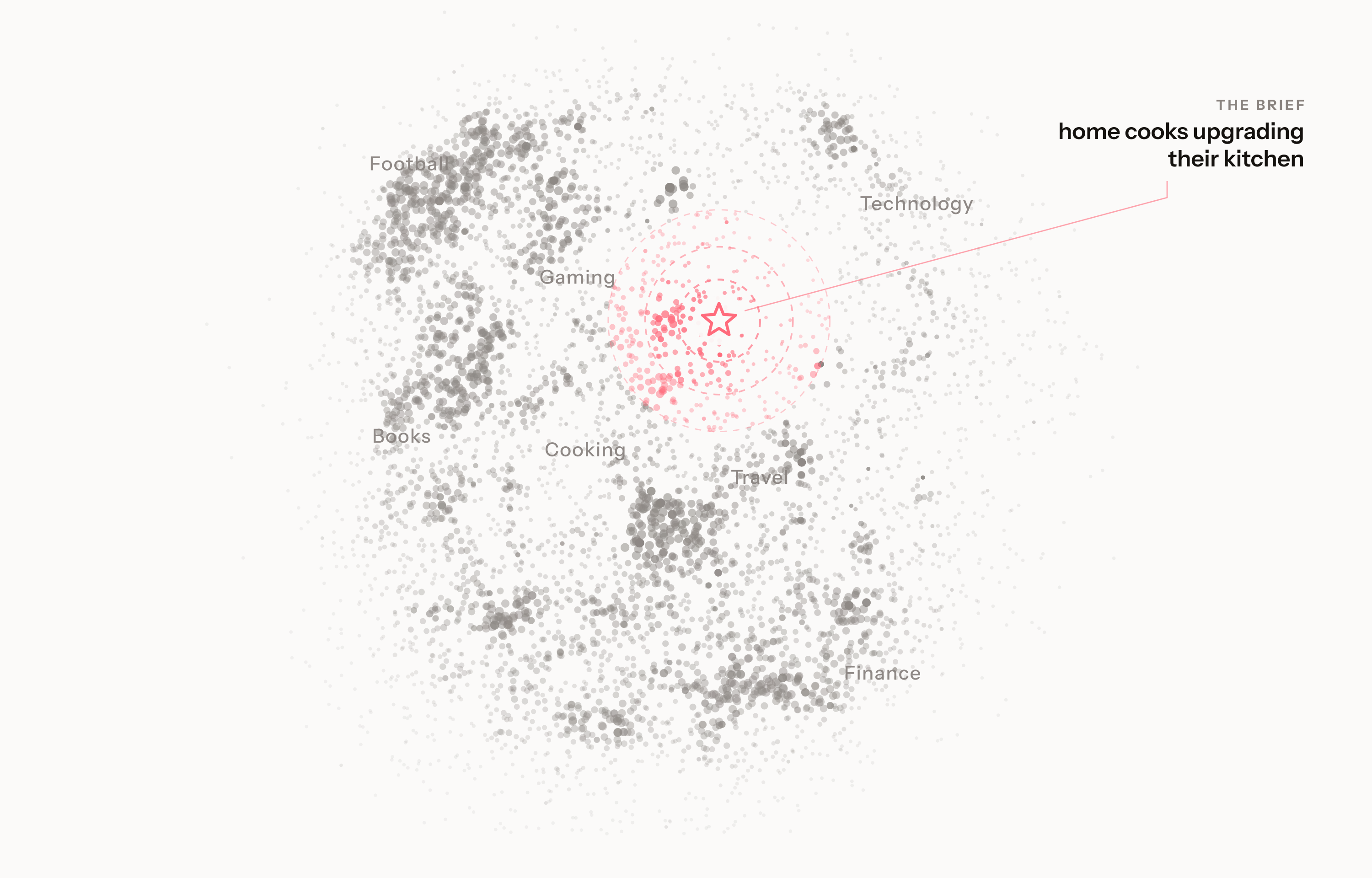
The map of meaning. Every dot represents a page, TV show, or images and video resources mapped purely by context so related topics cluster together. A brand's brief or first-party data lands as the seed point. Targeting captures the content nearby—widen the circle for scale, or measure the distance to judge the fit.
So, is audience targeting solved? Not quite. The IAB standard makes it easy to agree on the benefits of using vectors, but it leaves the real challenge untouched: what those vectors actually mean. It doesn't define how a vector should be trained, nor what makes one location in the map of meaning superior to another. In fact, the standard leaves the real challenge untouched by requiring buyers and sellers to use the exact same model; otherwise, their vectors can't be compared. But meaning lives in the model, not in the envelope. The hard part hasn't been standardized. It has been named.
Why is everyone turning to vectors in the first place? To reclaim the reach lost as user IDs disappear. Cookies are fading, and vast parts of the Open Web and CTV are out of reach. But let’s be clear: a vector alone doesn’t magically restore that reach with precision. It simply shifts the core question: reach toward what? Similar to whom, and based on what?
“Close” on a map only means something because of how the map was drawn: items are close because of what the AI model was trained to see as similar. So the critical question to ask any vendor pitching vector-based targeting isn't, “How many dimensions do you use?” It's: “What did you train the model to consider similar, and why does that definition serve my campaign goals?”
Embeddings built from behavior. Inside the big, logged-in walled gardens, this is a proven formula: model what users did (clicks, views, purchases) and represent each person by their history. It works in this setting because the platforms see every action of every logged-in user. But this breaks down on the Open Web, where signals are sparse, identities are fragmented, and interests evolve faster than models can adapt. Behavioral models also suffer from a subtle bias: they learn exclusively from audiences a platform has already reached, making them brilliant at finding more of the same while remaining blind to receptive audiences who never happened to log in.
Embeddings built from language. The other route is to build a space from text, and the off-the-shelf embedding models anyone can license do exactly that. To be fair, they're genuinely good at semantics: two pages don't need to share a word to sit close together; modern models understand the underlying meaning. But semantic proximity isn't the metric a media plan relies on. Two pages about the exact same topic can perform completely differently: one crackles with curiosity, the other drips with anger. The meaning of the text isn't the meaning of the moment.
The pre-vector baseline—the traditional taxonomy—isn't even a space; it's just a lookup table. A page matches a category, or it doesn't. There's no concept of "close," and no room to expand.
Here's what all three miss: the moment. Behavior tells you who: that someone once did something similar, not whether now is the moment. Language tells you what the text means, not the emotional impact on the user. A taxonomy tells you which shelf the page sits on. None of them evaluate the reader's current state of mind—the interest, emotion, and intent surrounding an impression. And those signals are present on every single impression, on every device, with no identifier required.
This is where years of experience matter. Off-the-shelf vector spaces weren't built for media performance, so we trained our own. And it's the training, not the architecture, that takes AI beyond language understanding and gives it a human-like understanding of interest, emotion, and intent.
The Seedtag Neuro-Contextual embeddings model reads three signals from every piece of content: Which interest is it relevant to? What emotion does it trigger? What intent does the reader bring—is it just browsing, actively learning, or ready to buy? Those three signals aren't tags stapled on afterward; they're core coordinates baked directly into the map. Built on more than a decade of contextual inventory, with hundreds of millions of pages and hundreds of thousands of videos and shows analyzed, our space is continuously shaped by real impression performance. So on our map, “close” doesn't mean “uses similar vocabulary.” It means “performs similarly for the same type of campaign brief.”
Two examples show why this matters:
Consider two football articles filed under the exact same taxonomy node: a transfer rumor charged with curiosity and a post-match report heavy with anger. A rigid taxonomy puts them on the same shelf, but our model reads the emotional tone, pushing them far apart on the map where targeting decisions are made. The taxonomy isn't enough; the content reading is what tells these two apart.
Now imagine reading just one of those articles twice: on your phone during the morning commute versus late at night on the sofa. Same words, same inferred interest and emotion, but not the same context—and not the same value to a brand. Reading the content alone isn't enough either. Content × the moment is what really matters.
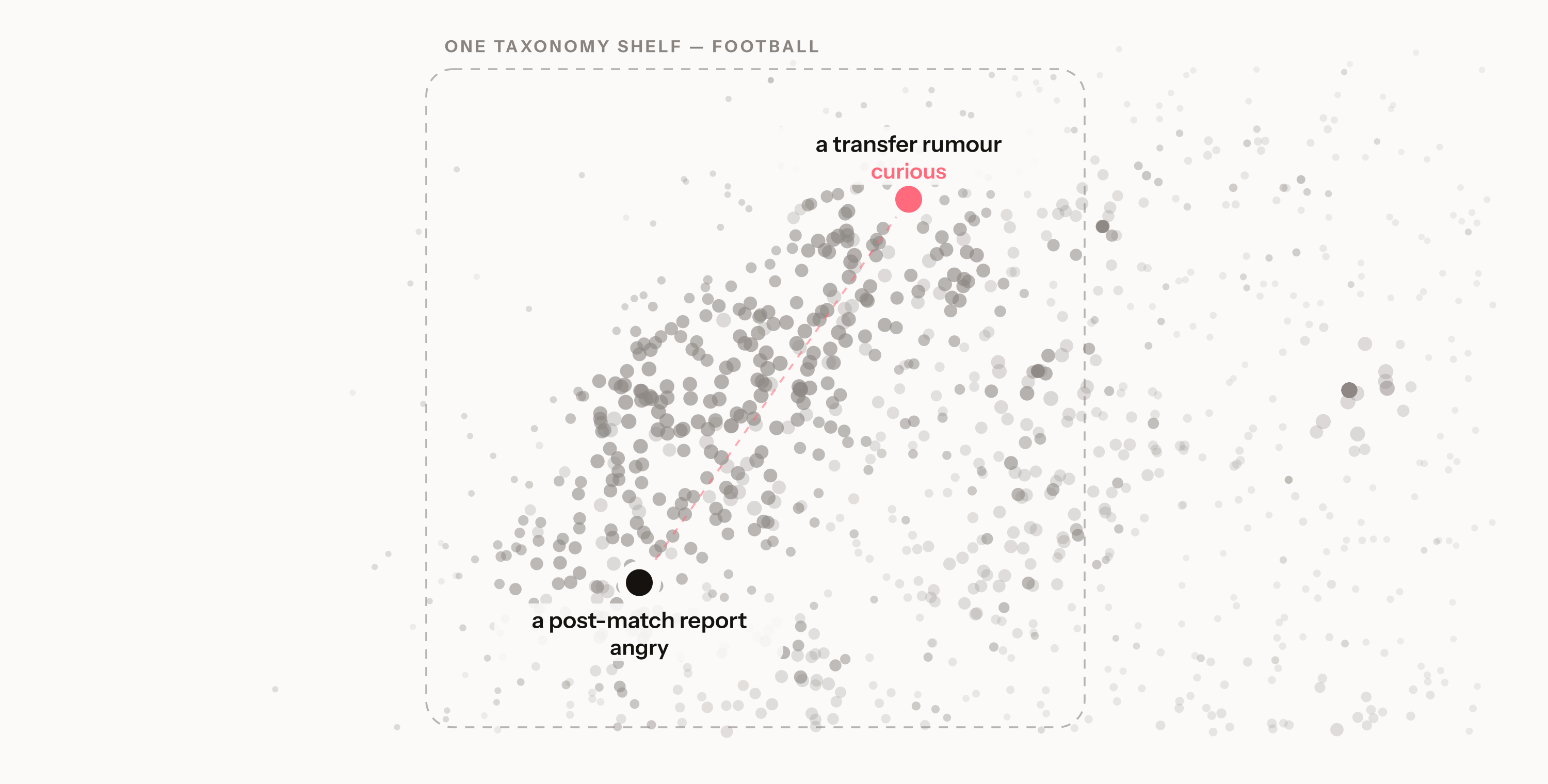
Same taxonomy shelf, different moments. A lookup can't tell the two articles apart; in Seedtag's space, emotion and intent push them far apart—and distance is exactly what targeting acts on.
The same is true for individuals. A single reader experiences a curious morning, a distracted lunch break, and a relaxed evening all in one day. User identifiers flatten this nuanced journey into a single label: “sports fan.” But reaching the same user in different moments requires fundamentally different approaches.
This brings us to the “neuro” in Neuro-Contextual, because precision matters here. We didn’t put neuroscience inside the model: decades of research established which dimensions drive attention, memory, and receptivity (emotional state, motivation, timing), and our models operationalize those constructs at a scale no lab could reach. Whether the model’s interpretation matches human response is testable, and we keep testing it against measured human behavior. Neuroscience identifies what drives human attention; machine learning delivers the scale; real-world testing proves it works.
And because the tech is ours, the same approach can go further. For strategic partners, we can build custom fine-tuned embeddings that continuously adapt the space to their specific domain and its goals. Take travel: a fine-tuned embedding could learn the nuanced differences between audiences interested in luxury resorts, mountain hiking, or city sightseeing, recognizing the distinct interests, contexts, and emotional drivers within each. Over time, it can build a richer, domain-specific embedding space from new insights and real campaign performance, while preserving everything the Seedtag Neuro-Contextual embeddings already understand.
The industry is finally agreeing on how agents should describe an audience. That’s real progress, but it’s a bit like agreeing that everyone will give directions using a map: useful only if the map is any good. Standardizing the coordinates doesn’t make the underlying geography more accurate.
A map drawn from the words on a page will send you to pages that sound alike. A map drawn from what people clicked last month will send you back to the audiences you already reached. A map drawn from how people actually experience those pages sends you somewhere more valuable. What are they interested in? How does the content make them feel? What are they trying to do, and at what moment? Answer those, and you're pointed toward impressions that are more likely to perform. The distinction matters because the industry isn't really trying to find things that are similar. It's trying to find the right opportunities.
Which brings the conversation back to agents. We share the excitement about what agents can do, but we also believe their potential depends on the quality of the models they interact with underneath.
Agents won't act at the level of a single bid request or a single embedding; that layer belongs to smaller, faster models. Agents will plan, negotiate, and activate at the audience level, interacting with models that understand the underlying meaning of content and audiences. Because even the most sophisticated agent won't reach the right destination if the map underneath it doesn't describe the landscape accurately.
That's why the conversation between agents and what they exchange must be about understanding, not bags of numbers. A seller agent should be able to explain what an audience is made of, show its value, and make the case for why it matters. Ours already does: our Liz Agent builds an audience from a plain-language brief and explains every component.
Language in, geometry underneath, explanation out. That’s the agent-to-agent conversation worth standardizing.

Find answers to get the most out of Seedtag.
Neuro-Contextual Advertising is an evolution of contextual advertising that uses AI to understand interest, emotion, and intent within content. Instead of relying on personal data, it helps brands align advertising with the moment people are experiencing in real time.
Contextual advertising places ads based on the content a person is engaging with, rather than personal browsing history or identifiers. Neuro-Contextual approaches go beyond traditional contextual targeting by understanding audience interest, emotion, and intent.
CTV advertising refers to ads delivered through Connected TV environments, including streaming platforms and smart TV applications. It allows brands to reach audiences across premium video experiences using more contextual and privacy-first targeting approaches.
Liz is Seedtag’s proprietary Neuro-Contextual AI, designed for full-funnel advertising across premium open web, video, and CTV environments. Grounded in neuroscience, Liz understands contextual signals such as interest, emotion, and intent in a human-like way to deliver relevant advertising experiences in real time while respecting user privacy.
With consumers increasingly wary of data collection and cookies, privacy-first advertising focuses on delivering personalized and relevant ads while respecting user privacy. Neuro-Contextual advertising enables relevant advertising experiences without relying on personal data or third-party cookies.
Leveraging neuroscience principles, Liz recognizes patterns, interprets context, and responds dynamically to user interests, emotions, and intentions. This creates a more cohesive and intelligent system capable of delivering more relevant advertising experiences.