AdTech Collective by Seedtag
Noticias, tendencias y perspectivas en publicidad digital
For a long time, contextual advertising worked like a matching game. A recipe page showed a cookware ad. A marathon training guide showed running shoes. It was relevant, privacy-safe, and it worked at scale.
But people don’t experience a web page as a list of keywords.
They read a recipe differently on a rushed Tuesday night than on a slow Saturday morning. They feel something when they watch a tense final quarter or a quiet documentary. And what they feel shapes what they notice, remember, and decide.
That’s where relevance reaches its ceiling. An ad can sit next to the right topic and still miss the moment. And as the signals the industry once used to track users fade, that gap matters more than ever.
Most contextual advertising services still stop at classifying content. The next step is understanding the moment: what people are interested in, how they feel, and what they’re ready to do next. At Seedtag, we call it Neuro-Contextual Advertising. Here’s how contextual got here, and what comes next for brands and agencies.
Key Takeaways
- Contextual advertising services place ads based on the content people engage with, not on who they are.
- Unlike behavioral advertising, contextual targeting doesn’t need to track users or rely on third-party data.
- Relevance has a ceiling: an ad can match the topic and still miss the moment.
- Contextual advertising has evolved from keyword matching to natural language processing, and Neuro-Contextual Advertising is the next step: understanding the moment.
- Liz, our Neuro-Contextual AI, reads interest, emotion, and intent to align ads with how a moment feels, without personal data.
What Are Contextual Advertising Services?
Contextual advertising services help brands serve ads based on the content of a web page, video, or stream, rather than on a person's browsing history. The ad follows the context. If someone is reading about a weekend camping trip, an outdoor gear brand can appear in that same environment.
It's a simple principle, and one of the oldest in advertising.
Long before digital, brands chose magazines, TV shows, and radio programs because the content matched their products or services. Contextual ads bring that same logic to the open web, video, and CTV, at scale and in real time.
So how does contextual advertising work in practice? Each time content loads, the technology analyzes it and decides whether it's a good fit for a campaign. If it is, the ad is served. If it isn't, the impression is skipped. The quality of that decision depends on how deeply the technology understands what it's reading.
That's where contextual advertising services start to differ.

Contextual vs. Behavioral Advertising: Context Over Identity
Behavioral advertising was built on a different question. Instead of asking what someone is looking at, it asked who they are. It tracked users across sites, built profiles from past clicks, visits, and purchases, and used those profiles to target ads, often relying heavily on third-party data.
For years, audience targeting meant exactly that. But profiles have limits.
A profile describes someone’s past. It says little about what they need right now. The same person who researched a new car last month may be planning a family dinner today. Nothing about them has changed. Only their context has.
Contextual targeting starts from the present instead. It reads the environment someone is in and the content they’ve chosen to engage with, which is often the clearest signal of current interest available. And because it doesn’t need to know who someone is, it respects privacy by design.
This shift isn’t about giving up on audiences. It’s about reaching them through what they’re experiencing, rather than through who a dataset says they were.
Context tells you where someone is. It doesn’t yet tell you how they feel there. That’s the gap the next stage of contextual is built to close.
Traditional Contextual Advertising Services: Keywords and Categories
Traditional contextual advertising typically works in one of two ways: matching keywords, or classifying a page by topic and category. Both have moved the industry forward. Both still stop at the page.
Here’s a closer look at how each one works
Keyword-Based Contextual Advertising
The first generation scanned a page for specific words and matched them to campaigns. Early tools like Google AdSense helped popularize this approach, displaying ads that matched the terms on a page.
It was a breakthrough at the time. But keywords miss nuance. “Apple” could be a fruit or a brand. A word like “shot” means something very different in a basketball recap than in a news report.
Keywords also miss tone, which makes brand safety harder. Picture an airline ad next to a news story about a plane crash. A keyword match might see “flight” and approve the placement, even though the context calls for the opposite.
Topic and Category Classification
A more advanced approach classifies content by topic and category, often using natural language processing. Instead of matching single words, it analyzes full sentences to understand what a page is actually about. Some systems can also assess sentiment across text, images, and video.
The result is more accurate targeting and stronger brand safety controls. Still, it understands the page, not the person reading it.
It can tell that an article is about family cars. It can’t tell whether the reader is daydreaming, comparing prices, or ready to book a test drive.

What Is Neuro-Contextual Advertising?
Here at Seedtag, we see Neuro-Contextual Advertising as the next evolution of contextual. Combining neuroscience and AI, it starts from a simple premise: the content people engage with reveals not just what they’re reading or watching, but how they feel.
Who someone is rarely changes from one hour to the next. How they feel, and what they’re focused on, can change in an instant. That’s why Neuro-Contextual Advertising looks at three signals that shape how people respond to advertising. Interest determines whether someone is engaged at all. Emotion affects how easily a new message connects with what they already know. Intent determines whether they’re in the right situation to act.
It’s also why viewability alone isn’t enough. An ad can be seen without ever being processed.
Liz, our Neuro-Contextual AI, reads these signals across the content people consume on the open web, video, and CTV. Where traditional approaches stop at what a page is about, it interprets the moment around it, all without personal data or identifiers. Brands and agencies can then align with that moment across the full funnel, from building awareness to driving action.
The difference is backed by science. In our neuroscience research, developed with Prof. Moran Cerf of Columbia University, Neuro-Contextual ads drove 3.5x higher neural engagement than non-contextual ads, and a 26% stronger emotional response than standard contextual ads.
What This Shift Means for Brands, Agencies, and Publishers
- For brands, the question changes. It’s no longer just where an ad should appear, but what someone is experiencing when they see it.
- For agencies, measurement changes too. Clicks and viewability show that an ad could be seen. They say little about whether it was noticed, felt, or remembered. Planning needs signals that reflect how people actually respond, and audiences they can look inside, rather than segments they have to take on trust.
- For publishers, quality content gains new value. When advertising responds to how content makes people feel, the stories that hold attention and spark emotion become the most valuable environments, not just the ones with the most traffic.
And across the open web, video, and CTV, that understanding can move from screen to screen, without following the people themselves.
From Context to the Moment
Contextual advertising began as a way to decide where an ad should appear. Neuro-Contextual Advertising takes it further, helping brands understand the people on the other side of the screen without needing to know who they are.
Keywords told us what a page said. Classification told us what it meant. Neuro-Contextual Advertising helps us understand how it feels.
That’s the next shift for every marketing strategy. Brands that win won’t just reach audiences. They’ll resonate with people, one moment at a time.

For most of digital advertising’s history, discovery and purchase lived in different places. People found a product in one channel, researched it in another, and bought it somewhere else, often after a long chain of clicks, forms, and checkout pages. Every step in between was a chance to lose them.
Social platforms are closing that gap. On TikTok, a single moment can hold the whole journey: people discover a product, watch a creator explain it, and buy it without leaving the app. A platform once seen mainly as a place to build awareness has become a place where brands drive real business results.
Two forces are making that possible. Creators give products a voice audiences already trust. And AI in digital advertising is removing friction from nearly every step in between, from producing creative to finding the right audience to measuring what worked.
In this episode of AdTech Heroes, our host Jon Wallett sat down with David Kaufman, VP of Product Management and Head of Monetization Product Solutions & Operations at TikTok, to explore how those forces come together.
They talked about integrated commerce, how brands of every size are using TikTok Shop, and how automation and agentic AI are reshaping creative production, media buying, and measurement. At the center of it all is the goal that shapes Kaufman’s work: removing every bit of friction between a client’s investment and the business result it’s meant to drive.
Key Takeaways
- When discovery and purchase happen in the same place, the hard part of selling online shifts from building a storefront to finding the right audience.
- Brands use TikTok Shop in different ways: as a primary channel for small businesses, a category accelerator for retailers, and a product testing ground for large CPG companies.
- On creator-led platforms, creative increasingly does the work of targeting by letting the message find its audience.
- Agentic AI for media buying gives marketers a choice between full automation and precise, hands-on control.
- Measurement credibility depends on third-party validation and on letting the client define what value means.
How TikTok Shop Turns Discovery Into Commerce
TikTok’s roots are in short-form video, and early on, brands saw it mainly as a way to build brand equity. Today, the platform supports a much wider range of business objectives, and more of them are about performance.
TikTok Shop has made social commerce part of everyday shopping.
Kaufman walked through the traditional online journey: see an ad, click it, visit a website, create an account, enter payment details, add to cart, check out. Every one of those steps is friction. Every step also loses people along the way, which weighs on engagement and conversion rates. On TikTok Shop, most of those steps disappear. People see a product, like it, tap it, and buy it.
The power of commerce at the point of discovery, he said, can’t be overstated.
It also changes what’s hard about selling online. Earlier in his career, as an entrepreneur, Kaufman worked in distributed e-commerce, sharing product data across the social web. Many of his clients believed building the website was the hardest part. It wasn’t. On TikTok Shop, the platform, its users, and its creator ecosystem do much of that work, helping brands find their audience faster and see results sooner.
“Finding your audience is the hard part.”
How CPG Brands and Retailers Use TikTok Shop to Test and Grow
Not every brand comes to TikTok Shop for the same reason. Kaufman described three distinct patterns, each shaped by the size and mechanics of the business.
Small and medium-sized businesses often treat it as another sales channel, and sometimes the main one. Around seven and a half million SMBs in the US use TikTok solutions. Some run their own websites, and some don’t. Either way, integrated commerce is easy to set up, and sales happen naturally as people discover products in their feed.
Established retailers tend to enter one category at a time. Health and beauty has been especially strong, which fits how much of the platform’s content already lives there. “Get ready with me” videos and hair and makeup tutorials create a natural home for products people want to see in action.
The third pattern may be the most surprising.
Large CPG (consumer packaged goods) companies without a direct-to-consumer presence are using TikTok Shop as a product testing ground. How do people respond to a new snack flavor? What kind of engagement does a new beverage concept earn? Instead of waiting on traditional research, these brands get real-time insights from real buyers. Fulfillment is the main challenge on the back end, and brands can either manage it themselves or work with TikTok.
The result is a hybrid of sales and market research, and it isn’t limited to large companies. For emerging brands, a low barrier to entry makes it easier to test an idea before committing to a bigger launch.

Why Creators Power Integrated Commerce on TikTok
If TikTok Shop is where the sale happens, creators are often what make it happen.
Kaufman pointed to TikTok’s creator ecosystem as one of its biggest strengths. Through the TikTok One platform, brands can work directly with creators who have already built trusted voices and the audiences brands want to reach.
That authenticity is changing performance advertising too. With Smart+, TikTok’s automated performance solution, a brand can bring a large product catalog and let the system match the right product to the right person in the right format.
The creative is evolving as well. Five or ten years ago, a product ad might have been a static image against a white background. Now, brands can bring in creators to explain and enrich the product, and TikTok Shop sellers can work with affiliate creators who make content specifically around what they sell.
On a platform like TikTok, creative has become the targeting. Rather than defining every audience in advance, brands can let their message find the people who respond to it. Personalizing content becomes less about who someone is and more about what they choose to engage with.
What Is AI in Digital Advertising and How Has It Evolved?
Behind the creators and the commerce sits a lot of AI. Kaufman’s view of it is a calm one: AI in advertising is not scary at all.
The industry has relied on ranking for years. What we used to call machine learning, we now call AI, and AI models have long decided which ad appears in front of which person. Kaufman called it maybe the most established and valuable use case for AI anywhere.
He remembers when that work was manual. As an entrepreneur, he found those kinds of insights through hands-on data analysis. Today, they live inside AI algorithms, built into how ads are delivered.
What’s new is where AI shows up next. Some use cases are small but practical: fixing aspect ratios, correcting color, or adding promotional overlays across a catalog of hundreds of thousands of assets. These are repetitive tasks that would be nearly impossible to do by hand at scale. Others are more ambitious. Through TikTok’s Symphony platform, AI enables brands to generate scripts and video from a prompt, or to create a digital avatar that explains a product.
What Is the Difference Between Traditional AI and Agentic AI in Digital Advertising?
Traditional AI works in the background. It ranks, predicts, and optimizes within rules a team has already set. Agentic AI goes a step further. It can understand a goal, plan the work, and act on it.
Kaufman sees TikTok’s role as offering both paths.
A marketer can upload a CRM file of their highest-value customers for a retargeting campaign, or turn on automation and let the system find those customers on its own. Teams that want a deterministic setup can program their business logic against the campaign management API (application programming interface). Others are testing the MCP (Model Context Protocol) offering TikTok announced at TikTok World in May. It lets an agent trained on a brand’s business logic connect directly to the ads platform and manage campaigns.
According to Kaufman, the most sophisticated advertisers are doing a little of everything to learn what works. That’s the real promise of agentic AI for media buying: giving teams the freedom to decide where automation helps and where precision matters more.

How Can Marketers Use Agentic AI in Digital Advertising to Streamline Creator Briefs and Targeting?
Creator marketing has long been one of the most manual parts of social media advertising. Finding the right partner meant researching profiles, scrolling through social media posts, and reaching out directly or tracking down a business manager.
This is where agentic AI in marketing starts to change the work. With natural language processing, a marketer can describe a goal in plain words and get back a shortlist of relevant creators, suggested outreach, and draft briefs. On TikTok, that happens through the Symphony agent, part of what Kaufman calls an agentic buying flow.
What doesn’t change is the need for judgment. An agent can surface options, but teams still decide which creators genuinely fit the brand and which messages will feel authentic to their audience.
AI avatars have a role too, but a different one. If a brand has already defined its audience and wants to test many versions of a message quickly, generative AI makes that possible without a camera crew or a long production timeline. When it comes to authenticity, though, most of the excitement Kaufman hears from advertisers is still about creators.
Why AI-Powered Digital Advertising Campaigns Need Independent Measurement
As commerce and automation grow, so does the need for proof. Sophisticated brands build marketing strategies across every channel, so measurement can’t stop at one platform’s walls.
Measurement was one of the defining topics at Cannes Lions this year, and the message from brands was consistent: they want partners that aren’t checking their own homework. That’s why third-party validation and multi-touch attribution matter as much as the numbers a platform reports on its own.
Kaufman added a principle worth remembering: the client owns the definition of value. For some brands, that means brand lift surveys. For others, it’s media mix models or in-house business intelligence teams. Either way, the platform’s job is to understand how each advertiser defines success and deliver against it.
Premium Formats and the Power of the Moment
Not every outcome is a sale. Some brands need to own a moment.
TopView, the ad people see when they first open the app, is built for advertisers who want a high share of voice around a moment that matters to their business. Pulse Premier lets brands appear alongside content tied to major events such as the World Cup, often to extend sponsorships they run on other channels.
Timing matters too. During the Super Bowl, TikTok found clear spikes in engagement during game breaks, a strong signal for sponsors to run complementary content on the platform. The exception was Bad Bunny’s halftime show, when engagement dipped. Some moments simply command full attention.
It’s an idea we come back to often. Attention clusters around moments, and the brands that understand those moments as they happen are the ones that earn real engagement.
Future Trends: Where Commerce, Creators, and AI Meet
The future trends Kaufman described point in one direction: less friction between discovery and purchase. Creators give products a trusted voice. Integrated commerce turns interest into action in a few taps. And AI adoption is speeding up everything around it, from creative production to buying and measurement.
The brands that grow fastest will treat discovery, creative, and commerce as one connected experience, built around the people they want to reach.

Automated media buying has changed almost every part of how campaigns get planned, priced, and delivered. Programmatic advertising and real-time bidding now move faster than any human could, and machine learning models decide which ad space and ad inventory fit a brand in milliseconds.
Will AI replace media buyers and turn paid advertising automation into the whole job? Not at all, because the parts of this job that actually move a client's business rarely show up in a dashboard.
In this episode of AdTech Heroes, I sat down with Sascha Lock, Executive Director, SVP of Integrated Investment at Hearts & Science, to talk about what automation has genuinely changed in media buying, what it hasn't touched, and why the agencies that win are the ones who treat data-driven tools as a starting point rather than the whole answer.
Key Takeaways
- Automated media buying has made the buying process faster, but it hasn't replaced the relationship-driven work that determines whether a campaign succeeds.
- AI in advertising is following the same path mobile did: it will keep growing until it stops being a separate conversation and simply becomes how digital advertising works.
- Programmatic advertising and first-party data give agencies more signal, but clients still need a human point of view to translate that signal into a decision.
- Real-time bidding has automated pricing, shifting negotiation from "what's the best price" to "what's the best strategic partnership."
- The most valuable habit in media buying right now is filtering. There's more data and more platforms than any one person can track.
Why Automated Media Buying Still Needs a Human at the Center
Ask most people what an "investment" role in media buying actually involves, and they'll picture spreadsheets and numbers moving between columns. Lock pushed back on that idea early in our conversation. His role, he explained, is much more about relationship capital than transaction management.
That distinction matters more as automation takes over the mechanical parts of the buying process. When machine learning and buying platforms handle pricing and placement, the value an agency brings shifts toward judgment: knowing which of the thousands of available options actually fits a client's goals, and being willing to say so.
Lock compared it to any real relationship, built on direct but kind communication and consistency. Automated media buying can optimize an auction. It can't build that trust on its own.
"The actual product isn't everything. You're buying service, and you're buying commitment, and you're buying this mutual strive to do better and to grow together."
Will AI Replace Media Buyers? Not Anytime Soon, Because Context Still Matters
Lock drew a comparison that's hard to argue with. Mobile advertising, he pointed out, used to get its own line item on every media plan. Eventually it stopped being a special category and simply became how advertising works.
He believes artificial intelligence is on the same track. Right now, AI in advertising gets a dedicated conversation on nearly every panel and podcast. Eventually, it will stop being a separate topic and just become the infrastructure underneath everything, the same way connectivity and speed are for the internet today.
That's a useful way to think about whether AI replaces media buyers and paid advertising automation makes the role obsolete. History in this industry tends to be cyclical. Each wave feels revolutionary in the moment, but what people actually need from a partner changes far more slowly than the tools do.

How Programmatic Advertising and First-Party Data Are Reshaping Client Conversations
With hundreds of CTV platforms and thousands of potential partners now available in the US alone, no single person can be an expert on everything. Lock described his role as a connector: someone who listens to every new product release, filters out what's genuinely relevant, and brings a clear point of view to the client.
That filtering depends on data, but the decision itself still depends on people. Clients see the same headlines about programmatic advertising and first-party data that agencies do. What they need isn't more information. It's a trusted read on what that information means for their business, and someone willing to make a recommendation rather than just present options.
From Transactional to Strategic: How Real-Time Bidding Changed Negotiation
Real-time bidding automated a huge part of what negotiation used to mean. Ask a newcomer to define negotiation, Lock said, and they'll usually describe getting the best price. That's still true, and it still matters.
But once pricing and inventory decisions run through an algorithm, the conversation left for humans is a different one. It's less about the number on a line item and more about building something together: better flexibility, stronger strategic terms, and closer collaboration between everyone at the table.
Some of the most productive moments, Lock noted, still come from putting the right minds from a media partner, a client, and an agency in the same room to work through a problem together.

What a Strong, Data-Driven Buying Process Actually Looks Like
When I asked Lock what a strong modern media partnership requires, he didn't point to a platform. He pointed to three habits: transparency, accountability, and speed.
Transparency means being upfront when something goes wrong, not just when it goes right. Accountability means showing up when you say you will, and explaining clearly when you can't. Speed means pivoting quickly once the data shows something isn't working, rather than over-analyzing a decision that's already clear.
The Two Questions Every Agency Should Be Asking Clients Right Now
Lock narrowed the most important client conversations down to two questions. The first is simple to ask and hard to answer well: what does success actually look like, and what sources of truth will we agree to measure it by?
The second is about risk tolerance. Our guest described a rough 70/20/10 framework many teams use: most investment into what's already proven, a portion into promising opportunities, and a smaller share for bolder tests. That last bucket should expand or shrink with how much risk a client can absorb, and it's worth revisiting often.
Getting clear on goals and risk tolerance matters more than any new platform. It's the foundation everything else in the buying process gets built on.
Toward the end of our conversation, I asked Lock what superpower he'd want in ad tech. His answer was "Mr. Transparency": the ability to see exactly what an algorithm is doing and why, not to fight the technology, but to bring that insight back into planning. It's a fitting note to end on. The tools keep getting faster. What agencies bring to the table is still deciding what that speed should be used for.
You can watch the full conversation with Sascha Lock above.

Publishers, agencies, and brands don't always sit on the same side of the table. But at the end of the day, they're facing the same challenge.
For publishers, the question is how to create content relevant enough that brands and agencies want to advertise within it. For agencies, it's where to place their clients and which environments are truly brand safe. For brands, it's where to invest to build a closer connection with their customers. The perspectives are different, and so are the priorities. But the challenge is shared: as the way people discover information keeps evolving, quality content needs to keep being found, valued, and sustained.
That challenge was one of many conversations we brought to Barcelona. From September 15 to 17, the Seedtag Innovation Summit gathered clients and partners from the United States, Latin America, and Europe, opening at the Joan Miró Foundation.
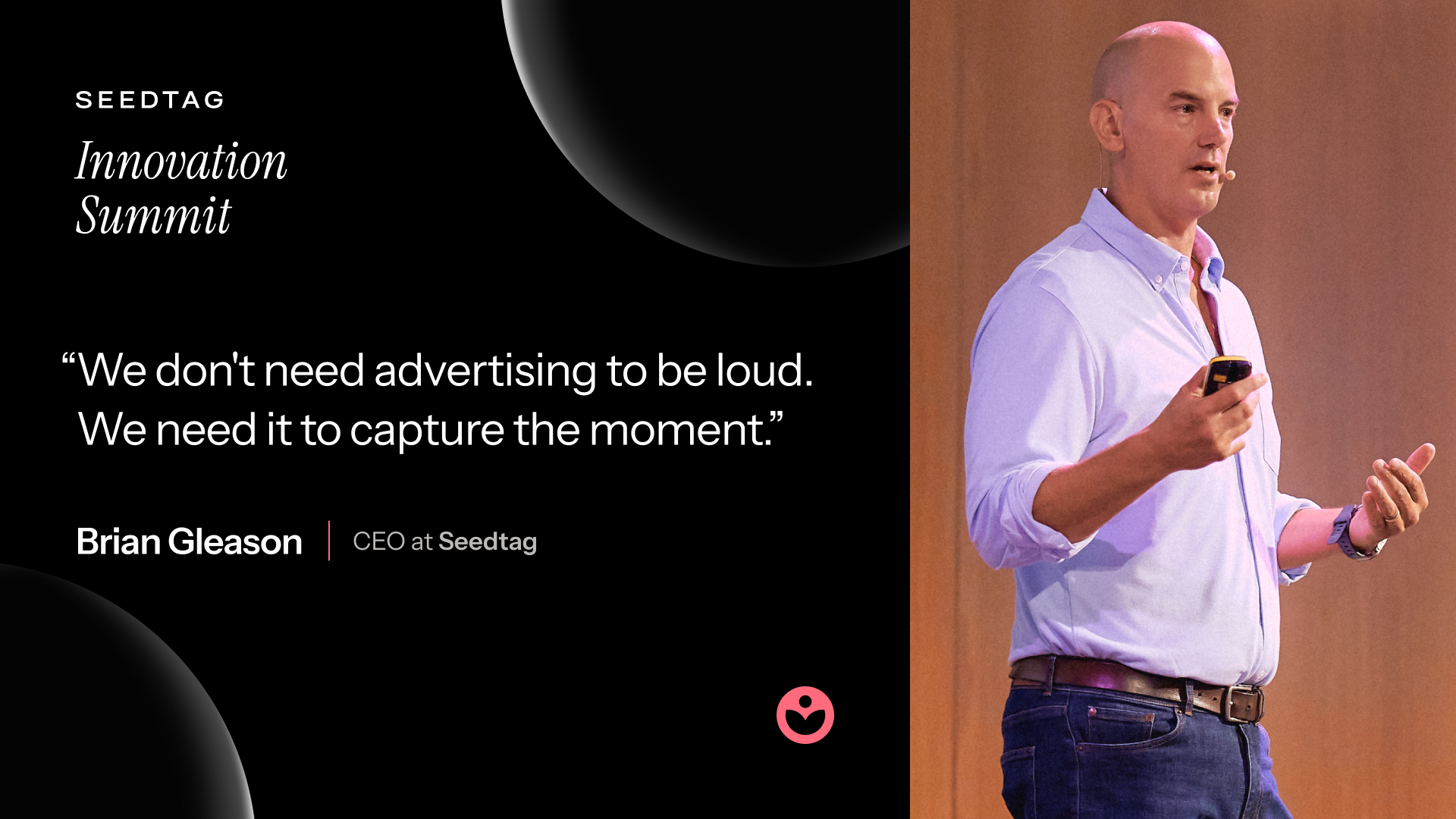
During the Summit, Brian Gleason, our CEO, added another layer: "We're more connected than we've ever been, but we're more distracted than we've ever been." For Brian, finding out how to connect in that moment is the most important thing, whether you're a brand, an agency, or a publisher.
The agenda combined dedicated sessions for the supply side and the demand side with joint sessions that put both in the same room. Topics ranged from the agentic shift and AI search to attention measurement, brand safety, CTV, creative, and life after the traffic. At lunches and dinners, the conversations kept going.
Across all of them, one thing became clear. The challenges facing the adtech ecosystem aren't local. They're global. And they become easier to solve when both sides look at them together.
Key Takeaways
- Consumers are more connected and more distracted than ever, and connecting with them in the moment matters for brands, agencies, and publishers alike.
- The same person makes different decisions in different situations, shaped by signals like time of day, screen, weather, and place.
- Fewer impressions carry identifiers, but audiences haven't gone anywhere, and reaching them requires a new structure.
- Interest, emotion, and intent shape how people process advertising, while viewability alone says nothing about that processing.
- Publishers, agencies, and brands face the same challenges from different perspectives, and the conversation is global, spanning the United States, Latin America, and Europe.
What Are the Biggest Challenges Facing the Digital Advertising Landscape?
Throughout the Summit, Brian Gleason put the consumer at the center of the conversation. For him, it's the one thing the industry doesn't focus on enough. We talk about acronyms, LLMs, and chats, but rarely about what consumers are doing every day or what their world is like.
And that world is full of noise. Attention is fleeting, and capturing it is hard. At the same time, clients are under pressure to grow and differentiate, and Brian raised an open question about what happens to them as products become commoditized in AI chat environments.
Grego Martínez, our Chief Product Officer, pointed to another challenge: media buying itself.
In CTV, most buying happens at the platform level, yet streaming services rarely have exclusive content. To illustrate the point, Grego shared a simple example: in Spain, Harry Potter is available on eight different platforms. So when a brand buys one of them, it's buying the service, not the moment. It learns nothing about the show being watched, the emotion it creates, or the hour and day it's being seen.
Buying through demand side platforms (DSPs) has a similar limitation. Brands and agencies can target IAB categories, keywords, domains, geography, or day part, but combining all of those signals to build moments manually is very complicated. The signals exist, but programmatic fragmentation keeps them apart.
Why the Adtech Ecosystem Is Moving From Understanding the Who to the Moment
For Grego, solving that fragmentation starts with a simple idea: the same person can make very different decisions depending on the situation they're in.
Picture someone commuting to work on a rainy Monday morning, phone in one hand, about to lose connection in five or six minutes. Any message has to be fast. Now picture the same person on a sunny Sunday morning, planning the week ahead with Monday off. They might spend 90 seconds on a powerful long video, one that takes them to the next step.
Nothing about them has changed. Only the moment has.
The same happens with a recipe. On a Tuesday evening after work, someone looking one up wants something fast. On a Saturday morning, with family and friends coming over, they're far more open to a message tied to that interest. The article is exactly the same. The moment is not.
That's why content is only one piece of context. The hour, the day of the week, and the season all matter. So do the type of screen someone is using, the weather, and the place they're in. On their own, these signals won't massively improve advertising. Combined, they create a scenario where advertising works much better.
Moments also change across environments. On mobile, things happen faster. On desktop, people are usually sitting down and paying more attention. CTV is often watched in a group rather than alone.
"We've spent more than 20 years understanding the who. Now, I think the future will be won by those who understand the moment much better," Grego said as he closed his session.
Audiences Were Never Identifiers
Hannes Sieling, our VP of Data & AI, started from programmatic advertising's long reliance on identifiers. They gave data teams structure, plus the reach to find people again. Today, fewer impressions carry them, but the reality hasn't changed. The same people are consuming the same content. And audiences were never identifiers in the first place.
What the industry needs is a new structure, built around the content people consume. That's the idea behind vector-based targeting: grouping similar content together so brands and agencies can find the environments closest to their goals, while balancing reach and precision.
Hannes also pointed to the technology that makes this possible: "Embedders are a little bit the hidden champions, the unsung heroes of the whole rise of large-language models."
The real question is what counts as similar. For him, the answer needs to go beyond clicks or categories and help find the right environment at the right moment. Understanding how people actually process what they see is a key part of that answer.
The Science Behind Attention, Emotion, and Intent
Professor Tino Meitz from the University of Münster explained how people process advertising. Who we are stays fairly stable, but how we feel and what we're focused on can change in milliseconds. When people consume media or advertising, that state of mind matters most.
That's also why viewability isn't enough. It shows that an ad could be seen, but says nothing about whether it was actually processed.
Three contextual signals shape that processing:
- Interest: If people aren't motivated to watch a show, they're unlikely to engage with the advertising within it.
- Emotion and affect: The brain relates new situations to past experiences, so a context that connects to familiar feelings makes new information easier to process.
- Intent: People need to be in the right situation for a message. If you want to buy a mid-sized SUV, you probably won't walk into a Ferrari dealership.
Tino was careful to separate affect from emotion: "Affect is something you can't govern. It's something that's happening, it's also, to a certain extent unconscious. Emotion is an evaluation of your affect afterwards."
How Can Supply and Demand Collaborate Across the Adtech Ecosystem?
Rob Beeler, who led the Two Sides, One Signal working session, explained why collaboration and supply and demand alignment matter. “Both sides are trying to solve the same things. This is a relationship-driven industry, and relationships are built by talking to each other in person. When both sides start working together, he said, they can be more effective for advertisers”, he said.
Kevin Donker, Head of Programmatic & Media Automation at Omnicom Media, brought that same spirit to the agentic conversation. For Kevin, agentic buying is still in its infancy, and the industry will have to come together to adopt protocols that make it reliable. When that happens, the productivity gains from AI should be reinvested in people.
In his view, the winners will be organizations that use AI to boost creativity, leadership, and judgment. The ones left behind will simply put an AI layer on top of an already fragmented workflow.
Brian Gleason echoed that idea in his closing remarks. He pointed to the feedback shared over the three days on different ways of working, ad inventory sources, and ways to measure. He also stressed the importance of trust: when you know you can trust someone, you know they'll do what they say they're going to do.
"There are a lot of pressures and challenges we think about in the world, and the things we shared over the last few days were brilliant. That's what we love to do: share information. It's an ecosystem that works together, and that's what we're trying to create", Brian Gleason.

How Does Neuro-Contextual Advertising Bridge the Gap Between Supply and Demand?
If both sides face the same challenge, they also need a shared way to understand the moment. That's what Neuro-Contextual Advertising offers.
Liz, our Neuro-Contextual AI, reads signals of interest, emotion, and intent to understand the moment behind each impression, without personal data or identifiers. For brands and agencies, that means reaching people when it matters most. For publishers, it means their content is valued for the moments it creates.
And it goes beyond advertising. Bringing value back to the open web helps keep quality content alive, and that's a responsibility the whole industry shares.
From Barcelona to the Next Conversation
Over three days, publishers, agencies, and brands from the United States, Latin America, and Europe approached the same questions from different perspectives. How do we capture attention? How do we reach audiences without identifiers? How do we make sure quality content keeps being found and valued as the way people discover information changes?
For us, at Seedtag, those conversations reinforce the vision behind Neuro-Contextual Advertising: understanding people's interest, emotion, and intent in the moment they're in.
It's not about knowing who. It's about understanding the moment.
Thank you to everyone who joined us in Barcelona. If you'd like to keep the conversation going, our team is here.
.png)
Nuestro blog
.jpg)
The International Festival of Creativity, Cannes Lions 2024, just wrapped in the French Riviera. It was action-packed as the advertising and communications industry convened for a week of world-class networking, learning, and extraordinary creativity.
The Seedtag team was thrilled to be a part of the festival, meeting partners, clients, and colleagues to explore The Power of Context, Uniting Innovation, Connection, and Creativity.
Our HQ was an uber cool penthouse suite where we welcomed people from all over the world to our exclusive Seedtag brunches, apéros and more. We also partnered with AdAge for an insightful panel discussion on the advantage of contextual AI hosted on the swanky VaynerX yacht. For a record third time, our podcast AdTech Heroes was live-streamed from Cannes, this time with a special crossover episode with The Pub Way podcast!
What are the key takeaways from the sessions at the Riviera? Mike Villalobos, VP of Strategy and Planning at Seedtag, shares all the details.
Top 3 takeaways from Cannes Lions 2024
- Contextual Advertising Strides Ahead
Contextual is all the buzz and having a pivotal resurgence given all of the legislation around privacy and user tracking limitations. While contextual has been around for a while, Seedtag’s ability to process and organize big data while leveraging custom LLMs positions the new approach to contextual as a key piece in conversations around a multitude of audience interests and first-party data. It is all about the consumer – not an assumption of who they are but their passions . But how can we transparently collect this information? Giving consumers the power to control how their data is being used beneficially and respectfully.
The world is tired of the constant conversational chaos around cookies and other identifiers going away, but the deprecation is imminent. We can’t continue to rely on third party cookies or device identifiers for much longer; those who do will most definitely be on the backfoot trying to sort through planning, targeting and attribution as they will not be ready for the future of advertising. Today, the focus lies on building a future-proof advertising strategy that pinpoints relevance – right place, right time, right audience. Advertisers are choosing the contextual route and enriching their strategies by augmenting efforts with their first-party data to display ads that truly resonate with consumers. With contextual, advertisers have a privacy-first alternative to intrusive, stereotypical, and oftentimes stale advertising practices that don’t fit the bill anymore.
- Contextual TV is the place to be
As CTV continues to disrupt the traditional TV ad market, new strengths and challenges emerge. Both buyers and sellers alike are navigating the changing landscape with telcos/OEMs now monetizing data to help buyers achieve better yields. The CTV advertising playbook is undergoing an overhaul, and the focus shifts to evoking watchers’ emotions and leverage what they might feel. While ads on linear TV do that well, they haven’t always translated to CTV ads just yet.
There was a spotlight on the key investment drivers and challenges buyers face, how sellers are aligning to meet that demand, and the difficulties around data and measurement. With increased competition and tighter ad budgets, price cuts might be among the few levers CTV players can pull to boost demand. Also, many TV manufacturers are eager to become advertising players in their own right thus fueling intense competition and uneasy collaboration, given their carriage agreements.
- It’s the Generative AI revolution
GenAI was the most discussed topic of the week at Cannes, captured in almost every booth and presentation. Beyond general topics, the emphasis was on real-world applications, their evolution, and use cases. GenAI's disruption in the creative space and impact on media production was truly the talk of the town.
The influence of GenAI on ad technology and its possible effect on agency productivity, as well as the scale of ad technology vendors and publishers, were also discussed. Other areas of interest in the GenAI space revolved around how it can be leveraged to access cleaner data and direct touchpoints with consumers to create more personalized marketing, how this data is a new form of research for brands to gain consumer insights, and the progress with use cases, approaches, and new applications like GenAI for image technology.
Curious to know more about how you can partner with us and leverage contextual advertising, CTV, or GenAI capabilities to catapult your advertising strategy? Let’s talk!
.jpg)
This year’s Digiday Media Awards winners celebrate new technologies and the power of partnerships throughout their digital media campaigns. Themes across 2024’s winners include leaning into a surge in short-form video content as consumption for dithe format increases, implementing more interactive storytelling and tech like VR and AR, as well as harnessing collaborations for impactful and innovative campaigns.
Seedtag's contextual AI was named the best at the Digiday Media Awards, highlighting the importance of privacy-first solutions in shaping the future of digital advertising.
The Digiday Media Awards recognize companies all over the world modernizing digital media and have over the years honored industry-leading work from The New York Times, Salesforce, PopSugar, and many more. This year's awards acknowledge the hard work and dedication Seedtag has put into its offerings over the last decade. By continuously innovating and expanding its contextual AI technology, Liz, the company successfully meets the ever-changing needs of advertisers in the dynamic digital landscape.
With Seedtag, brands and agencies effectively reach their target audience through user's real-time interests, enabling sustainable advertising at scale across the open web and CTV. As third-party cookies are being deprecated from all major web browsers, this award affirms the power of contextual AI in reaching consumers on a privacy-first basis, setting the course for the future of digital advertising.
.jpg)
It's the most colorful month of the year! Bring on the rainbows and queer. June is celebrated globally as #PrideMonth to commemorate the Stonewall riots, a pivotal moment in the LGBTQ+ rights movement. The first Pride marches were held in 1970, one year after Stonewall, and have continued ever since.
Pride Month is a time to celebrate the LGBTQ+ community's history, culture, and achievements. It's also a time to understand the oppression and discrimination faced by the LGBTQ+ community and raise awareness about the issues the community still faces today. The month of pride fights for equal justice and opportunity.
The march toward a more equal and inclusive world
Bright, bold colors, flamboyant outfits, and rainbow flags; The Pride Month parades are unique and bursting with energy. The marches present an opportunity for the people of the LGBTQ+ community and straight allies to show their solidarity and support, express freedom, and celebrate diversity.
The beauty of the pride parade is its inclusivity. People of all ages, races, ethnicities, and gender identities come together to celebrate identity, history, and the ongoing fight for equality. Overall, Pride Month focuses on raising awareness about LGBTQ+ rights, highlighting the challenges faced by the community like inequality and discrimination, and advocating for change.
Seedtag: Taking a step forward
In the ongoing struggle for equality, pride marches bring LGBTQ+ people and allies together. While progress has been made over the years, there’s still a long way to go. Brands play a pivotal role in addressing the struggles faced by the community by raising awareness and promoting understanding.
A cornerstone in this global movement is the steps brands take to shift from conventional stereotypes and build a more inclusive advertising landscape. Brands can show their support for LGBTQ+ rights by creating inclusive marketing campaigns that challenge stereotypes, celebrate diversity, and even feature LGBTQ+ people in their advertising.
Brands play a pivotal role in building the bridge towards a more inclusive advertising landscape. What values must brands embody in advertising strategies to create more inclusive campaigns?
Perspective
Representation
Inclusivity
Diversity
Empowerment
The five-pronged approach to advertising ensures a non-biased targeting strategy that helps brands consciously take great strides forward, welcome all, and create a more inclusive world.
Key takeaways: How to create an inclusive advertising strategy
- Capture diverse perspectives and viewpoints within your strategies to create messaging that strikes a chord with a larger audience base.
- Go beyond the stereotypes and traditional cohorts and represent a diverse audience that makes them feel connected to your brand and narrative.
- Champion inclusivity with messaging and targeting that fosters a sense of unity and belonging.
- Incorporate diverse narratives to capture a larger audience share with inclusive messaging that truly resonates.
- Make people the heart and soul of your narrative, empower them to define their own identity, establish authentic connections, and build long-standing customer relationships.
So, how can brands act on these ideas and build the bridge toward more inclusive ad strategies?
New-age technologies help brands understand and connect with their audiences better. Advanced advertising strategies transcend demographic data and traditional audience segmentation and rely on contextual relevance to engage users.
By displaying ads that align with the content the audience is engaging with in real-time, brands appeal to the unique interests of users. Leveraging non-discriminatory targeting practices that transcend assumptions and traditional cohorts empowers brands to reach a diverse audience. This includes individuals from various demographic groups, ethnicities, and genders.
Hyper-personalized messaging and creatives enable brands to connect with people from all backgrounds and identities effectively. The new era of advertising is inspiring brands to leave stereotypes behind and embrace an interest-based targeting approach that sparks instant connections and aligns with myriad passions, interests, and voices.
Elevate your contextual advertising game with us!
.webp)
In today’s increasingly competitive digital advertising landscape, the most important metric brands are vying for is attention. Brands want to establish themselves, actively engage with consumers, and build a loyal customer base that values the specific brand and everything it stands for.
Amidst all the chaos, brands taking steps to make their presence felt and garner audience attention must focus on a key factor: context. Advertisers have always prioritized the content and creatives that go on every ad and the target audience. But just content and targeting don’t make the cut anymore. Beyond the traditional elements, the content surrounding an ad also plays a crucial role in determining its impact on the audience.
Customers are quick to express their displeasure when irrelevant ads disrupt their browsing experience. While creating a compelling ad strategy is important, the context of an ad setting and the content accompanying an ad are equally important. The shift to a brand safety-first, contextual approach is not just being fueled by the demise of third-party cookies and the implementation of data privacy regulation but the need for contextually relevant advertising strategies.
What makes context in advertising essential?
While technology may have opened up a myriad of new channels and ad placements, when and where they meet a consumer makes all the difference. Imagine you’re reading an article on climate change and its impact and an ad for a new sports car breaks your flow. What if you search for a mountain bike once and it disrupts your online shopping experience with ads weeks later? That’s why they say context is king.
A study by DoubleVerify revealed that 69% of consumers are more likely to look at an ad if it is relevant to the content they are reading.
67% of consumers said they are open to viewing relevant ads from new brands while 44% said they have tried a specific brand after seeing a relevant ad alongside a piece of content they were consuming.
Contextual irrelevance can impact a brand beyond just attention metrics. Brands need to ensure their ads are displayed in an environment that is safe, relevant, and aligns with their values and brand image.
Prioritizing brand safety and brand suitability
Brand safety refers to the set of practices that help protect a brand’s image and reputation by ensuring it is not associated with inappropriate content or undesirable material online. Brand safety measures help prevent mismatches that can severely impact brand image. For example, imagine an organic baby food company’s ad appearing in an article about pesticide overuse. Such improper ad placements can damage the brand's image and erode consumer trust.
Brand safety measures protect reputation and display ads in a brand-safe and appropriate environment, preventing wastage of ad spend by ensuring ads are not placed next to irrelevant content that is unlikely to be effective. Brand suitability is an evolution of brand safety that goes beyond just avoiding the negative and aligns the brand with content that resonates with its values and target audience.
The Interactive Advertising Bureau (IAB), in collaboration with the Global Alliance for Responsible Media (GARM), has established guidelines to improve the safety and suitability of digital advertising. Understanding the GARM brand safety floor and suitability framework is integral to achieving brand safety and suitability. It enables brands to identify hazardous content or content that conveys an incorrect message about the brand’s values, ultimately improving brand alignment.

Going a Step Ahead with a Contextual Approach to Brand Safety
Brand safety vs brand suitability is no longer just about avoiding inappropriate content. It’s about strategically placing ads where they are most effective. A contextual approach empowers brands to achieve the highest levels of brand safety and suitability. The targeting strategy enables brands to reach target audiences within relevant contexts at the most opportune times, thus increasing the effectiveness of digital advertising campaigns.
Strategical ad placements create positive associations with the content and environment they appear in and allow brands to showcase their values while targeting audiences who share similar values.
Furthermore, demand-side platforms (DSPs) play a crucial role in ensuring that brands can fine-tune their targeting to match the most relevant user-generated content without compromising on brand safety measures. By leveraging AI-powered brand safety vs. brand suitability strategies, advertisers can mitigate risks and optimize their ad spend efficiently.
The Role of Contextual Technology in Brand Safety
As advertising continues to evolve, new technologies are enabling brands to implement more precise brand safety measures. AI-driven solutions analyze the context of web pages to determine their suitability for specific brand messaging, ensuring ads appear in a high-quality environment. This not only protects the brand but also enhances engagement by aligning with the right content.
Advertisers working with demand-side platforms can leverage contextual intelligence to avoid content that may pose risks and instead focus on placing ads in meaningful digital spaces. This ensures better campaign performance and strengthens consumer trust in the brand’s commitment to responsible advertising.
The Future of Brand Safety and Contextual Advertising
Contextual advertising empowers brands to achieve the highest levels of brand safety and suitability. The targeting strategy enables brands to reach target audiences within relevant contexts at the most opportune times, thus increasing the effectiveness of advertising campaigns. Strategical ad placements create positive associations with the content and environment they appear in and allow brands to showcase their values and target audiences who share similar values.
As the digital ecosystem continues to evolve, advertisers must take proactive steps to ensure high-quality ad placements that align with their brand identity. Concepts of brand safety are no longer about merely avoiding harm but about fostering positive connections between brands and consumers.
With the right blend of brand safety and suitability measures in place, contextual advertising avoids negative content and strategically places ads to maximize impact and brand alignment. By integrating brand safety measures, leveraging demand-side platforms, and prioritizing safety and suitability, brands can confidently invest in digital advertising without compromising their reputation. A contextual approach will continue to shape the future of advertising, ensuring ads reach the right audience in the right environment.
.webp)
It’s no secret that independent ad agencies are becoming more appealing to big brands. Traditionally, larger advertising agencies have enjoyed a competitive edge thanks to their substantial budgets that enable investments in cutting-edge platforms and systems. However, with the advent of powerful AI for advertising, the playing field is undergoing a transformative shift, allowing independent agencies to enhance their capabilities and appeal.
There are several advantages that independent agencies currently enjoy. First, these creative agencies are often in a much better position to understand local and regional markets. Brands need to understand, speak to, and reach people at these local levels. National branding messaging can risk alienating individuals or failing to connect with them. Similarly, national media plans often miss large cohorts of consumers or spend disproportionately on large publishers for easy reach while overlooking more trusted and better-indexing publishers in their respective local markets.
Indie agencies are better positioned to understand these levels as well as better suited to execute on them.
They are more likely to have local and regional knowledge of an area's culture & media sources, which makes it easier to develop more informed and relevant messaging and media strategies.
Secondly, independent ad agencies tend to be much more agile and collaborative than their holding company counterparts. Therefore, they are able to unify creative, strategy, and media agency teams to work more closely together instead of as separate parts. With fewer departments and shareholders, as well as less hierarchy and politics than networked ad agencies, independent agencies have more of a chance to present and share work they really believe in—work that hasn’t gone through as many stages. All the things that can get in the way of great ideas—those internal barriers—are stripped away, bolstering creativity and allowing the agency team to thrive.
AI Levels The Playing Field
According to a Gartner survey, nearly 63% of marketing leaders plan to invest in AI for advertising over the next year. With this growing interest, let’s examine how independent ad agencies are currently leveraging AI to become even more impactful.
Beyond the ad agency world, countless businesses and organizations use AI for advertising to streamline their workflows. Whether it’s through automating routine tasks, brainstorming visual/copy concepts, or streamlining market/campaign research, competition is about to heat up.
Independent agencies, at times, lack the resources and bandwidth of their big-brand counterparts. But thanks to AI, these creative agencies can streamline workflows more than ever, freeing up employees to work on other creative and strategic initiatives.
By leveraging AI-driven tools and applications, these full-service agencies can automate routine tasks such as data analysis, content generation, and customer relationship management. This not only accelerates project timelines but also ensures accuracy and consistency. For independent ad agencies, AI represents an opportunity to overcome resource constraints, enhance productivity, and streamline operations.

Optimizing Ad Campaigns AI Advertising
In an era dominated by data-driven decision-making, independent ad agencies are leveraging AI to revolutionize how ad campaigns are planned and executed. By harnessing AI's predictive analytics and real-time optimization capabilities, these agencies can craft more targeted, efficient, and impactful campaigns.
From dynamically reallocating budgets to predicting consumer behavior, AI enables nimble independent agencies to stay ahead of the curve, delivering unparalleled value to advertisers and ensuring optimal returns on investment.
Horizon Media's e-commerce division, Night Market, introduced a retail media AI tool, Neon, to enhance ad investments across retail networks like Amazon, Walmart, and beyond. Neon dynamically reallocates funds during campaigns based on predictions, potentially boosting advertisers' revenue by 20% or more, according to Randy Browning, the president of Night Market.
Night Market utilizes historical data, client sales, and retailer-reported data to forecast optimal investment and improve ROI through real-time "micro-optimizations." It also boasts Hershey Co. as an early adopter (and endorser). While Horizon Media is known for its work with CPG brands, Night Market has piqued interest among non-CPG clients as well.
Personalization At Scale
Many advertising agencies are capitalizing on AI to craft personalized marketing experiences on a grand scale. By employing intelligent algorithms, agencies can uncover patterns in consumer behavior, such as product preferences, prime purchasing times, and preferred communication channels.
By adeptly utilizing AI, agencies can strategically zero in on specific audience segments identified by factors such as anticipated lifetime value. They can then develop tailored content replete with dynamic product recommendations catered precisely to these groups. Furthermore, AI helps analyze data to discern insights regarding the optimal timing for campaign launches, the perfect audience, and the most captivating content. With contextual AI, consumers are targeted based on their real-time interests, ensuring ads align perfectly with the content they are currently consuming.
AI remains an essential instrument for probing customer data and behavior to elevate personalized marketing. By harnessing AI algorithms, marketers can craft experiences that are meticulously fine-tuned to meet the unique needs and preferences of each consumer. These newfound capabilities empower independent ad agencies to boost user engagement and loyalty more effectively and fine-tune communications to deeply resonate with those consumers poised to derive the most value.
The Future of Independent Ad Agencies and AI
The rise of AI presents a unique opportunity for independent agencies to further solidify their market position. By integrating AI tools into their workflow, these agencies can enhance their entrepreneurial spirit, remaining agile while delivering data-driven, highly personalized campaigns. The ability to analyze trends, optimize campaigns in real-time, and automate workflows gives them a significant edge over holding company agencies.
As AI technology continues to evolve, expect creative agencies to develop even more innovative solutions to enhance campaign performance and measure the effectiveness of their campaigns with greater precision. This evolution will allow independent ad agencies to continue thriving in a competitive landscape, proving that size is no longer the sole determinant of success in the advertising industry.
.webp)
One of the most sought-after and viewed global sporting events, The Olympics, is back with its much-awaited 33rd edition this year. The quadrennial international multi-sport event is scheduled to take place from 26 July to 11 August 2024 in France. Paris will play host for the 2024 Summer Olympics, also known as Paris 2024.
With the games right around the corner, what’s buzzing this time of the year? What piqued the interest of the masses and how’s the trend growing; Seedtag Lab has got you the inside scoop with the exclusive Seedtag Olympic Games 2024 Insights.
For this survey, we leveraged our AI contextual technology, Liz, and looked through our worldwide publisher network to unearth valuable contextual insights.
The top category comes as no surprise - With over +700K articles and impressions, sports articles are the main category of articles related to the Olympic games. Racquet sports ~175K impressions, soccer ~160K, basketball ~40K, and cycling ~30K are the subcategories that stand out with particularly high-interest volumes.
Beyond sports, categories garnering interest include:
- Events & Attractions with a focus on celebrities, actors, and movies.
- Travel, particularly tourist destinations, and activities.
- Environment with an emphasis on animals and their natural habitats.
These categories have 50K impressions and less than 70K articles.
Who are the Olympic Games Audiences?
The Olympics is a massive advertising opportunity and brands are going all out to analyze areas of interest, audiences, and keywords. With the power of Liz and Seedtag Lab, we have arrived at Olympics game-based targeting strategies brands must leverage to get their money's worth.
- The Gambler
With a whopping 13.8M monthly impressions, gamblers love to tune in and gamify their experience of the sport by becoming a part of the action. Fantasy Footballers and The Bet Takers are key groups.
Keywords: Fantasy Football, Fantasy Premier League, online casino, Sportsbook, payout, and gambling.
- The Gamer and The Event Enjoyer
At 8.8M monthly impressions each, these are the next two groups. The gamers are interested in everything from the pitch to their controllers while the enjoyers are individuals who most likely live in and around the area of the event and enjoy the events of the Olympics.
The gamer group includes EA Sports Gamers and All-Around Gamers while the enjoyers are Urban Explorers and Culinary Enthusiasts and Entertainment Enthusiasts.
Gamer keywords: FIFA 23, Ultimate Team, EA Sports, FIFA Ultimate, Far Cry, PS5, Pokemon, Minecraft, Wii, and Nintendo Switch.
Enjoyer keywords: Best bars, restaurants, must-see places, markets, cultural places, music, entertainment, events, pop culture, streaming, social networking.
- The Family-oriented Spectator
This group garners 2.6M monthly impressions and includes key groups like Sports Enthusiasts and Family-Centric Gift Givers. These individuals enjoy family-friendly activities and events and are likely to watch the Olympics with their children, introducing them to different sports and cultures.
Keywords: Olympic qualification, games qualification, participation, winners, children's pleasure, children's gifts, toys, games, creative leisure, and vacations.
How can you attract and engage with the audiences interested in the Olympic Games?
The interest phase during the Olympics can be categorized into three parts: pre-, during, and post-Olympics. You can capture attention and engage viewers with Seedtag’s enriched creative formats:
- Pre-Olympics: Leverage our engagement focus configurations to start conversations with your desired audience.
- During the Olympics: Strengthen your positioning with creatives that update according to the time of day or the events lined up.
- Post-Olympics: Stand out and celebrate with the winners and key personalities on the Paris 2024 podiums.
With the exclusive configurations developed in the Seedtag studio combined with methodical positioning at the heart of the event, brands can create a memorable advertising campaign that strikes a chord with the desired audience, engages them, and delivers an impressive brand experience.
Games wide open. Level up your ad game with Seedtag this Olympics season. Capture 2.5x attention.
Want to learn more about the top audience groups and keywords? Get your hands on our latest report!

In the dynamic world of advertising, innovation and strategic growth are essential to maintaining a competitive edge. Seedtag has made a bold move to conquer the CTV landscape by acquiring Beachfront, a premier sell-side ad platform built for Connected TV (CTV) with proprietary technology offering direct premium supply.
This acquisition comes as no surprise, as it aligns seamlessly with Seedtag’s recent launch of Contextual TV, a groundbreaking solution that harnesses AI-based network dynamics, rich insights, and bespoke creative strategies to elevate CTV advertising.
According to eMarketer, CTV ad spend is projected to exceed $30 billion in 2024, marking a 22.4% increase from 2023. This growth provides the ideal backdrop for Seedtag to advance its mission of delivering contextual advertising solutions and becoming the ultimate omnichannel partner for brands and publishers.
By integrating Beachfront’s cutting-edge technology and expertise in CTV advertising into our leading contextual solutions, powered by our contextual AI Liz, Seedtag is ready to deliver even more relevant and engaging campaigns to audiences as they enjoy their favorite content while connecting with the brands they love.
Revolutionizing CTV advertising - How we do it
- Contextual Targeting + Premium CTV: Seedtag industry-leading contextual targeting paired with Beachfront's direct CTV inventory enables advertisers to reach highly relevant audiences with laser precision - a match made in heaven!
- Expanded CTV inventory: Beachfront’s capabilities and technology provide a broader range of premium CTV placements, ensuring ads reach the right viewers at the right time across an extensive network of streaming platforms.
- Privacy-first advertising that delivers: In the cookieless future, user privacy is paramount. Seedtag and Beachfront's combined expertise will unlock impactful advertising that puts user privacy regulations first.
- Deeper audience Insights: A holistic view of target audiences, no crystal ball needed. This integration allows for more effective campaign planning and optimization across all screens where content is consumed.
“With a decade of experience maximizing campaign effectiveness on the open web by leveraging contextual AI, Seedtag is now well-equipped to help brands, agencies and publishers navigate the challenges of CTV advertising,” said Jorge Poyatos, Co-CEO of Seedtag. “With the acquisition of Beachfront, we will further enrich our unique Contextual TV solution by incorporating a native platform into our stack, adding additional signals to our AI, and expanding our publisher partnerships. This move aligns perfectly with our mission to create the most effective advertising technology for a privacy first world, now also available on CTV.”
The teams at Seedtag and Beachfront are already collaborating to ensure a smooth integration of their technologies, promising a seamless experience for their partners. This strategic acquisition marks a significant milestone in Seedtag’s journey to build the future of contextual advertising through technology and deliver unmatched value to advertisers in a rapidly evolving digital landscape.
Chris Maccaro, CEO of Beachfront, shared his enthusiasm: “In recent years, the CTV advertising ecosystem has undergone significant growth and transformation. Beachfront has proudly served at the forefront of this industry-wide change, helping premium CTV media sellers drive monetization and deliver exceptional viewer experiences. With Seedtag’s unique solutions, global footprint, and scaled demand partnerships, we are excited to advance our services and creative value for our CTV publisher partners.”
Brian Danzis, President North America at Seedtag, added: “As we have done on the open web, Seedtag is committed to bringing unique, innovative solutions to contextualizing CTV programming. The acquisition of Beachfront will accelerate these efforts by combining access to direct premium supply with our proprietary approach to creating privacy-first audiences, optimizing creative and placements, and delivering insightful, action-oriented reporting and measurement.”
With privacy concerns on the rise and consumers demanding more relevant and engaging digital experiences, it’s crucial for brands to adapt their advertising strategies. Seedtag’s acquisition of Beachfront is a testament to its commitment to innovation and excellence, ensuring that advertisers can thrive in the privacy-first era while delivering exceptional results.
Are your ad campaigns keeping pace with these evolving trends? Discover how Seedtag’s enhanced contextual advertising solutions can help you stay ahead of the competition and connect with your audience like never before. Contact us today to learn more.

Connected TV, or CTV, no longer requires an introduction. The digital era has enabled hyper-connectivity and access to the internet which made information readily accessible anytime, anywhere. With CTV, the Internet was brought to the world of television, and any television set that can connect to the Internet can now stream video content, welcome to the future of Connected TV.
CTV has become increasingly popular as it offers a wider range of content than traditional television, and viewers can watch content of their choice, whenever they want.
This evolving landscape presents opportunities for advertisers to enhance the ad experience through interactive ads and advanced targeting capabilities.
On-demand viewing, flexibility, and access to a vast library of content make CTV the favored choice among viewers. These numbers will only continue to grow as more people switch to streaming services and internet-connected devices. The seismic shift in audience base has revolutionized advertising by paving the way for hyper-targeted CTV advertising with enhanced audience targeting capabilities and precise targeting methods.
What is Connected TV advertising?
CTV advertising has overcome the limitations of traditional TV ads where all ads are broadcast to a general audience. It focuses on personalized ads and relevant targeting based on audience interests and viewing habits. This interest-based targeting approach increases engagement and potentially boosts conversion rates for advertisers.
CTV advertising allows viewers to see ads that are relevant to them and helps measure campaign effectiveness, beating the limited tracking capabilities of traditional TV advertising. Access to key metrics like impressions, completion rates, and attribution of ad exposure to website visits or in-store purchases enables better measurement, campaign optimization, and ROI on CTV ad spend.

Navigating CTV advertising
A new channel that advertisers are actively tapping into, CTV advertising presents a massive opportunity for advertisers to effectively capture and engage with their target audience at the right time. However, similar to other channels of advertising, CTV advertising also has its limitations. Advertisers need to be mindful of poor inventory, quality concerns, ad fraud, and limited campaign measurement.
Contextual advertising has been garnering a lot of traction ever since the cookie phase-out announcement. Contextual targeting practices are emerging as a preferred solution among advertisers because of its hyper-personalization capabilities and the potential to measure campaign effectiveness through relevant and accurate metrics.
Contextual-connected TV advertising is bringing the magic of contextual targeting to CTV, allowing advertisers to target viewers based on the content they are currently watching. Contextual CTV targeting goes beyond generic demographics or browsing history and dives into the details of a viewer’s current channel, show, or genre. To determine what genres and programs work best for them, advertisers leverage information like descriptions, keywords, and genre classifications.
Post-analysis, the ads are aligned with the content being watched, thus improving the chances of ads appealing to the audience as they find them relevant and engaging. By analyzing the specifics, Contextual CTV goes beyond broad genre targeting and focuses on analyzing specific themes, topics, and emotions of programs to ensure a good fit for the ad. This evolving landscape of advertising is reshaping how brands connect with audiences through connected TV advertising.
Seedtag Contextual TV
We’ve been closely observing market trends and decided to bring our Open Web expertise to the CTV landscape. For 10+ years, we have been partnering with businesses and helping them connect with their audiences using technology we developed in-house for user understanding and targeting.
At Seedtag, we analyzed the CTV advertising space and uncovered the limitations around targeting precision. We aimed to empower advertisers to overcome the most traditional challenges:
- Targeting: Going beyond generic categories and genres with precise targeting capabilities.
- Reporting - Accessing valuable attention metrics and gauging the effectiveness of campaigns.
- Ad creatives - Creating ads that capture attention through an objective-led creative strategy .
Our objective was to explore how we could transfer all the possibilities and learnings from the open web campaigns to CTV, and we mapped topics between the two ecosystems. With Contextual TV, we are identifying audiences in the open web and bringing the benefits and granularity that we offer to CTV advertising through programmatic advertising:
- Comprehensive reporting to truly measure success.
- Engaging creatives that get attention.
- Targeting beyond genres.
- Maximize viewer attention.
How to manage the future of Connected TV
With Contextual TV by Seedtag, we are taking the learnings from our open web analysis and transferring that knowledge to find users in the CTV space. This allows more precision as we go beyond the genres and limitations of traditional CTV targeting methods.
Leverage our unmatched targeting capabilities, powered by the data extracted from the open web, to discover untapped opportunities and engage with the right audience at the right time, with the right message. These campaigns can reach a more targeted audience base and improve overall engagement. With the rise of smart TVs, advertisers must stay ahead by leveraging innovative solutions that enhance the ad experience.
Want to learn more about CTV and our exclusive contextual approach to CTV? Register to Seedtag Academy and become an expert on all things CTV!
.png)
At this point, Google’s intentions to phase out third-party cookies from Chrome are no surprise to anyone. But how has this transition actually played out, and why does the deadline keep getting extended? Google Q1 2024 report, published by The UK’s Competition and Markets Authority (CMA) and Google, shared the latest update on the timeline for the phase-out of third-party cookies on Chrome. In the report, Google recognized ongoing challenges related to reconciling divergent feedback from the industry, regulators, and developers, and said they will continue to engage closely with the entire ecosystem. Google also said that the CMA must have sufficient time to review all evidence including results from industry tests, which the CMA has asked market participants to provide by the end of June.
Citing these reasons, Google revealed that they will not be able to complete the phase-out of third-party cookies during the second half of Q4. However, the news doesn’t come as a complete surprise to those who have been following the cookie phase-out space.
Google Chrome third-party cookie depreciation: A timeline
As a part of its broader initiative to improve user privacy and create a more sustainable web ecosystem, Google first announced its intention to deprecate third-party cookies in January 2020.
- After announcing its intention to phase out support for third-party cookies in Chrome, Google worked with the web community and engaged with various industry stakeholders to gather feedback, as part of a larger initiative called the Privacy Sandbox, and explore alternative solutions to third-party cookies.
- The Privacy Sandbox initiative introduced a set of proposals for privacy-preserving advertising and measurement solutions.
- Google provided an update on the Privacy Sandbox, outlining potential solutions like Federated Learning of Cohorts (FLoC) for interest-based advertising while preserving user privacy.
- From the original deadline of 2020, Google shifted the phase-out to mid-2023.
- However, Google acknowledged the need for more testing and refinement of Privacy Sandbox APIs before complete removal, pushing back the date again to 2024.
- In late 2023, the testing phase began, and in early 2024, third-party cookies were restricted for 1% of Chrome users. Later that year, Google further expanded the test group to 20% of Chrome users.
- In April 2024, Google announced another delay, pushing back the full phase-out to early 2025, citing ongoing discussions with regulators and the need for further testing.
As it stands today, third-party cookies remain restricted for a portion of Chrome users as testing continues. However, the official phase-out is expected to be completed in early 2025.
You can view the latest update report on the implementation of Google’s Privacy Sandbox here.
The future of advertising
While Google’s plan to phase out third-party cookies will not be complete in 2024; it is merely a delay but imminent. Brands and agencies have already begun opting out of legacy, audience-based targeting practices and embracing privacy-compliant and effective alternatives like contextual advertising.
Leading global brands are using this time to test newer alternatives, better understand them, quantify the value created by these solutions, and how they can be incorporated into targeting playbooks to ensure a smooth transition once cookies inevitably disappear.
Contextual advertising is quickly emerging as one of the most sought-after alternatives to cookie-based targeting practices as it offers a privacy-compliant and non-intrusive way to reach the desired target audience. Powered by next-gen tech like AI, ML, and NLP, contextual advertising analyzes both the written and visual content of a web page, enabling brands to deliver ads on relevant websites that target relevant audiences without the use of cookies.
Powered by Liz, our pioneering AI technology, we at Seedtag offer future-proof, thoroughly tested contextual targeting solutions that find and engage with nuanced audiences and capture their attention by aligning with their current line of interest. Popular brands like KIA, Pedigree, LG, and Garnier have partnered with us to implement a superior AI-powered contextual advertising strategy to achieve higher accuracy and better ROI.
The results?
- KIA saw a 43% increase in brand awareness for contextual ads versus 18% for cookie-based ads
- Pedigree noticed a 61% increase in messaging association
- LG observed a 53% uplift in CTR
Want to learn more about our contextual advertising solutions?

For many years, brands were able to leverage the benefits of third-party cookies to help them identify consumer behavior and target them online with ads. Consumers were not particularly pleased with this approach and considered it an intrusion of privacy. This focus on data privacy became especially relevant in 2020 as online activity sky-rocketed, with most people staying home.
Companies like Apple have already moved to phase out third-party cookies, with Google looking to complete the same by 2024. With acts like GDPR and CCPA put in place by governments, the death of third-party cookies and other means to identify online behavior was welcomed by consumers; advertisers did not share the same enthusiasm.
The marketing and advertising industry has again looked to technology to solve the same challenges technology has created.
Contextual advertising emerged as one of the relatively easy options for companies to adopt and ensure they could still target consumers with some degree of certainty. It showed more significant benefits in targeting, increased sales, improved adherence to brand safety and suitability, and much more.
Reports estimate that the global market for contextual advertising will reach a size of US$335.1 Billion by 2026, growing at a CAGR of 13.3% over the analysis period.
Contextual advertising is all about analyzing the web page's content and context to determine whether an advertisement is relevant and suitable to that page. The tools in the market today allow brands to study a variety of parameters including keywords, page type,media channel, positive or negative connotations and more, without the use of third-party cookies.
Brands are able to optimize ad positions and deliver relevant and engaging communications with the target audience. The goal of contextual advertising is to make the ads as relevant as possible to the user to increase their chances of clicking on the ad. For example, someone reading a webpage on golf is more likely to buy golfing equipment and related apparel than possibly place an order for fast food.
Contextual advertising is continuously being refined by technologies like AI, machine learning, natural language processing and more. For the longest time, AI was confined to the realms of science fiction, books and movies. However, the science fiction of yesterday has become the reality of today. The advertising world got its first taste of the power of AI when Lexus released an advertisement entirely scripted by AI. By studying over a decade of award-winning car advertisements, Watson from IBM identified the winning elements and put them together in a single ad.
With AI, brands are able to gain actionable insights with regard to context behind digital content beyond just keywords and user behavior. AI is helping brands determine suitability of an ad in correlation to a webpage with greater accuracy, determine optimal spots for ad placement to yield higher returns on ad spend, enhance targeting through real-time analytics, deliver more relevant and personalized experiences to readers and much more.
Marketers and advertisers prefer to leverage AI to palace contextual ads than third-party cookies for various reasons. Some of the top reasons include the following –
- Adherence to data privacy - Third-party cookies have been under scrutiny for their potential impact on consumer privacy. Cookieless advertising methods, such as AI-powered contextual advertising, do not rely on personal data from users to target ads. AI can analyze data from first-party sources to create a complete picture of the user. This includes demographics, first-party customer data, interests, and behavior, which can be used to target ads more accurately.
- Improved targeting – AI algorithms can analyze and understand the context of a webpage or app beyond just text and keywords. These algorithms can optimize ad campaigns by adjusting targeting by studying performance metrics such as click-through and conversion rates to know what ads work in the page's context. AI-based NLP is even able to understand the intent behind a search query, allowing for more accurate ad targeting. AI is also helping brands locate the optimal spots for ad placements so as to ensure maximum return on advertising investments
- Enhanced personalization - Consumers today find most digital ads to be disruptive to their online experience. AI is helping address this challenge by not only finding the best spot to place the ad, but deliver the ability to blend ads into images or video more seamlessly into the larger webpage content, that is more attractive and interesting to readers and enabling a higher quality experience and subsequently returns
- Increased brand safety and suitability – AI algorithms can also identify negative articles, fake news, fraudulent articles, etc., and avoid placing content there to enhance favorability with audiences and avoid financial losses. When going beyond browsing data, AI allows brands to ensure that users see ads in the proper context. AI can also detect and prevent fraud, such as bots clicking on ads, making the advertising ecosystem more secure.
The market spending for AI in marketing is expected to grow significantly in the coming years. According to a report by Markets and Markets, the global market size of AI in marketing is expected to reach USD 40.09 billion by 2025. AI constantly improves, learns, and adapts as needed to make better decisions. This will allow brands to future-proof their targeting efforts and advertising spending as the market evolves. Cookie-less advertising is the future of digital advertising, and AI is set to usher in a new era of contextual advertising. If you are yet to adopt contextual advertising and technologies like AI to improve the return on your marketing investments, contact us at Seedtag today.
.webp)
The privacy era will reshape the ad tech landscape, and contextual advertising is set to emerge as a lynchpin for brands looking to adopt effective, privacy-first ad strategies.
According to research, the global digital advertising market is projected to reach 562 billion USD by 2030, growing at a CAGR of 13.8%.
With the progressive loss of effectiveness of third-party cookies and the introduction of data privacy laws, brands must explore privacy-first, future-proof alternatives. Contextual advertising is emerging as a frontrunner as it bridges the gap between privacy and targeting. The traditional practice of relying on personal information will not make the cut going forward.
How Contextual Advertising is Shaping the Future of Advertising
The shift in focus: Quality over Quantity
For the longest time, both advertisers and publishers have relied on data collected through profiling to attract audiences and make ad-buying decisions. The focus has always been on bringing in a large number of general audiences and never on what truly interests them. These traditional methods solely rely on the intrusive collection of personal data not backed by any other privacy-first approach.
This method of automated or programmatic ad buying has had a significant impact on the quality of content online. Programmatic advertising focuses on reaching a broad audience, thus incentivizing publishers to prioritize the volume game and diluting the emphasis on catering to specific audience interests.
But with the spotlight on data privacy laws and the progressive loss of reach of third-party cookies, the emphasis is back on content quality over engaging with generic audience pools. Contextual advertising offers a privacy-compliant alternative to display ads on relevant websites that target relevant audiences beyond just using cookies.
The rise of contextual advertising
Artificial Intelligence (AI) and Machine Learning (ML) have already made their way into various walks of life, and the advertising industry is no exception. AI-powered contextual advertising has the ability to analyze the written and visual content on a web page and display relevant ads that reach the desired targeted audience.
With rising privacy concerns and the progressive loss of reach of third-party cookies, contextual advertising is poised for significant growth in the coming years. It offers a more privacy-compliant and relevant way to target consumers compared to traditional methods by providing a solution that balances user privacy with effective targeting.

The Role of AI in Contextual Advertising
AI and machine learning are transforming the way digital ads are placed in the advertising industry. By analyzing consumer behavior and the content of web pages in real time, AI-driven ad campaigns ensure that ads are displayed in the most relevant ad space. Evolving at a rapid pace, and brands must adapt to the new reality where third-party data is no longer the gold standard. This method not only increases engagement but also prevents ads from being placed near inappropriate content, ensuring brand safety.
By leveraging first-party data and AI-powered contextual advertising, advertisers can make data-driven decisions without compromising consumer privacy. This privacy-first approach aligns with data protection regulations like GDPR and CCPA, ensuring brands remain compliant while still delivering highly relevant online ads.
A Privacy-First Future of Advertising
Privacy-first marketing strategies will shape the future of advertising as consumers demand more control over their data. As regulations tighten and consumers become more aware of their personal data, businesses that adopt contextual advertising will stay ahead in the digital advertising landscape. Those who fail to embrace it, risks falling behind as the industry shifts towards a more secure, transparent, and ethical future.
Additionally, linear TV is losing its dominance to Connected TV (CTV) and digital platforms, making programmatic advertising and contextual targeting the best strategies for brands looking to maximize ad spending while adhering to data privacy laws. Building niche audience segments, leveraging first-party data, and exploring new-age strategies like CTV advertising are a few among the myriad opportunities contextual advertising offers.
Contextual advertising is not just an alternative to cookie-based tracking; it is the foundation of the future of advertising. By focusing on real-time analysis, AI-powered targeting, and privacy-first approaches, brands can build trust and loyalty with their audiences. Interested to learn more about how you can benefit from contextual advertising?

As the number of consumers moving online grows at a meteoric pace, brands today are doubling down on the effort spent to understand and control what kind of online content their ads run along with. Growing consumer focus on brand reputation and data privacy have every brand treating ad placement with kid gloves.
Until 2019, brands defined their own rules and strategies of what was considered appropriate in the online space. It was in 2019 that the focus on brand safety and brand suitability saw a concrete direction with GARM.
For the uninitiated, GARM stands for the Global Alliance for Responsible Media. It is an industry-led initiative founded in 2019 that aims to improve the safety and sustainability of digital advertising, reduce harmful content online, and promote integrity and accountability in the digital media ecosystem.
Since the standard procedures and guidelines have been defined by representatives of agencies, advertisers, media platforms, and industry bodies, GARM is widely regarded as having set the brand safety and suitability standard for all to follow.
Despite the standards being defined, a report featured in The Guardian in 2020 found that over 100 big brands like Samsung, Decathlon, Audi, L'oreal were unknowingly running their advertisements on YouTube videos on the site that were actively promoting climate misinformation. These incidents highlighted the need for greater transparency and responsibility in digital advertising practices and underscored the importance of initiatives like GARM.
Brands can demonstrate their commitment to responsible advertising practices by aligning with the practice set forth by GARM in the following manner –
- Understand the GARM Framework - A comprehensive grasp of the brand safety floor and suitability framework enables organizations to identify hazardous content and convey an incorrect message about brand values, which can significantly affect consumer perception. Without knowing the tools that one is working with, building a successful concrete campaign would be improbable.
- Audit existing brand campaigns and partners – Once you know what the playing field looks like, you must audit your brand's advertising practices and make changes as necessary to ensure compliance with GARM standards. This is not limited to just the company that owns the brand itself but needs to extend into the larger ecosystem to ensure partners, including media platforms and agencies, and everyone responsible for developing and implementing brand campaigns understands and implements the standards thoroughly. For example, in 2020, Unilever announced that it would stop advertising on Facebook, Instagram, and Twitter in the United States until at least the end of the year, citing concerns over hate speech and divisive content on the platforms.
- Leverage relevant tools and technologies to monitor the brand: Leverage available technologies and tools, such as brand safety verification services, to monitor where your ads are being placed and ensure that they do not appear next to harmful content. With the growing focus on contextual advertising, brands can leverage advanced tools like AI to determine brand suitability and contextual fit. Brands like P&G and Nestle are already experimenting with AI in market analysis and product development, analyzing ad placements in real-time and ensuring that ads are not appearing next to inappropriate content.
- Given the pace of change in the digital advertising landscape, the renewed interest in contextual advertising, and the bright spotlight focused on brand suitability, it is essential for brands to continuously engage with the GARM community and work with partners who understand how brands can thrive in the digital space.
We at Seedtag understand the digital advertising landscape and possess the relevant technical knowledge to ensure that brands can grow in today's world. Do write to us to know how we can audit and help your brand stay safe by adopting the latest GARM standards.

The cord-cutting era is here! We’re officially in the age where streaming services have changed the course of television and how content is delivered worldwide. As a result, the shift from traditional TV (Linear TV) to Connected TV (CTV) is also impacting the landscape of online ads, making them more dynamic, interactive, and personalized for viewers.
According to a survey, 2023 was the first year non-pay TV households stood at 68.7 million vs. traditional cable at 62.8 million, outnumbering cable connections for the first time in the United States. Broadcast and cable fell below 50% of all TV usage, and Statista revealed that in 2023, 88% of U.S. households owned at least one internet-connected TV device. The number of CTV users totalled more than 110 million among Gen Z and Millennials.
What is CTV? Laying the Foundations for CTV advertising
Connected TV refers to the device that delivers streaming content, a rapidly growing market with increasing popularity. The past years have seen a growing cord-cutting trend, as people are canceling traditional cable and switching to streaming services. Connected TVs have become the most sought-after and popular choice among the masses as they offer a vast library of content beyond traditional channels, the freedom to browse in one's own time, and choose content that aligns with one’s interests.
Connected TVs give users on-demand access to streaming services like Netflix, Hulu, Disney+, and HBO Max which stream movies, TV shows, documentaries, and even live programs. Flexibility, content diversity, convenience, and overall experience are among the top reasons why people increasingly turn to Connected TV.
The change in trend and massive viewership have naturally garnered the attention of advertisers too. Brands want to display their ads where their audiences are, and today, CTV advertising has gained a top spot. CTV advertising allows brands to reach this growing audience base by offering far superior audience targeting capabilities, higher engagement rates, deeper insights, and measurable results.
CTV advertising is transforming the digital ad landscape, allowing brands to reach highly engaged audiences with more precise targeting. Unlike traditional display ads, CTV ads offer immersive, full-screen experiences that drive higher engagement and brand recall.

Advertising tips: How to choose the right CTV partner for your brand
A strong CTV partner should offer advanced ad tech solutions, including programmatic ad buying, to optimize placements and maximize reach. This ensures advertisers can automate their media buying processes efficiently while targeting the right audiences at the right time.
Inventory quality
Advertisers need to be mindful of the quality of the inventory and its relevance to their brand and audience. Brands need to target their audience effectively and avoid irrelevant placements. Rather than choosing any CTV partner based on demographics or audience types, the focus should be contextual relevance. Placing ads that align with the content audiences are engaging which ensures better engagement.
Brands must also know what type of content will accompany the CTV ads. While CTV ads can be placed across various platforms, the inventory must comprise premium and professionally produced content to attract the right audience and capture their attention. The right CTV partner helps advertisers place ads alongside content the audience trusts, thus going beyond just engagement, elevating brand credibility, and increasing brand loyalty.
Brand safety and brand suitability
As advertisers unlock CTV inventory, it is important to ensure ad messaging and placement are optimal. Ads appearing alongside content that is offensive or harmful can have a negative impact on a brand's reputation. Advertisers must pick CTV partners who provide tried and tested brand safety expertise and contextual relevance to suit the brand’s values, messaging, and positioning.
Many CTV partners leverage AI in advertising, using AI-powered tools and AI and machine learning algorithms to analyze metadata and ensure brand safety. They analyze metadata like the descriptions of CTV videos and titles to determine safety and relevance. It’s crucial to go beyond just metadata and analyze the full content of a video to assess safety and suitability. Brands must gain a complete understanding of a video’s suitability before finalizing a campaign or any ad placement.
This approach goes beyond simple keyword scanning, allowing advertisers to understand the full context of video content and make informed decisions on ad placements."
Reporting capabilities
Like any advertising campaign, understanding performance in-depth for attribution measurement is critical for advertisers. Beyond real-time metrics, brands can analyze search results to evaluate audience interest after exposure to CTV ads. The effectiveness of CTV campaigns relies on analyzing party data and other data collected from audience interactions to better understand consumer behavior.
By tracking how often users search for a brand or product after seeing an ad, advertisers can gain deeper insights into brand recall and effectiveness. When picking a CTV partner, brands must analyze what metrics will be accessible to measure the impact of CTV ads. Transparency of campaign performance and reporting is critical to evaluate ROI.
How did the target audience engage with the brand after viewing an ad, what was the viewer intent and how did the ad impact this journey, what action did they take after viewing the ad, etc. are key metrics that advertisers must have access to. Brands must ensure real-time reporting and insights into metrics like impressions, reach, completion rates, and frequency for transparency.
Enhancing CTV Campaigns with Effective Advertising Tips
To maximize the effectiveness of CTV advertising, brands should adopt advertising tips that enhance their overall campaign strategy. Incorporating eye-catching creatives ensures that ads capture audience attention and leave a lasting impression. Additionally, brands should integrate email marketing strategies such as email newsletters to complement CTV ad campaigns and maintain ongoing engagement with their audience.
Using programmatic ad buying can also improve efficiency by automating ad placements, ensuring that brands reach the right audience at the right time. By leveraging AI-driven insights, advertisers can fine-tune their CTV advertising efforts and optimize results.
Introducing Contextual TV by Seedtag
Seedtag’s latest offering for the Connected TV ecosystem, Contextual TV aims to extend our contextual expertise to enable brands to activate strong CTV campaigns with precise targeting capabilities that go beyond the standard targeting practices.
CTV has now become one of the most effective ways to target audiences, especially the new generations like the Millenials and Gen Z, who have cut the cord. For over a decade, we at Seedtag have been empowering brands to effectively connect with their audiences using our unmatched technology that provides superior targeting capabilities and user understanding.
With Contextual TV, we’re not just adapting to trends, but actively helping to shape the future of advertising in the CTV space. Brands can now leverage open web benefits for the big screen, eliminating today’s limitations of targeting precision and reporting in the CTV advertising landscape.
- Combining the Open Web with Connected TV empowers brands to explore, uncover untapped opportunities, and engage with the right audience at the right time with the right message.
- Comprehensive reporting options to ensure you truly understand the effectiveness of your campaigns.
- Engaging creatives that garner audience attention.
Trust, reputation, review, and recommendations play a critical role among consumers today, during any decision-making process. Customers want to purchase from a reputed brand. Thus, brands invest significant budget and workforce to ensure their image and reputation are built and safeguarded at all times.
The public's overall perception of a brand is forged over a period based on the brand’s values, messaging, reviews, and the customer’s interactions and experiences with the brand. The brand image focuses on the messages a business intends to convey through marketing, design, and communication efforts. Brand reputation reflects trustworthiness, ethics, reliability, the quality of their products or services, and the high-quality advertising content they create and place.
Advertising plays a key role in making or breaking a brand’s image and reputation: The messaging and creatives floated by brands through their ads are a direct reflection of their ideas and values. So, the ads a brand creates and where it chooses to place them have a crucial impact on consumer perception. Effective ad campaigns should take into consideration brand safety, ensuring that the messaging aligns with the company’s values and avoids harmful contexts.
For example, a children's toy company running ads on a website or article that features explicit language or violent content can negatively impact how they are perceived. Similarly, a brand that sells vitamins or fitness products placing ads on a platform that promotes unhealthy lifestyle choices and dangerous behaviors such as extreme dieting or risky physical activities, it goes against its fundamental values.
Brand safety: The need of the hour
Today, there is an ever-increasing need to be mindful of the advertising content created and where they are showcased, making way for the implementation of brand safety and suitability measures. These advertising practices aim to shield a brand's image and reputation from being negatively impacted by online advertising placements.
Whether it is social media or the web universe, ad placement plays a critical role in ensuring brands avoid content that may harm their image, maintain trust with consumers, and build their reputation. To protect your brand’s image, it is essential to ensure that your ads do not appear in inappropriate contexts or next to harmful content. So, the focus lies in making sure brand ads do not show up next to content that could be considered harmful or inappropriate.
Factors pose a threat to brand safety in today’s digital landscape
- Placing ads in inappropriate or controversial contexts using exclusion lists, etc.
- Ad placement alongside unrelated or conflicting content.
- Brand presence besides fake news or misinformation, preventing ads from showing alongside unrelated or harmful content.
- Losing precious advertising dollars to ad fraud on dubious websites set up to generate false clicks.
- Data breaches or data privacy violations of precious consumer information.
The deprecation of third-party cookies has already put contextual advertising as a front runner in the digital landscape. However, contextual AI’s ability to ensure the highest levels of brand safety and suitability is another reason that makes contextual ads an ideal alternative to cookie-based advertising practices. Contextual advertising and AI advertising enable a brand to target relevant audiences while ensuring the ads align with its values, thus protecting its reputation.
The spotlight on brand safety and brand suitability
Contextual advertising relies on Artificial Intelligence (AI) to deliver ads on relevant websites that target relevant audiences without the use of cookies. Contextual advertising’s Machine Learning (ML) and Natural Language Processing (NLP) capabilities go a step further and have the ability to understand nuances in language and semantically interpret editorial content.
By analyzing the written and visual content of a page, contextual advertising offers brands an environment where the values and ideas seamlessly fit with their image and values, thus ensuring the highest levels of brand safety. Additionally, brand suitability helps bridge the divide between risk and opportunity and provides context-based protections.
The merge of brand safety and suitability
It helps brands elevate their targeting strategy:
- Shields your brand image and reputation from any negative impact
- Prevents your ads from appearing alongside harmful or inappropriate content
- Aligns ad placement with content that reflects brand identity and values .
- Places ads where they resonate with the right audience.
What can we expect of the future of brand safety and suitability
With brand safety and suitability, brands can navigate tricky spaces where there is a risk of exposure to controversial and harmful content. For instance, a website that focuses on financial news might cover some topics that brands might deem unsafe. However, websites that cover topics like finance or the stock market might be a great bet for a luxury watch brand. Therefore, strategic ad placement plays an important role in maximizing opportunity and impact.
As we venture into the future of digital marketing, the combination of brand safety and suitability emerges as a guiding light for brands seeking to safeguard their reputation while maximizing their reach. By embracing contextual advertising and its contextual AI capabilities, brands can confidently navigate the complexities of online advertising, secure in the knowledge that their message is not just heard, but heard in the right place, at the right time, by the right audience.
.webp)
Connected TV or CTV advertising is swiftly becoming a core advertising strategy as internet-connected televisions take over households and the interest shifts towards content streaming platforms. Leichtman Research Group reported that 88% of US households own at least one Internet-connected TV device. The number of adults in the United States households who watch videos on a TV via a connected device daily rose from 6% in 2013 to a staggering 49% in 2023.
Audience inclination toward CTV from traditional television has shifted the spotlight to CTV advertising, making it the next big thing in the ad tech space for brands seeking to reach their target audiences. Brands need to be where their audiences are and make their presence felt. With the audience behavior shifting toward streaming platforms, understanding consumer behavior is essential for brands to adapt their advertising strategies accordingly. Likewise, dedicating a significant amount of time in their day-to-day to spend on streaming platforms like Netflix, Amazon Prime Video, Disney+, and Hulu; it is only obvious that brands are changing gears in their ad strategies and allocating more more advertising budgets to CTV ads.
Beyond just the viewership
While the rising viewership numbers are an important factor that is shining the light on CTV advertising, another critical aspect is brand safety. Maintaining brand reputation is imperative in today’s chaotic digital landscape where there are myriad stories, news pieces, opinions, and debates. As a more regulated and transparent medium, Connected TV offers a safer space for brands to engage with the audience in the digital age.
Brand safety refers to the practice of protecting a brand's online reputation and image by taking steps to prevent its ads from appearing alongside inappropriate or harmful content. For example, no brand would want its ads to appear next to content about hate speech or terrorism. Similarly, a fast food chain will not want ads to appear in an article about heart attacks or a travel company’s ad next to news around layoffs or economic downturns.
Tackling Ad Fraud and Viewability in the CTV Advertising Landscape
As CTV advertising continues to shape the modern advertising landscape, brands must also consider the impact of ad fraud and viewability challenges. Unlike traditional TV, where ad placements are predetermined, CTV operates in a dynamic digital environment where fraudsters exploit loopholes through practices like device spoofing and invalid traffic.
To ensure both brand safety and budget efficiency, advertisers must leverage advanced verification tools and collaborate with trusted ad tech partners. Implementing AI-driven fraud detection and adopting programmatic transparency measures will help brands safeguard their campaigns from wasted ad spend and reputational damage.

Brand safety and Connected TV (CTV)
A survey revealed that 70% of advertisers felt brand safety incidents impacted their campaigns. It also showed that 67% of brands said they believe they are taking a serious financial risk by not addressing brand safety online. 37% of brands have experienced a brand safety issue and the worldwide advertising dollars wasted due to a lack of brand safety in 2019 was estimated to be $14.8 billion.
While there is transparency in the inventory and regulations in the space, CTV advertising is still a struggle for brands and advertisers when it comes to a buying environment. They need a more in-depth understanding of the inventory and where their ads will appear. With no industry-wide protocols in place yet and a lack of transparency on what marketers are buying, the need of the hour is visibility. Brands and marketers need real-time visibility of ad placement to prevent their ads from appearing in inappropriate or harmful environments and requiere to be watchful of ad placement to prevent their ads from appearing in inappropriate or harmful environments.
A mix of reputable inventory sources and contextual relevance is a tactic many brands are opting for to overcome the brand safety issues that the sought-after CTV advertising currently poses. Analyzing and reviewing media buying at a content level can help alleviate brand safety concerns by ensuring the content is not just safe but relevant too.
With contextual advertising-backed CTV targeting, brands can address both brand safety and brand suitability. By analyzing the content and context of shows, contextual targeting empowers brands to place their ads alongside the most brand-safe and relevant content. Users are more likely to engage with an ad that aligns with the content they are currently viewing, thus driving engagement and ad recall by garnering more impactful consumer attention.
Relevant and engaging content creates a great connection with the user, increases the time users spend on an ad, and goes beyond just visibility to deliver meaningful engagement. CTV ads bolstered by contextual targeting help brands better navigate the relatively new ad space, improve ad targeting, deliver more impactful outcomes, and enhance the overall brand impression.
The Future of Brand Safety in CTV Advertising
n today’s evolving advertising landscape, winning brand safety in CTV advertising requires a multi-faceted approach that combines transparency, technology, and strategic media buying. As brands continue to shift budgets toward CTV, adopting proactive safety measures, such as contextual targeting, premium inventory selection, and third-party verification, will be key to maintaining brand integrity. By staying ahead of industry developments and investing in secure advertising practices, brands can maximize the potential of CTV advertising while ensuring their message reaches the right audience in a safe and suitable environment.
Recibe las últimas noticias e información sobre AdTech directamente en tu bandeja de entrada