
AdTech Collective by Seedtag
Noticias, tendencias y perspectivas en publicidad digital
For a long time, contextual advertising worked like a matching game. A recipe page showed a cookware ad. A marathon training guide showed running shoes. It was relevant, privacy-safe, and it worked at scale.
But people don’t experience a web page as a list of keywords.
They read a recipe differently on a rushed Tuesday night than on a slow Saturday morning. They feel something when they watch a tense final quarter or a quiet documentary. And what they feel shapes what they notice, remember, and decide.
That’s where relevance reaches its ceiling. An ad can sit next to the right topic and still miss the moment. And as the signals the industry once used to track users fade, that gap matters more than ever.
Most contextual advertising services still stop at classifying content. The next step is understanding the moment: what people are interested in, how they feel, and what they’re ready to do next. At Seedtag, we call it Neuro-Contextual Advertising. Here’s how contextual got here, and what comes next for brands and agencies.
Key Takeaways
- Contextual advertising services place ads based on the content people engage with, not on who they are.
- Unlike behavioral advertising, contextual targeting doesn’t need to track users or rely on third-party data.
- Relevance has a ceiling: an ad can match the topic and still miss the moment.
- Contextual advertising has evolved from keyword matching to natural language processing, and Neuro-Contextual Advertising is the next step: understanding the moment.
- Liz, our Neuro-Contextual AI, reads interest, emotion, and intent to align ads with how a moment feels, without personal data.
What Are Contextual Advertising Services?
Contextual advertising services help brands serve ads based on the content of a web page, video, or stream, rather than on a person's browsing history. The ad follows the context. If someone is reading about a weekend camping trip, an outdoor gear brand can appear in that same environment.
It's a simple principle, and one of the oldest in advertising.
Long before digital, brands chose magazines, TV shows, and radio programs because the content matched their products or services. Contextual ads bring that same logic to the open web, video, and CTV, at scale and in real time.
So how does contextual advertising work in practice? Each time content loads, the technology analyzes it and decides whether it's a good fit for a campaign. If it is, the ad is served. If it isn't, the impression is skipped. The quality of that decision depends on how deeply the technology understands what it's reading.
That's where contextual advertising services start to differ.

Contextual vs. Behavioral Advertising: Context Over Identity
Behavioral advertising was built on a different question. Instead of asking what someone is looking at, it asked who they are. It tracked users across sites, built profiles from past clicks, visits, and purchases, and used those profiles to target ads, often relying heavily on third-party data.
For years, audience targeting meant exactly that. But profiles have limits.
A profile describes someone’s past. It says little about what they need right now. The same person who researched a new car last month may be planning a family dinner today. Nothing about them has changed. Only their context has.
Contextual targeting starts from the present instead. It reads the environment someone is in and the content they’ve chosen to engage with, which is often the clearest signal of current interest available. And because it doesn’t need to know who someone is, it respects privacy by design.
This shift isn’t about giving up on audiences. It’s about reaching them through what they’re experiencing, rather than through who a dataset says they were.
Context tells you where someone is. It doesn’t yet tell you how they feel there. That’s the gap the next stage of contextual is built to close.
Traditional Contextual Advertising Services: Keywords and Categories
Traditional contextual advertising typically works in one of two ways: matching keywords, or classifying a page by topic and category. Both have moved the industry forward. Both still stop at the page.
Here’s a closer look at how each one works
Keyword-Based Contextual Advertising
The first generation scanned a page for specific words and matched them to campaigns. Early tools like Google AdSense helped popularize this approach, displaying ads that matched the terms on a page.
It was a breakthrough at the time. But keywords miss nuance. “Apple” could be a fruit or a brand. A word like “shot” means something very different in a basketball recap than in a news report.
Keywords also miss tone, which makes brand safety harder. Picture an airline ad next to a news story about a plane crash. A keyword match might see “flight” and approve the placement, even though the context calls for the opposite.
Topic and Category Classification
A more advanced approach classifies content by topic and category, often using natural language processing. Instead of matching single words, it analyzes full sentences to understand what a page is actually about. Some systems can also assess sentiment across text, images, and video.
The result is more accurate targeting and stronger brand safety controls. Still, it understands the page, not the person reading it.
It can tell that an article is about family cars. It can’t tell whether the reader is daydreaming, comparing prices, or ready to book a test drive.

What Is Neuro-Contextual Advertising?
Here at Seedtag, we see Neuro-Contextual Advertising as the next evolution of contextual. Combining neuroscience and AI, it starts from a simple premise: the content people engage with reveals not just what they’re reading or watching, but how they feel.
Who someone is rarely changes from one hour to the next. How they feel, and what they’re focused on, can change in an instant. That’s why Neuro-Contextual Advertising looks at three signals that shape how people respond to advertising. Interest determines whether someone is engaged at all. Emotion affects how easily a new message connects with what they already know. Intent determines whether they’re in the right situation to act.
It’s also why viewability alone isn’t enough. An ad can be seen without ever being processed.
Liz, our Neuro-Contextual AI, reads these signals across the content people consume on the open web, video, and CTV. Where traditional approaches stop at what a page is about, it interprets the moment around it, all without personal data or identifiers. Brands and agencies can then align with that moment across the full funnel, from building awareness to driving action.
The difference is backed by science. In our neuroscience research, developed with Prof. Moran Cerf of Columbia University, Neuro-Contextual ads drove 3.5x higher neural engagement than non-contextual ads, and a 26% stronger emotional response than standard contextual ads.
What This Shift Means for Brands, Agencies, and Publishers
- For brands, the question changes. It’s no longer just where an ad should appear, but what someone is experiencing when they see it.
- For agencies, measurement changes too. Clicks and viewability show that an ad could be seen. They say little about whether it was noticed, felt, or remembered. Planning needs signals that reflect how people actually respond, and audiences they can look inside, rather than segments they have to take on trust.
- For publishers, quality content gains new value. When advertising responds to how content makes people feel, the stories that hold attention and spark emotion become the most valuable environments, not just the ones with the most traffic.
And across the open web, video, and CTV, that understanding can move from screen to screen, without following the people themselves.
From Context to the Moment
Contextual advertising began as a way to decide where an ad should appear. Neuro-Contextual Advertising takes it further, helping brands understand the people on the other side of the screen without needing to know who they are.
Keywords told us what a page said. Classification told us what it meant. Neuro-Contextual Advertising helps us understand how it feels.
That’s the next shift for every marketing strategy. Brands that win won’t just reach audiences. They’ll resonate with people, one moment at a time.

For most of digital advertising’s history, discovery and purchase lived in different places. People found a product in one channel, researched it in another, and bought it somewhere else, often after a long chain of clicks, forms, and checkout pages. Every step in between was a chance to lose them.
Social platforms are closing that gap. On TikTok, a single moment can hold the whole journey: people discover a product, watch a creator explain it, and buy it without leaving the app. A platform once seen mainly as a place to build awareness has become a place where brands drive real business results.
Two forces are making that possible. Creators give products a voice audiences already trust. And AI in digital advertising is removing friction from nearly every step in between, from producing creative to finding the right audience to measuring what worked.
In this episode of AdTech Heroes, our host Jon Wallett sat down with David Kaufman, VP of Product Management and Head of Monetization Product Solutions & Operations at TikTok, to explore how those forces come together.
They talked about integrated commerce, how brands of every size are using TikTok Shop, and how automation and agentic AI are reshaping creative production, media buying, and measurement. At the center of it all is the goal that shapes Kaufman’s work: removing every bit of friction between a client’s investment and the business result it’s meant to drive.
Key Takeaways
- When discovery and purchase happen in the same place, the hard part of selling online shifts from building a storefront to finding the right audience.
- Brands use TikTok Shop in different ways: as a primary channel for small businesses, a category accelerator for retailers, and a product testing ground for large CPG companies.
- On creator-led platforms, creative increasingly does the work of targeting by letting the message find its audience.
- Agentic AI for media buying gives marketers a choice between full automation and precise, hands-on control.
- Measurement credibility depends on third-party validation and on letting the client define what value means.
How TikTok Shop Turns Discovery Into Commerce
TikTok’s roots are in short-form video, and early on, brands saw it mainly as a way to build brand equity. Today, the platform supports a much wider range of business objectives, and more of them are about performance.
TikTok Shop has made social commerce part of everyday shopping.
Kaufman walked through the traditional online journey: see an ad, click it, visit a website, create an account, enter payment details, add to cart, check out. Every one of those steps is friction. Every step also loses people along the way, which weighs on engagement and conversion rates. On TikTok Shop, most of those steps disappear. People see a product, like it, tap it, and buy it.
The power of commerce at the point of discovery, he said, can’t be overstated.
It also changes what’s hard about selling online. Earlier in his career, as an entrepreneur, Kaufman worked in distributed e-commerce, sharing product data across the social web. Many of his clients believed building the website was the hardest part. It wasn’t. On TikTok Shop, the platform, its users, and its creator ecosystem do much of that work, helping brands find their audience faster and see results sooner.
“Finding your audience is the hard part.”
How CPG Brands and Retailers Use TikTok Shop to Test and Grow
Not every brand comes to TikTok Shop for the same reason. Kaufman described three distinct patterns, each shaped by the size and mechanics of the business.
Small and medium-sized businesses often treat it as another sales channel, and sometimes the main one. Around seven and a half million SMBs in the US use TikTok solutions. Some run their own websites, and some don’t. Either way, integrated commerce is easy to set up, and sales happen naturally as people discover products in their feed.
Established retailers tend to enter one category at a time. Health and beauty has been especially strong, which fits how much of the platform’s content already lives there. “Get ready with me” videos and hair and makeup tutorials create a natural home for products people want to see in action.
The third pattern may be the most surprising.
Large CPG (consumer packaged goods) companies without a direct-to-consumer presence are using TikTok Shop as a product testing ground. How do people respond to a new snack flavor? What kind of engagement does a new beverage concept earn? Instead of waiting on traditional research, these brands get real-time insights from real buyers. Fulfillment is the main challenge on the back end, and brands can either manage it themselves or work with TikTok.
The result is a hybrid of sales and market research, and it isn’t limited to large companies. For emerging brands, a low barrier to entry makes it easier to test an idea before committing to a bigger launch.

Why Creators Power Integrated Commerce on TikTok
If TikTok Shop is where the sale happens, creators are often what make it happen.
Kaufman pointed to TikTok’s creator ecosystem as one of its biggest strengths. Through the TikTok One platform, brands can work directly with creators who have already built trusted voices and the audiences brands want to reach.
That authenticity is changing performance advertising too. With Smart+, TikTok’s automated performance solution, a brand can bring a large product catalog and let the system match the right product to the right person in the right format.
The creative is evolving as well. Five or ten years ago, a product ad might have been a static image against a white background. Now, brands can bring in creators to explain and enrich the product, and TikTok Shop sellers can work with affiliate creators who make content specifically around what they sell.
On a platform like TikTok, creative has become the targeting. Rather than defining every audience in advance, brands can let their message find the people who respond to it. Personalizing content becomes less about who someone is and more about what they choose to engage with.
What Is AI in Digital Advertising and How Has It Evolved?
Behind the creators and the commerce sits a lot of AI. Kaufman’s view of it is a calm one: AI in advertising is not scary at all.
The industry has relied on ranking for years. What we used to call machine learning, we now call AI, and AI models have long decided which ad appears in front of which person. Kaufman called it maybe the most established and valuable use case for AI anywhere.
He remembers when that work was manual. As an entrepreneur, he found those kinds of insights through hands-on data analysis. Today, they live inside AI algorithms, built into how ads are delivered.
What’s new is where AI shows up next. Some use cases are small but practical: fixing aspect ratios, correcting color, or adding promotional overlays across a catalog of hundreds of thousands of assets. These are repetitive tasks that would be nearly impossible to do by hand at scale. Others are more ambitious. Through TikTok’s Symphony platform, AI enables brands to generate scripts and video from a prompt, or to create a digital avatar that explains a product.
What Is the Difference Between Traditional AI and Agentic AI in Digital Advertising?
Traditional AI works in the background. It ranks, predicts, and optimizes within rules a team has already set. Agentic AI goes a step further. It can understand a goal, plan the work, and act on it.
Kaufman sees TikTok’s role as offering both paths.
A marketer can upload a CRM file of their highest-value customers for a retargeting campaign, or turn on automation and let the system find those customers on its own. Teams that want a deterministic setup can program their business logic against the campaign management API (application programming interface). Others are testing the MCP (Model Context Protocol) offering TikTok announced at TikTok World in May. It lets an agent trained on a brand’s business logic connect directly to the ads platform and manage campaigns.
According to Kaufman, the most sophisticated advertisers are doing a little of everything to learn what works. That’s the real promise of agentic AI for media buying: giving teams the freedom to decide where automation helps and where precision matters more.

How Can Marketers Use Agentic AI in Digital Advertising to Streamline Creator Briefs and Targeting?
Creator marketing has long been one of the most manual parts of social media advertising. Finding the right partner meant researching profiles, scrolling through social media posts, and reaching out directly or tracking down a business manager.
This is where agentic AI in marketing starts to change the work. With natural language processing, a marketer can describe a goal in plain words and get back a shortlist of relevant creators, suggested outreach, and draft briefs. On TikTok, that happens through the Symphony agent, part of what Kaufman calls an agentic buying flow.
What doesn’t change is the need for judgment. An agent can surface options, but teams still decide which creators genuinely fit the brand and which messages will feel authentic to their audience.
AI avatars have a role too, but a different one. If a brand has already defined its audience and wants to test many versions of a message quickly, generative AI makes that possible without a camera crew or a long production timeline. When it comes to authenticity, though, most of the excitement Kaufman hears from advertisers is still about creators.
Why AI-Powered Digital Advertising Campaigns Need Independent Measurement
As commerce and automation grow, so does the need for proof. Sophisticated brands build marketing strategies across every channel, so measurement can’t stop at one platform’s walls.
Measurement was one of the defining topics at Cannes Lions this year, and the message from brands was consistent: they want partners that aren’t checking their own homework. That’s why third-party validation and multi-touch attribution matter as much as the numbers a platform reports on its own.
Kaufman added a principle worth remembering: the client owns the definition of value. For some brands, that means brand lift surveys. For others, it’s media mix models or in-house business intelligence teams. Either way, the platform’s job is to understand how each advertiser defines success and deliver against it.
Premium Formats and the Power of the Moment
Not every outcome is a sale. Some brands need to own a moment.
TopView, the ad people see when they first open the app, is built for advertisers who want a high share of voice around a moment that matters to their business. Pulse Premier lets brands appear alongside content tied to major events such as the World Cup, often to extend sponsorships they run on other channels.
Timing matters too. During the Super Bowl, TikTok found clear spikes in engagement during game breaks, a strong signal for sponsors to run complementary content on the platform. The exception was Bad Bunny’s halftime show, when engagement dipped. Some moments simply command full attention.
It’s an idea we come back to often. Attention clusters around moments, and the brands that understand those moments as they happen are the ones that earn real engagement.
Future Trends: Where Commerce, Creators, and AI Meet
The future trends Kaufman described point in one direction: less friction between discovery and purchase. Creators give products a trusted voice. Integrated commerce turns interest into action in a few taps. And AI adoption is speeding up everything around it, from creative production to buying and measurement.
The brands that grow fastest will treat discovery, creative, and commerce as one connected experience, built around the people they want to reach.

Automated media buying has changed almost every part of how campaigns get planned, priced, and delivered. Programmatic advertising and real-time bidding now move faster than any human could, and machine learning models decide which ad space and ad inventory fit a brand in milliseconds.
Will AI replace media buyers and turn paid advertising automation into the whole job? Not at all, because the parts of this job that actually move a client's business rarely show up in a dashboard.
In this episode of AdTech Heroes, I sat down with Sascha Lock, Executive Director, SVP of Integrated Investment at Hearts & Science, to talk about what automation has genuinely changed in media buying, what it hasn't touched, and why the agencies that win are the ones who treat data-driven tools as a starting point rather than the whole answer.
Key Takeaways
- Automated media buying has made the buying process faster, but it hasn't replaced the relationship-driven work that determines whether a campaign succeeds.
- AI in advertising is following the same path mobile did: it will keep growing until it stops being a separate conversation and simply becomes how digital advertising works.
- Programmatic advertising and first-party data give agencies more signal, but clients still need a human point of view to translate that signal into a decision.
- Real-time bidding has automated pricing, shifting negotiation from "what's the best price" to "what's the best strategic partnership."
- The most valuable habit in media buying right now is filtering. There's more data and more platforms than any one person can track.
Why Automated Media Buying Still Needs a Human at the Center
Ask most people what an "investment" role in media buying actually involves, and they'll picture spreadsheets and numbers moving between columns. Lock pushed back on that idea early in our conversation. His role, he explained, is much more about relationship capital than transaction management.
That distinction matters more as automation takes over the mechanical parts of the buying process. When machine learning and buying platforms handle pricing and placement, the value an agency brings shifts toward judgment: knowing which of the thousands of available options actually fits a client's goals, and being willing to say so.
Lock compared it to any real relationship, built on direct but kind communication and consistency. Automated media buying can optimize an auction. It can't build that trust on its own.
"The actual product isn't everything. You're buying service, and you're buying commitment, and you're buying this mutual strive to do better and to grow together."
Will AI Replace Media Buyers? Not Anytime Soon, Because Context Still Matters
Lock drew a comparison that's hard to argue with. Mobile advertising, he pointed out, used to get its own line item on every media plan. Eventually it stopped being a special category and simply became how advertising works.
He believes artificial intelligence is on the same track. Right now, AI in advertising gets a dedicated conversation on nearly every panel and podcast. Eventually, it will stop being a separate topic and just become the infrastructure underneath everything, the same way connectivity and speed are for the internet today.
That's a useful way to think about whether AI replaces media buyers and paid advertising automation makes the role obsolete. History in this industry tends to be cyclical. Each wave feels revolutionary in the moment, but what people actually need from a partner changes far more slowly than the tools do.

How Programmatic Advertising and First-Party Data Are Reshaping Client Conversations
With hundreds of CTV platforms and thousands of potential partners now available in the US alone, no single person can be an expert on everything. Lock described his role as a connector: someone who listens to every new product release, filters out what's genuinely relevant, and brings a clear point of view to the client.
That filtering depends on data, but the decision itself still depends on people. Clients see the same headlines about programmatic advertising and first-party data that agencies do. What they need isn't more information. It's a trusted read on what that information means for their business, and someone willing to make a recommendation rather than just present options.
From Transactional to Strategic: How Real-Time Bidding Changed Negotiation
Real-time bidding automated a huge part of what negotiation used to mean. Ask a newcomer to define negotiation, Lock said, and they'll usually describe getting the best price. That's still true, and it still matters.
But once pricing and inventory decisions run through an algorithm, the conversation left for humans is a different one. It's less about the number on a line item and more about building something together: better flexibility, stronger strategic terms, and closer collaboration between everyone at the table.
Some of the most productive moments, Lock noted, still come from putting the right minds from a media partner, a client, and an agency in the same room to work through a problem together.

What a Strong, Data-Driven Buying Process Actually Looks Like
When I asked Lock what a strong modern media partnership requires, he didn't point to a platform. He pointed to three habits: transparency, accountability, and speed.
Transparency means being upfront when something goes wrong, not just when it goes right. Accountability means showing up when you say you will, and explaining clearly when you can't. Speed means pivoting quickly once the data shows something isn't working, rather than over-analyzing a decision that's already clear.
The Two Questions Every Agency Should Be Asking Clients Right Now
Lock narrowed the most important client conversations down to two questions. The first is simple to ask and hard to answer well: what does success actually look like, and what sources of truth will we agree to measure it by?
The second is about risk tolerance. Our guest described a rough 70/20/10 framework many teams use: most investment into what's already proven, a portion into promising opportunities, and a smaller share for bolder tests. That last bucket should expand or shrink with how much risk a client can absorb, and it's worth revisiting often.
Getting clear on goals and risk tolerance matters more than any new platform. It's the foundation everything else in the buying process gets built on.
Toward the end of our conversation, I asked Lock what superpower he'd want in ad tech. His answer was "Mr. Transparency": the ability to see exactly what an algorithm is doing and why, not to fight the technology, but to bring that insight back into planning. It's a fitting note to end on. The tools keep getting faster. What agencies bring to the table is still deciding what that speed should be used for.
You can watch the full conversation with Sascha Lock above.

Publishers, agencies, and brands don't always sit on the same side of the table. But at the end of the day, they're facing the same challenge.
For publishers, the question is how to create content relevant enough that brands and agencies want to advertise within it. For agencies, it's where to place their clients and which environments are truly brand safe. For brands, it's where to invest to build a closer connection with their customers. The perspectives are different, and so are the priorities. But the challenge is shared: as the way people discover information keeps evolving, quality content needs to keep being found, valued, and sustained.
That challenge was one of many conversations we brought to Barcelona. From September 15 to 17, the Seedtag Innovation Summit gathered clients and partners from the United States, Latin America, and Europe, opening at the Joan Miró Foundation.
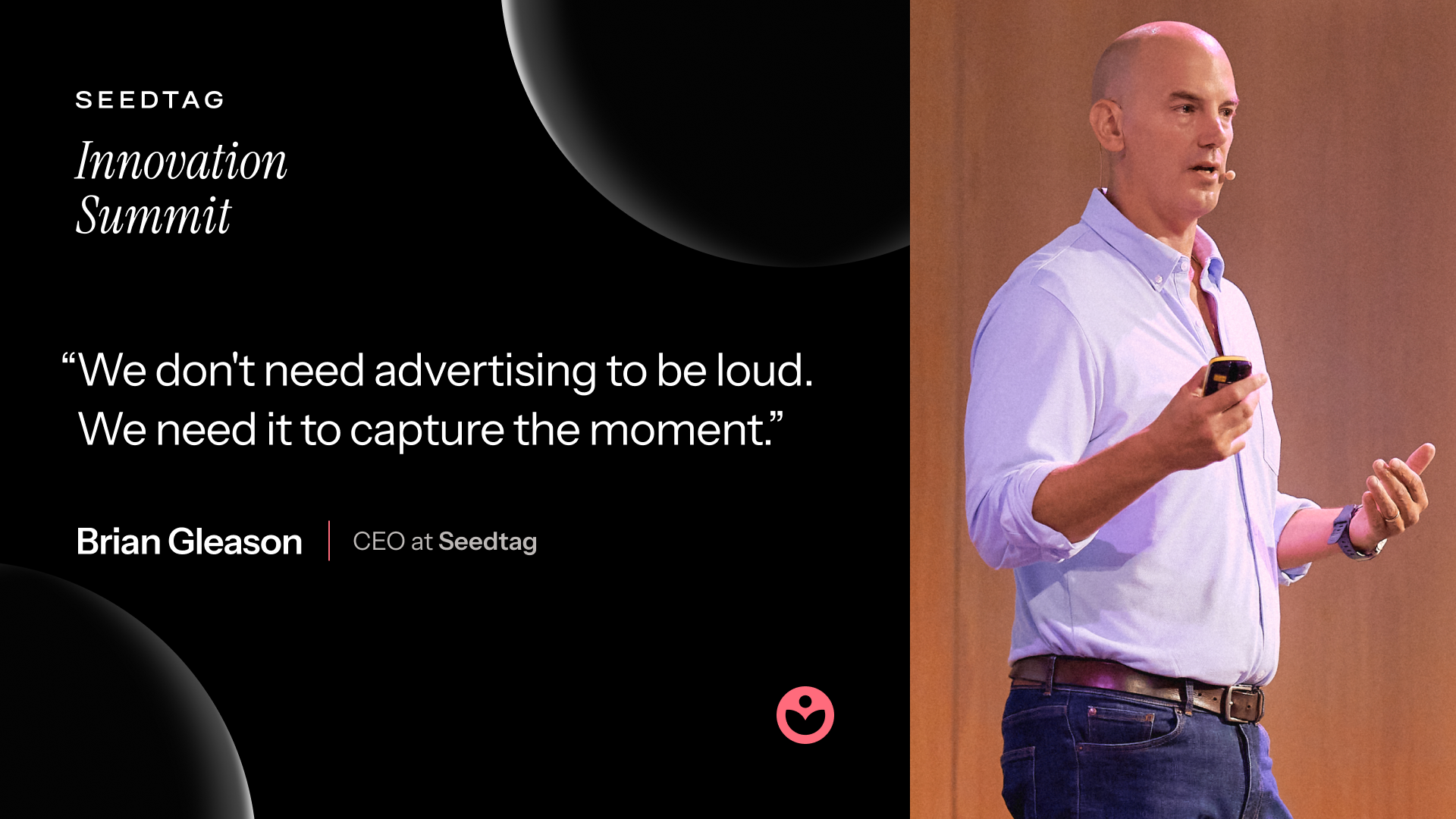
During the Summit, Brian Gleason, our CEO, added another layer: "We're more connected than we've ever been, but we're more distracted than we've ever been." For Brian, finding out how to connect in that moment is the most important thing, whether you're a brand, an agency, or a publisher.
The agenda combined dedicated sessions for the supply side and the demand side with joint sessions that put both in the same room. Topics ranged from the agentic shift and AI search to attention measurement, brand safety, CTV, creative, and life after the traffic. At lunches and dinners, the conversations kept going.
Across all of them, one thing became clear. The challenges facing the adtech ecosystem aren't local. They're global. And they become easier to solve when both sides look at them together.
Key Takeaways
- Consumers are more connected and more distracted than ever, and connecting with them in the moment matters for brands, agencies, and publishers alike.
- The same person makes different decisions in different situations, shaped by signals like time of day, screen, weather, and place.
- Fewer impressions carry identifiers, but audiences haven't gone anywhere, and reaching them requires a new structure.
- Interest, emotion, and intent shape how people process advertising, while viewability alone says nothing about that processing.
- Publishers, agencies, and brands face the same challenges from different perspectives, and the conversation is global, spanning the United States, Latin America, and Europe.
What Are the Biggest Challenges Facing the Digital Advertising Landscape?
Throughout the Summit, Brian Gleason put the consumer at the center of the conversation. For him, it's the one thing the industry doesn't focus on enough. We talk about acronyms, LLMs, and chats, but rarely about what consumers are doing every day or what their world is like.
And that world is full of noise. Attention is fleeting, and capturing it is hard. At the same time, clients are under pressure to grow and differentiate, and Brian raised an open question about what happens to them as products become commoditized in AI chat environments.
Grego Martínez, our Chief Product Officer, pointed to another challenge: media buying itself.
In CTV, most buying happens at the platform level, yet streaming services rarely have exclusive content. To illustrate the point, Grego shared a simple example: in Spain, Harry Potter is available on eight different platforms. So when a brand buys one of them, it's buying the service, not the moment. It learns nothing about the show being watched, the emotion it creates, or the hour and day it's being seen.
Buying through demand side platforms (DSPs) has a similar limitation. Brands and agencies can target IAB categories, keywords, domains, geography, or day part, but combining all of those signals to build moments manually is very complicated. The signals exist, but programmatic fragmentation keeps them apart.
Why the Adtech Ecosystem Is Moving From Understanding the Who to the Moment
For Grego, solving that fragmentation starts with a simple idea: the same person can make very different decisions depending on the situation they're in.
Picture someone commuting to work on a rainy Monday morning, phone in one hand, about to lose connection in five or six minutes. Any message has to be fast. Now picture the same person on a sunny Sunday morning, planning the week ahead with Monday off. They might spend 90 seconds on a powerful long video, one that takes them to the next step.
Nothing about them has changed. Only the moment has.
The same happens with a recipe. On a Tuesday evening after work, someone looking one up wants something fast. On a Saturday morning, with family and friends coming over, they're far more open to a message tied to that interest. The article is exactly the same. The moment is not.
That's why content is only one piece of context. The hour, the day of the week, and the season all matter. So do the type of screen someone is using, the weather, and the place they're in. On their own, these signals won't massively improve advertising. Combined, they create a scenario where advertising works much better.
Moments also change across environments. On mobile, things happen faster. On desktop, people are usually sitting down and paying more attention. CTV is often watched in a group rather than alone.
"We've spent more than 20 years understanding the who. Now, I think the future will be won by those who understand the moment much better," Grego said as he closed his session.
Audiences Were Never Identifiers
Hannes Sieling, our VP of Data & AI, started from programmatic advertising's long reliance on identifiers. They gave data teams structure, plus the reach to find people again. Today, fewer impressions carry them, but the reality hasn't changed. The same people are consuming the same content. And audiences were never identifiers in the first place.
What the industry needs is a new structure, built around the content people consume. That's the idea behind vector-based targeting: grouping similar content together so brands and agencies can find the environments closest to their goals, while balancing reach and precision.
Hannes also pointed to the technology that makes this possible: "Embedders are a little bit the hidden champions, the unsung heroes of the whole rise of large-language models."
The real question is what counts as similar. For him, the answer needs to go beyond clicks or categories and help find the right environment at the right moment. Understanding how people actually process what they see is a key part of that answer.
The Science Behind Attention, Emotion, and Intent
Professor Tino Meitz from the University of Münster explained how people process advertising. Who we are stays fairly stable, but how we feel and what we're focused on can change in milliseconds. When people consume media or advertising, that state of mind matters most.
That's also why viewability isn't enough. It shows that an ad could be seen, but says nothing about whether it was actually processed.
Three contextual signals shape that processing:
- Interest: If people aren't motivated to watch a show, they're unlikely to engage with the advertising within it.
- Emotion and affect: The brain relates new situations to past experiences, so a context that connects to familiar feelings makes new information easier to process.
- Intent: People need to be in the right situation for a message. If you want to buy a mid-sized SUV, you probably won't walk into a Ferrari dealership.
Tino was careful to separate affect from emotion: "Affect is something you can't govern. It's something that's happening, it's also, to a certain extent unconscious. Emotion is an evaluation of your affect afterwards."
How Can Supply and Demand Collaborate Across the Adtech Ecosystem?
Rob Beeler, who led the Two Sides, One Signal working session, explained why collaboration and supply and demand alignment matter. “Both sides are trying to solve the same things. This is a relationship-driven industry, and relationships are built by talking to each other in person. When both sides start working together, he said, they can be more effective for advertisers”, he said.
Kevin Donker, Head of Programmatic & Media Automation at Omnicom Media, brought that same spirit to the agentic conversation. For Kevin, agentic buying is still in its infancy, and the industry will have to come together to adopt protocols that make it reliable. When that happens, the productivity gains from AI should be reinvested in people.
In his view, the winners will be organizations that use AI to boost creativity, leadership, and judgment. The ones left behind will simply put an AI layer on top of an already fragmented workflow.
Brian Gleason echoed that idea in his closing remarks. He pointed to the feedback shared over the three days on different ways of working, ad inventory sources, and ways to measure. He also stressed the importance of trust: when you know you can trust someone, you know they'll do what they say they're going to do.
"There are a lot of pressures and challenges we think about in the world, and the things we shared over the last few days were brilliant. That's what we love to do: share information. It's an ecosystem that works together, and that's what we're trying to create", Brian Gleason.

How Does Neuro-Contextual Advertising Bridge the Gap Between Supply and Demand?
If both sides face the same challenge, they also need a shared way to understand the moment. That's what Neuro-Contextual Advertising offers.
Liz, our Neuro-Contextual AI, reads signals of interest, emotion, and intent to understand the moment behind each impression, without personal data or identifiers. For brands and agencies, that means reaching people when it matters most. For publishers, it means their content is valued for the moments it creates.
And it goes beyond advertising. Bringing value back to the open web helps keep quality content alive, and that's a responsibility the whole industry shares.
From Barcelona to the Next Conversation
Over three days, publishers, agencies, and brands from the United States, Latin America, and Europe approached the same questions from different perspectives. How do we capture attention? How do we reach audiences without identifiers? How do we make sure quality content keeps being found and valued as the way people discover information changes?
For us, at Seedtag, those conversations reinforce the vision behind Neuro-Contextual Advertising: understanding people's interest, emotion, and intent in the moment they're in.
It's not about knowing who. It's about understanding the moment.
Thank you to everyone who joined us in Barcelona. If you'd like to keep the conversation going, our team is here.

Nuestro blog

The final quarter of the year is here, and with it comes an exciting opportunity for brands in the technology space. From cutting-edge audio experiences to smart home gadgets, consumers are engaging with tech content like never before. But how can your brand stay ahead in a competitive landscape?
Our latest Contextual Insights report dives deep into the trends driving consumer interest this quarter. With mentions of spatial audio up 35%, smart home devices seeing a 24% engagement increase, and console gaming commanding loyal attention, Q4 is the season to position your brand at the forefront of innovation. Here’s everything you need to know to power up your campaigns.
Spatial Audio: Turning Up the Volume on Immersive Sound+
Spatial audio is making waves this quarter, with a 35% surge in mentions and an average of 4,200 visits per article. From high-end headphones to advanced home theater systems, consumers are increasingly seeking audio experiences that put them at the center of the action.
- Top Drivers: Premium brands like Apple (AirPods Max) and Sonos (Beam) are leading the charge, sparking consumer interest in immersive audio that enhances music, gaming, and movie experiences.
- Why It Matters: Audio technology is no longer a luxury; it’s an expectation for tech-savvy audiences looking to upgrade their everyday experiences.
We recommend: Showcase how your audio products deliver a premium listening experience. Whether it’s through creative storytelling or experiential activations, emphasize the emotional connection that high-quality sound creates.
Smart Home Devices: Automating the Modern Lifestyle
The smart home revolution continues to gain traction, with engagement around smart locks, voice-activated assistants, and home automation systems up 24% this quarter. Articles in this category average 3,800 visits, reflecting strong consumer interest in convenience and connectivity.
- Top Trends: Amazon Alexa, Google Home, and innovative smart locks are leading the conversation, as consumers look for seamless integration into their daily routines.
- Holiday Opportunity: Smart home devices are a perfect fit for holiday gifting, offering a balance of practicality and innovation that appeals to tech-savvy shoppers.
We recommend: Highlight the lifestyle benefits of your smart home products in campaigns. Show how they simplify routines, enhance security, or add a touch of luxury to everyday living.
Console Gaming: Winning Engagement
Gaming remains one of the most engaging tech categories this quarter, with articles on PlayStation, Xbox, and popular gaming titles averaging 5,200 visits. Console gaming is not just about hardware; it’s about creating immersive entertainment experiences that captivate loyal audiences.
- Key Titles & Drivers: Content covering cross-platform gaming, game streaming, and major releases like Resident Evil and Grand Theft Auto drives high engagement.
- Why It Matters: The gaming community is highly engaged and loyal, making it a prime audience for brands looking to align with innovation and entertainment.
We recommend: Focus on the culture of gaming in your campaigns. Whether it’s accessories, exclusive game bundles, or immersive VR add-ons, position your products as a must-have for gamers this holiday season.
eCommerce and Holiday Tech Shopping: The Competitive Edge
Tech shoppers are flocking to eCommerce platforms like Amazon and Temu this quarter, with both platforms seeing significant engagement spikes. Articles focused on exclusive deals and discounts generate 6,100 visits per article on Amazon and 8,500 visits on Temu, showcasing the growing role of online shopping in the tech category.
- What’s Driving Traffic: Limited-time offers, early access deals, and curated gift guides are capturing consumer attention during Q4.
- Opportunity for Brands: Partnering with eCommerce platforms or creating online-exclusive promotions can help your brand stand out in a crowded digital marketplace.
We recommend: Leverage the power of urgency in your campaigns. Highlight limited-time offers or “shop early” messaging to capitalize on the eCommerce momentum driving holiday tech purchases.
This quarter, the tech space is buzzing with innovation, from immersive audio to smart home gadgets and gaming consoles. With consumer engagement surging in these categories, brands have a unique opportunity to connect with highly engaged audiences.
Download the full report and get the insights you need to power up your campaigns: Seedtag 2024 Tech & Q4 Insights.

As we head into the holiday season, the Christmas trees go up and the streets are filled with laughter and cheer. From around Thanksgiving weekend, the holiday spirits are high and the world welcomes the December festivities.
Holiday season trends show 4 key areas that garner audience interest during this time of the year. The growing trend starts in November and sees a significant uplift in interest and momentum from the beginning of December.
- Topics around Christmas Markets and Events capture the most interest and the articles cover information about local Christmas markets, dates, attractions, and tips for visitors. With over 27K views per article, the topic receives 17% of the views.
- The next topic is Best Christmas Deals and Promotions with a 9% view share. These articles focus on the best deals, discounts, and promotions available for shoppers and how consumers can save money.
- Gifts and Unique Finds for Christmas and Christmas Shopping Trends are the two other key topics that have a 7% view rate each. The topics include articles about gift ideas, popular presents, DIYs, and shopping trends.
What are the main content categories?
Our analysis around the holidays and Christmas showed that shopping is the main category of interest. But what areas generate the most interest among users?
- Shopping Brands
- Food and Drink
- Events & Attractions
- Travel
- Tech and Computing
Learn more about the top brands that are most relevant during the holidays.
Seedtag 2024 Holiday Guide: Download Now
Deep dive: What piques the audience's interest?
- Gift shopping
This topic receives maximum interest during the season and sees 6.1M brand-safe impressions per month. The audience is keen on finding the perfect presents such as toys and play areas, and are focused on instilling fundamental values through charity and donations.
- Home & Appliances
Many want to enhance their living space with home decor, furniture, and appliances by selecting pieces that showcase personal taste and enhance the quality of daily life. The topic receives 5.3M monthly impressions and the main clusters include home decoration, top lists, and reviews.
- Tech & Gadgets
This topic receives 4.5M monthly impressions and explores the latest innovations and cutting-edge devices like smart home systems, smartphones, and wearable tech. The main clusters of interest are VR, AI, and review websites.
- Fashion & Beauty
The main clusters for this topic are influencers, DIY at home, and new retail shop openings, contributing to 6.9M monthly impressions. This audience wants to know the latest trends and find stylish clothing & accessories, and beauty products.
- Deals & Discounts
With 5.2M monthly impressions, the audience is on the hunt for the best offers, special promotions, and price reductions. From flash sales to bargain shops, they are searching for ways to maximize budget and achieve excellent value on their purchases.
- Traditions
Festive customs and time-honored practices form an integral part of the holiday season, garnering 2.4M monthly impressions. From memorable Christmas ads and events to holiday calendars and traditions such as decorating trees and exchanging gifts, the audience wants to ensure they create cherished memories during the season.
- Travel
The holiday season is also a time for vacations and visiting new destinations. The topic garners 5.9M monthly impressions as the audience is on the lookout for the best destinations, unexplored routes, and flight details to plan a unique and memorable trip.
For more detailed insights, get your copy of the guide.
Seedtag 2024 Holiday Guide: Download Now

Understanding the intricacies of a particular market is crucial to achieving advertising success. For advertisers looking to penetrate the unique and diverse Canadian market, leveraging advanced techniques like network-level analysis (NLA) and contextual advertising can be game-changing. These strategies not only enable brands to tap into the growing market of newcomers to Canada but also ensure that their messages resonate with the right audience in a meaningful way.
The Unique Canadian Market and Its Growing Newcomer Segment
Canada's multicultural fabric is woven from the diverse backgrounds of its population, with a significant proportion being newcomers—immigrants and refugees who bring with them a range of cultural perspectives and needs. For advertisers, this presents both an opportunity and a challenge. The opportunity lies in the growing market; the challenge is understanding and effectively reaching this audience.
Newcomers to Canada often face the daunting task of navigating a new environment, from understanding the local consumer product landscape to managing personal finances, healthcare, housing, and education. This complexity demands a tailored approach to advertising, where understanding the audience’s unique profile is essential. By recognizing the overlaps between content that addresses these challenges, advertisers can craft messages that resonate deeply with this audience.
Network-Level Analysis: The Key Differentiator
At the heart of this approach is network-level analysis, a powerful tool that enables advertisers to understand the interconnectedness between key trends and topics across various media outlets. In the Canadian context, this means analyzing content from major publications such as The Globe and Mail, National Post, and Toronto Star, among others. These outlets frequently cover topics crucial to newcomers, such as housing, personal finance, healthcare, and education.
Network-level analysis allows advertisers to identify content clusters and trends that are particularly relevant to newcomers. For instance, articles discussing how to find a realtor, understand the rental market, or navigate Canada's healthcare system are invaluable for this audience. By pinpointing these content clusters and their adjacent topics, advertisers can gain insights into what matters most to newcomers and tailor their messaging accordingly.
This approach also extends to understanding the nuances of Canadian culture and what it means to be a proud Canadian. For many newcomers, questions of identity and belonging are intertwined with practical concerns like citizenship, visas, and transit. By clustering around these specific keywords and understanding the sentiment and context in which they are discussed, advertisers can create campaigns that speak to the values and aspirations of this audience.
Contextual Advertising: Reaching Newcomers Where It Matters
While network-level analysis provides the insights, contextual advertising is the mechanism through which these insights are activated. Contextual advertising involves placing ads in environments where the content is relevant to the audience, thereby increasing the likelihood of engagement.
For example, an advertiser targeting newcomers might place ads related to personal finance—such as opening a bank account or building a credit score—on websites or articles that discuss financial planning for new immigrants. Similarly, ads for healthcare services or supplementary health insurance could be placed alongside content that explains the Canadian healthcare system to newcomers.
The power of contextual advertising lies in its ability to reach audiences at the moment when they are most receptive to the message. For newcomers to Canada, who are actively seeking information to help them settle in, this approach ensures that the advertising is not just seen but is also relevant and valuable.
Harnessing the Power of NLA and Contextual Advertising
Success in the Canadian market, particularly when targeting newcomers, requires more than just understanding the demographic profile of the audience. It demands a deep understanding of the content they consume, the challenges they face, and the aspirations they hold. This holds true for any demographic, including GenZ, parents with kids, homeowners, etc. Network-level analysis and contextual advertising provide advertisers with the tools to achieve this understanding and to deliver messages that resonate on a personal level.
By leveraging these techniques, advertisers can navigate the complex and interconnected media landscape, reaching newcomers to Canada in a meaningful way that not only addresses their immediate needs but also helps them integrate and thrive in their new home. In a market as diverse and dynamic as Canada, this approach is not just advantageous—it is essential for success.

After multiple delays, Google announced that third-party cookies will not be phased out. While cookies may not be eliminated from Chrome, data privacy laws and consumer demands are rising. Publishers must look beyond third-party cookies as users dislike being tracked across websites and the lack of explicit consent invites significant legal scrutiny.
In today’s privacy-conscious environment, first-party cookies have become more valuable than ever. Unlike third-party cookies that do not comply with data privacy regulations, first-party data is collected directly and responsibly, with user consent. Data collected from users’ interactions with a publisher’s site creates a privacy-friendly foundation for understanding audiences.
Benefits of first-party data for publishers
Moving away from third-party cookies and focusing on first-party data enables publishers to comply with evolving privacy standards and future-proof their revenue strategies.
- With first-party data, there’s no risk of non-compliance. The data is collected straight from the user with their explicit consent, thus reducing the risks of legal challenges and ensures a stable revenue.
- The transparent, consent-based approach to data collection strengthens user trust and loyalty and enables a better overall user experience. This further enhances loyalty and engagement, thus providing long-term benefits to publishers.
- Since the data is collected from the source, the insights are richer and more accurate, leading to better ad targeting and hyper-personalized experiences.
- Other major browsers like Safari and Firefox have already blocked third-party cookies. Switching to first-party data collection enables publishers to create more sustainable strategies and future-proof their business.
- Making the shift to privacy-safe technologies and first-party data enables publishers to cater to the needs of the audience and advertisers without relying on conventional practices that are intrusive and less secure.
- First-party data is transparent and more reliable, leading to higher ad relevance and ROI. It helps minimize the dependence on external data providers and gives publishers more control over audience insights to generate revenue.
- Beyond just supporting ad revenue, first-party data can boost engagement, drive subscriptions, and help make informed editorial choices.
Using first-party data, publishers can build deeper relationships with their audiences, deliver more personalized, relevant, and engaging content, and enhance trust and loyalty. Privacy-safe data practices improve user experience, support engagement, and create opportunities for sustainable revenue growth.
Upgrading to a combination of privacy-preserving approaches
Consumers are increasingly wary about invasive tracking practices and are expressing their concerns about data privacy. Since first-party data is ethically collected from users with their consent, publishers can gather insights from the information shared by users themselves to optimize user profiling. The aim is to make a switch to a balanced approach that creates a privacy-centric strategy that overcomes the limitations posed by traditional practices.
How it works:
- Publishers collect first-party data from user interactions on the website like site activity, engagement with content, surveys, social media, and email interactions.
- Data Management Platforms (DMPs) help gather and organize data from the various sources and analyze them to effectively segment audiences.
- Data Clean Rooms (DCRs) help publishers and advertisers collaborate seamlessly and securely.
- DCRs facilitate privacy-safe matching and analysis of publisher data with advertisers, without sharing any personally identifiable information (PII).
To further enhance strategies, publishers are using first-party data repositories along with contextual advertising to create more compelling content and impactful interest-based audience segments. When used in conjunction, it empowers publishers to overcome privacy concerns and deliver ads relevant to users’ current interests.
These campaigns enable publishers to look beyond users’ personal data and monetize more of their inventory using a content engagement-based targeting approach. This enables publishers to widen their target group and potentially boost ad revenue as they can target even the users who opt out of tracking.
Non-intrusive, interest-based ad campaigns have shown better results as relevance increases the likelihood of clicks and conversions, thus commanding higher ad rates and improving publisher revenue. Leveraging first-party data and an interest-based targeting approach can help publishers develop premium content that they can monetize and grow revenue by increasing purposeful engagement.

Advertisers have a wide array of campaign options to capture the audience's attention. With shifting consumer demands, evolving privacy laws, and numerous ad creatives and channels, there’s much to navigate.
To optimize campaign performance and ROI, a comprehensive marketing plan is essential, covering key areas such as target audience, ad channels, creative elements, and messaging. An increasingly popular addition to marketers' toolkits is Connected TV (CTV) advertising.
Audiences have warmly embraced CTV, contributing to the rise of cord-cutters moving away from traditional cable. The rapid growth of CTV viewership has drawn advertisers’ interest, prompting budget shifts from linear TV to CTV. This shift allows marketers to future-proof their strategies and connect with a growing, engaged audience.
Marketing in the era of Connected TV and OTT
Unlike the limitations of traditional TV advertising, CTV allows brands to tailor messaging and display personalized ads to niche audiences.
Marketers can access key data points like viewer preferences and habits that provide deeper insights into their likings and preferences. Based on the understanding of viewers’ interests, the ads and the viewing experience are personalized to increase engagement. While traditional TV displays the same ad to all the viewers watching a particular show or channel, CTV ads can be tailored to align with a user’s interests.
The benefits
- Advertising to an engaged user base increases effectiveness as the viewers show a greater propensity to engage and interact with the ads.
- The ability to ensure precise targeting and serve personalized ads boosts engagement and conversion rates as the ads appeal to users’ interests.
- More detailed metrics to track and measure campaign performance, optimize on the go, and improve ROI.
The future of CTV ads
Connected TV (CTV) advertising is still a fresh, emerging channel that marketers and brands are exploring in depth. With continuous innovation on the horizon, there’s much potential left to unlock in this space.
CTV ads have already surpassed the limitations of traditional television, offering hyper-personalization, customization, and niche targeting. This unique medium allows brands to establish connections and build relationships with a growing audience. Advanced targeting capabilities enable marketers to engage audiences on a personal level, capture attention, and earn trust.
Seedtag Contextual TV provides a holistic approach by combining CTV signals and ad data with AI-driven contextual insights from the open web. This integration enables advertisers to understand user interests, target precisely, tailor creative content, and optimize performance. With CTV, brands can move beyond generic categories, access key attention metrics to measure campaign effectiveness, and create attention-grabbing ads.
As the future of advertising shifts to the OTT world, brands are increasingly targeting viewers based on the content they’re watching. Aligning ads with a viewer’s current interests fosters stronger connections and enhances the overall viewing experience.
Learn more about CTV advertising capabilities with Contextual TV by Seedtag.
Additionally, register for Seedtag Academy to become an expert in all things CTV!

As Connected TV (CTV) becomes a central channel in the advertising landscape, publishers are navigating new challenges and opportunities around audience engagement and revenue generation. At the Beachfront Publisher Summit, industry leaders came together for discussions on how contextual targeting and advanced adtech can help publishers meet these evolving needs, including practical approaches to CTV advertising that prioritize relevance and audience connection without relying on personal data.
Discover the key outcomes straight from Seedtag President North America Brian Danzis and Beachfront VP Business Development Marni Rommel as they share key insights on how contextual technology can empower publishers to enhance ad relevance, improve viewer experience, and unlock new revenue streams while aligning with privacy expectations.
- What is the role of video in the current advertising landscape?
Brian Danzis: Video continues to be one of the most impactful advertising formats because sight, sound and motion can evoke powerful sentiments which can help shape perception and drive people to action. The traditional thirty second spot once dominated the format, but over the last twenty years not only have new lengths emerged, but so has variety in screen orientation, customization and interactivity elements to make the format even more powerful.
- What are the keys to harnessing new technologies in CTV?
Marni Rommel: The role of contextual targeting and how Seedtag contextual AI and tech capabilities will enhance Beachfront’s proposition.
In today’s CTV landscape, having a deep understanding of your audience’s viewing preferences and habits is a critical starting point. This can be achieved through rich data analytics and insights, and then leveraged on campaign plans via advanced targeting methods like contextual.
Our belief is that contextual targeting will play a significant role in how CTV media is transacted going forward, as it allows media buyers and sellers to deliver ads based on what the consumer is currently watching – leading to improved ad relevance, engagement, and yield.
- How can publishers benefit from tech advancements in CTV?
Marni Rommel: The value Seedtag brings to Beachfront publishers
Through recent tech advancements in CTV, including those brought on by Seedtag, today's CTV publishers are well-positioned to enhance their monetization and drive new revenue streams, even amid changes to the broader privacy landscape.
With deeper audience insights and enhanced targeting capabilities, publishers can deliver a more seamless and engaging viewing experience for CTV audiences. Seedtag’s contextual CTV targeting offering specifically, as an example, has been proven to improve ad relevance and increase campaign scale – giving rise to new, contextually-driven demand opportunities for publisher
- How events like this CTV Publisher Summit add value to the CTV publishers industry?
Marni Rommel: The CTV ecosystem is evolving rapidly, so creating forums for collaboration, feedback, and knowledge sharing is absolutely essential to aligning on common challenges and goals. We’re all navigating the same industry dynamics after all.
We were delighted to host so many of our key partners and give them the opportunity to hear from Seedtag as well as some of their trusted media buyers. Seedtag’s strength in data, creative, and contextual makes them a critical partner for today’s CTV publishers, as we are collectively well-positioned to bring value to the buy-side in a way that drives engagement, revenue, and efficiencies for media sellers.
- What does the future hold for CTV in the United States?
Brian Danzis: CTV continues to be one of the fastest growing ad channels in the US, because of shifting user behaviors in how they consume video content. At Seedtag we expect more content to be made available through CTV channels and even more customization of ad formats including more advanced HH level targeting, customized creatives that are contextually relevant, engaging and fun!
- How can we strike the right balance between utilizing data for CTV without crossing the line into overly personal targeting?
Brian Danzis: Today’s consumer is much more aware of how companies track and target them online and are increasingly taking active measures to block these practices. While CTV is naturally “cookie free” as an industry we need to still be careful about how we use IP addresses and other HH level data to deliver ads. At Seedtag we believe wholeheartedly in delivering a privacy compliant approach that protects the end user from unnecessary data collection, stereotypical audience bucketing and other traditional targeting tactics that rely on third party sources.
- How can publishers achieve better ad personalization and relevance for both advertisers and audiences in the streaming ecosystem?
Marni Rommel: CTV publishers can achieve stronger ad personalization and relevance in streaming ecosystems using contextual monetization solutions, such as Seedtag’s, which utilizes Contextual AI to analyze and package content in real-time. It is through technology like this that publishers can deliver higher-yielding ads that align closely with the context of the programs the viewer is watching, ensuring that the ads are not only relevant to the in-the-moment content but also to the audience’s interests.
By focusing on contextual signals rather than relying solely on user data, publishers can create a more engaging and seamless ad experience that satisfies advertisers' goals for targeted messaging while enhancing viewer satisfaction and engagement. This approach fosters a win-win scenario where both advertisers and audiences benefit from more relevant and impactful advertising.
As digital advertising continues to evolve, actionable and privacy-compliant solutions for CTV enable publishers to maintain relevance with audiences while optimizing monetization models. By focusing on context over personal data, Seedtag’s approach offers a sustainable pathway forward for CTV publishers. Want to know more about achieving a balanced approach that meets both audience needs and industry standards? Let’s talk!

It's time to bring out those costumes, get your scare on, and let your imagination run wild! With the 31st of October nearing, costumes, masks, decor, candies, and parties are already on people’s minds. As people gear up for the festivities, understanding what’s on consumers' minds and what they are looking forward to is essential intel for brands.
Halloween offers an opportunity for brands to engage with consumers in a fun and memorable way. Consumers look for everything ranging from costumes and party supplies to home decor, events, and activities. Brands that can strike a chord with the audience by sharing relevant, quality content will garner interest, increase brand awareness, and drive sales.
Halloween 2024: Top categories of interest
To keep brands and advertisers abreast of the season’s trends and consumer interests, Liz Events powered by Seedtag Lab brings to you the exclusive 2024 Seedtag Halloween Insights report. Our research shows that the audience is interested in an array of categories that vary from events to pop culture, hobbies, and home decor.
Download the full report here.
Based on the number of articles in each category and the number of visits per article, here are the most notable categories:
- Family & Relationships: Articles on Halloween family activities like trick-or-treating with kids and parents.
- Events & Attractions: Special promotions at theme parks like Halloween discounts, haunted houses, and zombie survival experiences.
- Shopping: Guides on Halloween costumes, popular costume trends, home decorations, and accessories.
- Movies: A selection of horror movie recommendations, from classics to new releases in theaters and on streaming platforms.
Halloween 2024: Main content focus
With ~3+ million impressions, entertainment, decorations, costumes & accessories, and food & treats are the topics that capture maximum audience interest.
- Entertainment: 32% of articles revolve around entertainment as the audience loves binge-watching horror movies and TV shows or visiting amusement parks to experience themed attractions and haunted mansions. Movies & TV Shows garner 48% of total views, and the other clusters include theme parks, video games, and scary tales.
- Decorations: The decor is an important ingredient for homeowners and event planners eager to create spooky, festive environments to celebrate the holiday. This topic has an article share of 32%, and the main clusters are parties, decoration deals, and DIY projects.
- Costumes & Accessories: 26% of articles are for the majority that’s on the lookout for creative and themed attire. From playful outfits for children to themed party attires for adults, the clusters focus on influencers' costumes, quick & cheap costumes, costumes for women, and pet costumes.
- Food & Treats: An important element of any celebration, 15% of articles appeal to trick-or-treaters, home bakers, and party hosts exploring creative recipes and indulging in themed sweets. The main cluster trick-or-treating receives 43% of total views and other topics include Halloween candy and Halloween recipes.
This seasonal audience drives anywhere between 2.39 million to a whopping 3.69 million brand-safe impressions per month. The key to leveraging findings like these to a brand’s advantage lies in targeting niche or customized audience segments.
The 2024 Seedtag Halloween Insights report: Download now

Advertisers and publishers are increasingly capitalizing on the thriving Connected TV ecosystem as the channel continues to garner more viewers. CTV is the hottest new trend in digital marketing and the fastest-growing ad channel in the US due to the 2+ hours spent leaned in watching and 88% of GenZ and millennials owning an advanced TV. For publishers, CTV presents a significant opportunity to reach a targeted audience, monetize content on this channel, and provide interactive experiences that better engage users.
CTV provides publishers with a new and bustling platform to create and distribute content across video, display, and creative ad insertion that reaches new potential customers and generates revenue. While CTV advertising is an exciting channel to explore, it comes with its own set of complexities. The fragmented CTV landscape, lack of control and transparency, and absence of CTV-optimized solutions pose multiple challenges.
Digital advertising in the evolving media landscape
From monetizing content to choosing the right marketing strategy, managing operations, ensuring brand safety, optimizing ad revenues, and delivering exceptional user experiences, the right technology partner and marketing partner is pivotal in ensuring publisher success.
- Publishers must ensure the business partnership has a global reach to network with a larger pool of advertisers and agencies.
- The partnership marketing approach must be flexible, transparent, and tailored to cater to business-specific needs that yield better campaign results.
- Publishers should choose partners that leverage new-gen capabilities like AI and ML, ensure privacy-first practices, and leverage brand safety and suitability best practices to stay ahead and future-proof their business.
- Since CTV is a relatively new space, it is key to look for a marketing partner with a proven track record in the industry and carefully evaluate the platform’s capabilities and features.

The Benefits of Choosing a Solid CTV Technology & Marketing Partner
With CTVs increasingly replacing traditional cable, it offers publishers access to a large and growing audience. It presents an opportunity to generate revenue through advertising, subscriptions, or premium products or services on CTV platforms.
- Real-time bidding (RTB): Enables publishers to efficiently allocate ad inventory to the highest bidder and maximize their revenue.
- Header bidding: Allows publishers to simultaneously offer ad inventory to multiple ad exchanges, thus increasing competition and improving pricing.
- Demand-side platform (DSP) integration: Facilitate connections with myriad ad networks and exchanges, enabling access to a wider pool of advertisers and agencies.
The right blend of context and affiliate marketing forges a very effective strategy. Contextual-led CTV advertising will help publishers deliver based on the specific page content being watched, ensuring a higher relevance and better engagement as they are more likely to resonate with viewers. Higher engagement and click-through rates can help publishers attract higher-quality advertisers who are willing to pay a premium.
By leveraging affiliate programs and content partnerships, businesses can further increase brand awareness and extend their reach. Forms of partner marketing such as joint ventures with content creators or CTV platforms enable brands to tap into established audiences, boosting brand recognition and engagement while ensuring a cost-effective strategy for reaching new markets.
Enhancing User Experience and Ad Performance
Contextual CTV advertising also enhances the overall user experience as the ads are non-intrusive and relevant to their watchlist and preferences. The ads are also placed in safe and appropriate content environments, preventing any negative associations. Brand safety and suitability measures are integral elements in the busy media landscape as they help avoid harmful content and ensure the ad placements align with the brand’s overall messaging and ethos.
- Precise targeting: First-party data and contextual advertising help identify and build specific audience segments. The ads delivered are contextually relevant to the content being consumed by viewers, increasing engagement and key attention parameters.
- Privacy-first: Contextual-led CTV does not invade user privacy by accessing third-party data, thus making it a preferred choice among advertisers as it helps build relationships and gain user trust.
- User experience: The campaigns are highly targeted and personalized ads are effective, but the placements are non-intrusive and do not disrupt the viewing experience.
What can we expect of Connected TV Advertising
As competition in CTV advertising grows, companies that invest in partnership marketing will gain an edge by collaborating with strategic partners to optimize marketing initiatives. This approach not only ensures cost efficiency but also drives lead generating campaigns that convert high-intent viewers into loyal customers.
The right marketing partner is crucial for navigating the complexities of CTV advertising, and Seedtag is here for you. By leveraging affiliate marketing, content partnerships, and joint ventures, brands can develop cost-effective strategies that drive brand recognition and enhance audience engagement. As CTV continues to evolve, businesses that prioritize strategic collaborations will maximize their reach and long-term success.
Discover how we bring our Open Web expertise to the CTV landscape with Seedtag Contextual TV.

Connected TV is all the hype today as the rapid shift from traditional TV continues. People love having complete control over what they watch and when and enjoy having access to a vast library of content to choose from. The flexibility to connect to the internet, browse popular streaming services, and seamlessly switch between traditional TV and online content has garnered massive viewership for CTV over the years.
The ever-increasing number of “cord-cutters” has naturally persuaded advertisers to rethink ad budget allocation. The booming OTT platform subscriptions and CTV viewership have shifted investments toward CTV advertising. Like traditional TV commercials, CTV ads are placed within streaming content and operating system apps across internet-connected televisions.
The benefits of CTV advertising
CTV ads enable advertisers to reach the growing audience base that owns smart TVs by delivering the ads within streaming content such as movies and TV shows. CTV targeting is also more precise when compared to traditional television as the ads appeal to the real-time interests and viewing habits of users.
CTV advertising improves campaign performance as it reaches a larger audience base and helps advertisers engage with the audience that’s cutting the cord on traditional cable.
CTV also ensures improved audience targeting as the ads are displayed to specific segments where they are relevant and align with their area of interest, thus leading to higher engagement and better ROI. Overall, CTV ads reach a wider audience and increase brand awareness, making them a powerful tool in digital advertising.
Brand safety and alignment in CTV (Connected TV)
While advertisers opt for privacy-first alternatives and new advertising channels like CTV, it is imperative to ensure the brand image is upheld and always shown in good light. Brand safety measures help prevent a brand's ads from appearing alongside content that’s inappropriate or offensive. Brand alignment helps to create a consistent and positive brand experience by ensuring the ads align with the brand's overall messaging, values, and targeted audience.
Key considerations for brand safety and alignment
- Choosing content categories that align with the brand's values and overall positioning.
- Ad placement that aligns with the content of the streaming video.
- Preventing ads from appearing alongside topics that are harmful, offensive, or could damage the brand reputation.
Contextual CTV advertising brings the powers of AI-powered contextual advertising to Connected TV. Similar to ads matched to the content of web pages, contextual CTV matches ads to the content streamed by users. For example, users who watch more content about wildlife, nature, or documentaries about the environment are more likely to be interested in ads about eco-friendly, sustainable, and cruelty-free products or services.
Contextual CTV is emerging as a privacy-preserving ad strategy that enables brands to boost engagement, increase brand awareness, and improve brand reputation. With a better understanding of viewer interests, advertisers can serve ads that are contextually relevant to the current content browsed by the audience. Contextually targeted ads are non-intrusive and in line with a brand's ideas and values.
Additionally, contextual advertising-backed CTV targeting empowers brands to ensure brand safety and brand suitability with more precise and relevant ad placements. These measures prevent ads from appearing in environments that are inappropriate or harmful.

The Role of a Brand Safety Service in CTV Advertising
Given the complexities of programmatic advertising, a brand safety service is essential to ensure ads appear only in safe and brand-suitable environments. These services leverage AI-powered tools to analyze ad space and implement brand safety measures effectively.
Some of the key elements of a brand safety service include:
- Exclusion lists: Blocking certain categories of content that do not align with brand values.
- Real-time monitoring: Ensuring brand advertisements do not appear alongside fake news or offensive content.
- AI-driven contextual analysis: Identifying and classifying content to match ads with relevant content.
- Protection across social media and digital advertising: Applying brand safety strategies across multiple platforms.
Protecting Your Brand with the Right Tools
As brand safety issues continue to evolve in digital advertising, companies must invest in brand safety tools that provide real-time protection and ensure brand safety in every campaign. Implementing brand safety measures safeguards a brand’s ad placements from appearing in harmful or inappropriate content and helps protecting your brand from reputational damage.
Seedtag Contextual CTV brings our expertise from open web campaigns to the CTV landscape.
Our expertise brings granularity and helps advertisers to go beyond generic categories, garner valuable attention metrics, and build a more memorable brand experience. Reputable inventory sources coupled with brand safety and suitability measures help mitigate the risks of negative publicity or brand associations.
Brand safety service is crucial in the CTV landscape, ensuring that ads remain in brand-safe environments and align with a brand's messaging. Contextual CTV helps brands reach the intended target audience, ensures ads align with brand values, improves overall campaign effectiveness, and builds trust among consumers. Learn more.

Consumers have been voicing a growing number of concerns about how their data and personally identifiable information are collected and used by brands. Data collection practices have raised significant privacy concerns, leading to regulations that impact in the future of digital advertising.
Data privacy laws and Google’s Privacy Sandbox address these consumer concerns. They aim to give users more control over their data. This includes how brands access and use this data and contextual AI.
Privacy protection laws, like GDPR in the European Union and CCPA in the United States, set rules for businesses. These laws guide how companies can collect, use, and share personal information. . Google designs its Privacy Sandbox APIs and technologies to provide a more private and secure web experience. The main objective of these privacy initiatives is to give users more control over their online privacy and to limit the amount of party data collected and used.
Why the shift in focus toward privacy-first advertising?
Traditional audience targeting has been the norm for decades. Audiences are grouped and targeted based on their past interests and buying habits, this relies a lot on third-party cookies. Cookies are small snippets of code that are used to store data on a user's computer that enable websites to remember login details, preferences, etc.
The privacy issues arose because of third-party cookies that are set by domains other than the one visited by a user. These cookies allow businesses to monitor browsing patterns and customer data across multiple websites, and the data collected is used for programmatic advertising and tracking purposes.
Third-party cookies may be helping advertisers target users. However, they are intrusive, non-consensual, and manipulative, raising multiple privacy concerns. While Google decided to back out from its cookie deprecation plan after years of delays, the efforts toward improving online privacy continue.
The future of advertising is shifting toward privacy-first strategies, and marketing strategies need to adapt accordingly. Cookieless developments are a priority for Google as it aims to preserve the ad-supported internet by promoting the adoption of privacy-preserving digital advertising practices.

What are the privacy-preserving alternatives in advertising?
Whether it is privacy protection laws, browser controls like cookie blocking and tracking protection, or Privacy Sandbox APIs, the focus lies on consumer behavior and enabling users to make informed choices when they’re browsing. Consumers’ demand for data privacy has compromised reach and measurement for advertisers, impacting key areas like cross-site tracking, personalization capabilities, and audience categorization.
In the bid to create a privacy-focused ecosystem, contextual AI is swiftly emerging as a go-to solution among advertisers who are evaluating privacy-first alternatives to conventional advertising practices. Contextual AI offers an advanced solution that leverages the capabilities of artificial intelligence and its subsets like machine learning and Natural Language Processing algorithms to analyze millions of web pages.
A key advantage of contextual AI is its ability to provide hyper-personalized advertising without compromising user privacy. By analyzing content rather than user-specific customer data, brands can deliver highly relevant ads that align with the interests of their audiences in real-time. This shift allows digital marketers to implement AI-powered strategies that enhance engagement and improve the effectiveness of their campaigns.
Contextual ads are displayed based on the analysis of web pages to ensure they align with the content and context of every page. Contextual advertising is a complementary technology that caters to the needs of consumers and businesses. The advanced targeting capabilities move beyond the traditional audience categorization practices that are based on stereotypes, cliches, assumptions, and past browsing patterns.
Contextual AI and The Future of Digital Advertising
Contextual AI analyzes both the written and visual content of a page and places ads in the most optimal locations where the ad messaging aligns with the page. Contextual advertising relies on artificial intelligence to deliver ads on relevant websites that target the right audiences without using cookies. It allows brands to enhance their understanding of consumer behavior and makes ads more relevant and relatable.
Another significant trend shaping the future of digital advertising is the rise of short-form videos. These videos are a strong way to engage audiences.
Platforms like TikTok, Instagram Reels, and YouTube Shorts have demonstrated the effectiveness of video-based content in capturing audience attention. Video content, along with AI targeting, helps brands show ads that are engaging and relevant. This leads to higher conversion rates.
As marketing strategies evolve, brands are increasingly relying on AI-driven analytics to optimize their campaigns. Programmatic advertising powered by machine learning enables businesses to make data-driven decisions and allocate resources more effectively. This shift towards automation and AI-powered insights is helping advertisers navigate the complexities of a privacy-first digital landscape.
In an era where data privacy and user control are paramount, contextual AI is emerging as a transformative force in the future of digital advertising. By leveraging artificial intelligence, machine learning, and real-time analytics, brands can deliver relevant, hyper-personalized experiences while respecting consumer privacy.

Google’s renewed focus on the Privacy Sandbox aims to improve online privacy while preserving an ad-supported internet by promoting the adoption of a privacy-first approach. While Google may have dropped its plan to complete the deprecation of third-party cookies after multiple delays, the anchor continues to be data privacy and transparency.
Privacy Sandbox APIs have the potential to achieve this feat as they serve as an alternative to traditional tracking methods like third-party cookies. The APIs reduce tracking but ensure businesses continue to thrive using technology that can gather user data and deliver targeted ads without compromising personal information.
The key Sandbox APIs like Topics API, Attribution Reporting API, and Protected Audiences aim to protect user privacy and reduce reliance on third-party cookies. Whether it is enhancing audience targeting or improving ad effectiveness, these APIs allow businesses to continue thriving in the digital economy whilst being respectful of data protection regulation GDPR and other data privacy laws.
The shift toward a privacy-first digital landscape
From third-party cookie tracking to data breaches, changing regulatory landscape, and evolving user preferences, the transition to Privacy Sandbox APIs is driven by the need to protect personal data while allowing businesses to continue to flourish.
The aim is to create a more sustainable and trustworthy digital ecosystem by striking a balance between consumer data protection and business needs. Adopting a privacy-first marketing strategy ensures that businesses comply with GDPR and CCPA, giving users control over their data while still enabling effective advertising. Contextual advertising is a frontrunner in the privacy-focused ecosystem that these APIs aim to create.

Contextual advertising: A privacy-first approach alternative
Contextual advertising is moving away from conventional targeting practices that leverage keywords and phrases and rely on stereotypes and assumptions to reach audiences. With Custom AI, advertisers can shift from predefined audience targeting and build custom Contextual Audiences. Advertisers can create unique and dynamic audiences to suit business-specific needs and requirements for greater precision and impact.
With the right blend of data-driven audience targeting, creatives, and ad placement, contextual advertising empowers brands to engage with users at the most optimal time and place by delivering personalized and relevant experiences.
Building Trust Through Privacy-First Advertising
A privacy-first approach not only ensures compliance with regulations but also helps build trust and customer relationships. Consumers today are more conscious about the data you collect, and ensuring transparent and ethical handling of their information fosters trust and loyalty.
By prioritizing privacy-first advertising solutions, brands can create long-term strategies that respect consumer privacy while driving engagement and business growth. The shift towards privacy-conscious advertising is not just a trend—it is the future of digital marketing.

In the era of short attention spans, constant multitasking, and myriad distractions, global brands are battling it out for the most desirable currency: attention. A contextual approach provides a strategic framework to capture this attention while prioritizing data privacy. Attention metrics are the KPIs advertisers closely monitor today to understand campaign performance and how the audience resonates with ads.
Attention is the most sought-after metric in the advertising world as a multitude of brands vie for the top spot and aim to capture a larger market share. The biggest challenge advertisers have faced is the inability to quantify campaign performance beyond mere views or clicks.
The shift from Viewability to Attention Metrics
Conventionally, media quality has been assessed based on viewability percentages, which only measure the potential of an ad to be viewed and not its ability to draw user attention.
While the focus has been to increase viewability, it is not a detailed measure of the effectiveness of ads or where to serve them. A contextual approach, by contrast, allows advertisers to leverage modern social learning theories, stemming from the work of Russian psychologist Lev Vygotsky, to create more meaningful interactions. Attention metrics provide a more precise evaluation of how ads perform, directly correlating campaign performance with brand outcomes. This shift reflects a deeper understanding of ad effectiveness.

Understanding Attention Metrics
Attention measurement moves beyond superficial metrics, employing advanced technologies like eye-tracking and predictive modeling. This method relies on machines, eyes, and faces to provide legitimate signals. The predictive model is built on key metrics that include ad format, screen real estate, duration in view, scroll speed, page geometry, and domain.
Attention metrics enable advertisers to go beyond the basics and truly understand higher psychological processes involved in engagement. These metrics measure how engaged or focused a user is on an ad and their ability to absorb the ad’s message, which is more effective in measuring the impact of an ad when compared to views or clicks.
The eye-tracking technology focuses on what parts of the page users look at and how much time they spend. Eye-tracking surveys are conducted to understand how users scroll through a page to gauge ad recall and the probability of users purchasing after seeing the ad. The data gathered from the survey also helps understand what content and creatives resonate better with the audience.
Contextual approach: winning attention with contextual advertising
Advertisers are moving away from one single approach and are looking at leveraging a combination of approaches to win audience attention and improve ROI on advertising spends. One such strategy is contextual advertising—a data privacy-first alternative to traditional ad targeting practices, enabling advertisers to garner attention by producing ads that resonate, placing them in the most ideal locations, and displaying them to the desired audience.
- With various restrictions, ad and cookie blockers, compliances, and the broader shift towards privacy, advertisers have realized the need to shift toward a more inclusive, privacy-first approach.
- Traditional audience targeting practices rely on stereotypes and assumptions and fail to capture the right attention as the target audience is broad and not truly focused on the real addressable market share.
The Role of Context in Cognitive Development
Taking inspiration from cognitive development theories, John-Steiner & Mahn (1996) emphasized the timeframe which emphasizes contextual factors in cognitive development. This perspective aligns with advertising strategies that adapt dynamically to their environments. Just as American psychologist Urie Bronfenbrenner (1917-2005) suggested that a child’s growth is influenced by the mesosystem, which includes larger organizational structures, advertisements function within a layered ecosystem that affects user engagement.
Contextual advertising is a complementary technology that integrates well with new privacy initiatives like universal IDs and Privacy Sandbox, providing a more effective strategy that adapts to user preferences.
- Contextual ads effectively amass attention by producing impactful ad creatives and ensuring ideal creative placement.
- Whether it is images or video, contextual creatives resonate with users and capture their attention.
Contextual Creatives and Their Impact
Contextual ads effectively amass attention by producing impactful ad creatives and ensuring ideal creative placement. Whether it is images or video, contextual creatives resonate with users and capture their attention. With the right approach, advertisers can create a climate where social interaction plays a critical role in children’s learning—a principle that can be applied to audience engagement, where contextual relevance fosters deeper connections.
By leveraging a contextual approach, advertisers can create meaningful interactions while respecting data privacy. In doing so, they align with society’s self-image, growth, sense of accomplishment, and schedule, thereby impacting the audience physically, cognitively, and emotionally. This shift not only ensures compliance with privacy regulations but also enhances the efficacy of ad campaigns, making them more resonant and impactful.
With a focus on all the right elements, our contextual advertising solution powered by AI is empowering brands to grow affinity, achieve higher accuracy, and drive more intentional attention.

The digital advertising landscape is undergoing a profound transformation, driven by a relentless focus on consumer privacy. Regulations like GDPR and CCPA, coupled with browser restrictions, are rapidly eroding the traditional addressable advertising ecosystem. While the recent news about Google's decision on not deprecating third-party cookies has caused ripples, it's essential to recognize that the broader shift towards privacy is irreversible.
At Seedtag, we've been at the forefront of privacy-first advertising for a decade. We develop tools for advertisers to thrive beyond an evolving landscape, delivering campaigns that matter to users at the most relevant moment for them. Here is how we foresee going from an era of change to a change of an era:
Cookie limitations: Losing Signals and Reach
With Chrome market share ranging from 75% to 50% depending on the country, according to web-tracking firm StatCounter. Furthermore, if you factor in legislation, penetration of ad and cookie blocking apps and users choice (53% of users reject cookies on certain websites and 32% in all websites according to a study conducted in conjunction with YouGov), it’s clear marketers are now facing numerous restrictions.
Traditional audience categorization and targeting methods are becoming ineffective because they rely on stereotypes and assumptions and fail to comply with privacy regulations, but even more importantly, user preference. Conventional advertising methods aim for a broad audience, but they often miss the mark, leading to wasted ad spend as many viewers may not be interested in the product or service; and fails on delivering the message to the total addressable market. Modern targeting strategies move beyond conventional identity-based approaches and focus on users' current interests and the context of the content they consume. Interest-based targeting, which breaks away from stereotypes, is seen as a more effective, non-intrusive, and privacy-centric alternative.
Cookies have carried the industry far, but time has come to pass the torch - a significant challenge for many advertisers and a unique opportunity for those who can adapt.
Contextual: The key to Precision & Scale
Contextual advertising is the cornerstone of our approach. It focuses solely on the content of the page rather than the user, mitigating privacy concerns and complying with data protection regulations. Contextual advertising delivers both precision and scale by leveraging the context surrounding ads rather than tracking individual users. This method respects user privacy while providing highly relevant ad placements.
Contextual signals can be particularly effective on platforms like Connected TV (CTV), cookieless by nature, which accounts for one-third of combined US linear and CTV ad spend in 2024, according to eMarketer. With strong projected growth in 2025, these signals ensure that ads reach the right audience at the right time without compromising privacy. Our Contextual Graph, combined with advanced AI, allows us to target audiences with precision and scale, delivering exceptional results in a privacy-centric world.
Beyond Contextual: A Hybrid Approach
In the changing world of digital advertising, there is no one-size-fits-all solution. The future is undeniably hybrid, combining traditional signals with emerging privacy-first methods. Integrations with new privacy-focused initiatives, such as universal IDs, Privacy Sandbox, are becoming increasingly important.
By using a mix of contextual advertising and available tools, advertisers can achieve a balanced and effective strategy that adapts to ongoing changes and user preferences. This approach allows advertisers to diversify their tactics, ensuring they do not rely on a single method and can reach their target audiences effectively.
Seedtag’s Commitment to Privacy-Preserving Advertising
Powered by Liz, our pioneering AI technology, we at Seedtag offer future-proof, thoroughly tested contextual targeting solutions that find and engage with nuanced audiences and capture their attention by aligning with their current line of interest.
We believe that by focusing on context, relevance, and user experience, we can build a more sustainable and effective advertising ecosystem.
Are you ready to embrace the future of advertising? Want to learn more on how Seedtag can help you navigate the complexities of a privacy-centric world?

Can you hear the bells ring? School’s here.
The academic year kickoff is fast approaching, and the atmosphere is bubbling with energy as students and their families gear up for the new chapter. In the latest Seedtag Lab report - Back to School 2024, we uncover key details like the keywords and topics that are top of mind of the audience and align with the key values within the Back to School topic.
With a 30% article share, Student Finances is the key topic of interest as the audience focuses on the financial aspects of university life like student loans, budget management, scholarships, accommodation costs, and banking options tailored for students.
Next in line is School Material with a 28% article share. This includes notebooks, art and science kits, educational software, and stylish classroom materials that help students prepare and stay motivated to learn.
Next up we have Parenting with 23% of articles covering concepts like childcare, financial planning, educational support, school safety, and parenting strategies to ensure the academic and personal development of students.
Education & Learning is the final topic with a 19% share of articles. From classroom learning and curriculum enhancement to the integration of technology and extracurricular activities, the topics focus on the diverse aspects of education.
What are the main clusters garnering interest within the Back to School theme?
1. Student Finances
This topic garners 2.4M impressions during the back to school season.
- Cost of Living: Total views 43% and ~18 Avg. views
- Financial Solutions: Total views 19% and ~8.5 Avg. views
- Studying Abroad: Total views 15% and ~8.5 Avg. views
2. School Material
This category amasses 2.1M impressions.
- Integration of Technology: Total views 18% and ~7.6 Avg. views
- School & Sports Attire: Total views 15% and ~9.9 Avg. views
- School Supplies Bundles: Total views 13% and ~4 Avg. views
3. Parenting
With 3.8M impressions, parents are the main area of audience interest during the season.
- Back to School FAQ: Total views 25% and ~12 Avg. views
- Financial Assistance for Parents: Total views 23% and ~11 Avg. views
- Educational Standards: Total views 19% and ~8 Avg. views
4. Education & Learning
Learning is the second-most trending area of interest with 3.1M impressions.
- School Initiatives: Total views 37% and ~11 Avg. views
- Ofsted Ratings: Total views 25% and ~6 Avg. views
- Learning Approaches: Total views 15% and ~4.9 Avg. views
- Special Educational Needs: Total views 9% and ~4 Avg. views
For more on Contextual Audiences tailored for the season, reach out.
Seedtag continues to pursue strategic expansion, making a bold move with the acquisition of JustEggs, a powerhouse in creative intelligence solutions for brands and advertisers. This play marks Seedtag’s grand entrance into the Australian market, further solidifying our footprint in the APAC region.
Founded in 2013, JustEggs is renowned for its innovative digital solutions that craft truly engaging campaigns with measurable results. The exciting news? JustEggs will be integrating Seedtag’s industry-leading contextual AI technology Liz, into their offerings starting this month. This means even more targeted and effective campaigns for JustEggs’ clients, powered by the potential of contextual AI.
A seamless transition is on the horizon, with Seedtag and JustEggs working closely to ensure smooth integration of their technologies. JustEggs’ founder, Nik Kontoulas, will continue steering the ship as Managing Director of the Australia & New Zealand region.
This strategic move follows Seedtag’s successful market entries into India, Peru, and most recently Canada. With the acquisition of JustEggs, Seedtag’s presence expands to a total of 17 markets globally.
Australia’s digital landscape is booming, with Statista predicting the number of internet users to surpass a staggering 23.3 million by 2025, translating to an internet penetration rate of over 89%. Seedtag’s entry into this thriving market is a natural step in its mission to become the go-to contextual partner for brands, agencies, and publishers alike. Users in Australia can now benefit from all the advantages of privacy-first advertising that reaches consumers based on their real-time interests at massive scale, with truly unbiased targeting.
How will we redefine contextual advertising in Australia?
- Contextual Targeting meets Creative Intelligence: Seedtag’s industry-leading contextual targeting paired with JustEggs' innovative digital solutions enables advertisers to reach highly relevant audiences with pinpoint accuracy
- Privacy-First Advertising that Delivers: In a world increasingly focused on user privacy, Seedtag and JustEggs' combined expertise ensures impactful advertising that respects privacy regulations and delivers results.
- Expanded Reach and Insights: With the integration of Seedtag's AI and JustEggs' creative solutions, advertisers and publishers gain a comprehensive view of their target audiences, optimizing campaign planning and execution across all digital platforms.
“The acquisition of JustEggs perfectly exemplifies Seedtag’s unwavering commitment to global expansion, particularly within the APAC region,” said Albert Nieto, Co-CEO & Co-Founder of Seedtag. “We are thrilled to partner with such a stellar team in our industry, pushing the boundaries of contextual intelligence to new heights.”
“Joining forces with Seedtag catapults us into a new era of digital advertising innovation for the ANZ market,” said Nik Kontoulas, founder of JustEggs. “With their cutting-edge technology and global reach, we’re equipped to conquer the cookieless world and beyond. The future is bright!”
“Australia boasts a highly sophisticated market driven by data and technology, and we’re confident we have a lot to offer the local digital advertising scene,” said Dal Gill, VP of New Markets at Seedtag. “Following our successful foray into India, this marks our second market launch in APAC. We’re firmly convinced that our unique contextual advertising solutions will empower Australian brands and publishers to achieve their advertising goals while fulfilling the demand for privacy-centric, scalable targeting.”
With privacy concerns on the rise and consumers demanding more relevant and engaging experiences, this strategic alliance ensures brands can flourish in the privacy-first era, delivering exceptional results along the way and empowering brands to connect with audiences in more markets than ever before.
Are your ad campaigns keeping pace with these evolving trends? Discover how Seedtag’s enhanced contextual advertising solutions can propel you ahead of the competition and connect with your audience in a whole new way. Contact us today to learn more.
Recibe las últimas noticias e información sobre AdTech directamente en tu bandeja de entrada
