AdTech CollectiveCollectif AdTech
Actualités, tendances et informations en matière de publicité numérique
For a long time, contextual advertising worked like a matching game. A recipe page showed a cookware ad. A marathon training guide showed running shoes. It was relevant, privacy-safe, and it worked at scale.
But people don’t experience a web page as a list of keywords.
They read a recipe differently on a rushed Tuesday night than on a slow Saturday morning. They feel something when they watch a tense final quarter or a quiet documentary. And what they feel shapes what they notice, remember, and decide.
That’s where relevance reaches its ceiling. An ad can sit next to the right topic and still miss the moment. And as the signals the industry once used to track users fade, that gap matters more than ever.
Most contextual advertising services still stop at classifying content. The next step is understanding the moment: what people are interested in, how they feel, and what they’re ready to do next. At Seedtag, we call it Neuro-Contextual Advertising. Here’s how contextual got here, and what comes next for brands and agencies.
Key Takeaways
- Contextual advertising services place ads based on the content people engage with, not on who they are.
- Unlike behavioral advertising, contextual targeting doesn’t need to track users or rely on third-party data.
- Relevance has a ceiling: an ad can match the topic and still miss the moment.
- Contextual advertising has evolved from keyword matching to natural language processing, and Neuro-Contextual Advertising is the next step: understanding the moment.
- Liz, our Neuro-Contextual AI, reads interest, emotion, and intent to align ads with how a moment feels, without personal data.
What Are Contextual Advertising Services?
Contextual advertising services help brands serve ads based on the content of a web page, video, or stream, rather than on a person's browsing history. The ad follows the context. If someone is reading about a weekend camping trip, an outdoor gear brand can appear in that same environment.
It's a simple principle, and one of the oldest in advertising.
Long before digital, brands chose magazines, TV shows, and radio programs because the content matched their products or services. Contextual ads bring that same logic to the open web, video, and CTV, at scale and in real time.
So how does contextual advertising work in practice? Each time content loads, the technology analyzes it and decides whether it's a good fit for a campaign. If it is, the ad is served. If it isn't, the impression is skipped. The quality of that decision depends on how deeply the technology understands what it's reading.
That's where contextual advertising services start to differ.

Contextual vs. Behavioral Advertising: Context Over Identity
Behavioral advertising was built on a different question. Instead of asking what someone is looking at, it asked who they are. It tracked users across sites, built profiles from past clicks, visits, and purchases, and used those profiles to target ads, often relying heavily on third-party data.
For years, audience targeting meant exactly that. But profiles have limits.
A profile describes someone’s past. It says little about what they need right now. The same person who researched a new car last month may be planning a family dinner today. Nothing about them has changed. Only their context has.
Contextual targeting starts from the present instead. It reads the environment someone is in and the content they’ve chosen to engage with, which is often the clearest signal of current interest available. And because it doesn’t need to know who someone is, it respects privacy by design.
This shift isn’t about giving up on audiences. It’s about reaching them through what they’re experiencing, rather than through who a dataset says they were.
Context tells you where someone is. It doesn’t yet tell you how they feel there. That’s the gap the next stage of contextual is built to close.
Traditional Contextual Advertising Services: Keywords and Categories
Traditional contextual advertising typically works in one of two ways: matching keywords, or classifying a page by topic and category. Both have moved the industry forward. Both still stop at the page.
Here’s a closer look at how each one works
Keyword-Based Contextual Advertising
The first generation scanned a page for specific words and matched them to campaigns. Early tools like Google AdSense helped popularize this approach, displaying ads that matched the terms on a page.
It was a breakthrough at the time. But keywords miss nuance. “Apple” could be a fruit or a brand. A word like “shot” means something very different in a basketball recap than in a news report.
Keywords also miss tone, which makes brand safety harder. Picture an airline ad next to a news story about a plane crash. A keyword match might see “flight” and approve the placement, even though the context calls for the opposite.
Topic and Category Classification
A more advanced approach classifies content by topic and category, often using natural language processing. Instead of matching single words, it analyzes full sentences to understand what a page is actually about. Some systems can also assess sentiment across text, images, and video.
The result is more accurate targeting and stronger brand safety controls. Still, it understands the page, not the person reading it.
It can tell that an article is about family cars. It can’t tell whether the reader is daydreaming, comparing prices, or ready to book a test drive.

What Is Neuro-Contextual Advertising?
Here at Seedtag, we see Neuro-Contextual Advertising as the next evolution of contextual. Combining neuroscience and AI, it starts from a simple premise: the content people engage with reveals not just what they’re reading or watching, but how they feel.
Who someone is rarely changes from one hour to the next. How they feel, and what they’re focused on, can change in an instant. That’s why Neuro-Contextual Advertising looks at three signals that shape how people respond to advertising. Interest determines whether someone is engaged at all. Emotion affects how easily a new message connects with what they already know. Intent determines whether they’re in the right situation to act.
It’s also why viewability alone isn’t enough. An ad can be seen without ever being processed.
Liz, our Neuro-Contextual AI, reads these signals across the content people consume on the open web, video, and CTV. Where traditional approaches stop at what a page is about, it interprets the moment around it, all without personal data or identifiers. Brands and agencies can then align with that moment across the full funnel, from building awareness to driving action.
The difference is backed by science. In our neuroscience research, developed with Prof. Moran Cerf of Columbia University, Neuro-Contextual ads drove 3.5x higher neural engagement than non-contextual ads, and a 26% stronger emotional response than standard contextual ads.
What This Shift Means for Brands, Agencies, and Publishers
- For brands, the question changes. It’s no longer just where an ad should appear, but what someone is experiencing when they see it.
- For agencies, measurement changes too. Clicks and viewability show that an ad could be seen. They say little about whether it was noticed, felt, or remembered. Planning needs signals that reflect how people actually respond, and audiences they can look inside, rather than segments they have to take on trust.
- For publishers, quality content gains new value. When advertising responds to how content makes people feel, the stories that hold attention and spark emotion become the most valuable environments, not just the ones with the most traffic.
And across the open web, video, and CTV, that understanding can move from screen to screen, without following the people themselves.
From Context to the Moment
Contextual advertising began as a way to decide where an ad should appear. Neuro-Contextual Advertising takes it further, helping brands understand the people on the other side of the screen without needing to know who they are.
Keywords told us what a page said. Classification told us what it meant. Neuro-Contextual Advertising helps us understand how it feels.
That’s the next shift for every marketing strategy. Brands that win won’t just reach audiences. They’ll resonate with people, one moment at a time.

For most of digital advertising’s history, discovery and purchase lived in different places. People found a product in one channel, researched it in another, and bought it somewhere else, often after a long chain of clicks, forms, and checkout pages. Every step in between was a chance to lose them.
Social platforms are closing that gap. On TikTok, a single moment can hold the whole journey: people discover a product, watch a creator explain it, and buy it without leaving the app. A platform once seen mainly as a place to build awareness has become a place where brands drive real business results.
Two forces are making that possible. Creators give products a voice audiences already trust. And AI in digital advertising is removing friction from nearly every step in between, from producing creative to finding the right audience to measuring what worked.
In this episode of AdTech Heroes, our host Jon Wallett sat down with David Kaufman, VP of Product Management and Head of Monetization Product Solutions & Operations at TikTok, to explore how those forces come together.
They talked about integrated commerce, how brands of every size are using TikTok Shop, and how automation and agentic AI are reshaping creative production, media buying, and measurement. At the center of it all is the goal that shapes Kaufman’s work: removing every bit of friction between a client’s investment and the business result it’s meant to drive.
Key Takeaways
- When discovery and purchase happen in the same place, the hard part of selling online shifts from building a storefront to finding the right audience.
- Brands use TikTok Shop in different ways: as a primary channel for small businesses, a category accelerator for retailers, and a product testing ground for large CPG companies.
- On creator-led platforms, creative increasingly does the work of targeting by letting the message find its audience.
- Agentic AI for media buying gives marketers a choice between full automation and precise, hands-on control.
- Measurement credibility depends on third-party validation and on letting the client define what value means.
How TikTok Shop Turns Discovery Into Commerce
TikTok’s roots are in short-form video, and early on, brands saw it mainly as a way to build brand equity. Today, the platform supports a much wider range of business objectives, and more of them are about performance.
TikTok Shop has made social commerce part of everyday shopping.
Kaufman walked through the traditional online journey: see an ad, click it, visit a website, create an account, enter payment details, add to cart, check out. Every one of those steps is friction. Every step also loses people along the way, which weighs on engagement and conversion rates. On TikTok Shop, most of those steps disappear. People see a product, like it, tap it, and buy it.
The power of commerce at the point of discovery, he said, can’t be overstated.
It also changes what’s hard about selling online. Earlier in his career, as an entrepreneur, Kaufman worked in distributed e-commerce, sharing product data across the social web. Many of his clients believed building the website was the hardest part. It wasn’t. On TikTok Shop, the platform, its users, and its creator ecosystem do much of that work, helping brands find their audience faster and see results sooner.
“Finding your audience is the hard part.”
How CPG Brands and Retailers Use TikTok Shop to Test and Grow
Not every brand comes to TikTok Shop for the same reason. Kaufman described three distinct patterns, each shaped by the size and mechanics of the business.
Small and medium-sized businesses often treat it as another sales channel, and sometimes the main one. Around seven and a half million SMBs in the US use TikTok solutions. Some run their own websites, and some don’t. Either way, integrated commerce is easy to set up, and sales happen naturally as people discover products in their feed.
Established retailers tend to enter one category at a time. Health and beauty has been especially strong, which fits how much of the platform’s content already lives there. “Get ready with me” videos and hair and makeup tutorials create a natural home for products people want to see in action.
The third pattern may be the most surprising.
Large CPG (consumer packaged goods) companies without a direct-to-consumer presence are using TikTok Shop as a product testing ground. How do people respond to a new snack flavor? What kind of engagement does a new beverage concept earn? Instead of waiting on traditional research, these brands get real-time insights from real buyers. Fulfillment is the main challenge on the back end, and brands can either manage it themselves or work with TikTok.
The result is a hybrid of sales and market research, and it isn’t limited to large companies. For emerging brands, a low barrier to entry makes it easier to test an idea before committing to a bigger launch.

Why Creators Power Integrated Commerce on TikTok
If TikTok Shop is where the sale happens, creators are often what make it happen.
Kaufman pointed to TikTok’s creator ecosystem as one of its biggest strengths. Through the TikTok One platform, brands can work directly with creators who have already built trusted voices and the audiences brands want to reach.
That authenticity is changing performance advertising too. With Smart+, TikTok’s automated performance solution, a brand can bring a large product catalog and let the system match the right product to the right person in the right format.
The creative is evolving as well. Five or ten years ago, a product ad might have been a static image against a white background. Now, brands can bring in creators to explain and enrich the product, and TikTok Shop sellers can work with affiliate creators who make content specifically around what they sell.
On a platform like TikTok, creative has become the targeting. Rather than defining every audience in advance, brands can let their message find the people who respond to it. Personalizing content becomes less about who someone is and more about what they choose to engage with.
What Is AI in Digital Advertising and How Has It Evolved?
Behind the creators and the commerce sits a lot of AI. Kaufman’s view of it is a calm one: AI in advertising is not scary at all.
The industry has relied on ranking for years. What we used to call machine learning, we now call AI, and AI models have long decided which ad appears in front of which person. Kaufman called it maybe the most established and valuable use case for AI anywhere.
He remembers when that work was manual. As an entrepreneur, he found those kinds of insights through hands-on data analysis. Today, they live inside AI algorithms, built into how ads are delivered.
What’s new is where AI shows up next. Some use cases are small but practical: fixing aspect ratios, correcting color, or adding promotional overlays across a catalog of hundreds of thousands of assets. These are repetitive tasks that would be nearly impossible to do by hand at scale. Others are more ambitious. Through TikTok’s Symphony platform, AI enables brands to generate scripts and video from a prompt, or to create a digital avatar that explains a product.
What Is the Difference Between Traditional AI and Agentic AI in Digital Advertising?
Traditional AI works in the background. It ranks, predicts, and optimizes within rules a team has already set. Agentic AI goes a step further. It can understand a goal, plan the work, and act on it.
Kaufman sees TikTok’s role as offering both paths.
A marketer can upload a CRM file of their highest-value customers for a retargeting campaign, or turn on automation and let the system find those customers on its own. Teams that want a deterministic setup can program their business logic against the campaign management API (application programming interface). Others are testing the MCP (Model Context Protocol) offering TikTok announced at TikTok World in May. It lets an agent trained on a brand’s business logic connect directly to the ads platform and manage campaigns.
According to Kaufman, the most sophisticated advertisers are doing a little of everything to learn what works. That’s the real promise of agentic AI for media buying: giving teams the freedom to decide where automation helps and where precision matters more.

How Can Marketers Use Agentic AI in Digital Advertising to Streamline Creator Briefs and Targeting?
Creator marketing has long been one of the most manual parts of social media advertising. Finding the right partner meant researching profiles, scrolling through social media posts, and reaching out directly or tracking down a business manager.
This is where agentic AI in marketing starts to change the work. With natural language processing, a marketer can describe a goal in plain words and get back a shortlist of relevant creators, suggested outreach, and draft briefs. On TikTok, that happens through the Symphony agent, part of what Kaufman calls an agentic buying flow.
What doesn’t change is the need for judgment. An agent can surface options, but teams still decide which creators genuinely fit the brand and which messages will feel authentic to their audience.
AI avatars have a role too, but a different one. If a brand has already defined its audience and wants to test many versions of a message quickly, generative AI makes that possible without a camera crew or a long production timeline. When it comes to authenticity, though, most of the excitement Kaufman hears from advertisers is still about creators.
Why AI-Powered Digital Advertising Campaigns Need Independent Measurement
As commerce and automation grow, so does the need for proof. Sophisticated brands build marketing strategies across every channel, so measurement can’t stop at one platform’s walls.
Measurement was one of the defining topics at Cannes Lions this year, and the message from brands was consistent: they want partners that aren’t checking their own homework. That’s why third-party validation and multi-touch attribution matter as much as the numbers a platform reports on its own.
Kaufman added a principle worth remembering: the client owns the definition of value. For some brands, that means brand lift surveys. For others, it’s media mix models or in-house business intelligence teams. Either way, the platform’s job is to understand how each advertiser defines success and deliver against it.
Premium Formats and the Power of the Moment
Not every outcome is a sale. Some brands need to own a moment.
TopView, the ad people see when they first open the app, is built for advertisers who want a high share of voice around a moment that matters to their business. Pulse Premier lets brands appear alongside content tied to major events such as the World Cup, often to extend sponsorships they run on other channels.
Timing matters too. During the Super Bowl, TikTok found clear spikes in engagement during game breaks, a strong signal for sponsors to run complementary content on the platform. The exception was Bad Bunny’s halftime show, when engagement dipped. Some moments simply command full attention.
It’s an idea we come back to often. Attention clusters around moments, and the brands that understand those moments as they happen are the ones that earn real engagement.
Future Trends: Where Commerce, Creators, and AI Meet
The future trends Kaufman described point in one direction: less friction between discovery and purchase. Creators give products a trusted voice. Integrated commerce turns interest into action in a few taps. And AI adoption is speeding up everything around it, from creative production to buying and measurement.
The brands that grow fastest will treat discovery, creative, and commerce as one connected experience, built around the people they want to reach.

Automated media buying has changed almost every part of how campaigns get planned, priced, and delivered. Programmatic advertising and real-time bidding now move faster than any human could, and machine learning models decide which ad space and ad inventory fit a brand in milliseconds.
Will AI replace media buyers and turn paid advertising automation into the whole job? Not at all, because the parts of this job that actually move a client's business rarely show up in a dashboard.
In this episode of AdTech Heroes, I sat down with Sascha Lock, Executive Director, SVP of Integrated Investment at Hearts & Science, to talk about what automation has genuinely changed in media buying, what it hasn't touched, and why the agencies that win are the ones who treat data-driven tools as a starting point rather than the whole answer.
Key Takeaways
- Automated media buying has made the buying process faster, but it hasn't replaced the relationship-driven work that determines whether a campaign succeeds.
- AI in advertising is following the same path mobile did: it will keep growing until it stops being a separate conversation and simply becomes how digital advertising works.
- Programmatic advertising and first-party data give agencies more signal, but clients still need a human point of view to translate that signal into a decision.
- Real-time bidding has automated pricing, shifting negotiation from "what's the best price" to "what's the best strategic partnership."
- The most valuable habit in media buying right now is filtering. There's more data and more platforms than any one person can track.
Why Automated Media Buying Still Needs a Human at the Center
Ask most people what an "investment" role in media buying actually involves, and they'll picture spreadsheets and numbers moving between columns. Lock pushed back on that idea early in our conversation. His role, he explained, is much more about relationship capital than transaction management.
That distinction matters more as automation takes over the mechanical parts of the buying process. When machine learning and buying platforms handle pricing and placement, the value an agency brings shifts toward judgment: knowing which of the thousands of available options actually fits a client's goals, and being willing to say so.
Lock compared it to any real relationship, built on direct but kind communication and consistency. Automated media buying can optimize an auction. It can't build that trust on its own.
"The actual product isn't everything. You're buying service, and you're buying commitment, and you're buying this mutual strive to do better and to grow together."
Will AI Replace Media Buyers? Not Anytime Soon, Because Context Still Matters
Lock drew a comparison that's hard to argue with. Mobile advertising, he pointed out, used to get its own line item on every media plan. Eventually it stopped being a special category and simply became how advertising works.
He believes artificial intelligence is on the same track. Right now, AI in advertising gets a dedicated conversation on nearly every panel and podcast. Eventually, it will stop being a separate topic and just become the infrastructure underneath everything, the same way connectivity and speed are for the internet today.
That's a useful way to think about whether AI replaces media buyers and paid advertising automation makes the role obsolete. History in this industry tends to be cyclical. Each wave feels revolutionary in the moment, but what people actually need from a partner changes far more slowly than the tools do.

How Programmatic Advertising and First-Party Data Are Reshaping Client Conversations
With hundreds of CTV platforms and thousands of potential partners now available in the US alone, no single person can be an expert on everything. Lock described his role as a connector: someone who listens to every new product release, filters out what's genuinely relevant, and brings a clear point of view to the client.
That filtering depends on data, but the decision itself still depends on people. Clients see the same headlines about programmatic advertising and first-party data that agencies do. What they need isn't more information. It's a trusted read on what that information means for their business, and someone willing to make a recommendation rather than just present options.
From Transactional to Strategic: How Real-Time Bidding Changed Negotiation
Real-time bidding automated a huge part of what negotiation used to mean. Ask a newcomer to define negotiation, Lock said, and they'll usually describe getting the best price. That's still true, and it still matters.
But once pricing and inventory decisions run through an algorithm, the conversation left for humans is a different one. It's less about the number on a line item and more about building something together: better flexibility, stronger strategic terms, and closer collaboration between everyone at the table.
Some of the most productive moments, Lock noted, still come from putting the right minds from a media partner, a client, and an agency in the same room to work through a problem together.

What a Strong, Data-Driven Buying Process Actually Looks Like
When I asked Lock what a strong modern media partnership requires, he didn't point to a platform. He pointed to three habits: transparency, accountability, and speed.
Transparency means being upfront when something goes wrong, not just when it goes right. Accountability means showing up when you say you will, and explaining clearly when you can't. Speed means pivoting quickly once the data shows something isn't working, rather than over-analyzing a decision that's already clear.
The Two Questions Every Agency Should Be Asking Clients Right Now
Lock narrowed the most important client conversations down to two questions. The first is simple to ask and hard to answer well: what does success actually look like, and what sources of truth will we agree to measure it by?
The second is about risk tolerance. Our guest described a rough 70/20/10 framework many teams use: most investment into what's already proven, a portion into promising opportunities, and a smaller share for bolder tests. That last bucket should expand or shrink with how much risk a client can absorb, and it's worth revisiting often.
Getting clear on goals and risk tolerance matters more than any new platform. It's the foundation everything else in the buying process gets built on.
Toward the end of our conversation, I asked Lock what superpower he'd want in ad tech. His answer was "Mr. Transparency": the ability to see exactly what an algorithm is doing and why, not to fight the technology, but to bring that insight back into planning. It's a fitting note to end on. The tools keep getting faster. What agencies bring to the table is still deciding what that speed should be used for.
You can watch the full conversation with Sascha Lock above.

Publishers, agencies, and brands don't always sit on the same side of the table. But at the end of the day, they're facing the same challenge.
For publishers, the question is how to create content relevant enough that brands and agencies want to advertise within it. For agencies, it's where to place their clients and which environments are truly brand safe. For brands, it's where to invest to build a closer connection with their customers. The perspectives are different, and so are the priorities. But the challenge is shared: as the way people discover information keeps evolving, quality content needs to keep being found, valued, and sustained.
That challenge was one of many conversations we brought to Barcelona. From September 15 to 17, the Seedtag Innovation Summit gathered clients and partners from the United States, Latin America, and Europe, opening at the Joan Miró Foundation.
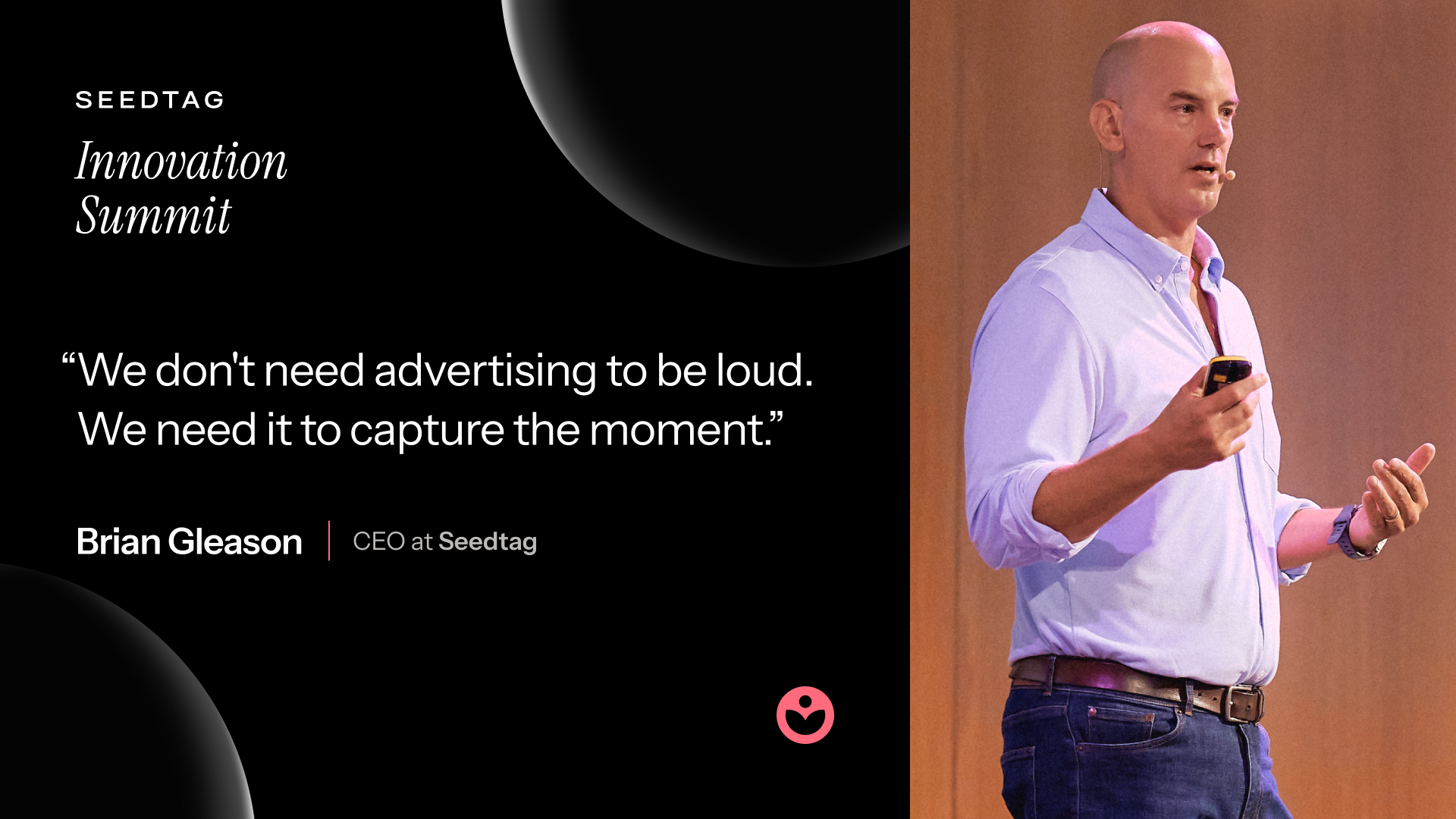
During the Summit, Brian Gleason, our CEO, added another layer: "We're more connected than we've ever been, but we're more distracted than we've ever been." For Brian, finding out how to connect in that moment is the most important thing, whether you're a brand, an agency, or a publisher.
The agenda combined dedicated sessions for the supply side and the demand side with joint sessions that put both in the same room. Topics ranged from the agentic shift and AI search to attention measurement, brand safety, CTV, creative, and life after the traffic. At lunches and dinners, the conversations kept going.
Across all of them, one thing became clear. The challenges facing the adtech ecosystem aren't local. They're global. And they become easier to solve when both sides look at them together.
Key Takeaways
- Consumers are more connected and more distracted than ever, and connecting with them in the moment matters for brands, agencies, and publishers alike.
- The same person makes different decisions in different situations, shaped by signals like time of day, screen, weather, and place.
- Fewer impressions carry identifiers, but audiences haven't gone anywhere, and reaching them requires a new structure.
- Interest, emotion, and intent shape how people process advertising, while viewability alone says nothing about that processing.
- Publishers, agencies, and brands face the same challenges from different perspectives, and the conversation is global, spanning the United States, Latin America, and Europe.
What Are the Biggest Challenges Facing the Digital Advertising Landscape?
Throughout the Summit, Brian Gleason put the consumer at the center of the conversation. For him, it's the one thing the industry doesn't focus on enough. We talk about acronyms, LLMs, and chats, but rarely about what consumers are doing every day or what their world is like.
And that world is full of noise. Attention is fleeting, and capturing it is hard. At the same time, clients are under pressure to grow and differentiate, and Brian raised an open question about what happens to them as products become commoditized in AI chat environments.
Grego Martínez, our Chief Product Officer, pointed to another challenge: media buying itself.
In CTV, most buying happens at the platform level, yet streaming services rarely have exclusive content. To illustrate the point, Grego shared a simple example: in Spain, Harry Potter is available on eight different platforms. So when a brand buys one of them, it's buying the service, not the moment. It learns nothing about the show being watched, the emotion it creates, or the hour and day it's being seen.
Buying through demand side platforms (DSPs) has a similar limitation. Brands and agencies can target IAB categories, keywords, domains, geography, or day part, but combining all of those signals to build moments manually is very complicated. The signals exist, but programmatic fragmentation keeps them apart.
Why the Adtech Ecosystem Is Moving From Understanding the Who to the Moment
For Grego, solving that fragmentation starts with a simple idea: the same person can make very different decisions depending on the situation they're in.
Picture someone commuting to work on a rainy Monday morning, phone in one hand, about to lose connection in five or six minutes. Any message has to be fast. Now picture the same person on a sunny Sunday morning, planning the week ahead with Monday off. They might spend 90 seconds on a powerful long video, one that takes them to the next step.
Nothing about them has changed. Only the moment has.
The same happens with a recipe. On a Tuesday evening after work, someone looking one up wants something fast. On a Saturday morning, with family and friends coming over, they're far more open to a message tied to that interest. The article is exactly the same. The moment is not.
That's why content is only one piece of context. The hour, the day of the week, and the season all matter. So do the type of screen someone is using, the weather, and the place they're in. On their own, these signals won't massively improve advertising. Combined, they create a scenario where advertising works much better.
Moments also change across environments. On mobile, things happen faster. On desktop, people are usually sitting down and paying more attention. CTV is often watched in a group rather than alone.
"We've spent more than 20 years understanding the who. Now, I think the future will be won by those who understand the moment much better," Grego said as he closed his session.
Audiences Were Never Identifiers
Hannes Sieling, our VP of Data & AI, started from programmatic advertising's long reliance on identifiers. They gave data teams structure, plus the reach to find people again. Today, fewer impressions carry them, but the reality hasn't changed. The same people are consuming the same content. And audiences were never identifiers in the first place.
What the industry needs is a new structure, built around the content people consume. That's the idea behind vector-based targeting: grouping similar content together so brands and agencies can find the environments closest to their goals, while balancing reach and precision.
Hannes also pointed to the technology that makes this possible: "Embedders are a little bit the hidden champions, the unsung heroes of the whole rise of large-language models."
The real question is what counts as similar. For him, the answer needs to go beyond clicks or categories and help find the right environment at the right moment. Understanding how people actually process what they see is a key part of that answer.
The Science Behind Attention, Emotion, and Intent
Professor Tino Meitz from the University of Münster explained how people process advertising. Who we are stays fairly stable, but how we feel and what we're focused on can change in milliseconds. When people consume media or advertising, that state of mind matters most.
That's also why viewability isn't enough. It shows that an ad could be seen, but says nothing about whether it was actually processed.
Three contextual signals shape that processing:
- Interest: If people aren't motivated to watch a show, they're unlikely to engage with the advertising within it.
- Emotion and affect: The brain relates new situations to past experiences, so a context that connects to familiar feelings makes new information easier to process.
- Intent: People need to be in the right situation for a message. If you want to buy a mid-sized SUV, you probably won't walk into a Ferrari dealership.
Tino was careful to separate affect from emotion: "Affect is something you can't govern. It's something that's happening, it's also, to a certain extent unconscious. Emotion is an evaluation of your affect afterwards."
How Can Supply and Demand Collaborate Across the Adtech Ecosystem?
Rob Beeler, who led the Two Sides, One Signal working session, explained why collaboration and supply and demand alignment matter. “Both sides are trying to solve the same things. This is a relationship-driven industry, and relationships are built by talking to each other in person. When both sides start working together, he said, they can be more effective for advertisers”, he said.
Kevin Donker, Head of Programmatic & Media Automation at Omnicom Media, brought that same spirit to the agentic conversation. For Kevin, agentic buying is still in its infancy, and the industry will have to come together to adopt protocols that make it reliable. When that happens, the productivity gains from AI should be reinvested in people.
In his view, the winners will be organizations that use AI to boost creativity, leadership, and judgment. The ones left behind will simply put an AI layer on top of an already fragmented workflow.
Brian Gleason echoed that idea in his closing remarks. He pointed to the feedback shared over the three days on different ways of working, ad inventory sources, and ways to measure. He also stressed the importance of trust: when you know you can trust someone, you know they'll do what they say they're going to do.
"There are a lot of pressures and challenges we think about in the world, and the things we shared over the last few days were brilliant. That's what we love to do: share information. It's an ecosystem that works together, and that's what we're trying to create", Brian Gleason.

How Does Neuro-Contextual Advertising Bridge the Gap Between Supply and Demand?
If both sides face the same challenge, they also need a shared way to understand the moment. That's what Neuro-Contextual Advertising offers.
Liz, our Neuro-Contextual AI, reads signals of interest, emotion, and intent to understand the moment behind each impression, without personal data or identifiers. For brands and agencies, that means reaching people when it matters most. For publishers, it means their content is valued for the moments it creates.
And it goes beyond advertising. Bringing value back to the open web helps keep quality content alive, and that's a responsibility the whole industry shares.
From Barcelona to the Next Conversation
Over three days, publishers, agencies, and brands from the United States, Latin America, and Europe approached the same questions from different perspectives. How do we capture attention? How do we reach audiences without identifiers? How do we make sure quality content keeps being found and valued as the way people discover information changes?
For us, at Seedtag, those conversations reinforce the vision behind Neuro-Contextual Advertising: understanding people's interest, emotion, and intent in the moment they're in.
It's not about knowing who. It's about understanding the moment.
Thank you to everyone who joined us in Barcelona. If you'd like to keep the conversation going, our team is here.
.png)
Notre blog

In the rapidly shifting landscape of digital advertising, one question is dominating every strategy conversation: What is contextual advertising and why is it central to the future of media?
Today’s advertising environment looks nothing like it did ten years ago. What was once a channel dominated by third-party cookies and behavioral data is now being reshaped by stricter privacy regulations, growing user awareness, and changing consumption habits. Advertisers are being asked to do more with less and to do it while respecting users' privacy expectations.
The answer lies in context. As traditional tracking tools phase out and reliance on personal data becomes increasingly problematic, brands and publishers need new ways to serve relevant, effective ads that drive results.
This is where contextual advertising comes in, and where our new Mastering Contextual Advertising Guide delivers the insights needed to navigate this new reality with confidence.
Understanding Contextual Advertising
At its core, contextual advertising is about delivering relevant ads based on the content a user is actively engaging with - not their personal data or browsing history.
It differs from behavioral advertising in a few key ways:
- Targeting method: While behavioral ads rely on tracking users across websites to build profiles, contextual ads are based on the actual content of the page being viewed.
- Privacy: Contextual advertising does not require cookies or invasive tracking. It's a privacy-first solution, built for a landscape where user consent and transparency are non-negotiables.
- Relevance: Because contextual ads match the environment they appear in, they tend to feel more organic, and drive stronger engagement.
- User experience: With no intrusive data collection or off-base assumptions, contextual ads offer a smoother, more user-centric experience.
And thanks to AI, contextual ads have become smarter than ever. With the ability to analyze not just keywords but entire articles, visuals, and video content, Contextual AI delivers human-like understanding at scale enabling advertisers to place messages that truly align with the moment.

Why Contextual Is Back
While contextual advertising isn’t new, its return marks a shift in priorities for advertisers.
In the early 2000s, contextual ads were widely used in search and display formats. But with the rise of behavioral tracking in the 2010s, they faded into the background. Now, with increasing regulation and consumer demand for data protection, contextual has not only returned but it’s evolved.
The latest generation of contextual tools:
- Analyze page content in real time using machine learning and semantic models.
- Place ads based on relevance rather than identity.
- Avoid the pitfalls of demographic and behavioral bias.
- Offer campaign performance without sacrificing user trust.
It’s this combination of relevance, scale, and privacy that makes contextual the most future-ready approach in digital advertising today.
The Benefits: What’s In For Advertisers
Relevance That Drives Results
Contextual ads meet users in the moment, serving messages that align with what they’re reading, watching, or listening to. Whether it's a cooking ad on a recipe site or a fitness brand on a health article, the match feels intuitive and delivers stronger click-through rates and conversions.
Higher Engagement, Lower Intrusion
Ads that reflect the user’s current interests are less likely to disrupt their experience. This means more attention, less ad fatigue, and a more positive perception of the brand.
Non-Biased Targeting
Because contextual advertising doesn’t rely on personal identifiers, it avoids the ethical concerns and stereotyping risks that can come with behavioral targeting. This results in more inclusive reach and a fairer experience for all users.
Privacy Compliance by Design
As privacy laws evolve, contextual targeting remains fully compliant, helping advertisers future-proof their strategies without compromising performance.

Powered by AI: The New Era of Contextual
Today’s contextual solutions go far beyond keyword matching. With Contextual AI, brands can understand and respond to page content in real time, factoring in everything from tone to visual elements.
This enhanced precision means:
- Better ad placements
- Higher relevancy scores
- Stronger ROI
Contextual AI also unlocks creative optimization that helps brands test, adapt, and personalize ad content depending on the page or platform it appears on.
And with formats like display, video, and even CTV now context-enabled, the reach and flexibility of contextual campaigns are wider than ever.
Ready To Launch Your Own Strategies? Start Here
In our new Mastering Contextual Advertising Guide, we cover everything you need to get started, scale up, or refine your contextual strategy.
What’s inside:
- A deeper look at how contextual advertising works
- 5 steps to developing a privacy-first, high-performance strategy
- Targeting methods explained: keywords, topics, categories
- Insights into AI-powered contextual tools
- Tips for designing creatives that resonate with the content around them
- Guidance on tracking the right KPIs to optimize for success
We also explore how contextual is expanding across channels from the open web to CTV, in-app environments, digital audio, and more.
Contextual advertising isn’t just an alternative, it’s the future. As digital privacy becomes non-negotiable, advertisers need strategies that can perform without personal data.
By aligning with content, not identities, contextual advertising builds relevance that users welcome and results that marketers can measure. And at Seedtag we have taken it to the next level with our new category, Neuro-Contextual advertising.
Want to master the strategy that’s reshaping the advertising landscape?
Download the Mastering Contextual Advertising Guide now and discover how to build smarter campaigns that resonate, perform, and respect privacy from the start.


The Pub Way Podcast returns with an in-depth look at CTV advertising, focusing on demand side platforms (DSPs). Hosted by Tina Iannacchino (VP of Publisher Partnerships North America at Seedtag) and Mike Villalobos (SVP of Strategy and Commercial Operations, North America at Seedtag), Episode 13 welcomes Keith Gooberman, CEO and Co-Founder of Pontiac Intelligence, to discuss how DSPs are adapting to evolving data policies and the new opportunities CTV brings for publishers. Here we bring you all you publishers need to know about how DSPs are changing connected TV buys, why privacy remains central, and what it all means for publisher revenue.
Why DSPs Matter: A Crash Course For Publishers
A demand side platform (DSP) is the digital interface that enables advertisers to purchase inventory across channels (desktop, mobile, and especially CTV advertising) in a unified manner.
Historically, DSPs relied on cookie-based data for granular targeting. Now, with privacy concerns reshaping online advertising, DSPs are turning to private marketplace (PMP) deals, prioritizing direct collaboration with content owners.
Publishers stand to benefit. PMP deals typically command higher CPMs and more transparent data-sharing. As Keith observes, tomorrow’s programmatic environment will feature deeper partnerships between DSPs and content owners, creating unique revenue streams for publishers who can provide distinctive inventory or advanced targeting signals.

Shifting From Cookies To Context
Global privacy regulations are forcing a move away from broad data collection. While Google’s cookie plans fluctuate, the overall direction remains privacy-first. In a CTV context, cookies are largely irrelevant, so targeting methods must evolve. DSPs are adapting by focusing on content signals, forging direct relationships with streaming services, and negotiating PMPs that bypass the open exchange.
This is good news for publishers: those who excel at packaging content and user engagement data without compromising confidentiality will be well-positioned. Although sharing log-level data can be sensitive, it often reassures advertisers that they’re buying premium inventory, encouraging greater spend.
CTV Advertising & Log-Level Data: Striking A Balance
Advertisers increasingly seek transparency. They want show-level insights (e.g., “Which program did my ad appear in?”) to confirm brand suitability and measure effectiveness. Yet publishers understandably guard their data, worried about undercutting direct deals or exposing proprietary information.
Keith explains that with a tailored DSP approach (built around PMPs) publishers can negotiate exactly what to share. This selective data release can elevate CPMs, especially when unique audience contexts or exclusive programming is on offer.
The key is clear communication: publishers who help advertisers understand the content environment can attract stronger campaign commitments.
The New Wave Of Contextual Targeting In CTV
Traditional contextual targeting (based on keywords or page categories) now faces its biggest test in CTV advertising, where video content dominates. AI tools can parse shows at a deeper level beyond mere categories, recognizing mood, dialogue, or plot themes. This refined approach offers advertisers a better sense of what’s on screen, ensuring relevant ad placements without relying on personal data.
For publishers, robust AI-driven context elevates value. If you can detail the emotional tone or specific segments of your videos, you stand out in a crowded market. DSPs want premium signals to differentiate one CTV channel from another, and sophisticated content analytics can deliver that competitive edge.

Evolving Identity Strategies
Despite Google’s shifting timeline on cookies, the days of unrestricted data collection are numbered. Many CTV environments rely on device or IP-based identifiers rather than cookies. DSPs address this by blending partial user details with broader contextual cues and PMP agreements. Publishers with strong first-party data or advanced audience insights can fill that gap, commanding higher prices if they maintain user trust.
Key Takeaways For Publishers
- Demand Side Platforms (DSPs) Are Central To CTV
Publishers should recognize that DSPs are the gateway to expanding CTV ad buys. By accommodating PMP deals, you can secure premium revenue while retaining more control. - Privacy Shifts Ad Buying Toward Context
As personal identifiers phase out, brand alignment rests on deeper content signals. Publishers who refine their program data and present it in user-friendly ways will see sustained interest. - Log-Level Data Requires Careful Sharing
Advertisers crave transparency. Selective data disclosures like show title, genre, location, can raise advertiser confidence. Clear boundaries protect publisher advantage. - AI Enhances Contextual Value
Automated tools can interpret video scenes and sentiment. Publishers who incorporate AI-based insights can stand apart and deliver more targeted inventory to advertisers. - Direct Communication Builds Better Deals
Flexible PMP relationships allow publishers to define how data is shared. DSPs often welcome these refined deals, provided they gain reliable insights into inventory quality.
DSP technology once revolved around open exchanges and third-party data; now it’s pivoting to direct deals, granular content analysis, and privacy-friendly user signals. Publishers who adapt to these market realities and offer a mix of audience clarity, brand safety, and strong contextual data are poised for long-term success.
Want the full story? Tune in to Episode 13, featuring Pontiac Intelligence’s Keith Gooberman, to hear firsthand how DSPs operate, where CTV advertising is headed, and how publishers can thrive in a shifting ecosystem.


Advertising has always aimed to connect brands with their audience, ideally in the right place and at the right time. Historically, digital advertising intelligence relied heavily on traditional methods such as keyword matching, URL targeting, or content categories. Yet, as consumer expectations and privacy regulations tighten, brands demand more nuanced solutions that understand not just what people consume, but how they think, feel and decide.
Enter neuro-contextual advertising, Seedtag’s new category that leverages neuroscience principles alongside advanced AI to interpret interest, emotion and intent in real time. This shift moves marketing from rigid, content-based triggers to a human-centric model that mirrors the brain’s information processing in order to deliver high-quality, privacy-first, full-funnel advertising across premium CTV, video and the open web.
Here, we explore how this new approach fundamentally transforms advertising strategies, shifting from simply reading pages to truly understanding people and what moves them.
Contextual Advertising: From Classification to Understanding
When programmatic advertising first emerged, contextual targeting offered a privacy-friendly way to reach audiences by matching ad placements to page-level topics. Early systems relied on static taxonomies, predefined categories such as “automotive” or “travel.” At its best, this method ensured ads appeared alongside relevant content, but it also introduced two key challenges:
- Surface-Level Relevance
Matching ads to pages based on keywords or tags alone often failed to capture nuance. A single article titled “The Future of Electric Cars” might garner targeted auto advertisers, yet within that page, a negative review of a specific model could mean the reader is unlikely to buy. Traditional contextual simply could not distinguish between promotional enthusiasm and critical analysis. - Upper-Funnel Focus
By design, keyword- or URL-based systems excel at generating awareness while driving clicks when audiences present broad interest. However, as marketers pushed for measurable conversions, the limitations became clear. Without insight into audience intent (the stage in the buying journey), media spend risked being wasted on readers who lacked the inclination to act.
In short, traditional contextual approaches were good at placing ads adjacent to relevant content, but less adept at understanding the underlying motivations and emotions driving user behavior.
Advances in artificial intelligence advertising as part of the AI revolution in advertising improved on basic keyword matching. Modern contextual AI platforms began employing natural language processing (NLP) and computer vision to parse page structure, sentiment, tone and images. This allowed systems to identify whether an article was positive, negative or neutral about a topic, and to understand whether images depicted aspirational lifestyles or technical specifications.
Still, these algorithms primarily focused on content recognition and classifying each page into thematic buckets such as “Luxury Vehicles” or “Fuel Efficiency.” While more accurate than earlier methods, the approach remained fundamentally aligned with “What is on this page?” rather than “What does this page say about the user’s mindset?” In other words, it still lacked a true understanding of interest, emotion and intention - the three pillars of human decision-making.

Introducing Neuro-Contextual Advertising
Neuro-contextual advertising represents a fundamental leap: it mirrors how the human brain processes information, creating a more cohesive model of audience engagement. Instead of surface-level content analysis, neuro-contextual integrates neuroscience insights into artificial intelligence advertising. By interpreting interest, intent, and emotion in real-time, Seedtag’s proprietary AI, Liz, mirrors human cognitive processes, enabling highly precise, responsive, and scalable ad delivery.
What sets neuro-contextual apart? It comprehends not just the "what," but also the "why" behind user behavior, delivering advertising that resonates on deeper, cognitive levels. This translates directly into improved outcomes at every funnel stage, making neuro-contextual an essential evolution for marketers who demand more from their ad spend.
Understanding Interest: Capturing Attention
From neuroscience, we know that human brains respond more favorably to familiar, context-congruent stimuli, processing them faster and more efficiently. Neuro-contextual technology leverages these insights to position advertising precisely within moments of heightened relevance.
For instance, when a user engages with content around sustainability, Liz immediately understands their genuine interest based on intention based targeting and AI intention models. Rather than serving generic environmental ads, neuro-contextual recognizes subtle patterns, such as emotional tone, narrative focus, and visual elements… to identify deeper resonance. As a result, the advertising aligns seamlessly with the user’s attention, driving significantly higher engagement.
Decoding Emotion: Enhancing Recall and Affinity
Emotions play a central role in decision-making processes. Neuro-contextual goes beyond traditional analytical approaches by actively interpreting emotional signals within digital content, from sentiment and imagery to narrative style.
Consider an advertising campaign for luxury travel. Traditional contextual might align this campaign with content containing keywords like "travel" or "vacation." Neuro-contextual, however, evaluates the emotional nuances, placing ads within content reflecting aspiration, relaxation, or indulgence - all emotions that directly align with the luxury traveler’s mindset. This refined alignment drives deeper emotional engagement, enhancing brand recall and affinity.
Identifying Intention: Driving Action
At its core, neuro-contextual advertising is designed to not only understand user intent but also act upon it dynamically. By analyzing deeper cognitive signals, Seedtag's Liz detects when a user's engagement indicates readiness to act.
Take the example of financial products: a user reading detailed comparative content about investment options indicates a much stronger intention than someone casually exploring financial news. Neuro-contextual recognizes this intent in real-time, adjusting campaign delivery to prioritize highly specific, action-driven messaging. This precise targeting of user intention significantly enhances conversion rates, optimizing ad spend for measurable outcomes.
Neuroscience Principles in Neuro-Contextual AI
Cognitive Fluency and Emotional Encoding
At the heart of neuro-contextual lies the principle of cognitive fluency: the ease with which our brains process familiar, context-congruent stimuli. When an advertisement appears alongside content that aligns with the user’s interests or emotional state, it is processed more readily and regarded more favorably. Neuroscientific research confirms that positive emotional context enhances memory encoding which makes users more likely to recall both the content and the brand message.
Seedtag applies this by identifying emotionally charged intersections, that is pages where audience interest and sentiment peak. In each case, neuro-contextual AI analyses audio sentiment, facial expressions, color palettes and even pacing to gauge emotional intensity. Ads served in these windows benefit from the emotional resonance, translating into higher attention, recall and eventual action.
Interest, Attention and Memory
Interest acts as the gateway to attention; without curiosity or relevance, information is ignored. Neuroscience shows that attention is a limited resource as stimuli must compete for cognitive prioritisation. By matching ads to content that already captures genuine interest, neuro-contextual AI ensures that brand messages earn that scarce attention.
Furthermore, episodic and semantic memory processes work in tandem when we engage with emotionally-charged, interest-driven content. By aligning ads to these rich, multi-layered experiences, Seedtag’s technology capitalises on both types of memory encoding and thus helping brands remain top-of-mind when users transition from exploration to decision-making.
The Role of Neuroscience for Full-Funnel Outcomes
Neuro-contextual advertising moves Seedtag decisively beyond traditional contextual limitations. While conventional contextual targeting excels in awareness, Seedtag’s neuro-contextual approach supports full-funnel marketing outcomes, from initial attention through mid-funnel interest and emotional resonance, down to lower-funnel conversions.
Neuro-contextual ensures advertising remains relevant across premium CTV, video, and open web environments, with advanced embedding technologies analyzing content and context across vast digital ecosystems. Instead of pre-defined segments, Seedtag’s neuro-contextual advertising dynamically creates custom, scalable audiences based on real-time cognitive signals. This cross-environment synergy ensures marketing efforts remain aligned with consumer states of mind - no matter where or how audiences consume content.

Real-Time Optimization: From Predictive to Agentic Intelligence
Central to Seedtag’s approach is the combination of advanced neuroscience insights with sophisticated AI algorithms. Unlike predictive analytics that merely forecast outcomes, neuro-contextual applies real-time cognitive intelligence, adjusting ad delivery dynamically.
Seedtag’s Liz Agent remains an enabler, transforming Liz’s deep insights into actionable campaign configurations via a conversational interface. The agent layer interprets natural-language prompts and retrieves relevant segments and automates bid adjustments across channels. The Liz Agent plays a crucial role in realising neuro-contextual intelligence in real time, blurring the line between strategy and execution.
This is transformative for marketing strategies. Campaigns leveraging neuro-contextual advertising no longer remain static post-launch. Instead, they evolve continuously, optimizing at unprecedented speed and precision. The result? High-quality engagements precisely attuned to real-time user interest, emotion, and intent.
Connecting the Dots: Neuroscience and Digital Advertising Intelligence
The adoption of neuroscience principles within digital advertising intelligence underscores a broader trend in marketing: a shift toward understanding the holistic human experience.
The advertising landscape has outgrown the label of “contextual targeting.” Seedtag's evolution from contextual to neuro-contextual represents a decisive shift for the advertising industry. No longer confined to simple classification or upper-funnel objectives, neuro-contextual technology introduces the sophisticated cognitive insights marketers have long needed.
In an advertising ecosystem challenged by consumer privacy, evolving regulations, and increasing demand for meaningful engagement, neuro-contextual advertising presents not merely an upgrade but a necessary evolution. It reshapes digital advertising intelligence, moving from mere keyword recognition to real-time understanding of how audiences think, engage, and make decisions.
This groundbreaking approach signifies more than technological advancement as it signals a fundamental redefinition of advertising itself at every stage of the funnel.
Win Your Audience: Tap into Interests, Emotions and Intentions
Learn more about Seedtag's neuro-contextual advertising and explore how your brand can leverage cutting-edge neuroscience and artificial intelligence to deliver superior marketing outcomes.

At this year’s Cannes Lions International Festival of Creativity, amid sun-soaked terraces and industry-wide discussions about the future of advertising, one theme overtook all conversations at the Croisette: redefining relevance through deeper user understanding. For Seedtag, Cannes 2025 marked the opportunity to return to the French Riviera and bring forward the future of artificial intelligence for marketing: neuro-contextual advertising.
Built on the idea that context is no longer enough, neuro-contextual advertising moves beyond static classifications and towards cognitive intelligence - interpreting real-time signals of interest, emotion, and intent to connect with people in more meaningful, privacy-first ways.
Defining the New Era Through Emotion, Intention, and Intelligence
Seedtag recently unveiled its new positioning by championing a model that resonates far beyond keywords or audiences. Focusing on more than just data, but on better understanding on how people feel, why they care, and what drives their decisions in the moment.
From the stage to the shoreline, our team helped define this new era of contextual advertising - one powered by neuroscience principles and made scalable by Agentic AI. Seedtag’s neuro-contextual intelligence connects not only content and creativity, but also emotion and cognition, bringing brands closer to the real drivers of consumer behavior.
In a marketplace seeking relevance without compromise, Seedtag’s approach stands as one built for privacy, designed for outcomes and powered by understanding.
A Crossover to Tune Into: AdTech Heroes x The Pub Way
One of the highlights of the week was the special crossover episode of our two flagship podcasts: AdTech Heroes x The Pub Way – Winning Audiences in a New Era of Engagement. Hosted live at The Drum’s podcast studio, the session brought together voices from across the ecosystem to answer a timely question: how can brands and publishers use real-time context and AI to engage audiences more effectively, while prioritizing passions over profiles, and meaning over assumption?
Moderated by Seedtag’s Tina Iannacchino and Marko Johns, the conversation featured Jamie Dunlop, Managing Partner at MediaPlus UK, and Tony Gemma, VP Global Head of Creative at Yahoo. Together, they unpacked the shifts in strategy required to meet audiences where they are, not demographically but behaviorally and emotionally.
Jamie unpacked how MediaPlus moved beyond demographic targeting to focus on real human behavior, arguing that knowing how people think and feel is more important than knowing who they are. “Demographics treat Prince Charles and Ozzy Osbourne as the same person,” he said. “They’re not.”
Tony, from Yahoo, made the case that the creative side of programmatic has long been neglected. “Programmatic forgot to bring its creative friend along,” he noted. The group agreed that while media and data have advanced, creativity often lags behind. The takeaway? Brands that succeed are the ones reuniting data, creative, and context while treating creative as a measurable driver of outcomes, not just a finishing touch.
From personalization at scale to creativity that aligns with intent, the conversation reflected an industry yearning for a system that doesn’t just automate targeting but understands people and delivers campaigns that connect.

Elevating Brands with Purposeful Technology
AI was examined with depth, especially in terms of its role in shaping more intelligent, ethical advertising. As Mike Villalobos, SVP of Strategy North America, noted during the AI in Action panel hosted by Sigma Software, AWS, and Ipsos:
“AI isn't a feature, but rather a core part of our foundation to accelerate and sustain our growth.”
That sentiment was echoed across the festival. The conversation has clearly shifted from curiosity around AI to a firm expectation that it delivers measurable value. The bar is no longer automation. Neuro-contextual delivers on that expectation by integrating neuroscience insights with real-time emotional understanding. It’s not just about being faster. It’s about being smarter and enabling marketers to activate campaigns that align with how people actually feel and think, in the moment.
This theme of thoughtful progress was also front and center in Cannes Truth Be Told, a panel exploring the monetization of journalism hosted by Unplugged Collective and Beeler.Tech. Representing Seedtag, Tina Iannacchino, VP of Publisher Partnerships North America, addressed the challenge of balancing brand safety with media responsibility.
“In today’s ad tech ecosystem, quality journalism is often caught in the crossfire of rigid brand safety measures.”
Keyword blocklists, while designed to protect brands, frequently end up demonetizing essential reporting on politics, conflict, or climate. That creates a disconnect where high-value editorial content is excluded from media plans, while sensational or low-quality content remains monetized.
Advertisers must move beyond blanket controls and toward more intelligent, context-aware solutions. Only then can we ensure brand safety without undermining trusted journalism.
And in a forward-looking conversation hosted by VaynerX, Seedtag’s Global Chief Revenue Officer Brian Danzis, joined executives from VaynerMedia and Digiday’s Editor-in-Chief Jim Cooper, to explore how AI is reshaping the media ecosystem. The panel challenged the industry to cut through the noise and focus on real use cases that are actively changing how content is created, distributed, and monetized.
The group discussed how AI is helping companies rethink how they reach audiences, make decisions, and define success. One example shared during the session was United Airlines’ recent campaign with Seedtag. By combining contextual AI with high-impact formats, the campaign reached premium audiences in brand-safe environments, without relying on personal data. The result? A measurable boost in attention and engagement, proving that relevance and performance can go hand in hand in a privacy-first world.
As Brian highlighted:
“Relevance drives cognition, interest, emotion and intent. That is what neuro-contextual means, and it is leading us into the new era of advertising.”
Together, these conversations reflected a broader shift at Cannes Lions this year: toward solutions that not only perform, but reflect the values and complexity of the audiences they aim to serve.

Seedtag in the Spotlight: A Full Week of Industry Impact
From private roundtables on brand safety and media integrity, to our collaboration with HUMAN for the “Collective Apéro,” Seedtag showed up to Cannes ready to share how brands, agencies and publishers worldwide can embrace the new era of digital advertising.
Whether joining VaynerMedia on stage for a sunset conversation on AI’s future in media, or exploring how to balance personalization with accountability on Île Sainte-Marguerite, our team helped shape the conversations that will guide the next wave of marketing strategy.
While the industry has long relied on contextual targeting for privacy-first reach, Seedtag’s conversations at Cannes showed how far we’ve come. Today’s marketers are looking for relevance that adapts, moment by moment, to the emotional and cognitive state of the consumer.
Seedtag’s neuro-contextual system is built to do just that. Through dynamic semantic embeddings and continuous network-level analysis, our proprietary AI Liz delivers scalable understanding of what moves people. Whether in a premium CTV environment or across the open web, campaigns adapt in real time to changing intent, interest, and emotional tone.
It’s strategic evolution - meeting the moment when creativity, audience mindset, and media come together.
From launching our latest Contextual TV capabilities to showcasing our AI Intention Models and real-time contextual insights platform, Seedtag’s presence reflected our ambition: to make advertising work better by understanding more deeply.
Engagement, Intelligence, and the Industry We Want
As Cannes Lions 2025 came to a close, one thing was clear: the most effective campaigns are no longer the ones that shout the loudest, but the ones that understand the audience most deeply.
If AI was the buzzword of the week, emotional relevance was the quiet headline underneath. And neuro-contextual advertising is where those two forces meet: scalable intelligence grounded in how people actually think, feel, and decide.

It is a well-known truth that summer always brings with it a certain expectation. Longer days, lighter routines, and moments we try to make last just a little longer. But for advertisers, the season is more than a backdrop. It's a dynamic series of moments where context makes the difference in your summer campaign hits.
From road trips to national holidays, sports dominating all conversations, and to back-to-school planning, consumers engage with summer in ways that are both emotional and practical. The question for brands is no longer “What should we say this summer?” but “What are people already thinking about… and how can we show up meaningfully in those moments?”
This post explores the summer marketing ideas that emerge when brands listen more closely to seasonal behaviors, and how Seedtag’s neuro-contextual technology helps decode not just the what, but the why behind each interaction.
What Summer Trends Should Advertisers Watch to Craft Impactful and Timely Summer Marketing Ideas?
One of the most striking findings from Seedtag’s analysis of more than 2,400 summer-related topics is just how many dimensions the season contains. What appears on the surface to be a linear journey from Memorial Day to Labor Day is actually a layered narrative of shifting priorities, emotions, and buying signals.
Memorial Day: A Moment of Remembrance, Gathering, and Everyday Traditions
For many, Memorial Day marks the beginning of summer. But beyond the grill and three-day weekend, it’s also a deeply personal and reflective holiday.
Seedtag’s insights show consumers gravitate toward content centered around honoring veterans, visiting national landmarks, and engaging in symbolic activities that carry emotional weight. At the same time, there’s a distinct uptick in planning for seasonal cookouts and outdoor events buffalo chicken, caprese salads, and summer drinks top search patterns.
Campaigns that recognize both the reverence and everyday togetherness of this holiday are far more likely to resonate. For automotive brands, it’s an opportunity to speak to travel and mobility. For CPG and food retailers, it’s a chance to help families set the table, literally and figuratively.
Juneteenth: A Growing Space for Culture, Community, and Creativity
As Juneteenth grows in visibility, so too does the way consumers engage with it. People are looking not only to learn but to celebrate through music, food, history, and shared identity.
From Beyoncé and Kendrick Lamar to heritage travel and soul food recipes, interest around this holiday cuts across multiple categories. The content reflects pride, creativity, and exploration whether it's through music playlists, recipes, or tributes to trailblazing Black figures in history.
For advertisers, Juneteenth is a moment to show up with intention and cultural clarity. It’s not about running “holiday creative.” It’s about aligning with stories already being told and doing so in a way that feels both timely and considered.
Road Trips: The Great American Reset
There may be nothing more quintessentially summer than packing up the car and heading somewhere (let’s be honest, just anywhere) with the windows down and snacks within reach. According to Seedtag’s analysis, road trips remain the season’s single largest area of consumer interest.
Topics range from dream destinations like Yosemite and Big Sur to checklists about rental car options, tire safety, and navigation apps. But beneath that lies something deeper: a collective craving for freedom, spontaneity, and being in control of the journey.
This is fertile ground for automotive, travel, tech, and lifestyle brands. The best campaigns aren’t about the destination but how you get there. And Liz can help pinpoint exactly when, where, and how those intentions emerge across the open web.

Independence Day: A Celebration of Taste, Color, and Connection
Independence Day content shows clear engagement with themes like creative desserts, themed decorations, and festive drinks. It’s a holiday where the visual and sensory elements come to life and where shareability soars.
This is also one of the few summer moments where user-generated content naturally thrives. Recipes, party setups, backyard tables, and homemade cocktails become canvases for expression.
Brands that find smart, light-touch ways to invite participation (think branded ingredients, color-themed collections, or interactive social challenges) can tap into both emotional connection and cultural momentum.
Labor Day: Where Endings Create Urgency
Labor Day signals more than a long weekend. It’s the point in the summer when consumers begin shifting mentally toward what comes next from fall wardrobes to routines and school schedules.
Content patterns reflect this duality: on one hand, people are still looking for summer meal inspiration and weekend getaways. On the other, searches spike for productivity tips, sales events, and seasonal transitions.
Retailers that time their campaigns to this emotional pivot, and build urgency around it, can outperform the typical “seasonal clearance” approach. Think of messaging that acknowledges the shift, while offering a final invitation to enjoy what’s left.
Back to School: One of the Year’s Most Predictable (and Personal) Journeys
If Labor Day is the pivot point, then Back to School is the plunge. Engagement here is widespread and diverse, ranging from parents planning for first grade to students decorating dorm rooms.
Seedtag’s insights show four clear categories: school supplies, crafts and projects, educational content, and college prep. It’s one of the few times of year when content is not only seasonally relevant but emotionally sticky.
Brands that show up with empathy, solutions, and timing aligned to regional school calendars can gain meaningful traction, especially if they understand when those searches begin and how they evolve from mid-July through early September.

How Can Brands Develop Summer Marketing Ideas That Are Directly Inspired by Emerging Summer Trends?
There’s no shortage of summer campaign ideas. The real challenge is making sure those ideas land in the right moment, in the right environment, with the right message. That’s where contextual intelligence becomes the creative starting point, not just the targeting layer.
Here’s how brands can begin to shift their thinking:
Start with Moments, Not Months
Instead of framing campaigns around quarterly plans or static timelines, start with behavior. Memorial Day cookout planning doesn’t start on May 25 but actually starts in early May. College dorm checklists trend long before move-in week.
Seedtag’s neuro-contextual AI, Liz, reads these shifts as they happen. That means brands can build campaigns around actual audience intention, not calendar assumptions.
Use Content as a Creative Brief
If people are engaging with themed drink recipes, start from the content itself. What emotion does it evoke? What intention does it reflect?
Contextual creative can reflect the same tone and cues consumers are already responding to. Liz helps uncover not only what topics are spiking, but how people are reacting to them, whether that’s with curiosity, nostalgia, or inspiration.
Think Across Categories
Summer marketing ideas don’t need to stay in one lane. A road trip kit can feature snacks, car care, and sunglasses. A dorm prep campaign can pair storage solutions with coffee makers and motivational posters.
Liz doesn’t just see individual topics but she maps how they overlap across real-life behavior. Brands that embrace this interconnectedness can create richer, more layered messaging.
Plan for Participation
Summer is social, and not just on social media. It’s a season of shared experiences, with recipes swapped, playlists created, photos taken and plans made throughout the season.
Brands that make it easy for people to participate, be it through branded content, contests, or creator partnerships - all can tap into the momentum of the moment without needing to dominate it.

From Context to Connection: The Role of Neuro-Contextual Intelligence
What enables all of this is not just technology but actually truly understanding the content and what it conveys. Seedtag’s neuro-contextual AI, Liz, doesn’t simply classify articles or surface keywords. It interprets the full spectrum of user attention by combining neuroscience principles with advanced contextual signals.
Rather than relying on identity or outdated segments, Liz reads each moment of engagement in order to decode not just the topic, but the intent, emotion, and mindset behind it. This means advertisers can show up in the right frame of mind, not just on the right page.
While contextual targeting has often been viewed as a top-funnel solution, Liz delivers across the funnel - matching brand messaging with awareness, consideration, and even purchase signals as they emerge in real time.
In a summer marketing landscape that’s becoming more fluid, more expressive, and more diverse, this kind of intelligence isn’t optional. It’s what enables brands to scale relevance without sacrificing nuance.
Final Thoughts: Embrace Summer Stories
The real shift for marketers in 2025 is recognizing that summer isn’t a campaign but a conversation. One that evolves from celebration to reflection to transition. One where road trips and recipes, milestones and markdowns, all coexist.
Seedtag’s contextual insights help map this journey not just by what’s trending, but by how people are feeling and what they’re planning for next. And with Liz’s neuro-contextual intelligence at the center, advertisers can respond in the most human way possible, with empathy, relevance, and intention.
Want to learn more about how Seedtag can help shape your summer campaigns?
Discover the full picture and all of our curated contextual insights here.

Bringing elements of traditional TV to programmatic media buying and selling, ad pods bridge the gap between disparate viewing environments and help to deliver optimal ad experiences for CTV viewers.
The migration of advertising budgets from linear TV to connected TV (CTV) is closely following increases in ad-supported streaming. According to eMarketer, CTV advertising is forecasted to reach over $35 billion in spending in the U.S. by 2025. In the midst of this significant growth, media buyers and sellers alike are seeking to enhance the way in which CTV ads are bought and sold. And thus, a TV-centric concept – ad pods – has remerged to the forefront of industry conversation.
If you aren’t familiar with their history, ad pods were first formally introduced to the digital advertising ecosystem in 2012 via the IAB Tech Lab’s VAST 3.0 specification. At this time, streaming services were still nascent and lacked the capabilities needed to manage key considerations such as competitive separation, ad duplication, and frequency.
With the CTV ad market growing considerably within the last decade, and more recently within the last two years, the industry has become more focused on driving efficiency and delivering pristine viewer ad experiences in CTV. To support this endeavor, the IAB Tech Lab earlier this year released OpenRTB 2.6, a transaction protocol that includes features to support CTV buying and selling, including – you guessed it – new attributes and guides for ad pods.
As the sell-side ad server built for Convergent TV, we often receive questions about ad pods, how they can be best deployed, and the advantages they offer. Below, we’ve answered some of the most common questions we receive, to provide insight on how the adoption of the IAB Tech Lab’s oRTB 2.6 technical specification can help CTV publishers, advertisers, and viewers alike.
What are ad pods?
Ad pods are a sequenced group of ads that play back-to-back within an ad break, most often in CTV and streaming environments. Using ad pods, programmers and publishers can receive multiple contiguous ads from a single ad request. Scheduled in pre-, mid-, and post-roll environments, ad pods resemble the type of commercial break you’d see in traditional TV, or hear within a radio structure.
Related to ad pods, pod bidding signals are an important feature of the oRTB 2.6 spec that allow key information about the pod and its impression opportunities to be shared among media buyers and sellers. This, for example, includes the sequence of ad impressions, total pod length, maximum number of ads within the pod, and more.
What are the different types of ad pods?
The OpenRTB 2.6 spec outlines three main types of ad pods for CTV environments – structured, dynamic, and hybrid.
Within a structured ad pod, the media seller fully defines the number of ad slots, position in the pod, and respective duration. This gives the publisher full control over every aspect of the pod, but it is largely manual and can be somewhat time-consuming to construct.
Dynamic ad pods, by comparison, are more flexible. While the total duration and maximum number of ads are constrained within a dynamic ad pod, the number of ads and duration of each are indeterminate. This offers publishers more flexibility and efficiency in optimizing their selection of ads in order to fill a pod.
A hybrid ad pod is exactly what it sounds like, combining elements of both structured and dynamic pods. Hybrid ad pods are composed of slots with predetermined durations, along with undefined numbers and durations of individual ads.
What benefits do ad pods provide to media buyers and sellers?
Ad pods afford both publishers and advertisers more strategic and transparent ways of transacting in CTV.
For media sellers, ad pods and pod bidding signals allows for more strategic monetization, including the ability to:
- Optimize inventory yield based on metrics like CPM per second.
- Reduce latency in CTV auctions.
- Provision slot-based targeting and pricing.
- Uphold key brand rules including competitive separation.
- Deliver premium viewer ad experiences by accounting for ad duplication and frequency.
Conversely, for media buyers, ad pods can unlock opportunities to:
- Increase win rates.
- Reduce infrastructure costs and trading volume.
- Execute key business rules, including competitive separation.
- Provision strategic buying opportunities to advertisers, including purchasing of specific slots.
Above all else, what's most important is that ad pods can enable more pristine ad experiences in CTV, which benefits publishers, advertisers, and viewers alike.
Why are ad pods so important in Convergent TV advertising?
As traditional and connected TV converge, ad pods – when paired with necessary ad serving technology – play an essential role in bridging the gap between disparate viewing environments. In addition to the benefits previously mentioned, ad pods and pod bidding signals make the real-time buying and selling of CTV media more akin to traditional TV, via support for key tenets like competitive separation and slot-based pricing.
What’s more, ad pods help to deliver pristine ad experiences to CTV viewers. The challenges and shortcomings of CTV advertising have been well-documented in recent years – from blank slates to timeouts to frequency issues – and the implementation of ad pods with powerful ad serving technology will help to solve for these issues.
If you’re increasingly operating in CTV, or looking to gain an edge, adoption of and support for ad pods, including via the oRTB 2.6 spec, is a must. To learn more about ad pods and how they enable a more efficient, viewer-friendly, and profitable way to buy and sell CTV media, reach out to us here:

The UK automotive market has never been more complex. Stricter privacy regulations, economic headwinds and the surge of electric-vehicle challengers have rewritten the rules for automotive brands. Today’s car buyers move seamlessly between devices and researching family SUVs during morning coffee, comparing EV range at lunch, then exploring finance deals after work. To win their business, brands and agencies must understand not just who is in the market but why, when and how their intentions evolve.
Seedtag’s contextual AI platform Liz has analysed over 10,000 automotive-related articles and webpages to decode the audiences driving new cars home. In this post, we share the strategic insights that will help UK automotive marketers reach each segment precisely capturing fleeting purchase moments in a privacy-first environment.
Who’s Buying: A Deeper Dive into UK Car-Buyer Segments?
Moving beyond broad demographics, our research identifies five high-value audience cohorts, each defined by motivations, content habits and media touchpoints. Understanding these profiles enables brands to tailor creative, media and messaging for maximum relevance and efficiency.
1. First-Time Buyers: Cautious Digital Natives
Profile
- Age: 24–35, early career or young families.
- Priorities: Affordability, reliability, ease of ownership.
- Values: Financial prudence, wellness and work-life balance.
Media Habits
- Start with “best first car” articles, obsess over budget calculators
- Compare user forums and video reviews of entry-level models
- Search “PCP vs. hire purchase” and “insurance cost by age”
2. Young Urbans: Trendsetters on the Move
Profile
- Age: 25–40, professionals in metropolitan areas.
- Priorities: Sustainability, connectivity, compact-city practicality.
- Values: Social currency, experience-driven purchases.
Media Habits
- Read urban-mobility think-pieces; watch “EV for city living” video explainers.
- Scroll social feeds for trending EV scooter or compact car content.
- Engage with lifestyle influencers showcasing tech-integrated dashboards.
3. Family Upgraders: Space, Safety and Stability
Profile
- Age: 35–50, growing families upgrading from compact cars.
- Priorities: Interior room, safety tech, running costs.
- Values: Reliability, long-term value, lifestyle consistency.
Media Habits
- Binge-read “top seven-seater SUVs” and “best electric family car” comparisons.
- Click through to “family car maintenance” and “insurance discounts for minivans”.
- Watch sponsored test drives by family vloggers.
4. Luxury Seekers: Prestige and Performance
Profile
- Age: 40+, affluent professionals and executives.
- Priorities: Brand heritage, driving experience, exclusivity.
- Values: Craftsmanship, bespoke options, peer recognition.
Media Habits
- Digest in-depth features on Nürburgring lap times, bespoke customisation options.
- Follow automotive journalists and fine-living platforms.
- Engage with virtual reality showrooms and high-res imagery.
5. Technophiles: Innovators Embracing Tomorrow
Profile
- Age: 25–45, tech industry professionals and early adopters.
- Priorities: Autonomous features, AI-driven safety, seamless connectivity.
- Values: Cutting-edge innovation, data-driven performance.
Media Habits
- Read “Tesla software updates” and “AI co-pilot reviews”.
- Watch footage of self-parking demos and LIDAR tests.
- Participate in online forums about OTA updates and app integrations.

Aligning Media to Moment: Seizing Intent-Driven Windows
Effective automotive advertising hinges on matching each audience’s mindset with the right content at the right stage of their journey. Whether you’re speaking to cautious First-Time Buyers or tech-obsessed Technophiles, recognising the moments that trigger purchase intent (and embedding your message in those contexts) is critical.
At the Awareness & Discovery stage, consumers encounter broad research queries and inspirational editorial. First-Time Buyers often begin by searching “best starter cars under £10 000,” while Young Urbans look for “EVs for city commuting.” Family Upgraders binge on “top seven-seater SUVs” lists, Luxury Seekers digest “luxury performance SUV design trends,” and Technophiles stream “latest autonomous driving demos.” To capture attention here, brands should place high-impact, value-driven creative such as eco-credentials or design innovations, in think-pieces and first-look videos that these segments naturally explore.
As buyers move to the Consideration & Interest phase, their queries become more focused on direct comparison and evaluation. First-Time Buyers compare PCP versus hire-purchase finance guides, Young Urbans review charging-app comparisons, and Family Upgraders read seven-seat crash-test results. Luxury Seekers investigate bespoke trim options, and Technophiles delve into technical whitepapers on AI safety systems. Serving calculators, detailed spec sheets, and interactive configurators alongside these articles helps nudge evaluators toward enquiry, bridging the gap between page view and test-drive booking.
In the Conversion & Action stage, transactional signals dominate. First-Time Buyers click “book first-time test drive” buttons, Young Urbans reserve subscription services, and Family Upgraders schedule showroom visits. Luxury Seekers RSVP to VIP launch events, while Technophiles sign up for beta tests of self-parking features. By detecting surges in content that indicates these final steps (dealer locators, “click to reserve” features or exclusive invites) brands can deploy geo-targeted offers, rapid-response chat prompts and dynamic call-to-action banners that turn interest into action. Seasonality further sharpens these windows: EV interest peaks in Q1 and Q4 around tax deadlines and New-Year resolutions, while SUV and hybrid demand stays robust year-round. Sports and off-road vehicle searches climb ahead of summer, underscoring the value of real-time bid adjustments whenever intent signals spike.
Three New Rules for Privacy-First Automotive Advertising
Context, Not Cookies
With third-party cookies crumbling, contextual signals are the new currency. Liz analyses page text, imagery and metadata without user data, to infer purchase intent in real time. This respects ICO guidelines while pinpointing engaged audiences.
Intent-Weighted Bidding
Allocate higher CPMs to content with strong transactional cues (e.g., finance breakdowns, dealer locators) and lower bids on general news or lifestyle reads. Intent scoring automates this process, ensuring spend follows real demand.
Agile Campaign Activation
Automotive trends shift with model launches, fiscal events and seasonality. Liz’s continuous intent recalculation enables brands to adapt budgets within hours of content consumption spikes rather than waiting weeks for manual reports.

A Roadmap for Brands and Agencies
- Deep-Dive into Audience Profiles
Use Seedtag’s segment definitions to audit current campaigns. Are you reaching Family Upgraders on finance comparison pages? Are Young Urbans seeing your ads during city-mobility reviews? - Tailor Creative to Context
Develop distinct creative sets for each segment: pragmatic messaging for First-Time Buyers, aspirational aesthetics for Luxury Seekers and tech demos for Technophiles. - Secure Premium Contextual Inventory
Partner via private marketplaces to place ads on specialist blogs, enthusiast forums and lifestyle verticals that ensure brand-safe, high-intent environments. - Automate Bid Adjustments
Configure your DSP to ingest Liz’s intent scores, automatically raising bids on high-value pages and suppressing low-relevance inventory. - Measure Full-Funnel Impact
Track downstream engagement metrics such as enquiry submissions, test-drive bookings, dealer visits…to validate that contextual campaigns drive real-world sales.
The Road Ahead: From Reach to Relevance
The UK automotive sector will see increased competition as EV incumbents, startup disruptors and subscription models accelerate. Consumer values, from sustainability to seamless digital experiences, will continue evolving. In this landscape, automotive advertising that focuses on when and why audiences act rather than who they are will outperform legacy approaches centred on broad demographics.
Contextual AI, anchored by real-time intent analysis, empowers brands to:
- Pivot Quickly in response to seasonal spikes and new model launches.
- Speak Directly to each segment’s core motivations, boosting relevance.
- Respect Privacy while maintaining precision in media targeting.
By adopting these strategies, UK automotive brands can shift from mass reach to micro-moments that steer budgets toward the content that truly drives consumer decisions and delivers measurable growth in an increasingly privacy-first world.
Discover the Full Contextual Insights Report
For a comprehensive breakdown of segments, seasonal intent curves and competitive benchmarks, download Seedtag’s Q2 2025 Automotive Contextual Insights: Access the report here.
When you understand who your buyers are, why they choose your brand, and when they’re ready to act, every impression moves them closer to the driver’s seat.

In a rapidly shifting digital landscape, publishers face mounting pressure to boost revenue while preserving audience trust. In Episode 16 of The Pub Way podcast, hosts Tina Iannacchino (Seedtag’s VP Publisher Partnerships, North America) and Mike Villalobos (Seedtag’s SVP Stratey & Success) sit down with Dan Benyamin, founder and CEO of Aeon, to explore AI in publishing - from adtech hurdles to creator collaborations, emerging AI influencers, and practical strategies for AI monetization. Below, we unpack the episode’s key moments, demonstrating how publishers can harness AI responsibly, keep the human touch, and unlock new revenue streams.
From Hardware to Headlines: Dan’s Journey
Dan Benyamin is no stranger to disruption. Over a career spanning chip design, social-media platforms, and data products at Condé Nast, he has seen technologies reshape audiences and ad models. At Aeon, his fourth startup, Dan is charting the next wave: helping media owners use AI to automate video production, personalize experiences, and optimize yield.
His adtech origin story selling the first Facebook beta ads by email underscores one constant truth: publishers succeed when they remain user-centric.
Facing Adtech’s Growing Complexity
The User as North Star
Dan recalls the early days of Facebook advertising with no targeting, no placements, just a postage-stamp ad sold for a day. Fast forward, and the adtech stack has ballooned: multiple platforms, countless measurement standards, opaque programmatic flows. Yet publishers often fall into two traps:
- Tech First: Investing heavily in bespoke data platforms and complicated pipelines, losing sight of editorial quality and brand loyalty.
- Platform Dependence: Relying on Google or a handful of ad networks for revenue, ceding control over user relationships.
Dan’s prescription is straightforward: prioritize your readers above all else. Every algorithm tweak, dashboard rollout, or content experiment should answer one question: does this create a better experience for our audience? If not, it risks becoming an expensive dead end.
The Value of Agility
Publishers that treat adtech as an ever-evolving toolkit, rather than a monolithic fortress, will outpace their peers. Dan highlights how rapidly user behaviors can pivot, whether due to a new video format on TikTok or shifting reading habits during major news events. By pairing AI for publishers with nimble workflows, media owners can test new formats, measure engagement in real time, and iterate before budgets are wasted.

Bridging Traditional Publishing and the Creator Economy
A Two-Front Battle
Publishers today are squeezed from both sides. On one hand, the major social platforms (Facebook, Instagram, TikTok) consolidate huge swaths of attention. On the other, a flourishing creator economy has turned individuals into media companies: micro-brands that build dedicated audiences on YouTube, Twitch, or Substack, often with minimal overhead.
Dan warns that consistent collaboration between legacy publishers and independent creators remains uneven. While a handful of partnerships, such as Vogue enlisting YouTube stars for the Met Gala, capture headlines, most publishers have yet to forge sustainable models to co-create content, share revenue, and cross-promote audiences.
Turning Creators into Partners
Yet the potential is immense. Traditional media houses boast seasoned editors, photographers, and brand equity. Creators bring agility, authenticity, and built-in fanbases. Smart alliances can combine those strengths:
- Content Repurposing: Use AI-powered video engines to transform written features or photo essays into engaging short-form clips.
- Co-Branded Sponsorships: Bundle creator channels with publisher sites for advertisers seeking both scale and niche community buy-in.
- Revenue-Share Models: Offer creators a slice of subscription or ad revenue in exchange for exclusive or early-access content.
By leveraging AI for content creation, from automated editing to dynamic personalization, publishers can scale these partnerships without ballooning production costs.
The Rise of AI Influencers and the Case for Transparency
When Bots Become Brand
Dan describes the phenomenon of AI influencers: digital personas designed to engage audiences on social platforms, often without any real human behind the account. Early adopters, such as fashion houses casting AI models, demonstrate AI’s capacity for high-volume, on-brand content. Yet the technology also raises red flags around authenticity, trust, and intellectual property.
Publishers must decide how far to embrace synthetic personalities. Dan suggests two guiding principles:
- Be Transparent: Clearly label AI-generated content or personas. Readers value honesty; misleading them risks reputational damage.
- Focus on Value: If an AI persona informs, entertains, or inspires better than a standard post (without pretending to be human) then it has earned its place. The goal is to enhance, not replace, genuine human connection.
Regulation on the Horizon
As AI content proliferates, regulators and platform owners are racing to define standards. Dan points to spam filters as an early example of automation policing automation: publishers that watermark AI-crafted imagery or sign API agreements with chatbot providers can ensure their content remains discoverable and compliant. Publishers that proactively engage with emerging policies will avoid last-minute compliance headaches.

AI as a Force Multiplier for Monetization
Beyond “Build vs. Buy”
Publishers often wrestle with whether to build in-house AI solutions or license third-party tools. While engineering teams may relish crafting bespoke pipelines, Dan cautions that such projects can distract from core editorial missions. Instead, he recommends:
- Evaluate ROI: Will a custom model truly outperform a commercial offering?
- Partner with Specialists: Use AI for publishers platforms that integrate seamlessly with existing CMS and ad stacks.
- Modular Adoption: Begin with high-impact use cases (automated video summaries, headline generators, or ad yield forecasting) before extending capabilities.
Five Low-Hanging Fruits for AI-Driven Revenue
- Automated Content Tagging & Personalization
Natural language processing can instantly categorize articles by topic, sentiment, and reader intent, fueling on-site personalization and boosting subscription conversions. - Video Production at Scale
Leverage AI video editors to turn long-form interviews or articles into short social teasers, generating new ad inventory and ancillary sponsorship opportunities. - Dynamic Ad Creative
Implement responsive banners or video ads that adapt messaging, call-to-action, and imagery based on real-time page context, raising click-through rates and CPMs. - Yield Optimization Tools
AI algorithms can forecast demand, identify under-monetized ad slots, and recommend price floors - putting publishers in control of their programmatic outcomes. - Rights Management Automation
Automated scans can detect copyright flags in submissions or user-generated content, protecting intellectual property and avoiding legal pitfalls.
Data-Driven Decision Making, Powered by AI
From Dashboards to Decisions
Publishers generate vast troves of behavioral data (pageviews, scroll depth, engagement time) but insights often remain locked behind manual reports. AI offers a leap forward:
- Anomaly Detection: Instant alerts when traffic patterns or ad performance deviate, so teams can respond to banner blockers or viral spikes in real time.
- Predictive Churn Models: Early warnings when subscribers show signs of disengagement, triggering targeted retention campaigns.
- Cross-Channel Attribution: A unified view across articles, newsletters, social posts, and podcasts - revealing which touchpoints truly drive ad revenue or subscriptions.
By embedding AI into the publishing process, editorial and commercial teams alike move from gut instinct to evidence-based strategies.
Balancing Automation with the Human Touch
The Perils of Overreliance
While AI can draft news articles or produce quick video summaries, Dan emphasizes that publishers’ most enduring asset is editorial credibility. Over-automation risks diluting brand voice, undermining trust, and scaling errors. Instead, he advocates:
- Human-In-The-Loop: Any AI-generated draft or creative asset should undergo editorial review for accuracy and tone.
- Ethical Guardrails: Establish internal guidelines on which content types (breaking news, investigative features, expert analysis) remain strictly handcrafted.
- Continuous Training: Use feedback loops where editorial teams flag AI missteps, refining models for better performance over time.
In this way, generative AI becomes a collaborator, not a replacement, empowering journalists and marketers to focus on high-value work.
Preparing for AI’s Next Chapter
AI for Publishers: A Mindset Shift
Dan’s closing advice is to treat AI not as a magic bullet but as a performance-enhancing tool. Publishers that:
- Stay Curious about emerging models and platforms
- Invest in Data Literacy across their teams
- Foster Cross-Functional Collaboration between editorial, technology, and sales
will build the resilience to adapt when the next big disruption arrives, be it voice interfaces, immersive media, or new regulations.
Six Months to Action
- Audit your current AI and data projects.
- Pilot one AI-powered tool in content creation or ad yield.
- Measure its impact on engagement, revenue, or efficiency.
- Scale successful experiments and sunset low-impact efforts.
- Document ethical guidelines and compliance checkpoints.
- Communicate wins and lessons to all stakeholders, building momentum for further AI adoption.
Tune In and Take the Wheel
AI-driven innovation is reshaping the publishing industry at every corner, from automated content creation and video automation to real-time yield optimization and personalized experiences. The Pub Way episode with Dan Benyamin offers a masterclass in how AI in publishing can become a catalyst for growth, not a source of distraction.
Ready for more actionable insights? Subscribe to The Pub Way and explore the full conversation with Aeon’s Dan Benyamin.
Discover more episodes and dive into the discussion

Modern advertising has always revolved around securing consumer attention. Yet, merely capturing eyes on a screen no longer guarantees real outcomes. In our initial blog, From Attention to Intention: Redefining Performance with Intent Based Marketing, we introduced the idea that intent—not viewability metrics alone—truly drives conversions.
Let’s now dive deeper into intent based targeting and AI intention models as a strategic solution for advertisers looking to connect with high-intent audiences at precisely the right moment.
Why Attention Alone Isn’t Enough
Attention metrics evolved because advertisers grew dissatisfied with superficial measurement. An ad might be “viewable,” but viewers often skip right past it if they lack genuine interest. Publishers sometimes exploit such metrics by overcrowding pages with ads, resulting in wasted budgets.
Conventional targeting often focuses on broad user traits or simple viewability. But these approaches overlook user intent, the critical indicator of someone’s motivation or readiness to act. If a consumer is in the research stage for a product or service, they’re more receptive to detailed information.
Conversely, a customer comparing prices might respond best to promotional offers. Recognizing these nuances reduces mid-funnel waste and ensures ad spend goes where it matters most.
Where attention is fleeting, intention signals a deeper commitment, whether that’s learning about a category or actively preparing to purchase.
By identifying high-intent users, you increase the likelihood of conversion and substantially improve performance metrics—all while respecting user privacy. This shift from mere visibility to meaning helps advertisers trim waste and realign marketing budgets with real outcomes.
Understanding Context and User Intent
Contextual advertising traditionally relied on keywords or broad topics, but it didn’t always capture a user’s mindset. Intent based targeting digs deeper, distinguishing casual curiosity from a genuine readiness to buy. Whether the user is checking detailed reviews, comparing costs, or seeking a product’s pros and cons, these actions highlight how far along they are in the buying journey.
What sets intent based marketing apart is its respect for user privacy. Rather than tracking personal data, you focus on the “why” behind a user’s content choice. For instance, if someone consistently reads about eco-friendly travel, an ad for renewable energy solutions hits closer to genuine customer intent than a random pop-up. By aligning messages with user motivation, advertisers see higher relevance, stronger engagement, and a more refined marketing approach overall.

AI Intention Models: Precision Targeting at Scale
Early contextual methods only scanned for keywords, missing the deeper meaning. AI intention models take it further by examining page structure, sentiment, and engagement signals in real time. Two similar-looking pages about electric cars may differ dramatically in tone—one might celebrate them; the other might criticize them. AI interprets these nuances, ensuring ads appear where the buying intent is highest.
Such AI models require vast amounts of labeled data to differentiate between purely informational content and content signaling purchasing decision readiness. Over time, the system refines its accuracy, quickly learning from which ad placements yield stronger results. This self-improving loop makes intent based targeting more flexible and immediate than any static keyword approach.
From Mid-Funnel Wasteland to Action
The mid-funnel often swallows large chunks of marketing budgets without delivering conversions. People might be curious but not quite ready to act. Intent based targeting, powered by AI intention models, helps filter out half-hearted browsers. Advertisers engage those who exhibit genuine interest—like searching for specific features or actively comparing reviews—rather than wasting impressions on visitors who remain on the fence.
With intent based marketing, brand messaging syncs up with the user’s stage in the buying journey, nudging them further along the funnel. In B2B marketing, for example, identifying a prospect who’s actively evaluating solutions can significantly improve lead generation efforts. You’re no longer yelling into the void; you’re helping potential clients finalize their choices.

Balancing Conversion Goals with User Respect
Regulations such as GDPR and CCPA demand a privacy-first approach, complicating how advertisers gather data. Intent based marketing meets this challenge by relying on context signals within content rather than personal identifiers. Advertisers stay compliant while still honing in on high intent audiences who genuinely match the product or service being promoted.
Unlike retargeting that follows a user around the web, intent based targeting zeroes in on immediate signals within content.
Ads feel relevant rather than invasive, boosting user intent to click. Freed from heavy tracking scripts, brands can build trust by delivering more respectful, better-timed ads that align with the user’s actual interests.
Performance, Privacy, and the Value of Intent
Seedtag’s proprietary contextual AI Liz, interprets language, visuals, and engagement signals to determine real-time intent. Traditional approaches might label a page simply “travel” or “health,” but Liz detects whether the content indicates a user casually browsing or actively evaluating a product or service. The result is a more refined approach that resonates with potential customers on the verge of making a decision.
Many brands, from automotive to consumer goods, have cut costs and increased conversions by using Liz’s AI intention models. Instead of blanketing broad categories, ads appear in contexts that reflect actionable customer intent. This fosters an environment of higher relevance, fewer wasted impressions, and stronger ROI.
From Mere Attention To Meaningful Intention
As machine learning grows more sophisticated, expect ongoing improvements in how systems interpret language and user signals. Advertisers will adapt in real time, recognizing subtle shifts in consumer interest. The upshot: a more agile marketing approach ready to pivot fast when trends or consumer preferences evolve.
The essence of intent based targeting is giving consumers ads they welcome at the moment they seek answers. With AI-driven insights, advertisers deliver messaging that stands out as helpful rather than intrusive. The result is a mutually beneficial ecosystem, where performance goals align naturally with user needs.
Gone are the days when superficial measures like viewability or broad-based targeting sufficed. Today’s advertisers must connect with real user intent, ensuring each impression lands in front of a high-intent audience ready to engage or convert. By integrating advanced AI intention models, the gap between vague browsing and concrete action narrows, helping brands cut through the noise.
Ready to meet your consumer right where they are with the power of intent based targeting with AI-driven precision? Learn how Seedtag’s proprietary AI, Liz, can transform your strategy

While the term artificial intelligence has been around for decades, recent AI trends are ushering in a wave of cutting edge approaches that surpass anything we could have imagined just a few years ago. At Seedtag, we believe this AI revolution marks the biggest shift in modern advertising since the rise of programmatic buying.
By integrating advanced machine learning, Large Language Models (LLMs), Agentic AI, and Cognitive AI techniques, we’re opening new possibilities that promise not only greater performance for advertisers but also more respectful, relevant experiences for consumers.
Below, we’ll explore how these AI models transcend basic automation and why Seedtag’s ongoing commitment to technological superiority, fueled by over a decade of dedicated R&D, is propelling the future of AI-driven contextual advertising forward.
What Is a Large Language Model?
No discussion of the AI revolution is complete without addressing Large Language Models, or LLMs. In simple terms, LLMs are AI models trained on massive volumes of text often gleaned from books, websites, and various digital sources. These models learn the underlying patterns in language, enabling them to process text, generate human-like responses, and understand context far beyond simple keyword matching.
An LLM is not limited to short sentences or rote tasks: it can summarize articles, create coherent narratives, answer questions, and even transform the marketing function through advanced language comprehension. These models have become essential in modern embedded systems that power chatbots, language translators, and dynamic content generation engines. For advertisers, an LLM can refine messaging in real time, adapting creative elements to different user mindsets, often with minimal human guidance.

Embeddings and the Power of Meaningful Connections
Understanding language at a human intelligence level goes hand in hand with another crucial technology: embeddings. But what are embedded systems or, more precisely, embedded representations? In essence, embedding technology converts words or phrases into numerical vectors (coordinates in a multi-dimensional space) that capture their conceptual relationships.
Picture the difference between two pages mentioning “fitness.” One might address the challenges of post-injury workouts, while another focuses on group yoga sessions. Both share a fitness keyword, yet they differ in tone and context. With embeddings, an AI system can instantly recognize these nuances, clustering content by semantic similarity rather than just surface words.
For advertisers, these vectors unlock the ability to match campaigns to the actual meaning behind pages. Instead of placing ads for running shoes anywhere the word “fitness” appears, an embedding-based approach can position those ads next to genuinely aligned topics such as rehabilitative exercise or mindfulness routines. This approach ensures better audience alignment and fosters a more positive brand interaction.
Agentic AI: When Machines Step In to Help
Another key concept in the future of AI is Agentic AI. Unlike simpler algorithms that simply make suggestions, agentic AI has the capacity to carry out actions in pursuit of a goal. Think of a tool that not only identifies optimal ad placements but autonomously changes campaign parameters and redeploying budgets, revising targeting clusters, or refining creative assets based on real-time data. This is a giant leap from conventional automation, which depends on continuous human input.
The implications for advertisers are immense. A brand could launch a marketing campaign, then have an AI “agent” dynamically improve performance based on fresh insights in order to minimize wasted spend, boost engagement, and adjust to new trends on the fly. This adaptive quality is especially powerful in volatile markets where consumer preferences shift quickly. One might liken it to having a nuclear power plant that continuously optimizes its output to maintain efficiency and safety, only in this case, the “plant” is an AI system that generates maximum advertiser ROI with minimal oversight.
Cognitive AI: Going Beyond Surface Context
Where agentic ai enables action, Cognitive AI adds the capacity for deeper comprehension. Traditional contextual solutions rely heavily on keywords: see a certain word, place an ad. By contrast, Cognitive AI evaluates the sentiment, tone, structure, and even emotional resonance of content. It’s an evolution from standard keyword matching to a more holistic, human level method of understanding.
Consider the difference between an upbeat product review and a scathing critique. Both may reference the same item, but the emotional weight is entirely different. Cognitive AI discerns this difference immediately, ensuring the brand’s ads appear in places that truly reflect its values. Advertisers thus gain more robust brand safety while also enjoying greater impact when content synergy is genuinely positive.
A Decade of Innovation at Seedtag
While many companies are racing to incorporate new AI features, Seedtag has been honing proprietary technology for 10+ years, pushing the boundaries of AI revolution long before it became a buzzword. Our technology stack has grown from straightforward contextual algorithms to integrated systems featuring embeddings, LLMs, agentic AI, and cognition ai capabilities.
This ongoing R&D effort is not about following trends; it’s about ensuring we remain at the cutting edge of applied AI. Over the years, we’ve amassed unique experience in analyzing massive datasets, refining our embedding methodology, and building an AI system that can scale across global markets. As a result, our solutions stand out in their precision, speed, and adaptability, allowing advertisers to harness advanced targeting without compromising user privacy or brand safety.
“All this innovation is not coming from competing with others - it’s about competing with ourselves. We're working to become the best version of Seedtag we can be.”, Jorge Poyatos, Seedtag Founder & Co-CEO.

Leading the Charge Into Tomorrow
The potential of AI is immense, and the current AI trends are just the beginning. We anticipate further breakthroughs in LLMs, deeper integration of cognition AI, and more sophisticated forms of agentic AI that will revolutionize how brands strategize and connect with audiences. By combining big data insights with nuanced language understanding, we’re poised to reshape everything from real-time creative optimization to predictive consumer intent forecasting.
Yet, this AI revolution demands responsibility. While these technologies can unlock unprecedented relevance, trust remains paramount. At Seedtag, we ensure our solutions respect user boundaries, deliver fair outcomes, and reflect modern privacy standards. AI might be the driving force, but it’s applied with a conscientious mindset that recognizes the line between helpful automation and intrusive overreach.
Whether you’re eager to enhance performance, strengthen brand safety, or simply future-proof your marketing strategies, harnessing these innovations is the next logical step. By embracing the synergy of agentic AI, cognition AI, embeddings, and Large Language Models, advertisers can thrive in a world where deeper, more authentic user engagement becomes the gold standard for digital success.
Ready to explore the full potential of AI-driven contextual advertising? Discover more about how Seedtag is leading the AI revolution in contextual advertising

The British automotive landscape is travelling through unfamiliar territory. Economic caution, stricter privacy rules, and a surge of EV‑focused challengers have reshaped how automotive brands reach and persuade car buyers. Car buyers start a search on their phone during a Sunday coffee, watch an EV review on their tablet that evening, and compare finance rates on a work laptop the next morning.
To stay ahead, advertisers must understand not only who is in market but why, when and how their intentions change along the route to purchase.
Seedtag’s latest UK analysis, powered by our contextual AI platform Liz, unpacks more than 10,000 automotive‑related URLs, combining third‑party research (GWI, Kantar) with real‑time content signals. The result is a clear map of consumer motivations, seasonal peaks and digital touchpoints that matter most for growth.
Below we highlight the new rules of automotive marketing, the media hurdles brands face, and how contextual targeting helps steer campaigns toward high‑value moments without relying on personal data.
From ‘Who’ to ‘Why’: Reframing the British Car Buyer
Traditional demographic slices like “men 25‑44” or “families in the Midlands” no longer tell the full story. Our research shows that:
- Intent‑driven moments govern decisions. Buyers zig‑zag through reviews, price calculators, EV incentives and lifestyle articles before contacting a dealer.
- Attitudes trump loyalty. Only 2 in 10 UK buyers cite brand loyalty as a deciding factor. Environmental concern (60 % of adults) and lifestyle fit weigh more heavily.
- Content choices signal readiness. Reading a financing guide is low‑intent; comparing trim levels or booking a test drive indicates high intent.
Marketing implication: Segmentation must include attitudes, values and stage‑specific needs. By recognising intent signals in content, brands can speak with relevance boosting lead generation and cutting media waste.

Navigating the Funnel: Common Roadblocks and Media Fixes
Awareness & Discovery
When a new model launches or a brand refreshes its EV range, noise is intense. Advertisers often default to broad reach, yet buyers here gravitate toward editorial rundowns, sustainability think‑pieces and first‑look videos. Without matching message to mindset, brands blur together. The fix? Position creative around bigger themes like eco credentials, tech innovation, and design leadership, so that early explorers remember your unique value.
Consideration & Interest
At this mid‑phase, car shoppers compare specs, watch long‑form reviews and price‑check across dealer sites. Competition for qualified traffic is fierce; misaligned ads bleed budgets. Contextual signals, such as an article contrasting leasing and PCP finance, reveal that the reader is weighing affordability. Serving calculators, configurator links or transparent monthly cost breakdowns here nudges prospects toward enquiry forms rather than another Google search.
Conversion & Actions
Plate‑change months (March and September) and bank‑holiday weekends still anchor the registration cycle, driving last‑mile urgency. Buyers dig into dealer ratings, click for real‑world range stats or book showroom slots. Yet many campaigns continue with broad awareness messaging, missing the chance to trigger “book now” intent. By detecting these calendar‑led spikes in transactional content, brands can deploy geo‑targeted offers, rapid‑response chat and booking widgets that translate clicks into test‑drive appointments.
Seasonality magnifies these patterns. EV content peaks in Q1 and Q4, aligned with tax deadlines and New‑Year eco resolutions. SUV and hybrid interest remains steady, ideal for always‑on prospecting. Sports and off‑road vehicles ramp up ahead of summer road trips. Each curve hints at when to push big‑ticket hero models versus down‑payment incentives or accessory bundles.
Three New Rules for UK Automotive Marketing
1. Context Is Your Compass
See content through the buyer’s lens. A parent reading “best seven‑seat SUVs” is evaluating practicality; an enthusiast dissecting Nürburgring lap times seeks performance proof points. Align copy and creative to these distinct needs and watch engagement metrics climb.
2. Treat Intent Like Currency
High‑intent environments (dealer comparisons, finance‑offer pages) deserve higher bids than broad lifestyle blogs. Liz scores each URL for intent on the fly, letting budgets rise or fall in milliseconds, so spend follows genuine purchase signals.
3. Act in the Moment, Honour Privacy
Retargeting cookies already fail on Safari and Firefox. Contextual AI delivers relevance without personal data, meeting ICO expectations while still spotting the right eyeballs in real time.

Liz Under the Bonnet: Turning Insight into Action
Seedtag’s contextual engine breaks automotive content into nuanced themes such as Luxury & Competition, Everyday Vehicles and Fuel Efficiency & CO₂. Within each impression, Liz assesses language, imagery and placement to assign one of three intent tiers:
- Explorers – broad curiosity about trends, lifestyle fit
- Evaluators – detailed side‑by‑side research, feature debates
- Deciders – finance, dealer locator, insurance queries
Campaign logic then adjusts: high‑level brand storytelling for Explorers, granular offers for Evaluators, and strong calls‑to‑action for Deciders. Because Liz recalculates intention every time a user lands on new content, ads stay as fluid as the journey itself - no shelf‑worn segments, no wasted impressions.
Real‑World Mileage: Ford and Nissan
Ford | Visibility That Converts
Launching an updated SUV line, Ford needed to stand out without ballooning spend. Liz prioritised pages heavy in transactional cues (leasing FAQs, “best family haulers” lists) while down‑weighting generic news reads. Viewability climbed 32 % above benchmark and click‑through rates rose 10 %, translating visibility into site visits and data‑capture submissions.
Nissan | Turning Interest Into Leads
For Qashqai, Nissan’s brief was straightforward: fill dealer pipelines. Seedtag isolated high‑intent content clusters (range calculators, ownership cost breakdowns) and dynamically inserted location‑based banners. Cost per visit fell 57 %, cost per lead 35 %, and average on‑site time hit 77 seconds, demonstrating genuine shopper engagement.
Roadmap for Automotive Brands and Agencies
- Audit Content Signals – List the triggers (e.g., “EV charge cost,” “used car depreciation”) that reveal stage and emotion.
- Mirror Motivations – Craft bespoke messages for eco‑first, tech‑obsessed or budget‑sensitive segments. One‑size banners are relics.
- Leverage PMPs – Use private marketplace deals to access premium review sites, enthusiast forums or EV‑news hubs, safeguarding brand fit.
- Optimise Quickly – Plate‑season interest spikes last weeks, not months. Shift weight as soon as Liz flags rising intent.
- Measure Beyond CTR – Track viewability, dwell time, booking completions and downstream showroom visits for a complete sightline to sale.
The Road Ahead for Automotive Marketing
Competition will intensify as legacy makers, EV specialists and subscription models tussle for share. Environmental concerns and flexible ownership plans will keep reshaping criteria. In this clutter, brands that decode when to nudge, rather than blanket who to target, will capture attention cost‑efficiently. Contextual AI, honed by intent signals, offers that navigational edge while respecting the UK’s privacy framework.
The road ahead may feature sharp bends, but with real‑time intent analysis guiding creative, media and timing, brands can move from guesswork to precision and from passive reach to profitable growth.
Discover the Full Deep Dive into the UK Automotive Industry
Learn all about segments, seasonal curves and competitor share in Seedtag’s contextual insights, Access it here

From binge-worthy boxsets to live linear channels, the way we watch TV has changed. The rise of Connected TV (CTV) and Free Ad-Supported Streaming Television (FAST) is transforming not only how audiences consume content but also how marketers reach them.
As consumers grow weary of high subscription costs and subscription fatigue sets in, more viewers are turning to free alternatives like FAST channels.
- Two in three (66%) TV content viewers in the US are using free, ad-supported streaming TV (FAST) platforms in a typical month, according to Horowitz Research
- Over 7 in 10 (73%) FAST users agree that TV is more enjoyable now that they can turn on these free services and watch whatever is on.
For marketers, this means access to large, diverse audiences across smart TVs and streaming devices, with the added bonus of granular ad targeting, measurable outcomes, and a lower barrier to entry than traditional TV buys.
CTV Is the New Prime Time
CTV refers to any television that can stream content over the internet. This includes smart TVs and devices like Roku, Fire TV, and gaming consoles. It provides users with access to both on-demand video and live programming through apps and services that operate outside the traditional broadcast and cable boundaries.
CTV has rapidly become a dominant force in the media landscape. With 88% of U.S. households owning at least one connected TV device and streaming becoming the default mode of viewing for younger audiences, marketers are quickly shifting their budgets to meet audiences where they are. CTV allows advertisers to combine the immersive storytelling of television with the precision of digital targeting.
Unlike linear TV, CTV supports interactive formats, dynamic ad insertion, and performance tracking. This opens up a new era for video advertising, where brands can serve tailored messages across premium inventory, all while optimizing for reach, frequency, and performance.

FAST Channels: The Return of Linear TV, Reimagined
FAST stands for Free Ad-Supported Streaming Television. These channels mimic traditional linear TV with scheduled programming but are delivered via the internet, without any subscription fees. The trade-off? Ads. But unlike traditional cable, FAST channels are flexible, free, and often highly specialized by genre, interest, or audience.
Platforms like Tubi, Pluto TV, Roku Channel, Freevee, and Samsung TV Plus have made FAST channels widely accessible, offering content that ranges from classic sitcoms and cult favorites to live news and niche verticals. This retro-meets-modern format appeals to audiences seeking background entertainment or a curated, low-key experience.
For advertisers, FAST provides a scalable, brand-safe, and measurable video environment. Audiences are not just growing, they are engaged.
A recent study found that only 7% of viewers skip ads on FAST channels, and more than half of millennial and Gen X viewers tune in each month. This makes FAST a prime space for awareness, consideration, and even conversion campaigns.
A Performance-Driven Ecosystem for Advertisers
CTV and FAST platforms bring together the best of both worlds. Advertisers can leverage the storytelling potential of TV with the targeting and measurement of digital. Key benefits include:
- High-quality inventory in brand-safe environments.
- Granular targeting based on content, geography, and device.
- Real-time performance metrics like impressions, completion rates, and conversions.
- Lower CPMs compared to traditional TV spots.
Because these platforms are digital-first, they enable seamless integration with broader omnichannel strategies. For example, a campaign might target viewers of a specific FAST cooking channel with a video ad and then retarget them with native or display ads on the open web.
Content Libraries and the Evolution of FAST
One of the early value propositions of FAST was access to vast content libraries. Many services built their offerings on classic shows and older programming, giving dormant IP new life. However, as those libraries become saturated, the next phase of FAST growth will depend on innovation.
Some platforms are beginning to invest in original content, while others explore partnerships and content swaps. Well-funded services may lead with fresh programming, while others will focus on curating genre-specific channels or mining niche interests.
The bottom line: FAST is evolving, and so are viewer expectations. Marketers who adapt quickly will be those who understand how to pair the right creative with the right context at the right time.

Why Now: The Strategic Value of CTV & FAST
Marketers are under pressure to do more with less. Rising acquisition costs, data restrictions, and shifting consumer behaviors make it essential to invest in channels that deliver attention and performance. CTV and FAST check all the boxes:
- Growing audiences and screen time.
- Better targeting and measurement.
- Brand-safe environments.
- Inventory diversity and creative flexibility.
- Cost-effective compared to traditional broadcast buys
Whether it’s a national brand looking to replace linear TV spend or a challenger brand exploring high-impact video, the CTV and FAST ecosystem offers solutions for upper-, mid-, and lower-funnel goals.
Looking Ahead: Sustainable Growth in CTV & FAST
The expansion of CTV and FAST is not without challenges. Measurement standardization, content licensing, and viewer fragmentation are hurdles that the industry is still working to overcome. Yet, the demand for accessible, ad-supported streaming continues to grow, and advertisers are responding accordingly.
As more platforms refine their offerings and invest in better ad experiences, marketers will gain even greater control over how they connect with audiences. From tailored content alignment to contextual targeting powered by AI, the future of CTV and FAST is about relevance at scale.
Discover Seedtag's Solutions for CTV
As the CTV and FAST landscape continues to evolve, brands that align their messaging with the right context and deliver it at the right moment, will rise above the noise. That’s where contextual intelligence makes the difference.
At Seedtag, we help marketers unlock the full potential of video advertising through privacy-first, AI-powered targeting that goes beyond demographics. Whether you're launching on a FAST channel or scaling CTV reach, our solutions are built to deliver attention, relevance, and results - all without relying on personal data.
Curious how it works? Let’s talk about how Seedtag can elevate your next video campaign.

Brand safety is often considered an advertiser’s priority. Yet in today’s complex ecosystem, digital marketing for publishers cannot thrive without robust brand safety measures of its own. In an era marked by privacy concerns, misinformation, and intensifying competition, publishers must ensure that their advertising environments protect both their reputation and the trust of premium advertisers.
In a landscape where 67% of advertisers prioritise brand safety and where brands risk losing two-thirds of their customers if their ads appear next to misinformation, publishers must take a proactive approach to ensuring a brand-safe environment.
Below, we explore the crucial role of brand safety for publishers, highlighting how advanced AI-driven solutions and contextual advertising can secure revenue streams and safeguard a publisher’s standing in the digital landscape.
Why Brand Safety Matters More Than Ever
In recent years, brand safety has surged in importance, following high-profile incidents where prominent advertisers discovered their content next to inappropriate or harmful material. While brand safety has traditionally been seen as an advertiser concern, publishers are finding themselves under similar scrutiny. Potential partners want assurances that their ads will not appear alongside questionable or damaging content, and any reputational risk is now a two-way street.
Publishers are brands in their own right, entities with values, reputations, and long-term visions. A single brand-unsafe association can weaken a publisher’s credibility, especially among advertisers who are increasingly selective about where they place their spend. Failure to address brand safety can also erode the loyalty of readers who expect a consistent, trustworthy environment.

Is Brand Safety the Missing Link?
When looking at digital marketing for publishers, brand safety often surfaces as the missing piece in achieving sustainable revenue growth. Without effective safeguards in place, publishers risk:
- Losing Premium Advertisers: Many advertisers simply refuse to partner with publishers lacking clear brand safety protocols.
- Damaging User Trust: Consumers notice mismatched or inappropriate ads and may question the editorial standards of the publisher.
- Jeopardising Future Growth: If your site gains a reputation for lax oversight, it becomes far harder to secure robust partnerships down the line.
How Brand Safety Affects Digital Marketing Campaigns
In practical terms, brand safety impacts everything from marketing strategies and marketing campaign planning to audience perception. Advertisers want to ensure that each campaign reaches the right target audience in a context that aligns with their brand. Publishers who fail to offer such security may see fewer bids, reduced eCPMs, and lower overall ad inventory value.
Are Your Brand Safety Practices Holding You Back?
Some publishers adopt overly broad keyword blocking or blanket restrictions, hoping to avoid risk entirely. While this can address the immediate concern, it often inadvertently blocks legitimate content, resulting in lower monetisation. In effect, too many marketing efforts get choked off before reaching audiences who would otherwise be receptive.
Balancing safety and scale is key. Relying on outdated or simplistic “malgorithm” keyword approaches can inadvertently eliminate entire verticals of content (think legitimate articles on health, travel, or politics) where an advertiser could have effectively engaged potential readers or prospective customers.
Common Brand Safety Pitfalls for Publishers
- Malgorithm Misalignments
When automated systems match ads to content based purely on surface-level keywords, they often disregard tone, sentiment, or context. For instance, a brand promoting healthy lifestyles might inadvertently appear next to articles discussing controversial or negative health claims. This mismatch not only diminishes ad impact but can also erode advertiser trust. - Inappropriate Content Conflicts
The “Dirty Dozen” (topics like violence, terrorism, and hate speech) may not always be relevant to every publisher. However, it is crucial to identify where your site stands on such themes. Publishers covering sensitive news topics, for example, must clearly differentiate between factual reporting and sensationalised content so advertisers can decide whether it matches their comfort level. - Bot Traffic and Fake Impressions
Advertisers are wary of spending budgets on non-human or fraudulent traffic. By ignoring ad fraud protection, publishers risk a situation where large segments of ad inventory are served to bots, wasting advertiser spend and sabotaging genuine engagement. Publishers who fail to address this will find high-quality advertisers less willing to invest.

The Strategic Role of AI-Driven Contextual Solutions
Publishers often struggle with brand safety because older systems rely on simplistic rules. However, advanced AI-driven technology interprets both text and visual signals, distinguishing fact-based journalism from sensational content. This nuance is especially critical in today’s climate, where news is sometimes automatically flagged for controversial topics even though it may be high-quality reporting.
By employing AI to read sentiment, identify subtle context, and filter out truly risky placements, publishers can prove that ads next to factual news need not harm brand perception. Indeed, premium journalism outlets that adopt these strategies tend to retain top-tier advertisers by ensuring a controlled environment without sacrificing editorial integrity.
As brand safety standards evolve, so too must publisher strategies. Overly cautious content blocking will deprive legitimate journalism of advertising revenue, leading to a vicious cycle of reduced funding for high-quality reporting. Conversely, ignoring brand safety leaves you vulnerable to misplaced adverts, reputational damage, and lost business.
A nuanced approach to brand safety, backed by AI-driven contextual advertising, allows publishers to present a consistent, secure, and valuable environment. Advertisers, reassured by these measures, are likely to invest more in your inventory. Readers, seeing carefully moderated content, trust your platform and return for informed engagement.
Building a Sustainable Brand Safety Approach
Brand safety is not an optional add-on; it is now integral to digital marketing for publishers. Whether you run a niche blog, a national news site, a CTV publisher, or an industry-specific portal, adopting a proactive stance on brand safety pays dividends in trust and monetisation. A robust brand safety framework underscores your commitment to editorial quality, premium partnerships, and user experience.
Publishers who embrace AI solutions that go beyond keyword-based filtering can strike the perfect balance between protecting brand interests and supporting crucial topics, even those that are challenging or sensitive.
By safeguarding your advertising space and creating an environment where brands feel truly secure, you position your publication at the forefront of digital marketing for publishers and proving that brand safety is not just an advertiser concern but a key to sustainable success for everyone involved.
Curious about how contextual AI can strengthen your brand safety strategy and maximise monetisation opportunities? Discover more about how contextual works for publishers

Advertising is continually reinventing itself in the face of new technology and changing consumer expectations. Many advertisers already see the possibilities of generative AI in improving efficiency and increasing sales. Yet there’s an even bigger shift on the horizon that goes beyond creating marketing copy or predicting audience segments.
That shift is agentic AI - but what is agentic AI, and why does it matter for advertising?
Agentic AI refers to AI-driven “agents” that can operate independently to achieve specific goals, carry out multi step tasks, and respond to real time data without constant human oversight.
Think of an AI assistant that does far more than generate content; it can plan, optimize, and autonomously tweak campaigns based on performance signals. For brands and publishers, these AI agents open new doors for reaching the right audiences in ways that respect user privacy while achieving tangible outcomes.
Below, we’ll explore how agentic AI is reshaping digital advertising, particularly how it elevates contextual advertising to a new level of relevance and effectiveness, and how real-time decision-making, continuous learning, and privacy-friendly design combine into a framework that marketers can use to solve complex challenges with minimal friction. Most importantly, we’ll show how advertisers can integrate these AI powered agents to stay ahead of industry shifts and future-proof their campaigns in an era that demands intelligence and trust in equal measure.
A Snapshot of an Evolving Advertising Landscape
More than ever, the advertising world finds itself grappling with consumer privacy concerns, new regulations, and an explosion of AI-driven tools. According to industry data from Forrester, about 91% of advertisers are already using or considering using generative AI. Of those adopters, nearly 81% believe it has the potential to boost sales. These figures reflect a real desire in the market: brands want flexible technology that can maximize results while respecting user boundaries.
Yet generative AI is only one piece of the puzzle. While generative models excel at producing text or visuals, advertisers need broader capabilities to plan and execute campaigns end-to-end. This is where agentic AI steps in, linking advanced analytics, optimization, and action to create seamless marketing flows.
Key Market Signals Driving Agentic AI Adoption
- Desire for Efficiency: Advertisers want to cut down on manual tasks and launch campaigns quickly.
- Increased Need for Personalization: Brands aim to deliver more relevant messages without violating privacy.
- Privacy Regulations: With cookies and user tracking under constant scrutiny, advertisers look to contextual methods that don’t rely on personal data.
- Competitive Advantage: Companies that experiment with AI-driven tactics early can adapt rapidly to new consumer behaviors.

When AI Takes the Wheel: The Essence of Agentic AI
So, what is agentic AI at a practical level? It’s a type of artificial intelligence AI that doesn’t just follow static rules or churn out one-time suggestions. Instead, agentic AI operates autonomously, gathering data, making informed decisions, and carrying out specific tasks with minimal human intervention. The technology stems from large language model innovations and other advanced ai models that support reasoning and problem solving steps.
By design, agentic AI systems can integrate with multiple data sources. This means they can scan real-time signals such as user engagement metrics or content trends, and immediately adjust campaign settings. Instead of waiting days for a human to interpret data and push new creative, the AI agent can optimize placements, budget allocations, or even messaging on a specific campaign. If customer queries spike around a particular product feature, the AI agent can serve relevant ads highlighting that exact feature with no lengthy lag time required.
A big question arises: If AI is handling so much, what’s the role of human experts? In practice, advertisers provide the strategic vision, define success metrics, and ensure human intervention when needed.
The AI focuses on executing tasks, optimizing campaigns, and learning from continuous feedback loops. This collaboration preserves creativity while reducing repetitive tasks.
Agentic AI and the Changing Web
Recent forecasts suggest a rapidly changing internet, where a significant portion of website visits could be carried out by AI-based tools. These automated systems might scan pages to compare prices or gather product details, all tasks once done only by humans. This shift might sound like a threat to traditional ad-supported sites, yet many see it as an opportunity to refocus on human engagement.
When bots handle the purely transactional side, websites can become more immersive spaces that truly capture user attention such as places for brand storytelling, vivid content, and genuine community interaction. This is especially vital for publishers who want to maintain audience loyalty. If a growing share of “visitors” are actually AI assistants, the real people who do visit will expect more than just product specs or quick checkouts; they’ll want meaningful experiences.
For advertisers, agentic AI can help identify these high-intent human visitors in real time, serving well-placed ads that speak to genuine user interests. By pairing agentic AI with contextual advertising, marketers ensure they’re not running ads solely aimed at personal data. Instead, they focus on the page itself (its theme, tone, even sentiment) automatically matched to user intent.

Unlocking Intention in the Mid-Funnel
For years, the mid-funnel in digital advertising has been a place where leads show interest but often drop off before converting. Many marketers find themselves spending on click-throughs that never lead to a purchase or deeper brand relationship. With AI intention models and agentic AI, this mid-funnel gap narrows dramatically.
- Immediate Adaptation:
If a user spends time reading about a particular product category, an AI powered agent can respond by showing a short case study or targeted promotional offer right then and there. It detects the shift from casual interest to deeper consideration and aligns ad content accordingly. - Smarter Sequencing:
Instead of bombarding users with repetitive messages, agentic AI can sequence content in logical steps. A person who has already read an introductory piece might see more specific insights or success stories that guide them toward a conversion. - Real-Time Reallocation:
If budgets are misaligned or if mid-funnel ads aren’t resonating, agentic AI can immediately adjust. It can allocate extra funds to more impactful messages or channels, ensuring advertisers don’t waste impressions on audiences that aren’t ready to act.
By turning attention into action at these crucial in-between stages, agentic AI doesn’t just capture leads; it nurtures them with timely content. As a result, advertisers can reduce mid-funnel drop-off and see stronger returns on every impression served.
The Contextual Connection: Privacy, Relevance, and Performance
While traditional audience-based targeting is under pressure from data regulations, contextual advertising provides a natural alternative that respects user privacy. Instead of profiling individuals, contextual approaches analyze the environment (a web page’s text, sentiment, or imagery) and serve relevant ads accordingly so brands can remain both effective and compliant.
When agentic AI meets contextual AI, the result is a marketing strategy that feels less like guesswork and more like continuous learning in motion:
- Faster Optimization: Campaigns can be recalibrated on the fly, aligning ad creatives with emerging trends or breaking news that resonates with the page’s content.
- Multi-Level Relevance: Agentic AI doesn’t only match ads to the surface-level topic; it can interpret subtext, user engagement signals, and real-time metrics.
- Future-Ready Model: As regulations tighten, contextual strategies anchored by AI agents stay a step ahead by minimizing reliance on personal data.
In essence, advertisers get a double benefit: data-driven insights without invasive practices, and real-time performance boosts courtesy of an AI that never sleeps.
Embracing an Agentic Future in Digital Advertising
Agentic AI isn’t a passing trend; it’s a new standard for how digital campaigns are planned, launched, and optimized. By tapping into decisions based on real-time content signals, advertisers gain agility and scalability that manual processes can’t match. Publishers, meanwhile, can refine their content and user experiences to attract both human visitors and AI-driven workflows.
In a landscape where “set-and-forget” strategies quickly become outdated, agentic AI offers a proactive, real time data–driven approach. It helps advertisers transform fleeting attention into meaningful engagement and drives publishers to create deeper connections with their human readers.
The convergence of agentic AI with contextual advertising elevates digital marketing to a place where ads are timely, relevant, and respectful of user privacy.
By automating the routine and accelerating the complex, these AI powered agents free up human teams to focus on creativity, strategy, and ethical innovation. The result? Campaigns that deliver consistent outcomes and adapt to market shifts faster than ever before.
If you’re looking to align your brand with the future of advertising, now is the time to explore the advantages of agentic AI. Its ability to solve complex tasks, deliver informed decisions, and power the next generation of contextual AI experiences will define how brands connect with consumers in the years to come.
Want to dig deeper into how advanced contextual advertising can elevate your campaigns? Explore more about Contextual AI here.

In the competitive world of advertising, sports continue to stand out as one of the most culturally resonant and emotionally charged arenas for brands to connect with consumers. And in 2025, this power intensifies, driven by a packed calendar of summer sports events, surging multi-screen consumption, and shifting audience behaviors.
The insights are clear: consumer interest in sports spikes by 34% during major summer events, and brands aligned with summer sports see a 21% increase in brand recall. This isn’t just a seasonal opportunity but a strategic imperative.
This blog post explores how sports marketing trends are evolving in 2025, and how Seedtag’s contextual AI, Liz, is powering the ability to align marketing strategies with the exact moments, athletes, and fan passions that matter most.
The Rise of Real-Time Sports Marketing
Sports are inherently contextual. Every game, match, or tournament unfolds in real time, and so does audience attention. What’s trending before kickoff might shift entirely by halftime. In this environment, traditional media plans are no longer enough. Advertisers need agility, anchored in intelligence.
Seedtag’s contextual insights, powered by Liz, its proprietary AI, reveal a dynamic, multidimensional map of what sports fans are truly engaging with. Across platforms and formats, Liz processes the full context of sports content, allowing advertisers to activate brand messaging in perfect alignment with fan moments.
And this isn’t speculation: 79% of consumers engage across multiple screens during sports events, and 62% of sports enthusiasts consume content primarily on mobile. The opportunity to deliver contextually relevant messaging that follows the rhythm of the fan journey has never been greater.
Golf: Precision Targeting Meets Prestige
Golf audiences represent a blend of tradition and tech-savviness. With iconic events like The Masters, PGA Championship, Ryder Cup, and British Open dominating the summer sports calendar, interest spikes around both players and venues.
The most engaged players (Rickie Fowler, Jordan Spieth, Tiger Woods, Jon Rahm, and Xander Schauffele) attract consistent media attention, while legendary venues like Pebble Beach and Augusta National create deep emotional resonance for fans.
Golf engagement is also evolving. Conversations around LIV Golf, streaming coverage across Peacock, ESPN, CBS, and Amazon, and PGA-LIV merger dynamics have introduced new narratives. Brands aligned with golf can activate around luxury travel, fashion, sportswear, wellness, and financial services - all within premium content environments.
Using Liz, advertisers can insert campaigns into contextually relevant golf content that spans from swing technique tutorials to pre-tournament speculation, tailoring messaging to the mindset of the moment.

Hockey and the Stanley Cup: Local Loyalty, International Reach
Ice hockey delivers one of the most engaged fan bases of any summer sport. The Stanley Cup playoffs bring together regional pride, historic rivalries, and fast-paced gameplay, fueling engagement across the U.S., Canada, and Europe.
The most talked-about teams include the Vancouver Canucks, Boston Bruins, Vegas Golden Knights, and Colorado Avalanche, while player-driven stories dominate fan interest. Sidney Crosby, Connor McDavid, Brad Marchand, and Auston Matthews are frequent media magnets.
What makes hockey especially valuable to marketers is the depth of context: fans aren’t just following scores, they're engaged with penalty box drama, draft class speculation, and international team stories. This creates an expansive contextual graph ideal for advertisers aiming to align with real-time fan energy.
Brands can activate across CTV, digital sports analysis, and fantasy platforms, reaching audiences where they’re comparing stats, discussing trades, or reliving game highlights.
FIFA Club World Cup 2025: Global Football, Local Activation
The 2025 FIFA Club World Cup, hosted by the United States, marks a significant evolution in the global football calendar and a pivotal moment for brands.
With games set in high-capacity stadiums like MetLife, Hard Rock, and Mercedes-Benz, this edition of the tournament brings together football’s global powerhouses and American audience reach. Real Madrid, FC Barcelona, Manchester United, Bayern Munich, and Inter Miami are already dominating mentions, with players like Haaland, Neymar, Modric, Vinicius Jr., and Messi attracting cross-continental attention.
Fan conversations overlap with Copa America, UEFA qualifiers, and national leagues, creating a rich and multilingual content ecosystem. Liz can identify where each club or player intersects with fan conversations whether it’s on team strategy, training regimens, or pre-game predictions.
For advertisers, this is a prime opportunity to connect with travelers, multicultural communities, sports bettors, and lifestyle consumers across premium content and multiple languages, all within privacy-first environments.
Tennis: Personalities That Power Year-Round Relevance
Few sports offer as much one-on-one narrative potential as tennis. With the Grand Slam season in full swing (Wimbledon, Roland Garros, the US Open, and Australian Open) players become storylines, and every match is a micro-drama.
On the women’s side, Coco Gauff, Iga Swiatek, Aryna Sabalenka, and Madison Keys headline engagement. For the men, Djokovic, Alcaraz, Nadal, Federer, and Medvedev lead digital conversations, alongside emerging names like Jack Draper and Ben Shelton.
Contextual interest goes beyond match scores. Fans are drawn to training insights, player rivalries, off-court personalities, and health routines, opening up powerful adjacency for brands in skincare, performance nutrition, fashion, and fitness tech.
Seedtag’s contextual AI enables brands to align with specific storylines - be it Gauff’s rise, Federer’s legacy, or Alcaraz’s next challenge, creating relevance at the exact moment it matters most.

Formula 1: A Global Platform Accelerating Fan Attention
Formula 1 continues to gain momentum as a high-engagement, multi-market platform. Its summer races in Monaco, Silverstone, Monza, Suzuka, Las Vegas, and Mexico City pull in viewers not only for speed and spectacle, but for stories of engineering, rivalry, and innovation.
Fans closely follow top drivers like Max Verstappen, Lewis Hamilton, Charles Leclerc, and Lando Norris, as well as rising stars such as Oscar Piastri and Andrea Kimi Antonelli. Team narratives (Red Bull, Ferrari, McLaren, and Mercedes) add depth to every race week.
F1’s audience overlaps with tech enthusiasts, travel buffs, and high-net-worth consumers, making it ideal for automotive, luxury, and electronics brands looking to deliver message precision.
With Liz, advertisers can target content where fans are exploring driver telemetry, race predictions, and post-race analysis in order to contextually sync ads with moments of high emotional investment.
Baseball: Multi-Generational Appeal and Cultural Identity
Baseball’s place in summer is unmatched for its consistency and cultural nostalgia. From Little League to the World Series, baseball threads through American life, offering long-form, habit-driven content engagement.
Teams like the Yankees, Dodgers, Astros, Braves, and Cubs dominate mentions, while star players like Shohei Ohtani, Juan Soto, Freddie Freeman, and Mookie Betts remain at the heart of fan conversations.
Importantly, baseball’s multi-generational appeal means brands can engage across age groups and interests. From stats-based storytelling to family traditions, it’s an environment where QSR, FMCG, education, and Americana-themed brands can deliver highly relevant creative.
Seedtag’s contextual tools allow advertisers to seamlessly insert messaging into game recaps, player interviews, historical comparisons, and fan prediction content, all while respecting user privacy.
Strategic Implications for Brands
Across all of these sports, one thing is clear: audiences are not passive. They’re active, informed, multi-screening, and emotionally invested. And as consumer interest in sports rises by 34% during summer, marketing strategies must evolve to meet the moment.
Contextual targeting offers brands a solution that’s real-time, privacy-first, and precisely aligned with the stories fans care about.
For advertisers, this means:
- Moving away from static media planning and toward real-time contextual planning.
- Using contextual insights to shape messaging that adapts to match in-the-moment fan attention.
- Activating across CTV, mobile, and publisher environments where sports conversations actually happen.
- Replacing reliance on outdated third-party data with AI-driven contextual relevance.
Sports Marketing Trends: From Audience to Impact
Summer 2025 will be defined by more than warm weather. It’s a season filled with high-impact sports moments, each representing a chance to do more than place an ad, but to resonate with fans, to deliver immersive experiences, and to create long-term brand affinity.
By aligning with sports marketing trends, understanding fan behavior through contextual insights, and activating through Seedtag’s AI-powered solutions, advertisers have the tools to make every impression matter.
Recevez les dernières actualités et informations relatives à l'AdTech directement dans votre boîte de réception