AdTech CollectiveCollectif AdTech
Actualités, tendances et informations en matière de publicité numérique
For a long time, contextual advertising worked like a matching game. A recipe page showed a cookware ad. A marathon training guide showed running shoes. It was relevant, privacy-safe, and it worked at scale.
But people don’t experience a web page as a list of keywords.
They read a recipe differently on a rushed Tuesday night than on a slow Saturday morning. They feel something when they watch a tense final quarter or a quiet documentary. And what they feel shapes what they notice, remember, and decide.
That’s where relevance reaches its ceiling. An ad can sit next to the right topic and still miss the moment. And as the signals the industry once used to track users fade, that gap matters more than ever.
Most contextual advertising services still stop at classifying content. The next step is understanding the moment: what people are interested in, how they feel, and what they’re ready to do next. At Seedtag, we call it Neuro-Contextual Advertising. Here’s how contextual got here, and what comes next for brands and agencies.
Key Takeaways
- Contextual advertising services place ads based on the content people engage with, not on who they are.
- Unlike behavioral advertising, contextual targeting doesn’t need to track users or rely on third-party data.
- Relevance has a ceiling: an ad can match the topic and still miss the moment.
- Contextual advertising has evolved from keyword matching to natural language processing, and Neuro-Contextual Advertising is the next step: understanding the moment.
- Liz, our Neuro-Contextual AI, reads interest, emotion, and intent to align ads with how a moment feels, without personal data.
What Are Contextual Advertising Services?
Contextual advertising services help brands serve ads based on the content of a web page, video, or stream, rather than on a person's browsing history. The ad follows the context. If someone is reading about a weekend camping trip, an outdoor gear brand can appear in that same environment.
It's a simple principle, and one of the oldest in advertising.
Long before digital, brands chose magazines, TV shows, and radio programs because the content matched their products or services. Contextual ads bring that same logic to the open web, video, and CTV, at scale and in real time.
So how does contextual advertising work in practice? Each time content loads, the technology analyzes it and decides whether it's a good fit for a campaign. If it is, the ad is served. If it isn't, the impression is skipped. The quality of that decision depends on how deeply the technology understands what it's reading.
That's where contextual advertising services start to differ.

Contextual vs. Behavioral Advertising: Context Over Identity
Behavioral advertising was built on a different question. Instead of asking what someone is looking at, it asked who they are. It tracked users across sites, built profiles from past clicks, visits, and purchases, and used those profiles to target ads, often relying heavily on third-party data.
For years, audience targeting meant exactly that. But profiles have limits.
A profile describes someone’s past. It says little about what they need right now. The same person who researched a new car last month may be planning a family dinner today. Nothing about them has changed. Only their context has.
Contextual targeting starts from the present instead. It reads the environment someone is in and the content they’ve chosen to engage with, which is often the clearest signal of current interest available. And because it doesn’t need to know who someone is, it respects privacy by design.
This shift isn’t about giving up on audiences. It’s about reaching them through what they’re experiencing, rather than through who a dataset says they were.
Context tells you where someone is. It doesn’t yet tell you how they feel there. That’s the gap the next stage of contextual is built to close.
Traditional Contextual Advertising Services: Keywords and Categories
Traditional contextual advertising typically works in one of two ways: matching keywords, or classifying a page by topic and category. Both have moved the industry forward. Both still stop at the page.
Here’s a closer look at how each one works
Keyword-Based Contextual Advertising
The first generation scanned a page for specific words and matched them to campaigns. Early tools like Google AdSense helped popularize this approach, displaying ads that matched the terms on a page.
It was a breakthrough at the time. But keywords miss nuance. “Apple” could be a fruit or a brand. A word like “shot” means something very different in a basketball recap than in a news report.
Keywords also miss tone, which makes brand safety harder. Picture an airline ad next to a news story about a plane crash. A keyword match might see “flight” and approve the placement, even though the context calls for the opposite.
Topic and Category Classification
A more advanced approach classifies content by topic and category, often using natural language processing. Instead of matching single words, it analyzes full sentences to understand what a page is actually about. Some systems can also assess sentiment across text, images, and video.
The result is more accurate targeting and stronger brand safety controls. Still, it understands the page, not the person reading it.
It can tell that an article is about family cars. It can’t tell whether the reader is daydreaming, comparing prices, or ready to book a test drive.

What Is Neuro-Contextual Advertising?
Here at Seedtag, we see Neuro-Contextual Advertising as the next evolution of contextual. Combining neuroscience and AI, it starts from a simple premise: the content people engage with reveals not just what they’re reading or watching, but how they feel.
Who someone is rarely changes from one hour to the next. How they feel, and what they’re focused on, can change in an instant. That’s why Neuro-Contextual Advertising looks at three signals that shape how people respond to advertising. Interest determines whether someone is engaged at all. Emotion affects how easily a new message connects with what they already know. Intent determines whether they’re in the right situation to act.
It’s also why viewability alone isn’t enough. An ad can be seen without ever being processed.
Liz, our Neuro-Contextual AI, reads these signals across the content people consume on the open web, video, and CTV. Where traditional approaches stop at what a page is about, it interprets the moment around it, all without personal data or identifiers. Brands and agencies can then align with that moment across the full funnel, from building awareness to driving action.
The difference is backed by science. In our neuroscience research, developed with Prof. Moran Cerf of Columbia University, Neuro-Contextual ads drove 3.5x higher neural engagement than non-contextual ads, and a 26% stronger emotional response than standard contextual ads.
What This Shift Means for Brands, Agencies, and Publishers
- For brands, the question changes. It’s no longer just where an ad should appear, but what someone is experiencing when they see it.
- For agencies, measurement changes too. Clicks and viewability show that an ad could be seen. They say little about whether it was noticed, felt, or remembered. Planning needs signals that reflect how people actually respond, and audiences they can look inside, rather than segments they have to take on trust.
- For publishers, quality content gains new value. When advertising responds to how content makes people feel, the stories that hold attention and spark emotion become the most valuable environments, not just the ones with the most traffic.
And across the open web, video, and CTV, that understanding can move from screen to screen, without following the people themselves.
From Context to the Moment
Contextual advertising began as a way to decide where an ad should appear. Neuro-Contextual Advertising takes it further, helping brands understand the people on the other side of the screen without needing to know who they are.
Keywords told us what a page said. Classification told us what it meant. Neuro-Contextual Advertising helps us understand how it feels.
That’s the next shift for every marketing strategy. Brands that win won’t just reach audiences. They’ll resonate with people, one moment at a time.

For most of digital advertising’s history, discovery and purchase lived in different places. People found a product in one channel, researched it in another, and bought it somewhere else, often after a long chain of clicks, forms, and checkout pages. Every step in between was a chance to lose them.
Social platforms are closing that gap. On TikTok, a single moment can hold the whole journey: people discover a product, watch a creator explain it, and buy it without leaving the app. A platform once seen mainly as a place to build awareness has become a place where brands drive real business results.
Two forces are making that possible. Creators give products a voice audiences already trust. And AI in digital advertising is removing friction from nearly every step in between, from producing creative to finding the right audience to measuring what worked.
In this episode of AdTech Heroes, our host Jon Wallett sat down with David Kaufman, VP of Product Management and Head of Monetization Product Solutions & Operations at TikTok, to explore how those forces come together.
They talked about integrated commerce, how brands of every size are using TikTok Shop, and how automation and agentic AI are reshaping creative production, media buying, and measurement. At the center of it all is the goal that shapes Kaufman’s work: removing every bit of friction between a client’s investment and the business result it’s meant to drive.
Key Takeaways
- When discovery and purchase happen in the same place, the hard part of selling online shifts from building a storefront to finding the right audience.
- Brands use TikTok Shop in different ways: as a primary channel for small businesses, a category accelerator for retailers, and a product testing ground for large CPG companies.
- On creator-led platforms, creative increasingly does the work of targeting by letting the message find its audience.
- Agentic AI for media buying gives marketers a choice between full automation and precise, hands-on control.
- Measurement credibility depends on third-party validation and on letting the client define what value means.
How TikTok Shop Turns Discovery Into Commerce
TikTok’s roots are in short-form video, and early on, brands saw it mainly as a way to build brand equity. Today, the platform supports a much wider range of business objectives, and more of them are about performance.
TikTok Shop has made social commerce part of everyday shopping.
Kaufman walked through the traditional online journey: see an ad, click it, visit a website, create an account, enter payment details, add to cart, check out. Every one of those steps is friction. Every step also loses people along the way, which weighs on engagement and conversion rates. On TikTok Shop, most of those steps disappear. People see a product, like it, tap it, and buy it.
The power of commerce at the point of discovery, he said, can’t be overstated.
It also changes what’s hard about selling online. Earlier in his career, as an entrepreneur, Kaufman worked in distributed e-commerce, sharing product data across the social web. Many of his clients believed building the website was the hardest part. It wasn’t. On TikTok Shop, the platform, its users, and its creator ecosystem do much of that work, helping brands find their audience faster and see results sooner.
“Finding your audience is the hard part.”
How CPG Brands and Retailers Use TikTok Shop to Test and Grow
Not every brand comes to TikTok Shop for the same reason. Kaufman described three distinct patterns, each shaped by the size and mechanics of the business.
Small and medium-sized businesses often treat it as another sales channel, and sometimes the main one. Around seven and a half million SMBs in the US use TikTok solutions. Some run their own websites, and some don’t. Either way, integrated commerce is easy to set up, and sales happen naturally as people discover products in their feed.
Established retailers tend to enter one category at a time. Health and beauty has been especially strong, which fits how much of the platform’s content already lives there. “Get ready with me” videos and hair and makeup tutorials create a natural home for products people want to see in action.
The third pattern may be the most surprising.
Large CPG (consumer packaged goods) companies without a direct-to-consumer presence are using TikTok Shop as a product testing ground. How do people respond to a new snack flavor? What kind of engagement does a new beverage concept earn? Instead of waiting on traditional research, these brands get real-time insights from real buyers. Fulfillment is the main challenge on the back end, and brands can either manage it themselves or work with TikTok.
The result is a hybrid of sales and market research, and it isn’t limited to large companies. For emerging brands, a low barrier to entry makes it easier to test an idea before committing to a bigger launch.

Why Creators Power Integrated Commerce on TikTok
If TikTok Shop is where the sale happens, creators are often what make it happen.
Kaufman pointed to TikTok’s creator ecosystem as one of its biggest strengths. Through the TikTok One platform, brands can work directly with creators who have already built trusted voices and the audiences brands want to reach.
That authenticity is changing performance advertising too. With Smart+, TikTok’s automated performance solution, a brand can bring a large product catalog and let the system match the right product to the right person in the right format.
The creative is evolving as well. Five or ten years ago, a product ad might have been a static image against a white background. Now, brands can bring in creators to explain and enrich the product, and TikTok Shop sellers can work with affiliate creators who make content specifically around what they sell.
On a platform like TikTok, creative has become the targeting. Rather than defining every audience in advance, brands can let their message find the people who respond to it. Personalizing content becomes less about who someone is and more about what they choose to engage with.
What Is AI in Digital Advertising and How Has It Evolved?
Behind the creators and the commerce sits a lot of AI. Kaufman’s view of it is a calm one: AI in advertising is not scary at all.
The industry has relied on ranking for years. What we used to call machine learning, we now call AI, and AI models have long decided which ad appears in front of which person. Kaufman called it maybe the most established and valuable use case for AI anywhere.
He remembers when that work was manual. As an entrepreneur, he found those kinds of insights through hands-on data analysis. Today, they live inside AI algorithms, built into how ads are delivered.
What’s new is where AI shows up next. Some use cases are small but practical: fixing aspect ratios, correcting color, or adding promotional overlays across a catalog of hundreds of thousands of assets. These are repetitive tasks that would be nearly impossible to do by hand at scale. Others are more ambitious. Through TikTok’s Symphony platform, AI enables brands to generate scripts and video from a prompt, or to create a digital avatar that explains a product.
What Is the Difference Between Traditional AI and Agentic AI in Digital Advertising?
Traditional AI works in the background. It ranks, predicts, and optimizes within rules a team has already set. Agentic AI goes a step further. It can understand a goal, plan the work, and act on it.
Kaufman sees TikTok’s role as offering both paths.
A marketer can upload a CRM file of their highest-value customers for a retargeting campaign, or turn on automation and let the system find those customers on its own. Teams that want a deterministic setup can program their business logic against the campaign management API (application programming interface). Others are testing the MCP (Model Context Protocol) offering TikTok announced at TikTok World in May. It lets an agent trained on a brand’s business logic connect directly to the ads platform and manage campaigns.
According to Kaufman, the most sophisticated advertisers are doing a little of everything to learn what works. That’s the real promise of agentic AI for media buying: giving teams the freedom to decide where automation helps and where precision matters more.

How Can Marketers Use Agentic AI in Digital Advertising to Streamline Creator Briefs and Targeting?
Creator marketing has long been one of the most manual parts of social media advertising. Finding the right partner meant researching profiles, scrolling through social media posts, and reaching out directly or tracking down a business manager.
This is where agentic AI in marketing starts to change the work. With natural language processing, a marketer can describe a goal in plain words and get back a shortlist of relevant creators, suggested outreach, and draft briefs. On TikTok, that happens through the Symphony agent, part of what Kaufman calls an agentic buying flow.
What doesn’t change is the need for judgment. An agent can surface options, but teams still decide which creators genuinely fit the brand and which messages will feel authentic to their audience.
AI avatars have a role too, but a different one. If a brand has already defined its audience and wants to test many versions of a message quickly, generative AI makes that possible without a camera crew or a long production timeline. When it comes to authenticity, though, most of the excitement Kaufman hears from advertisers is still about creators.
Why AI-Powered Digital Advertising Campaigns Need Independent Measurement
As commerce and automation grow, so does the need for proof. Sophisticated brands build marketing strategies across every channel, so measurement can’t stop at one platform’s walls.
Measurement was one of the defining topics at Cannes Lions this year, and the message from brands was consistent: they want partners that aren’t checking their own homework. That’s why third-party validation and multi-touch attribution matter as much as the numbers a platform reports on its own.
Kaufman added a principle worth remembering: the client owns the definition of value. For some brands, that means brand lift surveys. For others, it’s media mix models or in-house business intelligence teams. Either way, the platform’s job is to understand how each advertiser defines success and deliver against it.
Premium Formats and the Power of the Moment
Not every outcome is a sale. Some brands need to own a moment.
TopView, the ad people see when they first open the app, is built for advertisers who want a high share of voice around a moment that matters to their business. Pulse Premier lets brands appear alongside content tied to major events such as the World Cup, often to extend sponsorships they run on other channels.
Timing matters too. During the Super Bowl, TikTok found clear spikes in engagement during game breaks, a strong signal for sponsors to run complementary content on the platform. The exception was Bad Bunny’s halftime show, when engagement dipped. Some moments simply command full attention.
It’s an idea we come back to often. Attention clusters around moments, and the brands that understand those moments as they happen are the ones that earn real engagement.
Future Trends: Where Commerce, Creators, and AI Meet
The future trends Kaufman described point in one direction: less friction between discovery and purchase. Creators give products a trusted voice. Integrated commerce turns interest into action in a few taps. And AI adoption is speeding up everything around it, from creative production to buying and measurement.
The brands that grow fastest will treat discovery, creative, and commerce as one connected experience, built around the people they want to reach.

Automated media buying has changed almost every part of how campaigns get planned, priced, and delivered. Programmatic advertising and real-time bidding now move faster than any human could, and machine learning models decide which ad space and ad inventory fit a brand in milliseconds.
Will AI replace media buyers and turn paid advertising automation into the whole job? Not at all, because the parts of this job that actually move a client's business rarely show up in a dashboard.
In this episode of AdTech Heroes, I sat down with Sascha Lock, Executive Director, SVP of Integrated Investment at Hearts & Science, to talk about what automation has genuinely changed in media buying, what it hasn't touched, and why the agencies that win are the ones who treat data-driven tools as a starting point rather than the whole answer.
Key Takeaways
- Automated media buying has made the buying process faster, but it hasn't replaced the relationship-driven work that determines whether a campaign succeeds.
- AI in advertising is following the same path mobile did: it will keep growing until it stops being a separate conversation and simply becomes how digital advertising works.
- Programmatic advertising and first-party data give agencies more signal, but clients still need a human point of view to translate that signal into a decision.
- Real-time bidding has automated pricing, shifting negotiation from "what's the best price" to "what's the best strategic partnership."
- The most valuable habit in media buying right now is filtering. There's more data and more platforms than any one person can track.
Why Automated Media Buying Still Needs a Human at the Center
Ask most people what an "investment" role in media buying actually involves, and they'll picture spreadsheets and numbers moving between columns. Lock pushed back on that idea early in our conversation. His role, he explained, is much more about relationship capital than transaction management.
That distinction matters more as automation takes over the mechanical parts of the buying process. When machine learning and buying platforms handle pricing and placement, the value an agency brings shifts toward judgment: knowing which of the thousands of available options actually fits a client's goals, and being willing to say so.
Lock compared it to any real relationship, built on direct but kind communication and consistency. Automated media buying can optimize an auction. It can't build that trust on its own.
"The actual product isn't everything. You're buying service, and you're buying commitment, and you're buying this mutual strive to do better and to grow together."
Will AI Replace Media Buyers? Not Anytime Soon, Because Context Still Matters
Lock drew a comparison that's hard to argue with. Mobile advertising, he pointed out, used to get its own line item on every media plan. Eventually it stopped being a special category and simply became how advertising works.
He believes artificial intelligence is on the same track. Right now, AI in advertising gets a dedicated conversation on nearly every panel and podcast. Eventually, it will stop being a separate topic and just become the infrastructure underneath everything, the same way connectivity and speed are for the internet today.
That's a useful way to think about whether AI replaces media buyers and paid advertising automation makes the role obsolete. History in this industry tends to be cyclical. Each wave feels revolutionary in the moment, but what people actually need from a partner changes far more slowly than the tools do.

How Programmatic Advertising and First-Party Data Are Reshaping Client Conversations
With hundreds of CTV platforms and thousands of potential partners now available in the US alone, no single person can be an expert on everything. Lock described his role as a connector: someone who listens to every new product release, filters out what's genuinely relevant, and brings a clear point of view to the client.
That filtering depends on data, but the decision itself still depends on people. Clients see the same headlines about programmatic advertising and first-party data that agencies do. What they need isn't more information. It's a trusted read on what that information means for their business, and someone willing to make a recommendation rather than just present options.
From Transactional to Strategic: How Real-Time Bidding Changed Negotiation
Real-time bidding automated a huge part of what negotiation used to mean. Ask a newcomer to define negotiation, Lock said, and they'll usually describe getting the best price. That's still true, and it still matters.
But once pricing and inventory decisions run through an algorithm, the conversation left for humans is a different one. It's less about the number on a line item and more about building something together: better flexibility, stronger strategic terms, and closer collaboration between everyone at the table.
Some of the most productive moments, Lock noted, still come from putting the right minds from a media partner, a client, and an agency in the same room to work through a problem together.

What a Strong, Data-Driven Buying Process Actually Looks Like
When I asked Lock what a strong modern media partnership requires, he didn't point to a platform. He pointed to three habits: transparency, accountability, and speed.
Transparency means being upfront when something goes wrong, not just when it goes right. Accountability means showing up when you say you will, and explaining clearly when you can't. Speed means pivoting quickly once the data shows something isn't working, rather than over-analyzing a decision that's already clear.
The Two Questions Every Agency Should Be Asking Clients Right Now
Lock narrowed the most important client conversations down to two questions. The first is simple to ask and hard to answer well: what does success actually look like, and what sources of truth will we agree to measure it by?
The second is about risk tolerance. Our guest described a rough 70/20/10 framework many teams use: most investment into what's already proven, a portion into promising opportunities, and a smaller share for bolder tests. That last bucket should expand or shrink with how much risk a client can absorb, and it's worth revisiting often.
Getting clear on goals and risk tolerance matters more than any new platform. It's the foundation everything else in the buying process gets built on.
Toward the end of our conversation, I asked Lock what superpower he'd want in ad tech. His answer was "Mr. Transparency": the ability to see exactly what an algorithm is doing and why, not to fight the technology, but to bring that insight back into planning. It's a fitting note to end on. The tools keep getting faster. What agencies bring to the table is still deciding what that speed should be used for.
You can watch the full conversation with Sascha Lock above.

Publishers, agencies, and brands don't always sit on the same side of the table. But at the end of the day, they're facing the same challenge.
For publishers, the question is how to create content relevant enough that brands and agencies want to advertise within it. For agencies, it's where to place their clients and which environments are truly brand safe. For brands, it's where to invest to build a closer connection with their customers. The perspectives are different, and so are the priorities. But the challenge is shared: as the way people discover information keeps evolving, quality content needs to keep being found, valued, and sustained.
That challenge was one of many conversations we brought to Barcelona. From September 15 to 17, the Seedtag Innovation Summit gathered clients and partners from the United States, Latin America, and Europe, opening at the Joan Miró Foundation.
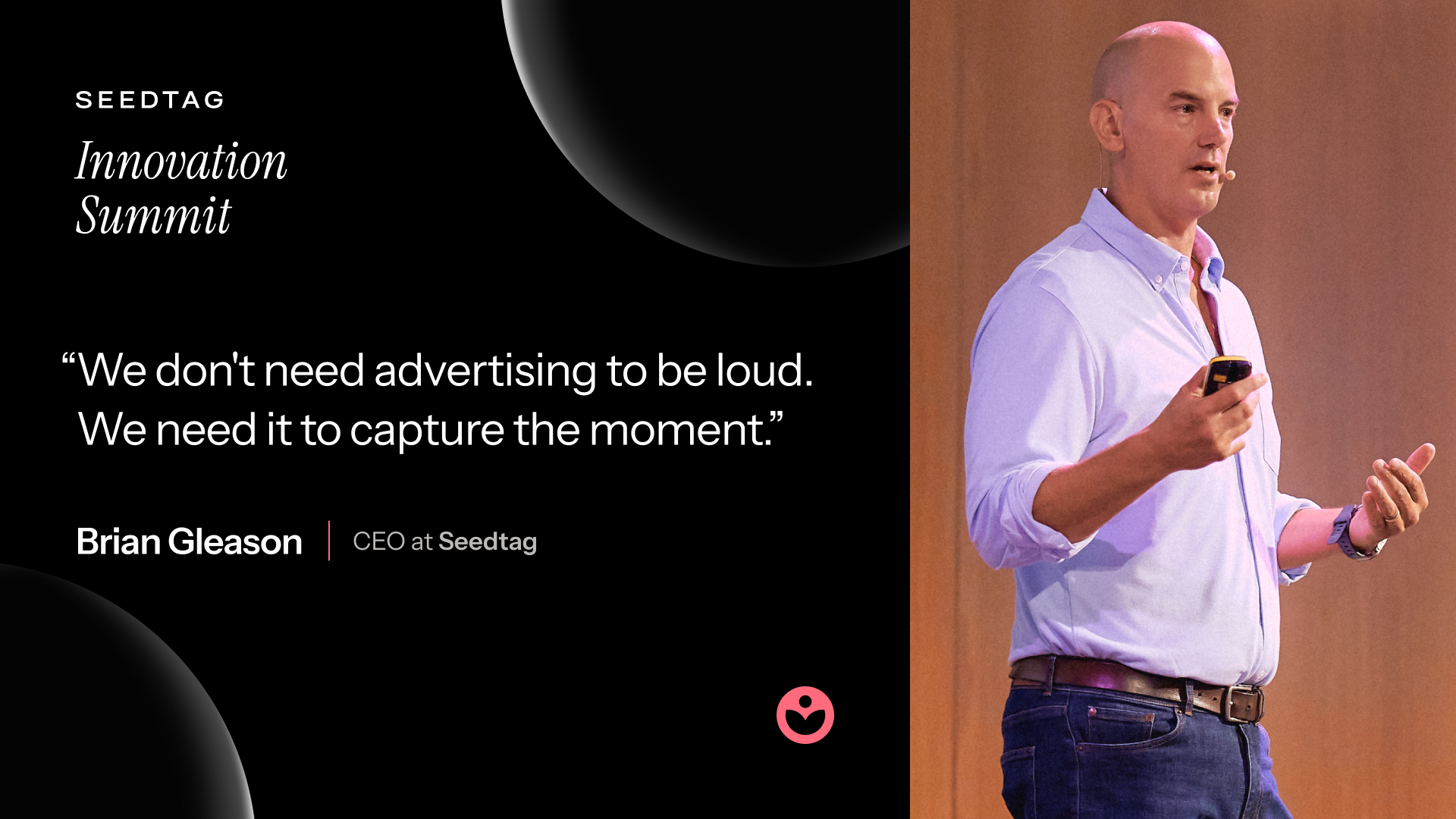
During the Summit, Brian Gleason, our CEO, added another layer: "We're more connected than we've ever been, but we're more distracted than we've ever been." For Brian, finding out how to connect in that moment is the most important thing, whether you're a brand, an agency, or a publisher.
The agenda combined dedicated sessions for the supply side and the demand side with joint sessions that put both in the same room. Topics ranged from the agentic shift and AI search to attention measurement, brand safety, CTV, creative, and life after the traffic. At lunches and dinners, the conversations kept going.
Across all of them, one thing became clear. The challenges facing the adtech ecosystem aren't local. They're global. And they become easier to solve when both sides look at them together.
Key Takeaways
- Consumers are more connected and more distracted than ever, and connecting with them in the moment matters for brands, agencies, and publishers alike.
- The same person makes different decisions in different situations, shaped by signals like time of day, screen, weather, and place.
- Fewer impressions carry identifiers, but audiences haven't gone anywhere, and reaching them requires a new structure.
- Interest, emotion, and intent shape how people process advertising, while viewability alone says nothing about that processing.
- Publishers, agencies, and brands face the same challenges from different perspectives, and the conversation is global, spanning the United States, Latin America, and Europe.
What Are the Biggest Challenges Facing the Digital Advertising Landscape?
Throughout the Summit, Brian Gleason put the consumer at the center of the conversation. For him, it's the one thing the industry doesn't focus on enough. We talk about acronyms, LLMs, and chats, but rarely about what consumers are doing every day or what their world is like.
And that world is full of noise. Attention is fleeting, and capturing it is hard. At the same time, clients are under pressure to grow and differentiate, and Brian raised an open question about what happens to them as products become commoditized in AI chat environments.
Grego Martínez, our Chief Product Officer, pointed to another challenge: media buying itself.
In CTV, most buying happens at the platform level, yet streaming services rarely have exclusive content. To illustrate the point, Grego shared a simple example: in Spain, Harry Potter is available on eight different platforms. So when a brand buys one of them, it's buying the service, not the moment. It learns nothing about the show being watched, the emotion it creates, or the hour and day it's being seen.
Buying through demand side platforms (DSPs) has a similar limitation. Brands and agencies can target IAB categories, keywords, domains, geography, or day part, but combining all of those signals to build moments manually is very complicated. The signals exist, but programmatic fragmentation keeps them apart.
Why the Adtech Ecosystem Is Moving From Understanding the Who to the Moment
For Grego, solving that fragmentation starts with a simple idea: the same person can make very different decisions depending on the situation they're in.
Picture someone commuting to work on a rainy Monday morning, phone in one hand, about to lose connection in five or six minutes. Any message has to be fast. Now picture the same person on a sunny Sunday morning, planning the week ahead with Monday off. They might spend 90 seconds on a powerful long video, one that takes them to the next step.
Nothing about them has changed. Only the moment has.
The same happens with a recipe. On a Tuesday evening after work, someone looking one up wants something fast. On a Saturday morning, with family and friends coming over, they're far more open to a message tied to that interest. The article is exactly the same. The moment is not.
That's why content is only one piece of context. The hour, the day of the week, and the season all matter. So do the type of screen someone is using, the weather, and the place they're in. On their own, these signals won't massively improve advertising. Combined, they create a scenario where advertising works much better.
Moments also change across environments. On mobile, things happen faster. On desktop, people are usually sitting down and paying more attention. CTV is often watched in a group rather than alone.
"We've spent more than 20 years understanding the who. Now, I think the future will be won by those who understand the moment much better," Grego said as he closed his session.
Audiences Were Never Identifiers
Hannes Sieling, our VP of Data & AI, started from programmatic advertising's long reliance on identifiers. They gave data teams structure, plus the reach to find people again. Today, fewer impressions carry them, but the reality hasn't changed. The same people are consuming the same content. And audiences were never identifiers in the first place.
What the industry needs is a new structure, built around the content people consume. That's the idea behind vector-based targeting: grouping similar content together so brands and agencies can find the environments closest to their goals, while balancing reach and precision.
Hannes also pointed to the technology that makes this possible: "Embedders are a little bit the hidden champions, the unsung heroes of the whole rise of large-language models."
The real question is what counts as similar. For him, the answer needs to go beyond clicks or categories and help find the right environment at the right moment. Understanding how people actually process what they see is a key part of that answer.
The Science Behind Attention, Emotion, and Intent
Professor Tino Meitz from the University of Münster explained how people process advertising. Who we are stays fairly stable, but how we feel and what we're focused on can change in milliseconds. When people consume media or advertising, that state of mind matters most.
That's also why viewability isn't enough. It shows that an ad could be seen, but says nothing about whether it was actually processed.
Three contextual signals shape that processing:
- Interest: If people aren't motivated to watch a show, they're unlikely to engage with the advertising within it.
- Emotion and affect: The brain relates new situations to past experiences, so a context that connects to familiar feelings makes new information easier to process.
- Intent: People need to be in the right situation for a message. If you want to buy a mid-sized SUV, you probably won't walk into a Ferrari dealership.
Tino was careful to separate affect from emotion: "Affect is something you can't govern. It's something that's happening, it's also, to a certain extent unconscious. Emotion is an evaluation of your affect afterwards."
How Can Supply and Demand Collaborate Across the Adtech Ecosystem?
Rob Beeler, who led the Two Sides, One Signal working session, explained why collaboration and supply and demand alignment matter. “Both sides are trying to solve the same things. This is a relationship-driven industry, and relationships are built by talking to each other in person. When both sides start working together, he said, they can be more effective for advertisers”, he said.
Kevin Donker, Head of Programmatic & Media Automation at Omnicom Media, brought that same spirit to the agentic conversation. For Kevin, agentic buying is still in its infancy, and the industry will have to come together to adopt protocols that make it reliable. When that happens, the productivity gains from AI should be reinvested in people.
In his view, the winners will be organizations that use AI to boost creativity, leadership, and judgment. The ones left behind will simply put an AI layer on top of an already fragmented workflow.
Brian Gleason echoed that idea in his closing remarks. He pointed to the feedback shared over the three days on different ways of working, ad inventory sources, and ways to measure. He also stressed the importance of trust: when you know you can trust someone, you know they'll do what they say they're going to do.
"There are a lot of pressures and challenges we think about in the world, and the things we shared over the last few days were brilliant. That's what we love to do: share information. It's an ecosystem that works together, and that's what we're trying to create", Brian Gleason.

How Does Neuro-Contextual Advertising Bridge the Gap Between Supply and Demand?
If both sides face the same challenge, they also need a shared way to understand the moment. That's what Neuro-Contextual Advertising offers.
Liz, our Neuro-Contextual AI, reads signals of interest, emotion, and intent to understand the moment behind each impression, without personal data or identifiers. For brands and agencies, that means reaching people when it matters most. For publishers, it means their content is valued for the moments it creates.
And it goes beyond advertising. Bringing value back to the open web helps keep quality content alive, and that's a responsibility the whole industry shares.
From Barcelona to the Next Conversation
Over three days, publishers, agencies, and brands from the United States, Latin America, and Europe approached the same questions from different perspectives. How do we capture attention? How do we reach audiences without identifiers? How do we make sure quality content keeps being found and valued as the way people discover information changes?
For us, at Seedtag, those conversations reinforce the vision behind Neuro-Contextual Advertising: understanding people's interest, emotion, and intent in the moment they're in.
It's not about knowing who. It's about understanding the moment.
Thank you to everyone who joined us in Barcelona. If you'd like to keep the conversation going, our team is here.
.png)
Notre blog

Advertising today demands more than just reach. As digital consumption evolves and regulations tighten, advertisers face a dual challenge: deliver meaningful results while respecting user privacy. The days of passive impressions and overreliance on personal data are fading fast.
Intent-based marketing is gaining more traction than ever as a strategic approach that targets audiences based on real-time context and content signals that suggest purchase readiness or interest.
Unlike traditional models that follow users around the web based on past behavior, intent based strategies look at what truly matters: what a user is actively engaging with in the moment.
At the core of this shift is intentionality: the ability to understand user purpose without personal identifiers. It's not just a workaround for privacy laws; it's a better way to market.
From Guesswork to Precision: Understanding Intent Based Marketing
Intent-based marketing focuses on users' real-time content consumption to determine their mindset. Instead of profiling users by demographics or historical browsing behavior, it aligns ads with the type of product or service the user is actively exploring. The goal: increase the likelihood of conversion by targeting based on intention, not identity.
This approach eliminates a major flaw in traditional digital marketing: mid-funnel waste. Many marketing teams struggle with lead generation that never materializes into action. Users click, scroll, and bounce. Why? Because they weren’t ready to buy.
With intention-based targeting, advertisers can:
- Minimize wasted impressions.
- Boost conversion rates.
- Align messaging with where users are in the buying journey.
- Stay compliant with privacy regulations.
It’s about precision over presence - reaching fewer users, but reaching them at the right moment.
For years, marketers have used keyword and category targeting to serve ads on pages aligned with certain topics. But this method has its limits. A page tagged "automotive" doesn’t reveal whether the reader is casually browsing or actively comparing models.
The difference between browsing and buying is the gap intent based marketing seeks to close. Without identifying user behavior or storing personal data, AI models can now infer intent directly from the content being consumed.
How AI Models Drive Intention Based Targeting
The backbone of modern intent based marketing is artificial intelligence. Advanced AI models, trained on intent-labeled data sets, allow marketers to distinguish between users who are simply curious and those who are ready to act.
These AI models evaluate more than keywords. They analyze structure, language, tone, sentiment, and visuals within digital content to assess intent signals in real time. For example:
- Informational content such as "What are hybrid car benefits?" signals research-phase interest.
- Transactional content like "Best lease offers for hybrid SUVs" signals readiness to purchase.
These nuances are invisible to basic contextual methods but they are critical to outcomes. AI models trained in intention modeling don’t just react to content, they interpret it. And because they continuously learn from performance data, they improve over time, enabling advertisers to fine-tune campaigns based on evolving user behavior.
Seedtag’s proprietary Contextual AI, Liz, brings this to life. Liz doesn’t just parse keywords but understands content with human-like depth. Powered by Natural Language Processing, machine learning, and computer vision, Liz can:
- Analyze textual and visual content in parallel.
- Score intent signals dynamically.
- Adapt targeting logic based on campaign goals.
What sets Liz apart is the ability to model intent across campaigns, meaning the same AI framework can flex to suit the conversion path of an automotive client one day and a consumer tech brand the next. Every page impression is scored and optimized for intent, aligning ad delivery with readiness, not randomness.
These AI-powered systems take into account where a piece of content ranks on search engines, how it’s written, and how audiences engage with it while creating a more robust view of user mindset than historical behavior ever could.
By combining AI’s real-time analysis with privacy-first design, intention modeling transforms digital marketing from reactive to proactive. And it does so without invading users’ personal space.

Real Outcomes Across the Marketing Funnel
Intent-based marketing isn’t just theory. It's already delivering stronger outcomes for brands looking to maximize every impression.
In a recent campaign, automotive leader Nissan used intention models to optimize vehicle consideration and lead generation. The results:
- 34% reduction in Cost Per Lead (CPL).
- 67% drop in Cost Per Qualified Visit (CPQV).
- Improved performance across every stage of the conversion funnel.
By identifying users who were further along the buying journey, Nissan engaged prospects who were ready to act and saw real return on their digital marketing investment.
These results highlight a key advantage of intent marketing: it turns attention into action.
"Our challenge was to optimize Nissan’s full-funnel strategy, improving consideration without compromising efficiency in the lower funnel. These results confirm that contextual AI is key to driving brand performance," said José Manuel Muries, Cluster Director, Nissan United.
Beyond the Funnel: Ethical, Efficient, and Future-Ready
In an era where users demand transparency and regulators demand compliance, intent based strategies offer a sustainable solution. There’s no need to trade relevance for responsibility.
Intention modeling does not collect personal data or track users across the web. Instead, it interprets signals within the environment a user has already chosen to engage with. That means brands can:
- Protect user privacy.
- Avoid data-driven bias.
- Reduce reliance on third-party cookies.
- Deliver messages that feel timely, not intrusive.
And because intent modeling is dynamic, it continues optimizing in real time, helping advertisers stay agile as market behavior evolves.

Reimagining the Mid-Funnel with Intent Based Strategies
For too long, the mid-funnel has been a blind spot in digital marketing - too broad for performance metrics, too narrow for brand awareness. But with the rise of intent modeling, marketers can now:
- Identify when users shift from awareness to consideration.
- Serve tailored content that matches their stage in the buying journey.
- Optimize marketing tools to drive higher value actions, not just clicks.
This shift transforms marketing efforts from static exposure to strategic activation, maximizing the value of each touchpoint.
Intentionality in Action: A New Standard for Performance
Performance marketing has long relied on short-term KPIs. But a privacy-first world requires more thoughtful planning. Intent-based marketing introduces a framework where long-term brand value and short-term results aren’t in conflict.
It enables advertisers to:
- Understand online behavior in real time
- Predict potential customers’ needs without invasive data
- Create high-performance campaigns rooted in trust and transparency
By aligning marketing approaches with real user purpose, brands can build relationships that last beyond a single click, closing the gap between strategy and signal.
But intent based strategies are not plug-and-play. They require:
- Clear alignment between business goals and user actions
- Campaigns built around relevance, not reach
- Investment in AI-powered platforms that understand content the way humans do
But the payoff is measurable. When brands stop chasing users and start meeting them in moments of intent, they turn uncertainty into opportunity.
The advertising ecosystem is evolving fast. Privacy-first doesn’t mean performance-second.
With intent based marketing, advertisers can reclaim efficiency, improve outcomes, and meet growing expectations for ethical, effective digital marketing.
To see this in action, explore Liz, the Contextual AI behind Seedtag’s intention models, designed to predict and act on real-time intent across the open web.

To mark International Women’s Month, Seedtag brought together a powerhouse group of industry leaders for a special episode of The Pub Way Podcast hosted by Tina Iannacchino, VP of Publisher Partnerships North America at Seedtag. She was joined for a dynamic conversation that brought forward honest, bold, and deeply human insights from women who are shaping the future of advertising and media.
This special panel featured:
- Jackelyn Keller, CMO at Comscore
- Natasha Byrne, Global Business Lead at Omnicom Media Group
- Samantha Skey, CEO at SHEMedia
- Luisa Izquierdo, CHRO at Seedtag
With this year’s International Women’s Day theme Accelerate Action as a guide, they explored leadership, representation, and the tangible steps needed to create more inclusive, impactful environments.
- From Imposter Syndrome to Imposter Awareness.
- Redefining What Leadership Looks Like.
- Why Context Matters In Advertising and Leadership.
- Taking Action That Moves the Needle.
- What Comes Next.
From Imposter Syndrome to Imposter Awareness
“I kept saying, ‘What if I’m not good at what I do?’” said Natasha Byrne, reflecting on a major career shift. “Even at my level, I had that imposter syndrome.”
But what many women label as internal insecurity is often a reaction to external dynamics. Samantha Skey challenged the very term: “Imposter syndrome was created by the patriarchy. It’s not that we’re broken, it’s that we’re made to feel like we don’t belong.”
Jackelyn Keller added, “We need to change the stories we tell ourselves. Instead of saying, ‘I’m quitting smoking,’ say, ‘I’m not a smoker.’ That shift in identity and self-talk is powerful.”
Across the board, the takeaway was clear: what we call self-doubt is often a response to environments that haven’t been built with us in mind. Changing the narrative starts with recognizing that - and speaking up anyway.

Redefining What Leadership Looks Like
“I was the only woman in the room and the youngest,” said Luisa Izquierdo, recalling her early years as an HR director. “I had to coach and guide people decades older than me. What helped was preparation. That’s how I built my confidence.”
For others, it was about redefining the qualities often negatively labeled as ‘feminine.’
“In the beginning, I thought empathy and emotion made me weak,” said Natasha Byrne. “Now, I see them as my superpowers.”
And leadership doesn’t just show up in boardrooms. Jackelyn Keller shared a moment of pride when her young daughter challenged her school’s curriculum for reinforcing outdated gender roles. “She raised her hand and said, ‘We don’t read that in my family.’ She changed the book for the whole class.”
These stories highlight how leadership today is rooted in authenticity, emotional intelligence, and a willingness to challenge the status quo, whether that’s in the workplace or the classroom.
Why Context Matters In Advertising and Leadership
Throughout the episode, the panel returned to a shared belief: that the future of advertising, and leadership, is personal.
Luisa Izquierdo emphasized the need to encourage women to take risks and aim higher, saying, “We raise the bar for ourselves constantly. It’s painful to see brilliant women still doubting their worth.”
And when discussing the evolution of advertising, personalization and relevance took center stage. But not at the expense of empathy or privacy.
The message? Advertising doesn’t need to follow users around. It can meet them where they are through meaningful, real-time context. That’s where contextual advertising has a role to play: making relevance possible without sacrificing respect.

Taking Action That Moves the Needle
Our panelists did not just reflect on challenges but also shared the concrete actions that can help change the system.
Samantha Skey spoke about the importance of transparency, explaining how her company reports compensation by gender and race and creates space for open conversations on topics that are often overlooked, like caregiving. “There’s power in visibility,” she said. “We can’t fix what we don’t acknowledge.”
Jackelyn Keller emphasized the value of starting before everything is perfect. “Let’s treat change like a product roadmap. Build the MVP, launch it, learn from it,” she said. “Progress doesn’t need to be perfect - it just needs to keep moving.”
The message across the board was clear: meaningful change doesn’t happen in one sweeping moment. It’s built through everyday decisions, intentional policies, and a willingness to speak up and show up, even (or maybe especially) when it’s uncomfortable.
What Comes After Women's History Month
This conversation offered a forward-looking view of what leadership can and should look like in today’s advertising world. Whether it was calling out outdated systems, rethinking how we support women at every life stage, or encouraging the next generation to lead with confidence, reinforcing that change starts with action, not intention.
At Seedtag, we’re committed to building the kind of workplace and advertising ecosystem where inclusion, authenticity, and context drive every decision. Because real relevance isn’t just about what people are watching or reading but about who they are, what they value, and how they want to be seen.
Want to discover the full conversation? Tune in to this special episode of The Pub Way Podcast and explore how women in advertising and media are leading change from the inside out.

The SXSW 2025 Conference and Festivals once again turned Austin, Texas into a dynamic hub of technology, creativity, and cultural convergence. Known for its eclectic mix of interactive media, film premieres, and featured sessions, this year’s event pushed boundaries beyond just what’s new, focusing instead on how tech can meaningfully serve people.
Seedtag brought together leading voices from the industry into the Wild Wild Land of Advertising for an unforgettable experience about connecting, learning, and exploring how contextual advertising can evolve in a world defined by data, privacy, and personalization.
A Seedtag Experience to Remember
In the middle of the buzzing South by Southwest, Seedtag hosted top-tier brand and agency leaders in immersive settings to encourage meaningful conversations, building stronger partnerships, discussing strategic insights, and exploring how our contextual AI Liz is reshaping the advertising ecosystem.
Our SXSW presence reflected Seedtag’s mission to deepen the connection between brands and audiences by helping advertisers and publishers deliver relevant, privacy-compliant, and engaging content at scale.
With an audience of marketers navigating increasingly complex media landscapes, we focused on what matters most: helping our clients understand how Seedtag’s solutions fit into a privacy-first, performance-driven, and attention-led future of advertising.

Personalization, Privacy, and AI: What Dominated the SXSW Conversation
Amid art installations and experiential activations, the conversations inside SXSW were grounded in practical insights. The event highlighted a growing industry focus on hyper-personalization. But the nuance lies in how that personalization is achieved. The call was clear: marketers want to move beyond static demographic profiles and understand what motivates their audiences in the moment. Contextual advertising answers that by meeting users where they are, based on what they’re engaging with rather than who they are.
Equally important was the topic of scale through AI-driven strategies, which are becoming increasingly essential for sorting and interpreting massive amounts of content and behavioral signals. However, speakers across the conference emphasized the importance of human oversight to ensure accuracy, transparency, and ethical application. This aligns with Seedtag’s approach to contextual AI: blending machine learning with human-like semantic understanding to deliver content suitability and brand safety.
Personalization also came up in discussions about content curation. Attendees explored how empowering users to shape their content environments results in deeper engagement and better advertising outcomes. For advertisers, this means more than programmatic efficiency; it means delivering messaging that feels natural, timely, and aligned with a user’s interests in that exact moment.
SXSW also highlighted the rising pressure on advertisers to shift toward privacy-forward solutions. With traditional identifiers fading and the industry moving beyond cookies, contextual targeting emerged repeatedly as a necessary, scalable alternative. Not only does it enable compliant, data-conscious ad delivery, it also enhances relevance and user experience.

See You Next: Where to Connect with Seedtag
If you missed us at SXSW 2025, don’t worry. Seedtag will be at POSSIBLE, the Digiday Programmatic Summit, and of course, Cannes. Catch up with us to continue the conversation on how contextual advertising is helping brands adapt, evolve, and thrive in the ever-changing digital ecosystem.
A Context-First Vision for the Road Ahead
At Seedtag, we believe in solutions that balance innovation with responsibility. That means designing advertising strategies that work for everyone: advertisers, publishers, and consumers.
Want to explore how contextual advertising can reshape your digital strategy? Let’s connect.

Television is undergoing one of the most significant transformations in its history. As viewers shift from traditional cable to streaming services, Connected TV (CTV) has become the new frontier for both brands and publishers.
By 2025, 86.3 million US households are expected to be CTV viewers, surpassing the reach of traditional TV. This shift presents an unparalleled opportunity for advertisers to engage with audiences in more personalized, measurable, and data-driven ways.
However, for CTV to reach its full potential, the industry must overcome challenges related to data fragmentation, standardization, and transparency. The future of CTV is about unlocking efficiencies, optimizing targeting, and fostering collaboration between advertisers and publishers.
CTV 101: What It Is and How It Works
CTV advertising refers to video ads delivered through internet-connected TV devices, such as Smart TVs, streaming sticks (Apple TV, Roku, Fire Stick), gaming consoles, and set-top boxes.
Unlike traditional TV ads, CTV advertising is highly targeted, using demographic, behavioral, and contextual signals to deliver relevant ads to viewers.
CTV ads can be inserted dynamically into streaming content and measured using real-time performance metrics, giving advertisers insights into:
- Who saw the ad.
- How they interacted with it.
- Whether they took an action after viewing.
"Household adoption of Smart TVs is set to exceed 80% in the U.S. within the next five years."
As more consumers shift to ad-supported streaming models, brands and publishers must rethink their ad strategies to capitalize on this expanding ecosystem.

Why CTV Is Winning Over Advertisers and Publishers
The shift toward CTV advertising is not just a response to changing consumer behavior, it’s a strategic move toward more efficient, measurable, and cost-effective advertising.
For Advertisers: A Smarter Way to Engage Consumers
"Studies show that CTV achieves an attention rate of 82% vs. 69% for linear TV."
This increased engagement makes CTV one of the most powerful digital advertising platforms available today. For brands looking to advertise on CTV, key advantages and additional benefits include:
- Precision Targeting – Unlike traditional TV, CTV enables granular audience segmentation, reaching consumers based on interests, viewing history, and demographics.
- Cost Efficiency – With programmatic buying, advertisers optimize their ad spend, reaching the right audience without excessive waste.
- Measurable Performance – Brands can track impressions, engagement, and conversions, ensuring their ads deliver tangible business results.
For Publishers: Unlocking Revenue Opportunities
With ad-supported streaming models growing, publishers have more ways to monetize premium content. Streaming giants like Netflix, Amazon Prime Video, and Disney+ have introduced ad-supported tiers, while over two-thirds of viewers on Peacock, Paramount+, and Hulu are expected to opt for ad-supported plans next year.
For publishers, CTV presents a way to maximize ad inventory and drive higher CPMs, thanks to:
- A more engaged audience – Streaming viewers are actively selecting content, leading to higher ad retention rates.
- Diverse revenue models – Publishers can monetize through pre-roll, mid-roll, and post-roll ads, ensuring a flexible ad strategy.
- Cross-device opportunities – CTV ads can integrate with mobile and desktop campaigns, providing an omnichannel advertising experience.
“By 2028, CTV is projected to grow at a compound annual growth rate (CAGR) of 13%, reinforcing the importance of this format for publishers looking to future-proof their business models.”
Solving CTV’s Biggest Challenges: Data, Measurement, and Standardization
Despite its advantages, CTV still faces hurdles that advertisers and publishers must navigate to fully unlock its potential.
Data Fragmentation and Standardization
One of the biggest challenges in CTV advertising is the lack of uniform data-sharing practices. Log-level data—which provides granular insights into user behavior—remains fragmented across different platforms.
This fragmentation leads to:
- Ad repetition issues – Viewers often see the same ad multiple times in succession, creating negative brand sentiment.
- Limited transparency – Advertisers struggle to track where their ads appear, impacting brand safety and performance measurement.
The industry must work toward standardized data-sharing models that give advertisers and publishers a clearer view of ad performance.
The Role of First-Party Data to advertise on CTV
As third-party cookies continue to decline, first-party data has become the most valuable asset in CTV advertising strategies.
- Better audience insights – First-party data enables precise targeting without infringing on user privacy.
- Privacy-compliant solutions – Cookieless advertising ensures compliance with evolving data regulations.
- Improved ad relevance – Personalized ad experiences lead to higher engagement and conversion rates.
"More than half of the open web and all CTV inventory have already been cookieless for some time."
By harnessing first-party data, brands and publishers can optimize ad placements, reduce waste, and improve targeting accuracy.

What’s Next for CTV Advertising?
The future of CTV advertising is being driven by emerging technologies and new industry standards that improve efficiency and measurement.
1. Programmatic TV & AI-Driven Targeting
Programmatic CTV advertising allows brands to buy ad inventory in real time, ensuring maximum efficiency and reach. AI-driven targeting enhances personalization and performance optimization.
2. New Ad Formats to advertise on CTV
New ad formats specifically designed for CTV are creating more immersive ad experiences, helping brands connect with audiences in meaningful ways.
3. Cross-Device Advertising for Seamless Engagement
CTV will become a seamless part of omnichannel campaigns, integrating with mobile, desktop, and social advertising strategies to enhance user engagement.
“CTV ad revenue is projected to reach $42.5 billion by 2028."
Why CTV Is the Future of Advertising
CTV is no longer an emerging trend—it is the present and future of television advertising. With higher engagement, precise targeting, and measurable performance, it offers a compelling alternative to traditional TV.
For publishers, it provides new monetization opportunities through ad-supported streaming models, maximizing revenue while maintaining a seamless viewing experience. As CTV viewership continues to grow and regulatory restrictions make other channels less effective, CTV campaigns will become an even more powerful way for advertisers to reach their target audiences and brands that advertise on CTV today will gain a long-term competitive advantage.
The industry’s next step is clear: addressing data-sharing challenges and embracing first-party data to improve measurement, targeting, and campaign effectiveness. The brands and publishers that invest in CTV today will gain a long-term competitive advantage.
At Seedtag, we help brands and publishers unlock the full potential of CTV advertising by providing contextual AI solutions that drive performance, ensure brand safety, and optimize targeting strategies. Our technology empowers advertisers to deliver privacy-first, engaging campaigns that reach the right audience at the right time. As CTV continues to grow, our solutions help advertisers maximize impact by refining placements, improving engagement, and enhancing measurement strategies.
Ready to take your CTV advertising strategy to the next level? Contact Seedtag today to explore how our contextual AI solutions can drive results for your brand.

For years, advertisers have debated whether their budgets should be concentrated within walled gardens or expanded across the open web. As consumer behaviors shift and privacy regulations reshape the advertising landscape, the conversation has become more relevant than ever. The dominance of closed ecosystems, such as Facebook, Instagram, Google, and Amazon, has led many brands to rely heavily on these platforms. However, growing concerns around lack of transparency, limited audience segmentation, and rising costs have pushed advertisers to explore alternatives.
Instead of viewing this as a binary choice, advertisers must recognize the need for a balanced approach—one that leverages the advantages of walled gardens while capitalizing on the transparency, scale, and contextual intelligence offered by the open web.
Where Are Users Spending Their Time?
The way people interact with digital content is changing, and advertisers need to follow the audience. While walled gardens continue to attract logged-in users, research indicates a growing shift toward the open web.
This shift is driven by consumer preference for quality content, greater control over privacy, and dissatisfaction with the experience in closed ecosystems. Users browsing the open web are often more engaged, actively seeking information, news, and entertainment—creating valuable moments for advertisers to connect with them.
.png)
Walled Gardens vs Open Web: What Advertisers Need to Know
Both walled gardens and the open web play a vital role in digital advertising. However, understanding their strengths and weaknesses is key to optimizing campaign performance.
The Appeal and Challenges of Walled Gardens
- High user engagement: Walled gardens benefit from logged-in users, allowing for better audience segmentation.
- First-party data access: Brands can leverage structured data for precise targeting.
- Seamless ad experiences: Advertisers can optimize for in-platform engagement within a controlled environment.
However, these platforms also present significant challenges:
- Lack of transparency: Advertisers have limited insight into ad performance beyond platform metrics.
- Higher costs: Competition for ad inventory in closed ecosystems drives up prices.
- Brand safety risks: As content moderation policies shift, advertisers face uncertainty about where their ads appear.
Advertising on the Open Web: Strengths and Challenges
- Greater transparency: Advertisers have full visibility into where ads are placed and how they perform.
- Expansive reach: Consumers spend most of their total online time on the open web, creating more opportunities for engagement.
- Privacy-first advertising: The open web enables contextual targeting without relying on third-party data.
However, challenges include:
- Fragmentation: The open web consists of thousands of websites, apps, and connected TV platforms, requiring robust ad strategies.
- Variable content quality: Ensuring ad placements appear alongside trusted, premium content requires advanced contextual intelligence.
A balanced digital ad strategy should integrate both ecosystems, leveraging the structured targeting of walled gardens while taking advantage of the transparency and reach of the open web.
Brand Safety in Walled Gardens: A Growing Concern for Advertisers
Recent changes in content moderation policies on platforms like Meta have raised brand safety concerns for advertisers. The relaxation of fact-checking programs and shifts in hate speech policies could increase the risk of brand exposure to controversial or harmful content.
Additionally, reliance on a black box model—where advertisers have minimal control over ad placements and audience data—adds to the challenge. The demand for more control over brand safety and ad transparency has led many advertisers to diversify their spending across trusted media outlets on the open web.

Contextual Advertising: A Key Strategy for the Open Web
With the decline of third-party cookies and increasing concerns over data privacy, contextual advertising has emerged as a powerful solution for targeting audiences effectively—without tracking personal information.
- No reliance on third-party cookies: Contextual AI analyzes content relevance instead of user behavior.
- Enhanced user experience: Ads appear in relevant, brand-safe environments, increasing engagement.
- Higher ad performance: Research shows that contextual ads achieve a 70% view rate, compared to 64% for cookie-based ads.
Brands that invest in contextual intelligence gain a privacy-compliant alternative that ensures effective targeting and brand suitability across the open web.
Why Advertisers Need an Omnichannel Strategy
Rather than viewing walled gardens vs open web as opposing forces, advertisers should adopt an omnichannel approach that leverages both ecosystems strategically:
- Use walled gardens for structured audience segmentation and conversion-driven campaigns—where first-party data plays a strong role.
- Capitalize on the open web for reach, brand safety, and contextual targeting—ensuring engagement in premium, high-quality content environments.
- Integrate contextual AI solutions to enhance relevance, improve audience targeting, and maintain compliance with privacy regulations.
Where Should Advertisers Invest?
The debate over open web vs walled gardens is no longer about choosing one over the other. A successful digital advertising strategy requires a hybrid approach that balances precision with scale, targeting with transparency, and brand safety with performance.
- Consumer habits are evolving—users are spending more time on the open web while walled gardens remain important for structured targeting.
- Brand safety concerns are rising—advertisers need control over where their ads appear.
- Privacy-first strategies are the future—contextual AI provides a sustainable, high-performing solution.
By combining targeted engagement from walled gardens with contextual intelligence on the open web, brands can future-proof their strategies while maximizing ad performance.
At Seedtag, we empower advertisers with cutting-edge contextual AI solutions that enhance targeting, ensure brand safety, and optimize campaign performance in a privacy-first world. Contact us today to explore how our technology can drive measurable results for your brand.

Each year, March Madness takes center stage as one of the most thrilling and unpredictable tournaments in sports. With bracket-busting upsets, rising college stars, and national title hopes on the line, the NCAA Tournament is more than just basketball—it’s a cultural phenomenon. But, When is March Madness 2025? The 86th annual edition of the tournament will begin on March 18, and will conclude with the championship game on April 7.
For advertisers, March Madness 2025 offers a golden opportunity to connect with engaged audiences through sports betting trends, brand sponsorships, and multi-platform fan interactions. Let’s dive into the top March Madness trends and the strategies brands can use to capitalize on the madness.
- March Madness Takes Over: How Fans Are Engaging.
- Brackets, Bets, and Big Wins: The Betting Boom.
- Rising Stars: The Players Defining March Madness 2025.
- Sponsorships That Score: How Brands Are Winning Big.
- Beyond the Court: March Madness as a Cultural Event.
- How Advertisers Can Maximize March Madness 2025.
- The Playbook for March Madness Success.
March Madness Takes Over: How Fans Are Engaging
College Basketball’s Biggest Stage Dominates the Conversation
"With 97% of sports-related discussions centered on March Madness, the tournament generates non-stop buzz across multiple media channels. Whether analyzing top seeds, predicting upsets, or debating NCAA tournament odds, fans are deeply invested in every game."
Key Insights:
- March Madness ranks as the most discussed sporting event, surpassing even the World Series and Bowl Season in cross-sport engagement.
- North Carolina, Notre Dame, and Iowa State are among the most talked-about programs, presenting regional engagement opportunities.
- Bracketology and sports betting discussions are skyrocketing, making March Madness a must-watch for advertisers looking to tap into fan excitement.
Why This Matters for Brands:
Companies that integrate their campaigns into the most engaging conversations around March Madness can maximize visibility and audience connection.

Brackets, Bets, and Big Wins: The Betting Boom
Bracket-building and sports betting have become March Madness staples. Fans are not only tuning in to watch but also placing wagers on point spreads, tournament game outcomes, and Cinderella story upsets.
Key Insights:
- Bracket predictions and NCAA tournament odds dominate engagement, with analysts like Joe Lunardi and Ken Pomeroy leading the discussion.
- Platforms like CBS Sports, ESPN, and DraftKings are at the forefront of sports betting and NCAA tournament odds coverage.
- The legalization of sports betting across more states has increased participation, with fans placing bets on everything from 16 seed upsets to national championships.
Why This Matters for Brands:
Companies in sports betting, analytics, and gaming can benefit from contextual advertising strategies that align with real-time betting trends and fan predictions.
Rising Stars: The Players Defining March Madness 2025
March Madness always produces breakout stars. Some will lead their teams to national titles, while others will cement their legacies with unforgettable performances. Tracking player momentum can help advertisers tap into real-time fan engagement.
Key Insights:
- Cooper Flagg (Duke) is the most mentioned player, with over 1,100 articles discussing his performance.
- Johni Broome (Auburn) leads in total visits per article, indicating high levels of fan engagement.
- Paige Bueckers (UConn) and JuJu Watkins (USC) are among the most-discussed women’s players, reflecting the growing media spotlight on women’s college basketball.
Why This Matters for Brands:
Advertisers can increase engagement by aligning with high-profile players, leveraging real-time highlights, and integrating contextual AI-driven ad placements during peak game moments.

Sponsorships That Score: How Brands Are Winning Big
Sponsorships remain one of the most powerful tools for brands looking to gain visibility during March Madness 2025. Leading sponsors are making waves with integrated campaigns, in-game activations, and digital-first advertising strategies.
Key Insights:
- AT&T leads all sponsorship discussions, appearing in 5,000+ articles.
- Capital One and Coca-Cola remain dominant sponsors, leveraging TV spots and digital activations.
- Buffalo Wild Wings and Reese’s are driving strong fan engagement, with Reese’s content receiving 64 visits per article.
Why This Matters for Brands:
Sponsors who integrate their messaging into game-day experiences, bracket challenges, and multi-platform activations will see the most impact.
Beyond the Court: March Madness as a Cultural Event
March Madness is bigger than basketball—it influences fashion, social media, and global sports discussions. Its reach extends far beyond the U.S., making it a key moment for international engagement and cross-industry collaborations.
Key Insights:
- International interest in March Madness is growing, particularly in Europe, Canada, and Australia.
- Basketball legends like Michael Jordan, Kobe Bryant, and LeBron James continue to shape NCAA tournament conversations.
- Social media engagement surges during the tournament, creating multi-screen advertising opportunities.
Why This Matters for Brands:
Companies that blend sports, culture, and digital trends into their March Madness marketing will connect with a broader, more engaged audience.

How Advertisers Can Maximize March Madness 2025
Key takeaways of March Madness Trends
Align with Bracketology & Betting Trends
- Place ads around bracket predictions, betting insights, and NCAA tournament odds.
- Partner with platforms like ESPN and CBS Sports to reach the most engaged audiences.
Tap Into Rising Stars & Team Storylines
- Focus on top-ranked seeds, standout players, and dramatic matchups.
- Use real-time highlights and AI-driven ad placements to stay relevant.
Capitalize on Women’s College Basketball Momentum
- Feature high-performing female athletes in campaigns.
- Support gender equity initiatives with strategic sponsorships.
Invest in High-Impact Sponsorships
- Leverage AT&T, Coca-Cola, and Capital One’s sponsorship visibility.
- Create March Madness-themed activations and promotions.
Expand Across International & Multi-Platform Audiences
- Adapt messaging for global audiences engaging with March Madness.
- Use CTV, mobile, and social media integration to maximize reach.
The Playbook for March Madness Success
March Madness is unpredictable, thrilling, and a dream opportunity for advertisers. As the tournament unfolds, seeds will fall, legends will rise, and millions of fans will stay glued to their screens.
Brands that align with bracket fever, top player narratives, betting trends, and cross-platform engagement will dominate the conversation and drive real impact.
Learn how Seedtag’s contextual AI solutions are ready to craft data-driven, contextual campaigns that capitalize on the excitement and unpredictability of March Madness.

The advertising industry is undergoing a seismic transformation driven by privacy regulations, changing consumer expectations, and evolving data policies. For years, third-party cookies played a critical role in targeted advertising, allowing brands to track users across the web and serve ads based on their behavior. However, rising concerns about sensitive information, transparency, and data privacy laws have led to a shift away from traditional tracking methods.
From the General Data Protection Regulation (GDPR) in Europe to the California Consumer Privacy Act (CCPA) in the U.S., advertisers must now navigate an increasingly complex regulatory landscape to ensure compliance while maintaining an effective ad experience.
In this article, we explore the major privacy regulations shaping the industry and what advertisers need to do to adapt.

The Evolution of Advertising Privacy: Key Milestones
Apple & Browser Tracking Restrictions (2017-2019)
The shift toward privacy-first advertising began when Apple introduced Intelligent Tracking Prevention (ITP) in Safari in 2017. This feature blocked third-party cookies, significantly limiting advertisers' ability to track users across websites. Shortly after, Firefox’s Enhanced Tracking Protection (ETP) followed suit in 2019, accelerating the industry’s shift toward privacy-focused solutions.
GDPR: The Global Benchmark for Privacy Regulations (2018)
The General Data Protection Regulation (GDPR) set a new standard for data protection and privacy laws worldwide, requiring businesses to obtain explicit user consent before collecting personal data. The regulation significantly impacted how advertisers use Google Ads, audience targeting, and personalized ads, as non-compliance can result in hefty fines.
What Advertisers Must Do:
- Implement clear, opt-in consent mechanisms for data collection.
- Use first-party data responsibly and ensure compliance with data privacy regulations.
- Adapt contextual targeting strategies to serve relevant ads without relying on cookies.
CCPA: Strengthening Consumer Data Rights in the U.S. (2020)
The California Consumer Privacy Act (CCPA) introduced stricter controls on consumer data by allowing users to opt-out of data sales and request access to their stored information. This law has become a model for other U.S. states implementing data protection and privacy laws.
What Advertisers Must Do:
- Ensure compliance with opt-out requirements, enabling users to control their data.
- Conduct annual cybersecurity audits to assess risk and compliance.
- Align third-party partnerships (DSPs, ad networks) with privacy regulations.
Google’s Privacy Sandbox & Chrome’s Changing Policies (2021-Present)
Google’s Privacy Sandbox was announced as a privacy-first alternative to third-party cookies, aimed at balancing privacy and targeted advertising. However, after several delays, Google announced in 2024 that it would no longer phase out third-party cookies, leaving many advertisers questioning the long-term viability of party data tracking.
What Advertisers Must Do:
- Shift focus toward privacy-first strategies, such as first-party data and contextual targeting.
- Explore Privacy Sandbox alternatives, including Google’s Topics API.
- Adapt campaign measurement methods to comply with data privacy laws.
Upcoming Global Privacy Regulations in 2025
The future of advertising privacy will be shaped by upcoming data privacy regulations worldwide. Here’s what advertisers need to know by region.

United States: Expanding State-Level Privacy Laws
By 2025, eight additional U.S. states will implement new privacy regulations modeled after CCPA, further restricting data collection and consumer tracking practices.
Key Updates for Advertisers:
- Universal opt-out mechanisms must be implemented to respect user privacy preferences across platforms.
- Restrictions on children’s data will increase, requiring stricter compliance when serving ads to minors.
- Automated decision-making transparency mandates will require advertisers to disclose AI-driven targeting processes.
How to Adapt:
- Review advertising platforms and ensure compliance with state-specific privacy laws.
- Implement clear consent options for personalized advertising.
- Work with privacy-first tech companies to align with evolving compliance standards.
European Union: Stricter GDPR Enforcement & AI Regulations
The GDPR framework continues to evolve, with stricter rules for cross-border data transfers and AI-driven advertising set to take effect in 2025. Additionally, the EU AI Act will introduce new restrictions on AI-powered ad targeting.
Key Updates for Advertisers:
- New Standard Contractual Clauses (SCCs) for intra-EU data transfers.
- Guidelines on ‘Consent or Pay’ models, requiring transparency on paid vs. free data-sharing options.
- AI risk assessments will be mandatory for automated ad targeting.
How to Adapt:
- Update user consent flows to align with GDPR’s enhanced transparency rules.
- Conduct risk assessments for AI-driven targeted advertising.
- Limit the use of sensitive information and ensure ethical AI practices.
LATAM: Stricter Data Protection Measures in Brazil
Brazil’s General Data Protection Law (LGPD) will introduce tougher penalties for non-compliance, making advertising privacy a top priority for brands operating in the region.
Key Updates for Advertisers:
- Users will gain stronger rights to data deletion.
- Fines for non-compliance will increase, affecting businesses that do not align with data privacy regulations.
- Stricter consent requirements for digital advertising.
How to Adapt:
- Strengthen first-party data collection strategies to align with consumer protection laws.
- Regularly audit advertising platforms to ensure LGPD compliance.
- Develop privacy-focused ad strategies that respect user consent.
APAC: New Data Privacy Regulations in India & Australia
In 2025, India’s Personal Data Protection Bill and Australia’s privacy tort law will introduce new challenges for advertisers in the APAC region.
Key Updates for Advertisers:
- India: Data localization rules will require companies to store consumer data within the country.
- Australia: Individuals will be able to sue companies for privacy breaches, increasing legal risks.
How to Adapt:
- Develop localized data processing solutions to comply with India’s regulations.
- Strengthen data security to protect against privacy lawsuits in Australia.
- Implement transparent ad disclosures to build consumer trust.
The Future of Privacy-First Advertising
Privacy-first advertising is no longer just a regulatory requirement—it’s a new standard for digital marketing. Brands that embrace first-party data, contextual targeting, and AI-driven compliance solutions will thrive in the evolving landscape.
Key Strategies for Advertisers:
- Invest in privacy-first ad technologies that enhance data protection.
- Use contextual targeting to deliver relevant ads without sensitive information.
- Align with tech companies focused on ethical data collection practices.
- Continuously update privacy compliance policies to meet evolving data privacy laws.
By prioritizing transparency, protecting consumer data, and adopting privacy-first ad strategies, advertisers can navigate this new era while maintaining trust and performance.
Want to stay ahead of the privacy revolution? Discover how Seedtag’s contextual solutions can help advertisers succeed in a privacy-first world.
%20Are%20Driving%20Smarter%20Monetization%20%26%20Improved%20Ad%20Experiences.png)
The role of Supply-Side Platforms in digital advertising has transformed significantly, shifting from simple intermediaries to strategic partners that enable publishers to maximize revenue, maintain transparency, and embrace privacy-first solutions.
In a recent episode of The Pub Way podcast, Jessica Breslav, Chief Customer Officer at Index Exchange, joined Seedtag VP of Strategy & Planning Mike Villalobos to discuss how SSPs are evolving to create long-term value for publishers. From automation and data-driven insights to sustainability and privacy-first advertising, the conversation highlighted the critical shifts taking place in the advertising supply-side platform ecosystem.
Let’s dive into the key takeaways from the episode and explore how SSPs are helping publishers optimize their inventory, connect with potential buyers, and navigate a changing landscape.
%2520Are%2520Driving%2520Smarter%2520Monetization%2520%2526%2520Improved%2520Ad%2520Experiences%25201.png)
What Does Supply-Side Platforms Stand for and How Does It Work in Advertising?
An Supply-Side Platform is a technology platform that helps publishers manage, sell, and optimize their ad inventory by connecting them with Demand-Side Platforms (DSPs), ad networks, and ad exchanges. SSPs facilitate Real-Time Bidding (RTB) transactions, allowing publishers to offer their inventory to multiple buyers in a competitive auction.
Key Supply-Side Platforms Benefits for Publishers
- Automation to streamline operations and maximize yield.
- Transparency to provide insights into ad performance and revenue streams.
- Privacy-first solutions to comply with data regulations while optimizing ad placements.
“Supply-Side Platforms are no longer just an intermediary; they’re strategic enablers helping publishers drive efficiency, maximize revenue, and navigate the evolving programmatic landscape.” - Jessica Breslav.
The Evolution of Supply-Side Platforms: Transparency, Automation & Value Creation
From Transactional Platforms to Publisher-Focused Partners
The SSP landscape has come a long way from being a simple technology platform that facilitated real-time bidding (RTB) transactions. Today’s Supply-Side Platforms are designed to do much more than just connect publishers with ad exchanges, networks, and demand-side platforms (DSPs).
Automation for Efficiency & Yield Optimization
Jessica Breslav emphasized that automation is now critical in enabling publishers to manage, sell, and optimize their ad inventory effectively. By leveraging automation, SSPs help publishers limit the number of times ads are shown to the same users, ensuring a better user experience and higher engagement.
Greater Transparency & Control
Transparency in Real-Time Bidding (RTB) transactions is now a priority for Supply-Side Platforms, with new tools allowing publishers to see where their ad spend is going, track impressions, and gain deeper insights into their target audience. This shift ensures that publishers retain greater control over their monetization strategies while building trust with advertisers.
%2520Are%2520Driving%2520Smarter%2520Monetization%2520%2526%2520Improved%2520Ad%2520Experiences%25205.png)
Maximizing Publisher Revenue with Supply-Side Platforms
As SSPs evolve, publishers are finding new ways to monetize their content more effectively.
Premium Inventory & Smart Monetization Strategies
Premium inventory has become a key focus for publishers aiming to attract high-value advertisers. As Jessica noted, “Premium inventory is critical—brands want to reach high-quality audiences in brand-safe environments.” SSPs play a crucial role by helping publishers’ sites optimize inventory, ensuring that display ads are matched with the most relevant potential buyers.
Data-Driven Insights for Smarter Monetization
Leveraging Real-Time Analytics: SSPs now provide real-time reporting and analytics, enabling publishers to track key performance indicators such as eCPM, fill rates, and revenue trends. These insights empower publishers to fine-tune their monetization strategies.
Better Audience Segmentation: SSPs help publishers refine audience segmentation, ensuring they can offer advertisers highly targeted placements that drive engagement and revenue.
Stronger Buyer-Publisher Collaboration: SSPs facilitate direct relationships between publishers and advertisers, reducing reliance on intermediaries while enhancing the value of programmatic deals.
The Privacy-First Future: How Supply-Side Are Adapting
With third-party cookies disappearing and stricter data privacy regulations in place, publishers must rethink their targeting strategies. SSPs are stepping up with privacy-first solutions that allow publishers to maintain their ad revenue while complying with regulatory changes.
Shifting Toward Contextual Targeting
Breslav highlighted the importance of contextual advertising as a privacy-friendly alternative to cookie-based targeting. SSPs are working closely with advertisers, DSPs, and ad networks to create privacy-first targeting strategies that rely on contextual insights rather than tracking user behavior.
Standardization & Compliance
From sellers.json to transparency benchmarks, SSPs are helping publishers manage, sell, and optimize impressions in ways that align with evolving industry standards. These efforts ensure that both buyers and publishers can navigate the digital ecosystem with confidence.
%2520Are%2520Driving%2520Smarter%2520Monetization%2520%2526%2520Improved%2520Ad%2520Experiences%25204.png)
Sustainability in Supply-Side: A Green Priority
Sustainability has become a major focus in Supply-Side advertising, with industry leaders like Index Exchange taking steps to reduce digital ad waste and improve environmental impact.
Reducing Supply Chain Redundancies
One key initiative involves minimizing duplicative supply paths, which helps limit excess bid requests and reduce energy consumption. By streamlining RTB transactions, SSPs are making digital advertising more efficient and sustainable.
Strategic Partnerships for Sustainability
Platforms like Index Exchange are forming partnerships with sustainability-focused organizations, such as Scope3, to measure and mitigate carbon emissions in programmatic advertising. These efforts not only align with industry goals but also enhance brand safety by ensuring advertisers invest in ethical, responsible advertising practices.
How Publishers Can Future-Proof Their Monetization Strategies
Supply-Side Platforms are no longer just technology platforms—they’re strategic partners that help publishers connect with buyers, optimize impressions, and drive sustainable revenue growth. Here are the key takeaways from this episode of The Pub Way:
- Embrace automation to optimize inventory and streamline operations.
- Invest in premium inventory to attract high-value advertisers.
- Adopt privacy-first solutions, including contextual targeting and first-party data strategies.
- Implement sustainability initiatives to reduce environmental impact and build brand trust.
- Leverage real-time data to refine audience segmentation and maximize performance.
As SSPs continue to evolve, publishers who prioritize automation, transparency, and privacy-first solutions will stay ahead of the curve in an increasingly competitive digital advertising space.
Final Thoughts: The Role of Supply Side Platforms in the Future of Digital Advertising
As the SSP landscape continues to shift, publishers must embrace data-driven strategies that balance revenue growth, privacy, and sustainability. Supply-side platforms are now critical enablers in helping publishers navigate the complex world of digital advertising, ensuring they can sell and optimize inventory while maintaining compliance with industry regulations.
If you’re looking to optimize your advertising strategy with contextual AI and privacy-first SSP solutions, reach out toSeedtag today and explore how we can help maximize your monetization potential.

Seedtag is aware of a recent research study conducted by DeepSee.io, regarding ad placements on websites with limited or low-quality content. We take these matters seriously and are committed to maintaining the highest standards for our advertising network.
We are actively investigating the specific instances highlighted and are conducting a thorough review of our publisher network. As a first step, we have already disconnected inventory from Bidgear from our network. We are also working closely with partners like Jounce Media to understand how these sites were not previously flagged and blocked.
Our immediate actions include:
- Enhanced Publisher Audits: We are implementing a more robust and comprehensive audit of our entire publisher network to ensure ongoing compliance with our quality standards.
- Automated Detection: We are developing an automated system to identify and flag websites with minimal or insufficient content for review and potential removal from our network. This will enhance our proactive monitoring capabilities.
Seedtag's premium network is a priority. We are dedicated to providing a high-quality advertising experience for our clients and users. We are committed to transparency and will continue to refine our processes to ensure brand safety and appropriate ad placement. We will share updates as we progress.

The Super Bowl isn’t just a sporting event—it’s a global media spectacle, drawing millions of viewers who tune in for the game, the halftime show, and, of course, the Super Bowl ads. With the Kansas City Chiefs and the Philadelphia Eagles set for a highly anticipated rematch in 2025, brands have a unique opportunity to engage audiences in new and innovative ways.
But as consumer behavior evolves, so does the way people watch NFL games. Traditional TV still commands significant reach, but NFL on CTV is on the rise, offering advertisers a more immersive, targeted, and measurable way to connect with audiences.
With CTV viewership surging, advertisers must rethink how they capture attention during the big game. Here’s what the data reveals about NFL trends leading up to Super Bowl 2025, and how brands can leverage them for maximum impact.
The New Prime-Time for Super Bowl Ads
The way audiences watch NFL games has changed dramatically over the past few years. According to Prosper Insights & Analytics, streaming platforms have gained significant traction among football fans, particularly younger demographics who prefer CTV NFL football over traditional cable TV.
Key Numbers Driving the CTV Shift
- Super Bowl content generates 4.3x higher engagement on CTV than traditional TV, making it the preferred platform for high-impact ad campaigns.
- Younger demographics (18-34) are 2.5x more likely to stream the game, reinforcing the importance of digital-first advertising strategies.
- The rise of sports betting has also fueled CTV NFL football engagement, as Super Bowl betting trends show increased second-screen activity during games.
Why This Matters for Advertisers:
Traditional Super Bowl TV ads remain powerful, but they come with significant challenges—high costs, limited personalization, and an inability to engage viewers in real time. Seizing the NFL football season allows brands to:
- Deliver targeted ads to relevant football audiences using first-party data
- Engage viewers throughout the regular season and not just on Super Bowl Sunday
- Leverage real-time insights to optimize ad placements dynamically
As more fans turn to watch the big game, advertisers must rethink how they distribute their budgets. Contextual AI offers the next step in precision targeting, ensuring that ads appear in the most relevant football content at the right moment.
Contextual AI: The New Playmaker for Ad Relevance
The challenge with Super Bowl advertising is relevance. Viewers are bombarded with flashy, high-budget ads during NFL games, but the brands that succeed are the ones that connect with audiences on a contextual level.
Why Context Matters for NFL Trends:
Contextual AI enables brands to tap into the conversations happening around the Super Bowl—not just through traditional sports content, but also via cultural moments, trending player storylines, and fan engagement topics.
Take the Travis Kelce and Taylor Swift phenomenon. Their high-profile relationship has transcended football, driving record-breaking NFL viewership numbers among non-traditional sports fans. Brands that can align their Super Bowl ads with trending moments like these stand to gain significantly more visibility and engagement.
- Contextual AI ensures your brand’s message is delivered in the right content environment.
- It dynamically adapts ad placements based on trending topics during the NFL season.
- It eliminates the need for cookies while still delivering precise audience targeting.
By leveraging NFL insights and real-time Super Bowl trends, brands can ensure their Super Bowl CTV campaigns are not just seen—but actually resonate with fans in meaningful ways.
Who is Who: The Matchup and Key Players
- The Kansas City Chiefs and the San Francisco 49ers are set to clash, generating significant digital engagement, with the Chiefs leading in media mentions (11,526 related articles) and the 49ers following closely with 9,987 mentions.
- Patrick Mahomes and the Chiefs lead in digital engagement, with Mahomes securing the highest brand-safe mentions and remaining the most visible player, commanding 7,472 related articles and 43 visits per article.
- Travis Kelce’s cultural crossover due to his relationship with Taylor Swift has resulted in a significant 49% increase in non-sports fan engagement with Super Bowl content and has fueled 6,791 related articles and 49 visits per article.
- Christian McCaffrey dominates offensive player conversations, making him a key figure for brands targeting fitness and performance audiences. He has seen significant fan interest, with 2,371 related articles and 26 visits per article.

The Super Bowl Fan Experience: What Drives Engagement?
Super Bowl engagement is fueled by more than just the game itself. Fans engage with the event through multiple touchpoints, including fantasy football, home-viewing experiences, sports betting, and social media interactions. With multi-screen usage increasing by 12%, fans are consuming game content across CTV, mobile, and social platforms, making it essential for advertisers to adopt cross-platform strategies. In addition, fantasy football discussions remain highly relevant, with top player mentions like Patrick Mahomes, Joe Burrow, and Tyreek Hill influencing engagement beyond just team loyalty. This means brands aligning with fantasy football, player stats, and live predictions have a greater chance of capturing audience attention.
Food and beverage trends also play a crucial role in shaping Super Bowl engagement. Game-day food culture remains a dominant force, with buffalo chicken dip, nachos, and tailgate snacks among the most-searched items in the weeks leading up to the event. Advertisers in the food and beverage sector should take advantage of this by integrating their products into game-day marketing narratives. Meanwhile, health-conscious eating trends continue to rise, with increased searches for air-fried snacks and dairy-free alternatives, presenting new opportunities for health and wellness brands.
Another key engagement factor is the crossover between sports and entertainment. The Super Bowl halftime show consistently generates a 29% increase in second-screen activity, making it an ideal moment for brands to connect with audiences. Additionally, Travis Kelce’s media influence—boosted by his relationship with Taylor Swift—has expanded NFL discussions beyond traditional sports fandom, driving a 49% increase in non-sports fan engagement with football-related content. Brands that integrate cultural moments into their Super Bowl campaigns can tap into a wider, more diverse audience.
On the digital front, sports betting is surging. Super Bowl-related betting searches saw a 43% increase leading up to last year’s game, demonstrating the high demand for real-time, AI-driven ad placements within sports betting content. Brands in the fintech and gaming industries should align their campaigns with live betting moments, odds updates, and game analysis content to maximize relevance.
Super Bowl Sunday is no longer a single-screen experience. As fans turn to Super Bowl CTV, mobile apps, and interactive social platforms, brands need to adapt their advertising strategies to stay ahead of evolving fan behaviors. The brands that prioritize multi-screen engagement, cultural relevance, and real-time AI-driven contextual advertising will be the ones celebrating a win long after the game clock runs out.

Where can I get some? How Brands Can Take the Trophy Home
With the rise of Super Bowl CTV, the evolution of NFL trends, and the growing role of AI-driven advertising, brands need smarter, more targeted strategies to stand out.
How to Get Ahead:
- Invest in CTV and multi-screen strategies: the shift to Super Bowl CTV is undeniable, and brands need to ensure they are where the audience is.
- Leverage Contextual AI to enhance ad relevance: forget one-size-fits-all Super Bowl ads. Align with trending NFL insights to create ads that feel natural and engaging.
- Engage fans beyond the game itself: the regular season, NFL betting trends, and cultural moments surrounding NFL games present extended opportunities to connect with fans.
Next Steps in the Game:

In July 2024, Google announced that it would not deprecate third-party cookies, a move that sent ripples through the advertising industry. However, while this development offered a temporary reprieve, the cookie remains on an irreversible track toward deprecation. Today, nearly half of the open web operates without cookies, with platforms like Connected TV (CTV) and mobile in-app environments being cookieless by design. Legislation, ad blockers, and shifting user consent patterns further complicate the landscape as studies conducted with YouGov reveal that over half of Chrome users reject cookies on certain websites, while almost a third reject cookies across all sites.
Advertisers are facing exponential challenges in user identification, forcing a rethink of traditional strategies.
Yet, is this a challenge, or an opportunity in disguise? Consumers are more concerned about their privacy than ever before, and brands that embrace this shift toward transparency and privacy-first approaches will build stronger, more trusted connections with their audiences. At the core of this transformation is the first-party data strategy, a sustainable and effective approach that builds deeper connections with audiences.
- The Evolution of Data Privacy and Its Impact on Advertising
- What is a First-Party Data Strategy?
- The Benefits of a First-Party Data Strategy
- How Contextual Advertising Complements First-Party Data
- Building a First-Party Data Strategy: A Step-by-Step Guide
- Pioneering Privacy-First Advertising with Seedtag

The Evolution of Data Privacy and Its Impact on Advertising
The digital advertising landscape has undergone a seismic shift in recent years. Privacy regulations such as GDPR and CCPA, alongside growing consumer awareness, have reshaped how brands collect and use data. While these changes create hurdles for advertisers who relied on third-party cookies, they also signal a new era of innovation and responsibility.
Why this matters:
- Third-party cookies are fading away: Platforms are phasing them out, and consumer opt-out rates are climbing.
- Privacy is non-negotiable: Modern consumers demand control over their data, and brands must adapt or risk losing trust.
- Cookieless environments are expanding: From CTV to mobile apps, more platforms are inherently cookieless, accelerating the need for new strategies.
Brands that adopt a first-party data strategy and integrate privacy-first approaches are not only surviving this transformation - they’re thriving.
What is a First-Party Data Strategy?
A first-party data strategy focuses on collecting, managing, and activating data that is directly sourced from consumers. Unlike third-party data, first-party data is collected consensually and is highly reliable. This data (gathered through interactions such as website visits, app engagements, email sign-ups, purchase histories, and surveys) provides a transparent, reliable foundation for marketing efforts.
Key features of first-party data:
- Privacy-compliant: Collected with user consent, ensuring alignment with data privacy regulations and building trust with your audience.
- Highly accurate: Reflects real consumer behavior, offering trustworthy insights for audience segmentation and campaign optimization.
- Brand-owned: Empowers businesses to craft tailored marketing strategies unique to their audience, reducing dependency on third-party providers.
In addition to compliance and accuracy, first-party data gives brands a competitive edge by allowing them to integrate their insights with contextual AI. At Seedtag, this approach amplifies the impact of contextual advertising by ensuring real-time relevance without compromising privacy. By layering first-party data with contextual insights, brands can achieve hyper-personalized campaigns that resonate deeply with users and really make the most of first-party data advertising.
The Benefits of a First-Party Data Strategy
- Enhanced Privacy Compliance With data privacy regulations tightening globally, first-party data provides a reliable way to engage audiences while respecting their rights. It eliminates reliance on third-party cookies and fits seamlessly into cookieless advertising strategies.
- Granular Audience Insights First-party data allows brands to segment audiences based on precise behaviors, enabling campaigns that resonate deeply with individual preferences. By understanding consumers better, advertisers can move beyond generic targeting to deliver meaningful experiences.
- Improved Campaign Performance Accurate data leads to more effective audience segmentation, resulting in better campaign performance and higher ROI. First-party data also reduces waste by ensuring that ads reach the right people at the right time.
- Future-Proof Strategies Relying on third-party cookies is no longer sustainable. A first-party approach ensures brands stay ahead of industry shifts and are prepared for an evolving advertising landscape.

How Contextual Advertising Complements First-Party Data
At Seedtag, we believe the future of advertising lies in the intersection of contextual AI and first-party data. This partnership creates a dynamic framework that allows advertisers to:
- Deliver precise, relevant ads: Contextual targeting ensures ads align with the content users are engaging with in real-time.
- Respect user privacy: By avoiding reliance on intrusive tracking methods, contextual advertising keeps campaigns compliant with data privacy regulations.
- Enhance engagement: By focusing on the user’s immediate environment, brands can create more meaningful connections and improve ad performance.
Seedtag’s contextual AI uses machine learning to provide human-like understanding of content. This ensures that ads are placed in contexts that align with user interests, increasing attention and engagement. According to research conducted by Seedtag and Lumen, contextual ads are 87% more likely to be viewed than standard ads. This highlights the importance of context in capturing fragmented attention spans, especially in a world moving away from third-party cookies where attention in advertising is becoming more crucial than ever.
The Privacy Advantage of Contextual Advertising
Unlike behavioral targeting, contextual targeting analyzes the semantic relevance of a page, ensuring ads are relevant to the content without relying on personal data. This makes it an inherently privacy-first solution. It also enhances brand safety by ensuring that ads are placed only in environments that align with brand values. For advertisers, this means reaching audiences in a way that builds trust and delivers results.
Imagine a customer exploring your website, browsing specific products, and providing feedback. This data reveals what they value, enabling you to craft a first-party data marketing strategy that delivers highly relevant ads. When combined with contextual targeting, these insights power engaging and privacy-compliant campaigns that reach users in the right moments.
For instance, a fashion brand could leverage first-party data to identify frequent shoppers and pair this insight with contextual advertising by serving ads on style-focused platforms. This dual approach ensures relevance without compromising trust.
Contextual advertising is more than just an alternative to behavioral targeting—it’s a long-term solution that aligns with evolving consumer expectations and regulatory frameworks. By analyzing the content of a page rather than tracking users, it delivers ads that feel natural and relevant. This approach fosters trust and ensures brand safety while providing measurable results.
Why Context Matters More Than Ever
- Boosts Engagement: Relevant ads capture attention without disrupting the user experience.
- Promotes Brand Safety: Ensures ads appear in suitable, trusted environments.
- Future-Proofs Campaigns: As third-party cookies phase out, contextual advertising offers a scalable and sustainable solution.
Building a First-Party Data Strategy: A Step-by-Step Guide
- Audit Your Data Sources: Identify where your data comes from; whether it’s website interactions, CRM systems, or offline touchpoints. Ensure these sources are comprehensive and privacy-compliant.
- Focus on Data Privacy: Adopt robust practices to secure user consent and comply with regulations like GDPR and CCPA. Transparency is key to building trust and ensuring long-term compliance.
- Leverage Contextual Technology: Integrate tools like Seedtag’s Contextual AI to amplify your data strategy, ensuring ads are relevant and engaging in real time.
- Create Detailed Audience Segments: Use your first-party data to define precise audience groups, enabling personalized messaging that resonates with individual preferences.
- Test, Learn, and Optimize: Monitor campaign performance regularly, refine your approach, and adapt to shifting consumer behaviors and market trends.
- Invest in Training and Collaboration: Ensure your teams are well-versed in leveraging first-party data and contextual technology. Cross-functional collaboration between marketing, analytics, and IT teams is essential for success.
Pioneering Privacy-First Advertising with Seedtag
The advertising industry is entering a new era where privacy, relevance, and innovation coexist. By adopting a first-party data strategy and integrating it with contextual advertising, brands can overcome the challenges of a cookieless world while delivering effective, engaging campaigns.
At Seedtag, we’re committed to helping advertisers navigate this transformation. Our contextual AI solutions ensure that brands can thrive in a privacy-first future, creating campaigns that resonate without compromising user trust.
Ready to future-proof your advertising strategy? Contact us today to discover how Seedtag can help you lead the way with first-party data and contextual AI.

Last week, the Consumer Electronics Show (CES) 2025 took over Las Vegas, the global stage for innovation showcased the latest advancements in technology. This year’s CES Show 2025 was a game-changer for digital advertising, shaped by transformative discussions, tech announcements, innovation and much more.
Ready to dive into what was buzzing in Las Vegas?
From our Seedtag Sky Suite at the ARIA Hotel to high-impact networking events, we connected with industry leaders, shared groundbreaking advancements in contextual AI, and explored how privacy in advertising is reshaping the future of marketing. We even managed to dance the night away at ‘Strangers No More’ with Unplugged Collective - truly an edition to remember.
Here’s a look at our very own event highlights and the key industry trends that had everyone talking at CES Las Vegas 2025.
- Seedtag going strong at CES 2025
- Key Industry Trends from CES 2025
- Seedtag’s CES 2025 Cheatsheet for Advertisers
- Leading the Way in Contextual Innovation

Seedtag going strong at CES 2025
We surely made a strong impression at CES Las Vegas 2025 with a series of exclusive events and experiences that brought the best of contextual advertising to the spotlight.
Seedtag Suite: A Hub for Innovation and Networking
Located in the luxurious Aria Sky Suite, the Seedtag Suite hosted our top-tier clients, including representatives from GroupM, OMG, Carat, NBCU, and Fubo. Guests were treated to personalized experiences, including rejuvenating IV transfusions, machine learning workshops, and exclusive Seedtag CES merchandise.
Unplugged Collective’s Strangers No More
Seedtag partnered with Unplugged Collective to host the Strangers No More event, a dazzling mix of networking, music, and immersive experiences. With over 600 attendees, this event left a lasting impression, highlighting how we bring creativity and innovation to the digital advertising landscape.
Contextual AI in the spotlight
At the Seedtag Suite, we unveiled our latest advancements in contextual AI technology, demonstrating how our solutions can redefine CTV advertising and improve ad relevance without compromising user privacy. From harnessing AI to power contextual strategies to privacy-first targeting strategies, we highlighted how Seedtag’s technology is leading the way in contextual targeting.
Key Industry Trends from CES 2025
1. AI’s Inflection Point: Transforming Targeting and Personalization
Generative AI took center stage at CES 2025, revolutionizing how brands approach contextual advertising. AI is no longer a buzzword but a vital tool in crafting precise, relevant, and engaging campaigns.
We showcased how AI contextual advertising enables brands to move beyond tracking user behavior to focus on the immediate context of user engagement. By analyzing real-time content, generative AI delivers display ads that align seamlessly with consumer interests, ensuring higher engagement and relevance.
What to Expect from Contextual Artificial Intelligence
- Generative AI is redefining marketing strategies by enabling hyper-personalization while respecting personal information and user privacy.
- 2025 is the year for brands to adopt AI-driven solutions that optimize content creation, campaign performance, and consumer engagement.
2. The Rising Dominance of CTV Advertising
As streaming continues to replace traditional TV, CTV advertising emerged as a hot topic at CES Las Vegas 2025. This shift reflects changing consumer habits, with cord-cutters embracing on-demand content and advertisers reallocating budgets to reach engaged streaming audiences.
Why CTV Is Essential
- Precision Targeting: Unlike traditional TV ads, CTV enables brands to tailor their messaging to niche audiences.
- Real-Time Metrics: Advertisers gain access to detailed insights into viewer preferences, optimizing campaigns on the fly to improve ROI.
- Personalized Ads: CTV offers unparalleled opportunities to connect with users based on their current interests and viewing habits.
Seedtag’s CTV advertising solutions stood out for their ability to combine contextual insights from the open web with streaming data. This approach ensures that ads resonate deeply with viewers while respecting their privacy. As CTV advertising evolves, it’s clear that contextual targeting will remain a cornerstone of effective campaigns in this space.
3. Privacy in Advertising: A Growing Imperative
Privacy was a recurring theme at CES 2025, reflecting the industry’s response to stricter data regulations and growing consumer awareness of how their data is used. With new privacy laws taking effect in multiple U.S. states and the continued influence of GDPR, brands must adapt their marketing strategies to prioritize user privacy.
Challenges of Privacy in Advertising
- Signal Deprecation isn’t Privacy: Many “privacy-safe” solutions fail to address the broader regulatory environment and consumer sentiment. This only emphasizes the importance of solutions that genuinely prioritize user privacy over short-term fixes.
- CTV and Privacy: While CTV avoids cookies, its reliance on IP address tracking introduces new privacy challenges. Regulations like the California Privacy Rights Act (CPRA) classifies IP addresses as personal information, requiring advertisers to rethink their targeting methods.
"The Time for Contextual Advertising is Now"
Seedtag demonstrated how contextual targeting provides a long-term solution to these challenges. By focusing on the content a user is engaging with at that moment, contextual advertising avoids the need for personal data while delivering relevant, engaging ads. This privacy-first approach aligns with the expectations of both consumers and regulators, ensuring compliance without sacrificing effectiveness.

Seedtag’s CES 2025 Cheatsheet for Advertisers
CES 2025 reaffirmed once again the power of contextual AI, CTV advertising, and privacy-first solutions in the evolving adtech landscape. What can brands and agencies learn from this?
- Embrace AI: Generative AI is essential for delivering personalized, efficient campaigns that resonate with modern consumers.
- Invest in CTV: The rapid growth of streaming audiences makes CTV advertising a must-have in any forward-looking marketing strategy.
- Prioritize Privacy: Contextual targeting offers a sustainable solution for balancing personalization with compliance, ensuring your ads remain impactful and trustworthy.
Leading the Way in Contextual Innovation
As CES 2025 demonstrated, the future of digital advertising lies in solutions that balance innovation with responsibility. Seedtag’s expertise in contextual advertising ensures that brands stay ahead of industry trends, delivering ads that engage audiences without compromising privacy.
Ready to elevate your advertising game? Discover how Seedtag’s contextual AI can transform your campaigns and help you thrive in the ever-changing landscape of digital advertising.

When United Airlines launched its new nonstop service from the United States to Marrakech, Morocco, they partnered with Seedtag for a Connected TV (CTV) advertising campaign to reach travelers with relevant interests. Through an innovative contextual advertising approach powered by our contextual AI Liz, the campaign has achieved a 48% increase in consumer recognition of the new route and drove notable lifts in brand favorability and travel consideration.
Contextual Advertising: Connecting the dots for United Airlines
In collaboration with agency partner Carat, United Airlines aimed to build awareness for its new Marrakech route by connecting with potential travelers whose interests aligned with the unique aspects of the destination, building an audience based on what inspires them. Traditional travel advertising typically focuses on narrow targeting categories, but this campaign pushed boundaries by using contextual AI to uncover custom audience interests beyond conventional travel themes.
How It Worked:
- Open Web Content Analysis Seedtag’s AI-powered solution Liz, mapped a contextual graph of open web content relevant to the Marrakech route, identifying untapped interest segments.
- Custom CTV Targeting: The open web analysis guided the targeting for CTV Audiences. By focusing on content related to adventure, arts & crafts, food, technology, and travel, we ensured the ads reached the right audiences in highly relevant contexts.
As a result, the campaign went beyond the limits of traditional travel advertising by identifying white-space opportunities and placing United Airlines’ ads where they would be most effective and earn the most engagement from viewers.
Campaign Highlights: Meaningful Engagement and Brand Impact
According to a third-party analysis by Cint, the partnership between United Airlines and Seedtag has delivered major results across key brand metrics:
- +48% Product Recognition: More consumers became aware of United’s new Marrakech route.
- +21% Brand Favorability: United Airlines earned stronger consumer sentiment.
- +7% Travel Consideration: Travelers showed increased interest in booking with United when flying to Marrakech.
- 80% Brand Differentiation: viewers agreed that United Airlines’ ads clearly set the brand apart from its competitors.
Additionally, the campaign reached over 122,000 unique households through CTV, placing ads in content genres that resonated with audiences ready to be inspired by new travel experiences. This targeted approach maximized relevance while keeping messaging contextually appropriate.
Maximizing CTV Campaigns Impact with Context
"This campaign was a perfect example of how our contextual advertising solutions can redefine audience engagement," said Kartal Goskel, CTO at Seedtag. "By merging our AI-powered contextual analysis of the open web with CTV execution, we connected United Airlines with travelers at the moments that truly mattered."
The ability to reach potential travelers through contextually relevant ads enabled United Airlines to establish a compelling narrative about its new route to Marrakech while reinforcing its brand promise. This strategy not only boosted awareness but also fostered deeper audience engagement, ensuring long-term brand loyalty.
Looking Ahead: Redefining Travel Advertising
The partnership with United Airlines highlights the transformative potential of contextual advertising in travel marketing. By blending CTV targeting with AI-driven open web content analysis, brands can craft campaigns that resonate emotionally while driving measurable business outcomes.
As travel continues to recover globally, contextual strategies will remain essential for brands seeking to differentiate themselves in a crowded market. Seedtag’s contextual solutions empower brands to stay ahead in a rapidly evolving advertising landscape, going beyond conventional targeting to create tailored, high-impact campaigns.
Ready to make your brand’s advertising strategy first class? Discover how contextual targeting can help your campaigns reach for the sky.

As we enter 2025, the digital marketing landscape continues to evolve rapidly, driven by advancements in technology and changing consumer expectations. Staying competitive requires understanding the new marketing trends shaping the industry and adapting strategies accordingly. Here are three key trends marketers should focus on this year—and how to put them into action.
Beyond Flat Targeting: Exploring Multi-Dimensional Insights
Consumers today are dynamic, with interests that change across contexts and platforms. In 2025, brands must move beyond outdated, one-dimensional targeting methods and embrace contextual AI for deeper personalization. Advanced AI-powered tools analyze environments holistically—text, visuals, and even video content—offering a comprehensive understanding of customer behavior.
Why it matters: Traditional targeting based on isolated data points is no longer enough. With contextual AI, brands can build marketing campaigns that adapt to evolving consumer interests by interpreting full contextual environments. This capability helps brands discover consumer insights they may have missed using conventional targeting.
Advanced contextual targeting allows marketers to understand not just what consumers are interested in, but why. By connecting the dots across multiple data points, brands can build richer audience profiles that lead to more meaningful engagements. This multi-dimensional approach ensures campaigns are both relevant and impactful.
By combining data from various touchpoints, such as browsing history, search behavior, and contextual content analysis, brands can identify emerging audience segments. This capability enables more precise targeting and ensures that advertising feels personal while respecting user privacy.
How to stay ahead:
- Reassess your targeting strategy—are you considering the full context of your audience’s behavior?
- Partner with technology experts who can decode complex content environments and identify emerging audience patterns.
- Conduct A/B testing to measure how multi-dimensional targeting impacts marketing performance.
Multi-Screen Messaging: Connecting Audiences Across Devices
Consumers navigate multiple screens daily, shifting from mobile devices to desktops and Connected TVs (CTV). In 2025, successful brands will take a unified, multi-screen approach, ensuring that messages flow naturally across all touchpoints.
Why it matters: Disconnected campaigns create fragmented customer experiences. By aligning campaigns across devices, brands can increase relevance and reduce acquisition costs. CTV, in particular, presents a valuable opportunity, enabling advertisers to extend personalized messaging from the web to the living room.
By using contextual AI, brands can enhance video advertising with precision. This technology can interpret visual elements, dialogue, and even tone of voice in video content. As large language models continue to improve, marketers will unlock more granular targeting opportunities across different content formats.
Consistency in messaging ensures that users encounter a unified brand story, regardless of how they interact with content. By maintaining thematic coherence across screens, brands can foster deeper emotional connections with their audiences.
How to stay ahead:
- Design campaigns that work across all screens and formats, from online video to CTV.
- Use data-driven insights to identify the best times and platforms to reach your audience.
- Develop a measurement framework that tracks cross-device engagement and campaign effectiveness.
Explore More: Discover how multi-screen strategies drive impact
Privacy-First Approaches: Winning in a Cookieless Future
With third-party cookies disappearing, brands must embrace privacy-first advertising strategies to remain competitive while protecting consumer trust. In 2025, forward-thinking marketers will combine first-party data, contextual targeting, and privacy-compliant alternatives for greater personalization without sacrificing data security.
Why it matters: According to industry reports, over half of internet users are now beyond the reach of third-party cookies. Brands that adopt privacy-first solutions can ensure their campaigns remain effective while respecting consumer preferences and data privacy regulations.
To achieve this balance, marketers must prioritize transparent data collection and consent-driven strategies. Building trust with consumers is no longer optional—it’s a critical factor in campaign success. Brands that clearly communicate how user data is handled will enjoy greater customer loyalty and better marketing results.
Adopting privacy-first marketing isn’t just about compliance—it’s a competitive advantage. By showing a commitment to ethical data use, brands can enhance their reputation while staying ahead of shifting regulatory requirements.
How to stay ahead:
- Develop a comprehensive data strategy that includes first-party data collection and privacy-safe sharing.
- Combine contextual targeting with privacy-compliant data-sharing environments to create contextual audiences that drive meaningful engagement.
- Stay updated on evolving privacy regulations and ensure your data management practices remain compliant.
Into The Next Era Of Advertising
The future of digital marketing is here. Adopting these marketing trends for 2025—from AI-powered targeting to multi-screen strategies and privacy-first marketing—will ensure that your brand stays competitive, adaptive, and ready for what’s next.
Ready to future-proof your marketing strategy? Contact us to discover all about contextual AI and see how Seedtag can help you thrive in this changing digital landscape.

The Pub Way is back! In the season two premiere of Seedtag's podcast for publishers, hosts Mike Villalobos and Tina Iannachino welcome Miles Fisher, Senior Director of Strategic Advertising Partnerships at Roku, to explore the dynamic and rapidly evolving landscape of Connected TV (CTV) on “Episode 15: Roku: The Power of Data and Transparency in CTV”.
With years of expertise spanning roles at T-Mobile Advertising and Google Marketing Platform, Fisher brings invaluable insights into how advertisers and broadcasters can adapt and thrive in this fast-paced industry.
Roku: From Streaming Hardware to CTV Pioneer
A key highlight of the episode is Roku's evolution. Originally launched as a Netflix project nearly two decades ago, Roku has transformed from a hardware manufacturer into a software-driven platform that powers TVs with its operating system. This pivot not only expanded Roku’s reach but also unlocked new opportunities in the world of CTV advertising.
Fisher explains how this shift positions Roku as a leader in delivering seamless user experiences, enabling innovative solutions for advertisers, including shoppable media—a game-changer that allows viewers to purchase products directly through their TV screens.
The Rise of Shoppable Media
Imagine watching your favorite show and effortlessly purchasing a featured product with just your remote. Thanks to Roku’s unique position as a TV operating system, this isn’t science fiction; it’s the future of advertising.
By leveraging first-party data—such as names, emails, and payment details—Roku creates frictionless shopping experiences tailored to user preferences. While many consumers still prefer making purchases on mobile devices, the growing adoption of shoppable ads signals a shift in consumer behavior that advertisers can’t afford to ignore.
Opportunities in the Shift from Linear to CTV
As traditional broadcasters embrace CTV, Fisher shares practical advice for making the transition successful. Collaborating with platforms like Roku can help broadcasters seamlessly adapt their content for streaming audiences while standing out in a crowded marketplace.
For advertisers, the benefits of CTV are clear. By tapping into first-party data, brands can deliver highly targeted campaigns that rival the precision of social media advertising. From reduced customer acquisition costs (CAC) to improved Return on Ad Spend (ROAS), CTV offers unparalleled opportunities for growth.
What’s Next for CTV?
The episode concludes with a look at the future of CTV. Fisher predicts a continued rise in ad-supported models, particularly in the FAST segment, as consumers push back against subscription fatigue. He also highlights the importance of niche programming—like women’s sports—to capture underserved audiences.
At the heart of this evolution lies data-driven transparency. Fisher emphasizes that the success of CTV advertising depends on giving marketers the tools they need to effectively plan, measure, and optimize their campaigns.
Next stop at The Pub Way
Packed with actionable insights and expert predictions, The Pub Way podcast is a must-listen for publishers navigating the intersection of technology, creativity, and advertising. Tune in now.
Recevez les dernières actualités et informations relatives à l'AdTech directement dans votre boîte de réception