Introducing Seedtag Emotion Quotient: How Neuro-Contextual AI Reads Trends


Every week, the internet tells you what's trending. It rarely tells you how any of it felt.
Open any trends page, any weekly recap, any "most talked about" list, and the logic is the same. Volume wins. Whatever generated the most clicks, shares, or mentions gets ranked first, regardless of what that attention actually meant. A blockbuster movie premiere and a last-minute playoff upset can sit side by side on the same list, indistinguishable by the metric used to rank them.
But attention and emotion are not the same thing. A story can dominate headlines and still leave people cold. Another can spike quietly in wonder, anger, or admiration without ever cracking the top of a trends page. Volume tells you where people looked. It says nothing about what they felt while looking.
That gap between the content people consume and how they actually feel about it is exactly where Neuro-Contextual advertising begins.
Today, we're putting Liz, our Neuro-Contextual AI, to work with the launch of the Seedtag Emotion Quotient, a weekly ranking of the five cultural moments that generated the strongest measured emotional response, not the ones simply generating the most volume.
Each moment is scored against its own emotional baseline. Take The Odyssey: admiration and anticipation for Nolan's epic were real, but off-screen romance between its stars ended up generating the strongest emotional signal of all, stronger than the film itself. And sometimes, what stands out is how differently the same event can be felt. At this year’s US Open, coverage around Carlos Alcaraz drove admiration to 3.93x its usual baseline, while stories around Novak Djokovic's early exit pushed sadness to 2.37x. Same tournament, same week, but two very different ways of experiencing it. For advertisers, that's an important distinction. Knowing that the US Open is capturing attention is one thing. Understanding whether that attention is being shaped by admiration or sadness gives brands a much more precise read on the moment and how their message can fit within it.
That's the point of the Emotion Quotient. It's the same intelligence behind Liz, our Neuro-Contextual AI, made visible: reading not just what a moment is about, but how it's genuinely felt.
It's Not About Who Someone Is. It's About What They're Passionate About, In This Moment.
Contextual targeting has been part of digital advertising for years. At its most basic, it matches ads to content using keywords and categories. A travel article gets travel ads. A sports recap gets sports ads. It works, but it reaches its limit there. Classification is as far as it goes.
More advanced systems now use vector embeddings, numerical representations that place related concepts closer together in meaning, even when they share no keywords at all. That's a real improvement in how machines read content. But embeddings alone only summarize meaning. They don't explain why a moment matters to the person reading it.
That's the gap Neuro-Contextual advertising is built to close.
Neuro-Contextual Advertising, our approach at Seedtag, adds a purpose-built layer of business logic on top of that foundation, one built to interpret interest, emotion, and intent within content itself.
Two articles can sit in the exact same category and still mean entirely different things. Someone reading a spoiler-filled recap of a finale and someone reading a spoiler-free review are both talking about the same show, but their intent runs in opposite directions: one wants closure, the other wants to be convinced to watch. Knowing what the content is about can't tell them apart. Understanding why each reader is there can.
The same holds for emotion. A product launch event and a product recall story can both sit under "tech news," yet one carries excitement and anticipation, the other frustration and concern. That same underlying intelligence, reading interest, emotion, and intent together, is what powers everything we build, the Seedtag Emotion Quotient included.
The same logic applies to people, not just pages. Two readers can share every demographic box, same age, same income, same zip code, and still care about completely different things. Demographics describe who someone is on paper. They say nothing about what actually moves that person in the moment. Neuro-Contextual advertising shifts the question from "who is this person?" to "what are they passionate about right now?", and content itself is where that answer shows up first.
Behind every score in the ranking is Liz, our Neuro-Contextual AI, reading content at scale and in real time. Liz scans more than 100 million URLs every day, with native understanding across 10+ languages and access to inventory from more than 30,000 premium media publishers globally, spanning the open web, video, and CTV.
That scale matters because the Seedtag Emotion Quotient isn't built from isolated pieces of content. Liz understands the connections between content across this broader ecosystem, identifying signals of interest, emotion, and intent as they emerge. The result is a view of cultural moments grounded not in a snapshot, but in what is happening across the content universe around us.
From there, understanding goes deeper than keywords. Liz maps the relationships between topics using vector embeddings grounded in neuroscience, which is how the ranking can isolate the specific terms driving a spike, not just name the general subject behind it.
Because human reactions are rarely singular, Liz reads emotion in layers rather than assigning one flat label. A single moment can carry curiosity and excitement at once, or admiration alongside real tension, and the ranking is built to reflect that complexity.
All of this happens without relying on personal data. Liz reads the content environment itself, not the individual people engaging with it, which is what keeps the ranking privacy-first by design.
Each week, the Seedtag Emotion Quotient publishes a new read on the five moments that generated the strongest measured emotional response over the week prior. It's built to be explored, not just read: every entry breaks down the specific emotions behind it, the story driving the spike, and how that moment's emotional profile compares to its usual baseline, a starting point for thinking through which emotional signals are worth aligning a campaign with, and when.
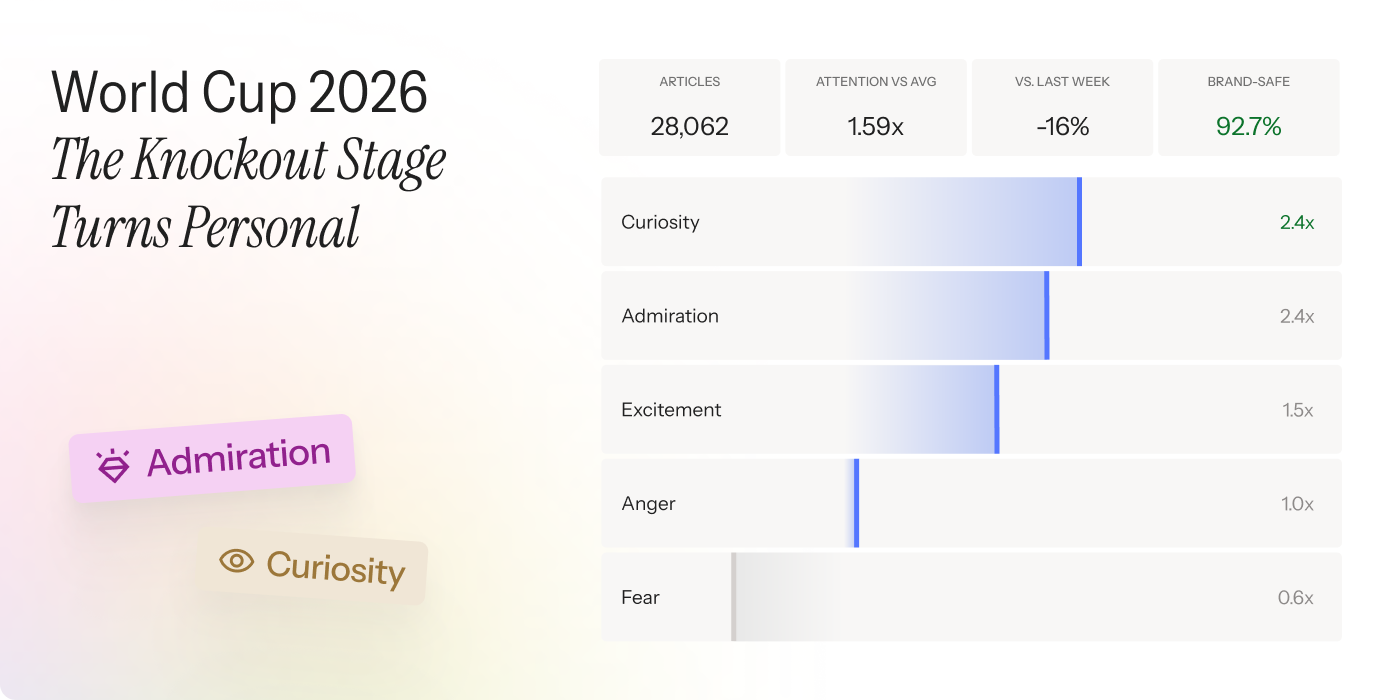
The Seedtag Emotion Quotient makes something visible that advertisers should care about directly: emotion is measurable, and it predicts performance.
That's not just true for the moments in this ranking. It holds inside real campaigns too.
The same Neuro-Contextual intelligence behind the ranking already drives stronger performance where it counts most: inside live campaigns. Liz, our Neuro-Contextual AI, is the same engine behind Seedtag NeuroX, our Neuro-Contextual Exchange, powering both from the same underlying intelligence. NeuroX connects that intelligence at scale across 30,000+ premium publishers and broadcasters, making every impression understood whether or not identity is present in the bidstream.
Working with Professor Moran Cerf from Columbia University, our neuroscience research measured real-time brain responses and found that Neuro-Contextual ads drive 3.5 times higher neural engagement than non-contextual ads, and a 26% stronger emotional response than standard contextual advertising. Full-funnel outcomes, from awareness to conversion, are consistently stronger when a message aligns with the emotional state of the moment it appears in.
Is Neuro-Contextual advertising the future of targeting? As identity signals keep fragmenting across the open web, understanding the moment becomes the only foundation that holds.
It's not about knowing what content people consume. It's about understanding how that content makes them feel.
The Seedtag Emotion Quotient is live now. Explore this week's ranking.

Find answers to get the most out of Seedtag.
Neuro-Contextual Advertising is an evolution of contextual advertising that uses AI to understand interest, emotion, and intent within content. Instead of relying on personal data, it helps brands align advertising with the moment people are experiencing in real time.
Contextual advertising places ads based on the content a person is engaging with, rather than personal browsing history or identifiers. Neuro-Contextual approaches go beyond traditional contextual targeting by understanding audience interest, emotion, and intent.
CTV advertising refers to ads delivered through Connected TV environments, including streaming platforms and smart TV applications. It allows brands to reach audiences across premium video experiences using more contextual and privacy-first targeting approaches.
Liz is Seedtag’s proprietary Neuro-Contextual AI, designed for full-funnel advertising across premium open web, video, and CTV environments. Grounded in neuroscience, Liz understands contextual signals such as interest, emotion, and intent in a human-like way to deliver relevant advertising experiences in real time while respecting user privacy.
With consumers increasingly wary of data collection and cookies, privacy-first advertising focuses on delivering personalized and relevant ads while respecting user privacy. Neuro-Contextual advertising enables relevant advertising experiences without relying on personal data or third-party cookies.
Leveraging neuroscience principles, Liz recognizes patterns, interprets context, and responds dynamically to user interests, emotions, and intentions. This creates a more cohesive and intelligent system capable of delivering more relevant advertising experiences.

.png)