AdTech Collective by Seedtag
Notizie, tendenze e approfondimenti sulla pubblicità digitale
For a long time, contextual advertising worked like a matching game. A recipe page showed a cookware ad. A marathon training guide showed running shoes. It was relevant, privacy-safe, and it worked at scale.
But people don’t experience a web page as a list of keywords.
They read a recipe differently on a rushed Tuesday night than on a slow Saturday morning. They feel something when they watch a tense final quarter or a quiet documentary. And what they feel shapes what they notice, remember, and decide.
That’s where relevance reaches its ceiling. An ad can sit next to the right topic and still miss the moment. And as the signals the industry once used to track users fade, that gap matters more than ever.
Most contextual advertising services still stop at classifying content. The next step is understanding the moment: what people are interested in, how they feel, and what they’re ready to do next. At Seedtag, we call it Neuro-Contextual Advertising. Here’s how contextual got here, and what comes next for brands and agencies.
Key Takeaways
- Contextual advertising services place ads based on the content people engage with, not on who they are.
- Unlike behavioral advertising, contextual targeting doesn’t need to track users or rely on third-party data.
- Relevance has a ceiling: an ad can match the topic and still miss the moment.
- Contextual advertising has evolved from keyword matching to natural language processing, and Neuro-Contextual Advertising is the next step: understanding the moment.
- Liz, our Neuro-Contextual AI, reads interest, emotion, and intent to align ads with how a moment feels, without personal data.
What Are Contextual Advertising Services?
Contextual advertising services help brands serve ads based on the content of a web page, video, or stream, rather than on a person's browsing history. The ad follows the context. If someone is reading about a weekend camping trip, an outdoor gear brand can appear in that same environment.
It's a simple principle, and one of the oldest in advertising.
Long before digital, brands chose magazines, TV shows, and radio programs because the content matched their products or services. Contextual ads bring that same logic to the open web, video, and CTV, at scale and in real time.
So how does contextual advertising work in practice? Each time content loads, the technology analyzes it and decides whether it's a good fit for a campaign. If it is, the ad is served. If it isn't, the impression is skipped. The quality of that decision depends on how deeply the technology understands what it's reading.
That's where contextual advertising services start to differ.

Contextual vs. Behavioral Advertising: Context Over Identity
Behavioral advertising was built on a different question. Instead of asking what someone is looking at, it asked who they are. It tracked users across sites, built profiles from past clicks, visits, and purchases, and used those profiles to target ads, often relying heavily on third-party data.
For years, audience targeting meant exactly that. But profiles have limits.
A profile describes someone’s past. It says little about what they need right now. The same person who researched a new car last month may be planning a family dinner today. Nothing about them has changed. Only their context has.
Contextual targeting starts from the present instead. It reads the environment someone is in and the content they’ve chosen to engage with, which is often the clearest signal of current interest available. And because it doesn’t need to know who someone is, it respects privacy by design.
This shift isn’t about giving up on audiences. It’s about reaching them through what they’re experiencing, rather than through who a dataset says they were.
Context tells you where someone is. It doesn’t yet tell you how they feel there. That’s the gap the next stage of contextual is built to close.
Traditional Contextual Advertising Services: Keywords and Categories
Traditional contextual advertising typically works in one of two ways: matching keywords, or classifying a page by topic and category. Both have moved the industry forward. Both still stop at the page.
Here’s a closer look at how each one works
Keyword-Based Contextual Advertising
The first generation scanned a page for specific words and matched them to campaigns. Early tools like Google AdSense helped popularize this approach, displaying ads that matched the terms on a page.
It was a breakthrough at the time. But keywords miss nuance. “Apple” could be a fruit or a brand. A word like “shot” means something very different in a basketball recap than in a news report.
Keywords also miss tone, which makes brand safety harder. Picture an airline ad next to a news story about a plane crash. A keyword match might see “flight” and approve the placement, even though the context calls for the opposite.
Topic and Category Classification
A more advanced approach classifies content by topic and category, often using natural language processing. Instead of matching single words, it analyzes full sentences to understand what a page is actually about. Some systems can also assess sentiment across text, images, and video.
The result is more accurate targeting and stronger brand safety controls. Still, it understands the page, not the person reading it.
It can tell that an article is about family cars. It can’t tell whether the reader is daydreaming, comparing prices, or ready to book a test drive.

What Is Neuro-Contextual Advertising?
Here at Seedtag, we see Neuro-Contextual Advertising as the next evolution of contextual. Combining neuroscience and AI, it starts from a simple premise: the content people engage with reveals not just what they’re reading or watching, but how they feel.
Who someone is rarely changes from one hour to the next. How they feel, and what they’re focused on, can change in an instant. That’s why Neuro-Contextual Advertising looks at three signals that shape how people respond to advertising. Interest determines whether someone is engaged at all. Emotion affects how easily a new message connects with what they already know. Intent determines whether they’re in the right situation to act.
It’s also why viewability alone isn’t enough. An ad can be seen without ever being processed.
Liz, our Neuro-Contextual AI, reads these signals across the content people consume on the open web, video, and CTV. Where traditional approaches stop at what a page is about, it interprets the moment around it, all without personal data or identifiers. Brands and agencies can then align with that moment across the full funnel, from building awareness to driving action.
The difference is backed by science. In our neuroscience research, developed with Prof. Moran Cerf of Columbia University, Neuro-Contextual ads drove 3.5x higher neural engagement than non-contextual ads, and a 26% stronger emotional response than standard contextual ads.
What This Shift Means for Brands, Agencies, and Publishers
- For brands, the question changes. It’s no longer just where an ad should appear, but what someone is experiencing when they see it.
- For agencies, measurement changes too. Clicks and viewability show that an ad could be seen. They say little about whether it was noticed, felt, or remembered. Planning needs signals that reflect how people actually respond, and audiences they can look inside, rather than segments they have to take on trust.
- For publishers, quality content gains new value. When advertising responds to how content makes people feel, the stories that hold attention and spark emotion become the most valuable environments, not just the ones with the most traffic.
And across the open web, video, and CTV, that understanding can move from screen to screen, without following the people themselves.
From Context to the Moment
Contextual advertising began as a way to decide where an ad should appear. Neuro-Contextual Advertising takes it further, helping brands understand the people on the other side of the screen without needing to know who they are.
Keywords told us what a page said. Classification told us what it meant. Neuro-Contextual Advertising helps us understand how it feels.
That’s the next shift for every marketing strategy. Brands that win won’t just reach audiences. They’ll resonate with people, one moment at a time.

For most of digital advertising’s history, discovery and purchase lived in different places. People found a product in one channel, researched it in another, and bought it somewhere else, often after a long chain of clicks, forms, and checkout pages. Every step in between was a chance to lose them.
Social platforms are closing that gap. On TikTok, a single moment can hold the whole journey: people discover a product, watch a creator explain it, and buy it without leaving the app. A platform once seen mainly as a place to build awareness has become a place where brands drive real business results.
Two forces are making that possible. Creators give products a voice audiences already trust. And AI in digital advertising is removing friction from nearly every step in between, from producing creative to finding the right audience to measuring what worked.
In this episode of AdTech Heroes, our host Jon Wallett sat down with David Kaufman, VP of Product Management and Head of Monetization Product Solutions & Operations at TikTok, to explore how those forces come together.
They talked about integrated commerce, how brands of every size are using TikTok Shop, and how automation and agentic AI are reshaping creative production, media buying, and measurement. At the center of it all is the goal that shapes Kaufman’s work: removing every bit of friction between a client’s investment and the business result it’s meant to drive.
Key Takeaways
- When discovery and purchase happen in the same place, the hard part of selling online shifts from building a storefront to finding the right audience.
- Brands use TikTok Shop in different ways: as a primary channel for small businesses, a category accelerator for retailers, and a product testing ground for large CPG companies.
- On creator-led platforms, creative increasingly does the work of targeting by letting the message find its audience.
- Agentic AI for media buying gives marketers a choice between full automation and precise, hands-on control.
- Measurement credibility depends on third-party validation and on letting the client define what value means.
How TikTok Shop Turns Discovery Into Commerce
TikTok’s roots are in short-form video, and early on, brands saw it mainly as a way to build brand equity. Today, the platform supports a much wider range of business objectives, and more of them are about performance.
TikTok Shop has made social commerce part of everyday shopping.
Kaufman walked through the traditional online journey: see an ad, click it, visit a website, create an account, enter payment details, add to cart, check out. Every one of those steps is friction. Every step also loses people along the way, which weighs on engagement and conversion rates. On TikTok Shop, most of those steps disappear. People see a product, like it, tap it, and buy it.
The power of commerce at the point of discovery, he said, can’t be overstated.
It also changes what’s hard about selling online. Earlier in his career, as an entrepreneur, Kaufman worked in distributed e-commerce, sharing product data across the social web. Many of his clients believed building the website was the hardest part. It wasn’t. On TikTok Shop, the platform, its users, and its creator ecosystem do much of that work, helping brands find their audience faster and see results sooner.
“Finding your audience is the hard part.”
How CPG Brands and Retailers Use TikTok Shop to Test and Grow
Not every brand comes to TikTok Shop for the same reason. Kaufman described three distinct patterns, each shaped by the size and mechanics of the business.
Small and medium-sized businesses often treat it as another sales channel, and sometimes the main one. Around seven and a half million SMBs in the US use TikTok solutions. Some run their own websites, and some don’t. Either way, integrated commerce is easy to set up, and sales happen naturally as people discover products in their feed.
Established retailers tend to enter one category at a time. Health and beauty has been especially strong, which fits how much of the platform’s content already lives there. “Get ready with me” videos and hair and makeup tutorials create a natural home for products people want to see in action.
The third pattern may be the most surprising.
Large CPG (consumer packaged goods) companies without a direct-to-consumer presence are using TikTok Shop as a product testing ground. How do people respond to a new snack flavor? What kind of engagement does a new beverage concept earn? Instead of waiting on traditional research, these brands get real-time insights from real buyers. Fulfillment is the main challenge on the back end, and brands can either manage it themselves or work with TikTok.
The result is a hybrid of sales and market research, and it isn’t limited to large companies. For emerging brands, a low barrier to entry makes it easier to test an idea before committing to a bigger launch.

Why Creators Power Integrated Commerce on TikTok
If TikTok Shop is where the sale happens, creators are often what make it happen.
Kaufman pointed to TikTok’s creator ecosystem as one of its biggest strengths. Through the TikTok One platform, brands can work directly with creators who have already built trusted voices and the audiences brands want to reach.
That authenticity is changing performance advertising too. With Smart+, TikTok’s automated performance solution, a brand can bring a large product catalog and let the system match the right product to the right person in the right format.
The creative is evolving as well. Five or ten years ago, a product ad might have been a static image against a white background. Now, brands can bring in creators to explain and enrich the product, and TikTok Shop sellers can work with affiliate creators who make content specifically around what they sell.
On a platform like TikTok, creative has become the targeting. Rather than defining every audience in advance, brands can let their message find the people who respond to it. Personalizing content becomes less about who someone is and more about what they choose to engage with.
What Is AI in Digital Advertising and How Has It Evolved?
Behind the creators and the commerce sits a lot of AI. Kaufman’s view of it is a calm one: AI in advertising is not scary at all.
The industry has relied on ranking for years. What we used to call machine learning, we now call AI, and AI models have long decided which ad appears in front of which person. Kaufman called it maybe the most established and valuable use case for AI anywhere.
He remembers when that work was manual. As an entrepreneur, he found those kinds of insights through hands-on data analysis. Today, they live inside AI algorithms, built into how ads are delivered.
What’s new is where AI shows up next. Some use cases are small but practical: fixing aspect ratios, correcting color, or adding promotional overlays across a catalog of hundreds of thousands of assets. These are repetitive tasks that would be nearly impossible to do by hand at scale. Others are more ambitious. Through TikTok’s Symphony platform, AI enables brands to generate scripts and video from a prompt, or to create a digital avatar that explains a product.
What Is the Difference Between Traditional AI and Agentic AI in Digital Advertising?
Traditional AI works in the background. It ranks, predicts, and optimizes within rules a team has already set. Agentic AI goes a step further. It can understand a goal, plan the work, and act on it.
Kaufman sees TikTok’s role as offering both paths.
A marketer can upload a CRM file of their highest-value customers for a retargeting campaign, or turn on automation and let the system find those customers on its own. Teams that want a deterministic setup can program their business logic against the campaign management API (application programming interface). Others are testing the MCP (Model Context Protocol) offering TikTok announced at TikTok World in May. It lets an agent trained on a brand’s business logic connect directly to the ads platform and manage campaigns.
According to Kaufman, the most sophisticated advertisers are doing a little of everything to learn what works. That’s the real promise of agentic AI for media buying: giving teams the freedom to decide where automation helps and where precision matters more.

How Can Marketers Use Agentic AI in Digital Advertising to Streamline Creator Briefs and Targeting?
Creator marketing has long been one of the most manual parts of social media advertising. Finding the right partner meant researching profiles, scrolling through social media posts, and reaching out directly or tracking down a business manager.
This is where agentic AI in marketing starts to change the work. With natural language processing, a marketer can describe a goal in plain words and get back a shortlist of relevant creators, suggested outreach, and draft briefs. On TikTok, that happens through the Symphony agent, part of what Kaufman calls an agentic buying flow.
What doesn’t change is the need for judgment. An agent can surface options, but teams still decide which creators genuinely fit the brand and which messages will feel authentic to their audience.
AI avatars have a role too, but a different one. If a brand has already defined its audience and wants to test many versions of a message quickly, generative AI makes that possible without a camera crew or a long production timeline. When it comes to authenticity, though, most of the excitement Kaufman hears from advertisers is still about creators.
Why AI-Powered Digital Advertising Campaigns Need Independent Measurement
As commerce and automation grow, so does the need for proof. Sophisticated brands build marketing strategies across every channel, so measurement can’t stop at one platform’s walls.
Measurement was one of the defining topics at Cannes Lions this year, and the message from brands was consistent: they want partners that aren’t checking their own homework. That’s why third-party validation and multi-touch attribution matter as much as the numbers a platform reports on its own.
Kaufman added a principle worth remembering: the client owns the definition of value. For some brands, that means brand lift surveys. For others, it’s media mix models or in-house business intelligence teams. Either way, the platform’s job is to understand how each advertiser defines success and deliver against it.
Premium Formats and the Power of the Moment
Not every outcome is a sale. Some brands need to own a moment.
TopView, the ad people see when they first open the app, is built for advertisers who want a high share of voice around a moment that matters to their business. Pulse Premier lets brands appear alongside content tied to major events such as the World Cup, often to extend sponsorships they run on other channels.
Timing matters too. During the Super Bowl, TikTok found clear spikes in engagement during game breaks, a strong signal for sponsors to run complementary content on the platform. The exception was Bad Bunny’s halftime show, when engagement dipped. Some moments simply command full attention.
It’s an idea we come back to often. Attention clusters around moments, and the brands that understand those moments as they happen are the ones that earn real engagement.
Future Trends: Where Commerce, Creators, and AI Meet
The future trends Kaufman described point in one direction: less friction between discovery and purchase. Creators give products a trusted voice. Integrated commerce turns interest into action in a few taps. And AI adoption is speeding up everything around it, from creative production to buying and measurement.
The brands that grow fastest will treat discovery, creative, and commerce as one connected experience, built around the people they want to reach.

Automated media buying has changed almost every part of how campaigns get planned, priced, and delivered. Programmatic advertising and real-time bidding now move faster than any human could, and machine learning models decide which ad space and ad inventory fit a brand in milliseconds.
Will AI replace media buyers and turn paid advertising automation into the whole job? Not at all, because the parts of this job that actually move a client's business rarely show up in a dashboard.
In this episode of AdTech Heroes, I sat down with Sascha Lock, Executive Director, SVP of Integrated Investment at Hearts & Science, to talk about what automation has genuinely changed in media buying, what it hasn't touched, and why the agencies that win are the ones who treat data-driven tools as a starting point rather than the whole answer.
Key Takeaways
- Automated media buying has made the buying process faster, but it hasn't replaced the relationship-driven work that determines whether a campaign succeeds.
- AI in advertising is following the same path mobile did: it will keep growing until it stops being a separate conversation and simply becomes how digital advertising works.
- Programmatic advertising and first-party data give agencies more signal, but clients still need a human point of view to translate that signal into a decision.
- Real-time bidding has automated pricing, shifting negotiation from "what's the best price" to "what's the best strategic partnership."
- The most valuable habit in media buying right now is filtering. There's more data and more platforms than any one person can track.
Why Automated Media Buying Still Needs a Human at the Center
Ask most people what an "investment" role in media buying actually involves, and they'll picture spreadsheets and numbers moving between columns. Lock pushed back on that idea early in our conversation. His role, he explained, is much more about relationship capital than transaction management.
That distinction matters more as automation takes over the mechanical parts of the buying process. When machine learning and buying platforms handle pricing and placement, the value an agency brings shifts toward judgment: knowing which of the thousands of available options actually fits a client's goals, and being willing to say so.
Lock compared it to any real relationship, built on direct but kind communication and consistency. Automated media buying can optimize an auction. It can't build that trust on its own.
"The actual product isn't everything. You're buying service, and you're buying commitment, and you're buying this mutual strive to do better and to grow together."
Will AI Replace Media Buyers? Not Anytime Soon, Because Context Still Matters
Lock drew a comparison that's hard to argue with. Mobile advertising, he pointed out, used to get its own line item on every media plan. Eventually it stopped being a special category and simply became how advertising works.
He believes artificial intelligence is on the same track. Right now, AI in advertising gets a dedicated conversation on nearly every panel and podcast. Eventually, it will stop being a separate topic and just become the infrastructure underneath everything, the same way connectivity and speed are for the internet today.
That's a useful way to think about whether AI replaces media buyers and paid advertising automation makes the role obsolete. History in this industry tends to be cyclical. Each wave feels revolutionary in the moment, but what people actually need from a partner changes far more slowly than the tools do.

How Programmatic Advertising and First-Party Data Are Reshaping Client Conversations
With hundreds of CTV platforms and thousands of potential partners now available in the US alone, no single person can be an expert on everything. Lock described his role as a connector: someone who listens to every new product release, filters out what's genuinely relevant, and brings a clear point of view to the client.
That filtering depends on data, but the decision itself still depends on people. Clients see the same headlines about programmatic advertising and first-party data that agencies do. What they need isn't more information. It's a trusted read on what that information means for their business, and someone willing to make a recommendation rather than just present options.
From Transactional to Strategic: How Real-Time Bidding Changed Negotiation
Real-time bidding automated a huge part of what negotiation used to mean. Ask a newcomer to define negotiation, Lock said, and they'll usually describe getting the best price. That's still true, and it still matters.
But once pricing and inventory decisions run through an algorithm, the conversation left for humans is a different one. It's less about the number on a line item and more about building something together: better flexibility, stronger strategic terms, and closer collaboration between everyone at the table.
Some of the most productive moments, Lock noted, still come from putting the right minds from a media partner, a client, and an agency in the same room to work through a problem together.

What a Strong, Data-Driven Buying Process Actually Looks Like
When I asked Lock what a strong modern media partnership requires, he didn't point to a platform. He pointed to three habits: transparency, accountability, and speed.
Transparency means being upfront when something goes wrong, not just when it goes right. Accountability means showing up when you say you will, and explaining clearly when you can't. Speed means pivoting quickly once the data shows something isn't working, rather than over-analyzing a decision that's already clear.
The Two Questions Every Agency Should Be Asking Clients Right Now
Lock narrowed the most important client conversations down to two questions. The first is simple to ask and hard to answer well: what does success actually look like, and what sources of truth will we agree to measure it by?
The second is about risk tolerance. Our guest described a rough 70/20/10 framework many teams use: most investment into what's already proven, a portion into promising opportunities, and a smaller share for bolder tests. That last bucket should expand or shrink with how much risk a client can absorb, and it's worth revisiting often.
Getting clear on goals and risk tolerance matters more than any new platform. It's the foundation everything else in the buying process gets built on.
Toward the end of our conversation, I asked Lock what superpower he'd want in ad tech. His answer was "Mr. Transparency": the ability to see exactly what an algorithm is doing and why, not to fight the technology, but to bring that insight back into planning. It's a fitting note to end on. The tools keep getting faster. What agencies bring to the table is still deciding what that speed should be used for.
You can watch the full conversation with Sascha Lock above.

Publishers, agencies, and brands don't always sit on the same side of the table. But at the end of the day, they're facing the same challenge.
For publishers, the question is how to create content relevant enough that brands and agencies want to advertise within it. For agencies, it's where to place their clients and which environments are truly brand safe. For brands, it's where to invest to build a closer connection with their customers. The perspectives are different, and so are the priorities. But the challenge is shared: as the way people discover information keeps evolving, quality content needs to keep being found, valued, and sustained.
That challenge was one of many conversations we brought to Barcelona. From September 15 to 17, the Seedtag Innovation Summit gathered clients and partners from the United States, Latin America, and Europe, opening at the Joan Miró Foundation.
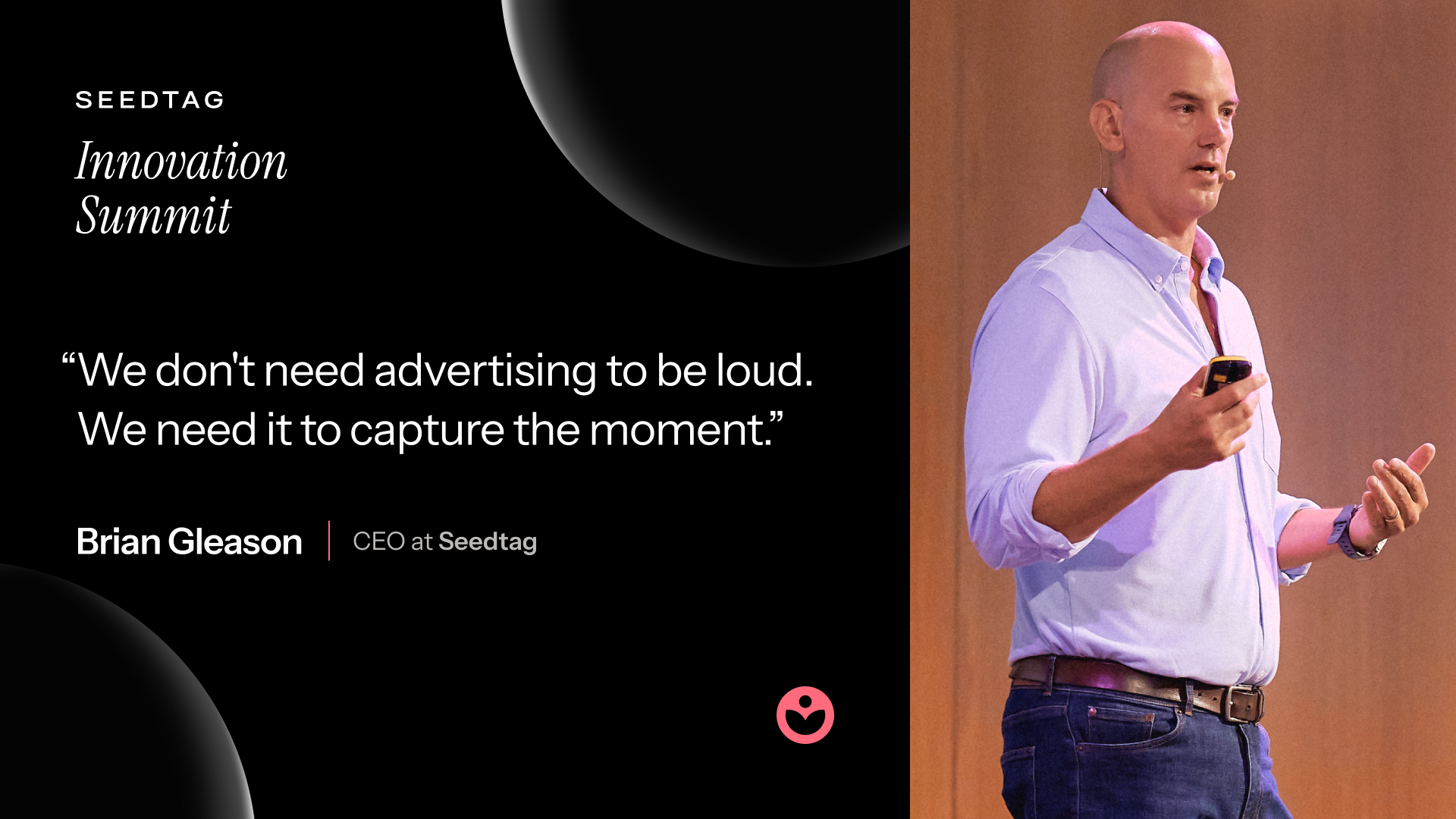
During the Summit, Brian Gleason, our CEO, added another layer: "We're more connected than we've ever been, but we're more distracted than we've ever been." For Brian, finding out how to connect in that moment is the most important thing, whether you're a brand, an agency, or a publisher.
The agenda combined dedicated sessions for the supply side and the demand side with joint sessions that put both in the same room. Topics ranged from the agentic shift and AI search to attention measurement, brand safety, CTV, creative, and life after the traffic. At lunches and dinners, the conversations kept going.
Across all of them, one thing became clear. The challenges facing the adtech ecosystem aren't local. They're global. And they become easier to solve when both sides look at them together.
Key Takeaways
- Consumers are more connected and more distracted than ever, and connecting with them in the moment matters for brands, agencies, and publishers alike.
- The same person makes different decisions in different situations, shaped by signals like time of day, screen, weather, and place.
- Fewer impressions carry identifiers, but audiences haven't gone anywhere, and reaching them requires a new structure.
- Interest, emotion, and intent shape how people process advertising, while viewability alone says nothing about that processing.
- Publishers, agencies, and brands face the same challenges from different perspectives, and the conversation is global, spanning the United States, Latin America, and Europe.
What Are the Biggest Challenges Facing the Digital Advertising Landscape?
Throughout the Summit, Brian Gleason put the consumer at the center of the conversation. For him, it's the one thing the industry doesn't focus on enough. We talk about acronyms, LLMs, and chats, but rarely about what consumers are doing every day or what their world is like.
And that world is full of noise. Attention is fleeting, and capturing it is hard. At the same time, clients are under pressure to grow and differentiate, and Brian raised an open question about what happens to them as products become commoditized in AI chat environments.
Grego Martínez, our Chief Product Officer, pointed to another challenge: media buying itself.
In CTV, most buying happens at the platform level, yet streaming services rarely have exclusive content. To illustrate the point, Grego shared a simple example: in Spain, Harry Potter is available on eight different platforms. So when a brand buys one of them, it's buying the service, not the moment. It learns nothing about the show being watched, the emotion it creates, or the hour and day it's being seen.
Buying through demand side platforms (DSPs) has a similar limitation. Brands and agencies can target IAB categories, keywords, domains, geography, or day part, but combining all of those signals to build moments manually is very complicated. The signals exist, but programmatic fragmentation keeps them apart.
Why the Adtech Ecosystem Is Moving From Understanding the Who to the Moment
For Grego, solving that fragmentation starts with a simple idea: the same person can make very different decisions depending on the situation they're in.
Picture someone commuting to work on a rainy Monday morning, phone in one hand, about to lose connection in five or six minutes. Any message has to be fast. Now picture the same person on a sunny Sunday morning, planning the week ahead with Monday off. They might spend 90 seconds on a powerful long video, one that takes them to the next step.
Nothing about them has changed. Only the moment has.
The same happens with a recipe. On a Tuesday evening after work, someone looking one up wants something fast. On a Saturday morning, with family and friends coming over, they're far more open to a message tied to that interest. The article is exactly the same. The moment is not.
That's why content is only one piece of context. The hour, the day of the week, and the season all matter. So do the type of screen someone is using, the weather, and the place they're in. On their own, these signals won't massively improve advertising. Combined, they create a scenario where advertising works much better.
Moments also change across environments. On mobile, things happen faster. On desktop, people are usually sitting down and paying more attention. CTV is often watched in a group rather than alone.
"We've spent more than 20 years understanding the who. Now, I think the future will be won by those who understand the moment much better," Grego said as he closed his session.
Audiences Were Never Identifiers
Hannes Sieling, our VP of Data & AI, started from programmatic advertising's long reliance on identifiers. They gave data teams structure, plus the reach to find people again. Today, fewer impressions carry them, but the reality hasn't changed. The same people are consuming the same content. And audiences were never identifiers in the first place.
What the industry needs is a new structure, built around the content people consume. That's the idea behind vector-based targeting: grouping similar content together so brands and agencies can find the environments closest to their goals, while balancing reach and precision.
Hannes also pointed to the technology that makes this possible: "Embedders are a little bit the hidden champions, the unsung heroes of the whole rise of large-language models."
The real question is what counts as similar. For him, the answer needs to go beyond clicks or categories and help find the right environment at the right moment. Understanding how people actually process what they see is a key part of that answer.
The Science Behind Attention, Emotion, and Intent
Professor Tino Meitz from the University of Münster explained how people process advertising. Who we are stays fairly stable, but how we feel and what we're focused on can change in milliseconds. When people consume media or advertising, that state of mind matters most.
That's also why viewability isn't enough. It shows that an ad could be seen, but says nothing about whether it was actually processed.
Three contextual signals shape that processing:
- Interest: If people aren't motivated to watch a show, they're unlikely to engage with the advertising within it.
- Emotion and affect: The brain relates new situations to past experiences, so a context that connects to familiar feelings makes new information easier to process.
- Intent: People need to be in the right situation for a message. If you want to buy a mid-sized SUV, you probably won't walk into a Ferrari dealership.
Tino was careful to separate affect from emotion: "Affect is something you can't govern. It's something that's happening, it's also, to a certain extent unconscious. Emotion is an evaluation of your affect afterwards."
How Can Supply and Demand Collaborate Across the Adtech Ecosystem?
Rob Beeler, who led the Two Sides, One Signal working session, explained why collaboration and supply and demand alignment matter. “Both sides are trying to solve the same things. This is a relationship-driven industry, and relationships are built by talking to each other in person. When both sides start working together, he said, they can be more effective for advertisers”, he said.
Kevin Donker, Head of Programmatic & Media Automation at Omnicom Media, brought that same spirit to the agentic conversation. For Kevin, agentic buying is still in its infancy, and the industry will have to come together to adopt protocols that make it reliable. When that happens, the productivity gains from AI should be reinvested in people.
In his view, the winners will be organizations that use AI to boost creativity, leadership, and judgment. The ones left behind will simply put an AI layer on top of an already fragmented workflow.
Brian Gleason echoed that idea in his closing remarks. He pointed to the feedback shared over the three days on different ways of working, ad inventory sources, and ways to measure. He also stressed the importance of trust: when you know you can trust someone, you know they'll do what they say they're going to do.
"There are a lot of pressures and challenges we think about in the world, and the things we shared over the last few days were brilliant. That's what we love to do: share information. It's an ecosystem that works together, and that's what we're trying to create", Brian Gleason.

How Does Neuro-Contextual Advertising Bridge the Gap Between Supply and Demand?
If both sides face the same challenge, they also need a shared way to understand the moment. That's what Neuro-Contextual Advertising offers.
Liz, our Neuro-Contextual AI, reads signals of interest, emotion, and intent to understand the moment behind each impression, without personal data or identifiers. For brands and agencies, that means reaching people when it matters most. For publishers, it means their content is valued for the moments it creates.
And it goes beyond advertising. Bringing value back to the open web helps keep quality content alive, and that's a responsibility the whole industry shares.
From Barcelona to the Next Conversation
Over three days, publishers, agencies, and brands from the United States, Latin America, and Europe approached the same questions from different perspectives. How do we capture attention? How do we reach audiences without identifiers? How do we make sure quality content keeps being found and valued as the way people discover information changes?
For us, at Seedtag, those conversations reinforce the vision behind Neuro-Contextual Advertising: understanding people's interest, emotion, and intent in the moment they're in.
It's not about knowing who. It's about understanding the moment.
Thank you to everyone who joined us in Barcelona. If you'd like to keep the conversation going, our team is here.
.png)
Il nostro blog

CTV vs Linear TV: What is the Difference of Connected TV and traditional?
Linear or traditional TV refers to the conventional television broadcasting model where content is delivered via satellite or cable. Content is programmed and displayed on particular channels at specific times and dates.
Connected TV (CTV), on the other hand, refers to any television set with an internet connection, offering viewers the freedom to watch content on-demand. Viewers can use smart TVs, gaming consoles, and streaming devices to access streamed content from platforms like Netflix, Hulu, and Amazon Prime Video, choosing from a wide range of programming, live events, and viewing options.
Key differences
- On traditional cable, content is broadcast at specific times and dates, while connected TV allows viewers to watch content on their own schedule.
- Typically, TV viewers watch programs in real-time on cable, and the content is delivered through broadcast channels. Connected TVs require an internet connection and provide content through streaming services, giving advertisers new ways to reach their target audience.
- While linear TV ad placements depend on specific times and scheduled programming, connected TV advertising offers more precision targeting. Advertisers can reach niche audiences based on demographics, interests, and viewing habits, making CTV advertising a more data-driven approach to ad spending.
- Additionally, CTV platforms allow users to interact with advertisements, creating a more engaging experience compared to linear TV. This interactive capability is a significant advantage of linear TV advertising’s digital counterpart, as it encourages higher conversion rates.

CTV vs Linear TV Advertising
Linear TV Advertising
Traditional television advertising involves placing commercials within programs by buying time slots or pods during specific commercial breaks to reach the target audience. The Designated Market Area (DMA) refers to a group of territories considered the primary television viewing area for a particular city or metropolitan region. The DMA defines the television markets, and everyone within a DMA viewing a specific channel where a brand purchases ad space will see the same commercial.
Linear TV ad placements are effective for broad audience reach but lack the precise targeting capabilities of connected TV vs. linear TV approaches. Advertisers must rely on DMA-based targeting, which can limit the effectiveness of ad spending since many viewers may fall outside the desired demographic.
CTV Advertising
CTV advertising is a form of digital advertising that involves placing ads on connected TVs like smart TVs and streaming devices. Advertisers buy ad inventory through ad exchanges or directly from CTV platforms and then place the ads within the content viewers watch on their connected TVs. This approach allows advertisers to reach their target audience with greater precision targeting by analyzing viewing habits and engagement data.
With the rising number of cord-cutters and increasing CTV viewership, advertisers are shifting their focus from traditional television advertising to connected TV advertising. CTV enables advertisers to reach highly specific demographics, ensuring that ads are delivered to relevant viewers. This capability contrasts sharply with traditional broadcast advertising, which cannot offer the same level of addressable TV precision.
While linear advertising enables advertisers to reach a wider audience base, the targeting capabilities are more limited. Advertisers cannot target niche audience segments making it difficult to target specific demographics or interests precisely. Since targeting is primarily based on DMAs, advertisers have restricted capabilities and could target segments where many viewers fall outside the desired target group.
Bagging prime-time slots for ads on traditional TV is also expensive when compared to CTV ads, and measuring campaign effectiveness is also difficult on cable as there is no access to detailed data and analytics. Advertisers only rely on traditional measurement methods like Nielsen ratings that provide a general overview of viewership.
Furthermore, CTV advertising provides real-time data and analytics, allowing advertisers to measure impressions, engagement rates, and conversions. Unlike linear TV, where success is measured through Nielsen ratings and broad estimates, connected TV advertising allows for more accurate and trackable results. This makes it easier to adjust advertising strategies and optimize campaigns in real-time.

The CTV advertising era
Unlike traditional television advertising, which broadcasts all ads to a general audience, CTV advertising enables personalization and relevance by targeting based on audience interests and viewing habits. CTV targeting focuses on an interest-based approach to effectively capture audience attention and engage them by showing viewers ads that are relevant to their preferences.
Since the ads align with a viewer’s real-time interests and you can now engage with the ads, CTV ad placements tend to lead to higher engagement and conversion rates. The ability to track key metrics like impressions, viewability, engagement rates, and conversions, makes it easier to measure the effectiveness of campaigns, optimize ads, and measure ROI.
Linear TV viewing is often passive, the engagement rates are lower, and viewers are less likely to interact with ads or take immediate action. CTV ads offer interactive capabilities that allow viewers to take action with an ad to learn more about the product or service, leading to higher levels of engagement and brand recall. The ability to target specific audiences reduces ad budget wastage on viewers who are not relevant, thus making CTV more cost-effective than traditional advertising.
CTV advertising is emerging as a preferred choice among advertisers as it empowers them with a more targeted, measurable, and engaging way to reach audiences compared to traditional advertising. CTV advertising can help maximize the effectiveness of campaigns by aligning ads with the current genre or show being watched by viewers. The ads appeal to the audience as they find them more relevant and engaging.
- Learn more about CTV advertising capabilities with Contextual TV by Seedtag.
- Additionally, register for Seedtag Academy to become an expert in all things CTV!
CTV vs Linear TV – Which is the Future of Advertising?
CTV and linear TV both have their strengths, but as consumer preferences shift towards streamed content, advertisers must adapt to these changes. While the advantages of linear TV advertising include broad audience reach and familiarity, CTV advertising offers better targeting, measurable engagement, and cost efficiency.
Additionally, comparisons highlight how CTV reduces ad budget wastage. Traditional TV ads often reach broad audiences, including many viewers who may not be interested in the product or service being advertised. In contrast, CTV’s addressable TV capabilities ensure ads are shown to the most relevant viewers, improving conversion rates and campaign effectiveness.
The growing adoption of smart TVs, gaming consoles, and streaming services like Netflix and Hulu further solidifies the dominance of connected TV in modern advertising strategies. As more TV viewers transition to digital platforms, advertisers who leverage CTV advertising will benefit from improved precision targeting, higher engagement, and a more effective return on investment. The future of advertising lies in the evolving landscape of CTV vs. linear TV, with connected TV leading the way in delivering personalized, data-driven ad experiences.

The automotive sector is entering one of its most transformative decades yet. From the rapid rise of EVs (electric vehicles) to new patterns in digital car buying, the landscape is being reshaped by evolving consumer expectations and smarter marketing technology.
But how is the automotive industry changing, and what does this mean for brands trying to connect with today’s drivers?
In the UK, the stakes have never been higher. With almost two million new cars registered in 2024 and the automotive sector forecast to double in value by 2035, opportunity is growing fast, but so is competition.
Seedtag’s latest white paper, How to Drive Marketing Success in the UK Automotive Industry, powered by our neuro-contextual AI platform Liz, analyses over 10,000 automotive-related web pages to map out the motivations, values, and intent signals shaping the next wave of automotive consumers.
Download the report to discover the up-to-date consumer trends in the automotive industry, and how neuro-contextual insights can put your brand in the driver's seat.
Key Takeaways
- Consumer expectations are reshaping the automotive industry. UK buyers are more value-driven, eco-conscious, and digitally connected, demanding vehicles that align with their lifestyles and ethics.
- Digital discovery leads to physical purchase. While 83% of buyers still close in-person deals, online research, reviews, and contextual content shape every decision.
- Marketing must move from “who” to “why.” Intent-driven insights and contextual advertising outperform demographic targeting, revealing why consumers act, not just who they are.
- Agility is essential. Seasonal intent peaks — such as EV interest in Q1 and Q4 — require real-time campaign optimisation to stay competitive.
- Privacy-first targeting is the future. Contextual AI enables precision advertising without cookies, aligning with new data regulations and consumer trust standards.
- The road ahead demands adaptability. Brands that leverage AI and neuro-contextual insights to anticipate emerging automotive consumer trends will lead the next era of marketing success.
From ‘Who’ to ‘Why’: A New Blueprint for the Car Buyer
Traditional targeting based on demographics is losing traction. The modern automotive consumer is no longer defined by who they are, but by why they buy, and when they’re ready to act.
According to the research, brand loyalty is fading fast, with only 2 in 10 UK buyers citing it as a decisive factor. Instead, environmental awareness and lifestyle alignment now play leading roles, influencing both brand choice and vehicle type.
Today’s car buyers move seamlessly between screens and moments of intent: watching EV reviews at lunch, comparing finance calculators after work, and booking test drives at the weekend.
Understanding why they engage—whether for status, practicality, or sustainability—allows brands to connect more meaningfully and time their messaging to perfection.

What’s Driving Automotive Conversations in 2025
By analysing the content people engage with, we uncover key themes across the web, revealing the shifting priorities, values, and motivations of today’s car buyers. Here are some examples:
- Luxury redefined: Innovation, personalisation, and tech integration are now as desirable as prestige.
- Everyday practicality: Cost-efficiency, reliability, and maintenance remain top of mind for mainstream buyers.
- Efficiency and control: Consumers are increasingly motivated by running costs, insurance rates, and tax savings.
- Sustainability as standard: With 60% of UK adults concerned about CO₂ emissions, environmental responsibility has become a key purchasing factor.
These themes reflect a broader shift across the global automotive industry, where consumers are demanding relevance, authenticity, and alignment with their personal values.
Learn More about how to win audiences
- Neuro-Contextual Advertising: Winning Audiences Through Interests, Emotions and Intentions
- Pioneering Neuro-Contextual: The Next Evolution in Artificial Intelligence Advertising
- Passions Over Profiles: AI for Advertising
Digital Journeys, Real Decisions
Car buying has become an omnichannel experience, but digital discovery is now firmly in the driver’s seat. Seedtag’s latest report identifies five key audience mindsets—each shaped by distinct motivations and online behaviours—that reveal how automotive advertising should evolve to drive success.
- First-Time Buyers: cautious and cost-conscious, rely heavily on forums, calculators, and user reviews.
- Young Urbans: dynamic city-living professionals, explore sustainability and connected EVs.
- Family Upgraders: focused on safety and practicality, engaging with comparison articles and test-drive videos.
- Luxury Seekers: guided by refinement and innovation, explore bespoke options and digital showrooms.
- Technophiles: early adopters, actively seek out autonomous features and AI-powered enhancements.
By aligning creative and media placement with these intent signals, brands can ensure that every impression lands at precisely the right moment in the car buyer’s journey.

How Is the Automotive Industry Changing?
The shift from traditional cars to electric and autonomous vehicles is more than technological. It's behavioural. Consumers now expect brands to deliver:
- Performance with purpose: EVs and hybrids are chosen not just for innovation, but for the statement they make.
- Intelligence and safety: Interest in autonomous driving and in-car AI systems is growing as trust builds.
- Seamless omnichannel experiences: 83% of car sales still close in person, but most of the decision-making happens online.
- Privacy-first engagement: As cookies disappear, contextual AI is redefining how brands reach audiences responsibly.
In short, automotive marketing is evolving from static messaging to real-time contextual storytelling. Driven by data, powered by emotion.
What to Expect From the Road Ahead
The future of automotive marketing will belong to brands that blend data intelligence with creative agility. The next era of success will not be about reaching everyone, it will be about reaching the right someone at the right time, with the right message.
Seedtag’s neuro-contextual AI approach helps marketers decode these micro-moments of intent, ensuring every campaign resonates with both head and heart.
To uncover the full insights: from seasonal intent curves to segment breakdowns and actionable recommendations, download Seedtag’s UK Automotive White Paper and put your brand in the driver’s seat.

The publishing industry is going through one of its most defining transformations. Attention is fragmented, competition is fierce, and artificial intelligence is reshaping how publishers create, distribute, and monetize content. Yet, amid all this disruption, one constant remains: the most successful publishers are the ones who understand their audience best.
In this episode of The Pub Way Podcast, Mike Villalobos and I spoke with Dan Benyamin, founder and CEO of Ion, about how AI is reshaping publishing, the impact of the creator economy, and what it really means to build a sustainable business model around attention.
What Matters Most — AI for publishers highlights
- Audiences still come first and publishers build a sustainable business model around attention.
- Smarter yield optimization, contextual and emotional intelligence, and predictive insights drive monetization.
- Automated video creation turns written stories into short-form videos and new ad inventory.
- The creator economy can be both competition and opportunity and repurposing long-form journalism into short videos helps publishers stay relevant.
- Build or buy combines specialized AI platforms with creative control and data ownership, and transparency is essential.
A Changing Landscape for Publishers
Dan’s career tells the story of modern adtech. As a four-time entrepreneur and former VP of Data Products at Condé Nast, he has seen the digital industry evolve from simple banner placements to data-driven ecosystems powered by artificial intelligence.
His takeaway is simple but powerful: audiences still come first. Everything else, from data pipelines to monetization tools, should revolve around creating meaningful experiences for readers. Publishers who lose sight of that connection risk being left behind, no matter how advanced their technology stack is.
Competing for Attention in a Fragmented Landscape
Publishers now find themselves in the middle of a new attention economy. On one side are the major social platforms that dominate reach. On the other, a generation of independent creators has become powerful competitors, building loyal audiences with minimal resources.
For traditional publishers, this shift can feel like a threat, but it also opens new doors. AI allows them to move faster, personalize experiences, and compete on equal terms with the creators who set the tone of online culture.
By analyzing what readers care about and how they behave, publishers can turn insights into action, adapting both content and monetization strategies in real time.
Turning AI into a Monetization Engine
Artificial intelligence is helping publishers grow revenue in ways that were unthinkable just a few years ago. Instead of relying solely on historical performance data, AI models identify trends, forecast demand, and optimize yield before opportunities are lost.
Here are some of the most impactful ways publishers are using AI to drive monetization:
Smarter yield optimization
AI analyzes traffic and engagement patterns to recommend pricing adjustments and increase the value of underperforming inventory.
Contextual and emotional intelligence
AI understands not just what a story is about but how it makes readers feel. This helps match ads that align with the emotional tone of the content, improving both performance and user experience.
Automated video creation
Platforms like Ion transform written stories or photo features into short-form videos, creating new ad inventory and sponsorship opportunities.
Predictive insights
Machine learning anticipates which readers are most likely to subscribe, engage, or leave, enabling faster and more personalized responses.
Through these applications, AI does not replace human creativity but amplifies it. The result is a smarter, more efficient monetization ecosystem built around audience understanding.
Learn more about AI for publishers & Monetization
- AI in Publishing: How Publishers Can Unlock Growth Through Audience-Centered Innovation
- Digital Marketing Musts for Publishers: Locking in Monetization with Brand Safety
- How Publishers Can Future-Proof Brand Safety and Revenue with the Right Advertising Supply Side Platform
Collaboration in the Creator Economy
The creator economy has redefined what it means to be a publisher. Individual creators now function as media brands, often capturing the cultural pulse faster than traditional outlets. For established publishers, this can be both competition and opportunity.
Dan believes collaboration is the key. Publishers already have trusted brands, strong editorial voices, and access to advertisers. Creators bring authenticity, community, and agility. AI can bridge the two worlds by making it easier to produce, adapt, and distribute content at scale.
Repurposing long-form journalism into short videos or co-branded pieces helps publishers stay relevant across formats while giving creators access to higher-quality storytelling. When powered by AI, this type of partnership can unlock entirely new revenue models.
Trust, Transparency, and the Rise of AI-Generated Influencers
As AI becomes part of the creative process, questions around authenticity naturally arise. We’re already seeing the emergence of AI-generated influencers, digital personalities capable of producing endless content. While these tools can be efficient, they also challenge the foundations of trust that publishers have built with their audiences.
Dan’s view is clear: transparency is essential. Audiences appreciate honesty about how technology is used. Publishers who clearly disclose AI-generated elements preserve credibility and maintain control over how their brands are perceived.
AI should enhance creativity, not disguise it. It should amplify human talent, not replace it.
Build or Buy: AI for publishers
As AI becomes more integrated into publishing, many organizations are asking whether to build their own solutions or partner with external providers. Dan’s answer is pragmatic.
Publishers are not technology companies; their true strength lies in culture, storytelling, and audience relationships. Building everything from scratch can distract from that mission. Partnering with specialized AI platforms allows teams to focus on what they do best while gaining access to innovation and scale.
The smartest approach often combines both: outsourcing infrastructure and automation while maintaining creative control and data ownership. This balance lets publishers innovate without losing their identity.
Practical Ways to Apply AI
Adopting AI does not have to mean overhauling every workflow. Many publishers start with small, high-impact projects that deliver quick results.
Some of the most effective examples include:
- Automated content tagging to improve ad targeting and user experience
- Personalized recommendations that increase engagement and session time
- Dynamic ad creatives that adapt to context and audience mood
- Predictive analytics that help forecast trends and performance
- Automated video summaries that repurpose existing assets for social media
Each of these applications generates incremental value. Together, they build a foundation for long-term, scalable monetization.
Why AI Matters for Publishers
AI is transforming how content is produced, delivered, and monetized. But beyond efficiency, it’s redefining how publishers connect with their readers and partners.
It enables privacy-first monetization models that respect user data while maximizing ad performance. It replaces manual reporting with predictive insights, helping teams anticipate trends instead of reacting to them. And it empowers publishers to offer advertisers something invaluable—relevance rooted in context rather than personal identifiers.
In a world where attention is scarce, understanding audience emotion and intent in real time has become a competitive advantage. AI gives publishers the ability to act on that understanding at scale.
As Dan summed up in our conversation, “It’s a battle for attention. You have a thousand companies fighting for a few minutes of someone’s day. Make sure you know what you’re fighting for.”
Listen to the Full Conversation
Artificial intelligence is redefining how publishers grow, compete, and connect with audiences. But technology alone is not the answer. The winners will be those who combine data, creativity, and authenticity to build stronger relationships with readers and advertisers alike.
Listen to the full episode ofThe Pub Way featuring Dan Benyamin, founder and CEO of Ion, to learn how publishers can use AI to improve monetization and stay ahead in a rapidly changing digital landscape.

Television has entered a new chapter. What was once a one-way medium is now one of the most dynamic and data-driven channels in the marketing mix. As viewers move from traditional TV to streaming, CTV ads are reshaping how audiences are reached and how content is monetized.
The numbers tell the story. As of 2024, over 115 million U.S. households consume television through connected devices, representing nearly 88 percent of all homes. That is not a trend; it is a complete redefinition of attention.
CTV Ads: Highlights
- CTV advertising blends TV impact with digital precision: targetable, measurable, and optimizable in real time.
- Reach the right viewers using demographics, interests, and content-viewing behavior to reduce guesswork and waste.
- Spend smarter with programmatic buying that optimizes price, location, co-viewing, relevance, and cross-screen ROI.
- Measure what matters with real-time analytics—impressions, completion rates, conversions—and benefit from higher attention than linear TV.
- Tackle fragmentation with first-party data, unified identity and measurement, and contextual targeting for privacy-safe relevance.
From Cable to Connection
For years, television revolved around reach. Brands bought airtime, crossed their fingers, and measured success with broad estimates. But the streaming era changed everything.
CTV advertising brings together two worlds that once lived apart: the impact of television and the precision of digital. With internet-connected TVs, ads can be targeted, measured, and optimized in real time.
This means advertisers can finally understand who saw their ad, how they engaged, and whether that exposure led to real action. It is still TV, but it behaves like digital.

Why Advertisers Are Moving to CTV
Let’s be honest. It is not just about following the audience. It is about efficiency, accountability, and more thoughtful engagement.
CTV ads allow brands to:
Reach the right viewers
Unlike traditional TV, CTV uses audience signals, such as demographics, interests, and content-viewing behavior. Advertisers can deliver messages that make sense in the moment rather than relying on guesswork or broadstroke targeting.
Spend smarter
Programmatic buying makes every impression count by optimizing signals for price, location, high-intention, co-viewing, audience relevance, and cross-screen ROI
Measure what matters
With real-time analytics, advertisers track impressions, completion rates, and conversions. The gap between storytelling and measurable outcomes is finally closing.
And there is another layer. Attention on CTV is higher than on linear TV. Viewers actively choose what to watch, making ads more likely to be noticed and remembered.
Learn More about CTV Ads
- How to Advertise on CTV: Streaming Into the Future for Brands and Publishers
- CTV vs Linear TV: How is CTV advertising different from Linear TV?
- A “Break” Down of Ad Breaks: Understanding CTV Ad Pods
- Closing the CTV Measurement Gap: Data Quality & Performance Talks
What CTV Means for Publishers
If CTV is a revolution for advertisers, it is a lifeline for publishers.
As streaming consumption grows, ad-supported models are generating new, sustainable revenue streams. Major platforms like Netflix, Disney+, and Amazon Prime Video now include ad tiers, and viewers are embracing them.
For publishers, CTV advertising unlocks:
More monetization opportunities
Pre-rolls, mid-rolls, post-rolls, homescreen spots, and pause ads offer flexibility, while premium ad-supported tiers generate recurring revenue without relying on subscriptions.
Premium value for premium content
Streaming viewers are intentional about what they watch. This attention translates into higher retention and stronger CPMs for publishers who can offer brand-safe, high-quality environments.
Cross-device consistency
With identity spines that include HHIDs, CTV can integrate with mobile and desktop campaigns, giving publishers a unified, omnichannel narrative that keeps audiences engaged across screens.
The result is a more balanced ecosystem where publishers are not only storytellers but strategic partners in delivering measurable, relevant advertising.

The Data Challenge Everyone Is Talking About
Still, growth brings complexity. The CTV advertising ecosystem faces its biggest challenge in one word: fragmentation.
Data lives across multiple platforms, formats are not standardized, and measurement practices vary widely. This leads to ad repetition, limited transparency, and difficulties in tracking performance across devices.
But there is good news. The industry is moving fast to fix it.
Collaboration among advertisers, publishers, and tech partners is leading to unified measurement and identity frameworks.
Contextual targeting is making a comeback, using content signals rather than personal data to reach audiences with relevance and respect.
These advances are not just technical upgrades. They are the foundation of a healthier advertising ecosystem.
From Streaming to Strategy
CTV is no longer just a way to deliver video content. It has become a strategic platform where brands compete for attention, measure performance in real time, and optimize investment with precision. It is the place where storytelling and outcomes finally come together, where reach gains relevance, and where media buying starts with the audience and ends with measurable impact.
For advertisers, this means campaigns that perform and connect without wasting impressions. For publishers, it means monetizing intentional viewing with more control and higher value. And for audiences, it means seeing ads that feel timely, respectful, and worth watching.
CTV is not just a continuation of television. It is a new model for how advertising works and where it is headed.

Connected TV (CTV) no longer needs an introduction. With more than 70% of U.S. households now owning at least one connected device, the shift from linear to streaming has transformed how audiences consume content and how advertisers connect with them.
CTV has quickly become the viewer’s favorite. On-demand access, flexibility, and a vast library of content have made it the natural replacement for traditional television. By 2024, viewership was already set to surpass 55 million in the U.S., with strong growth projected into 2025. This growth is not just about scale, it is also about transformation. Unlike linear TV, where advertising was based on broad demographic assumptions and limited measurement, CTV opens the door to personalized, trackable, and outcome-driven campaigns.
This evolution presents advertisers with unprecedented opportunities:
- Personalization: Ads tailored to viewing habits, interests, and purchase behavior.
- Measurement: KPIs such as reach, impressions, completion rates, CPCV, conversions, and incrementality deliver clarity on performance.
- Accountability: Unlike linear TV, CTV allows near real-time optimizations and outcome tracking.
But with opportunity comes complexity. The audience is fragmented across smart TVs, gaming consoles, set-top boxes, and streaming apps. Advertisers must learn to navigate this new ecosystem, master new tools, and rethink benchmarks to know whether their campaigns are truly working.
Against this backdrop, Episode 44 of AdTech Heroes welcomes Andy Beames, VP of Enterprise Partnerships at Samba TV, who breaks down how changing behaviors, IP-delivered data, and omnichannel extensions are rewriting the rules of TV measurement.
Below, we highlight the most critical takeaways from the conversation, enriched with insights on KPIs and contextual strategies that every advertiser should have in their playbook.
Key Highlights: Winning Audiences in the New Era of TV Measurement
- The shift from linear to CTV has redefined advertising — bringing personalization, measurable outcomes, and real-time optimization.
- IP-delivered data enables unified, privacy-safe measurement across platforms, turning fragmentation into actionable insight.
- CTV now drives both awareness and performance, allowing advertisers to measure outcomes like visits, downloads, and conversions.
- Complementing linear with CTV and digital video unlocks incremental reach and cost efficiency across audiences.
- Contextual TV and omnichannel data help advertisers connect meaningfully with underexposed households, ensuring campaigns are relevant, transparent, and outcome-driven.
TV Measurement at a Crossroads
Generational shifts are reshaping viewing. For younger audiences, Netflix and YouTube dominate the TV landscape. For viewers over 35, broadcasters still lead. This divergence means advertisers can no longer assume that a TV buy will reach a balanced spread of households.
Andy Beames points to recent BARB and Evan Shapiro data that highlight this split. Among 16–34s, the top three channels are Netflix, YouTube, and BBC, with no commercial broadcasters in the top tier. Among 35+, the top four remain broadcasters and pay TV. In other words, the value of broadcast airtime for younger audiences is rapidly diminishing, while for older demographics it still holds.
Measurement is not a call to action for the future, it is already evolving. Agencies and publishers are experimenting with new methodologies, incorporating clean rooms, and testing independent adtech tools to capture performance more holistically.

From IP Delivered Viewing to IP Delivered Data
IP delivery fractured attention, but also created the data to solve the problem. With Automatic Content Recognition (ACR) and other IP-based technologies, planners can:
- Connect broadcast, AVOD, SVOD, and social exposure at the household level.
- Use clean rooms to match datasets securely and respect privacy.
- Build unified measurement frameworks across devices and platforms.
As Andy explains, IP delivered content is both the problem and the solution. It has splintered viewing into multiple services, but it also generates the granular data advertisers need to stitch audiences back together.
When TV Drives Outcomes
Traditionally, TV was the channel for fame and reach. It built awareness at scale, but direct response and outcome metrics were limited. Today, CTV supports outcomes more typical of digital:
- Website visits and conversions
- App downloads and installs
- Store visits and purchases
This shift expands the role of TV. Advertisers no longer choose between brand or performance. They can measure both. Direct response advertisers who once relied exclusively on social platforms are now testing TV with DR-style KPIs, and brand advertisers are layering outcomes onto their traditional metrics.
The result is a richer, more flexible planning process where TV can play at every stage of the funnel.
Learn More
- Closing the CTV Measurement Gap: Data Quality & Performance Talks
- A “Break” Down of Ad Breaks: Understanding CTV Ad Pods
- What is FAST TV & Why Marketers Are Tuning In to CTV Opportunities
- Why the oRTB Content Object is Key for Programmatic TV
Linear’s Incremental Reach Problem
One of the most striking insights from Samba’s State of Viewership report is that 92% of linear impressions in the UK reach only half of households.
The implication is clear: heavy TV viewers absorb the vast majority of impressions, creating high frequency but limited incremental reach. For advertisers, the cost of finding new or light viewers through linear alone becomes prohibitively expensive.
The solution is to complement linear with CTV, YouTube, and the open web. These environments allow brands to reach audiences who are underexposed or absent from traditional TV, often at a lower incremental cost.
Where Ad Tiers Fit Today
Premium streamers like Netflix and Disney Plus have launched ad tiers, signaling a new frontier for advertisers. However, inventory is still limited and CPMs are high. Andy notes that these tiers are best positioned for brand budgets, offering reach to audiences that are otherwise unreachable through broadcast.
For performance-driven campaigns, broader CTV supply and open web video remain essential. They provide the scale, price flexibility, and targeting precision needed to balance cost efficiency with measurable outcomes.

The CTV KPI Toolkit
To evaluate campaigns effectively, advertisers must combine traditional TV metrics with digital-style KPIs:
- Reach and Impressions: Who saw the ad, and how often
- Viewability and Completion Rate: Were ads actually watched
- CPCV and Conversions: What was the cost per complete view, and did it drive actions
- Incrementality: What additional value did CTV bring compared with other channels
Beyond campaign KPIs, advertisers should also track consequential effects like website traffic, share of voice, time on site, leads, and brand lift. This broader perspective helps prove not only whether ads ran but whether they made an impact on business outcomes.
The real advantage of CTV is the ability to tie exposure to both attention metrics and conversion metrics, delivering a more comprehensive view of ROI.
Omnichannel Reach Extension with Context
Advertisers increasingly ask how to find the households that linear misses.
This is where Contextual TV plays a key role:
- Targeting beyond genres: Align ads to the themes, topics, and emotions of the content viewers are watching, not just broad categories.
- Comprehensive reporting: Blend classic CTV KPIs with incrementality and attention metrics.
- Objective led creative: Formats designed to capture attention and drive specific outcomes.
By combining contextual intelligence with omnichannel data, advertisers can close the linear gap, connect with viewers in relevant moments, and deliver campaigns that are both efficient and meaningful.
Looking Ahead: TV measurement
Three shifts will define it's next phase :
- Greater transparency of metadata so advertisers can verify placement, brand safety, and outcomes.
- Cleaner and interoperable datasets that respect privacy while enabling cross-screen planning.
- Outcome-aware benchmarks that treat TV as a multi-role channel, balancing reach, attention, and concrete business impact.
The cultural shift also matters. Andy emphasizes the importance of flexibility and empathy not only in hybrid work but also in how teams collaborate across TV, digital, and analytics. Measurement is technical, but the strategies that succeed are built on collaboration and shared understanding.
Tune In to the Full Episode
For a deeper dive into data quality, reach extension, and outcome-based TV, listen to AdTech Heroes Episode 44: “The New Rules of TV Measurement” with Andy Beames (Samba TV).
Want to become an expert in all things CTV? Explore Contextual TV and register for Seedtag Academy to learn how to measure success, target beyond genres, and design creatives built for attention.

From scanning pages to understanding people
For decades, advertising has relied on demographics and behavioral profiles to reach audiences. Age, gender, income brackets, cookie trails, broad labels that reduce people to categories. But none of us fit neatly into those boxes. Our identities are shaped by unique passions, emotions, and intentions that demographics alone cannot capture.
Contextual targeting emerged as a privacy-safe alternative, matching ads to keywords, URLs and category labels to deliver scalable reach and brand safety, particularly on the open web. It was effective at the top of the funnel, but its foundation was classification. It could identify what a piece of content was about, not why a consumer engaged with it.
Advertising needed to evolve. Advances in neuroscience and AI opened the door to a new approach: moving beyond labels to understand the deeper drivers of attention and decision-making. This is the foundation of Seedtag’s neuro-contextual advertising, an approach designed to deliver campaigns that feel timely, resonate emotionally, and achieve measurable outcomes while remaining fully privacy-first.
Winning Audiences: Key Highlights
- Moving beyond demographics, neuro-contextual advertising taps into passions, emotions, and intentions in real time for privacy-first, relevant campaigns.
- Interest captures attention, emotion enhances recall, and intention drives action—together powering full-funnel impact.
- Agentic AI transforms insights into dynamic activation, aligning content, audiences, and creative with contextual signals.
- Advertisers win audiences by moving beyond stereotypes, creating ads that resonate deeply, feel human, and deliver measurable outcomes.
Why passions matter more than profiles
On paper, demographics can make us look predictable. Traditional demographic targeting would drop someone into a box and serve generic products. But real people are more complex. Their passions, values and intentions go far beyond labels.
As Brian Danzis, Chief Revenue Officer at Seedtag, explained in a recent blog post about AI for Advertising:
“Traditional demographic targeting would drop me into a “male, 45–54, suburban” box and push sports cars or generic gadgets. Liz’s neuro-contextual targeting sees the chef, the cyclist, and the environmental steward—and serves me organic food products, sustainable gear, boutique travel experiences, and brands that share my values.”
This is exactly where Seedtag’s neuro-contextual advertising shows its strength. By combining neuroscience principles with Agentic AI, it interprets interest, emotion and intent in real time, moving beyond classification to understand how people think, engage and decide.
At the heart of this approach is Liz, our proprietary neuro-contextual AI. Liz mirrors the sophistication of human thought by interpreting deeper signals in real time and delivering high-quality, privacy-first, full-funnel advertising across premium CTV, video and the open web. Because Liz is developed entirely in-house, we have full control over its evolution, ensuring our technology stays ahead in the privacy-first era without relying on third-party tracking or personal data.

How do interest, emotion, and intention drive superior outcomes?
At the core of neuro-contextual are three main principles that explain how advertising can capture attention, build affinity and drive action more effectively.
- Interest captures attention. When ads are placed in contexts that are relevant and familiar, they are processed more fluently. This congruence between message and environment makes them easier to notice, understand and remember.
- Emotion enhances recall and brand affinity. Emotional stimuli do not just attract attention, they command it. Content associated with positive feelings generates stronger responses, boosting both memory and decision-making. Ads placed in these environments benefit from a halo effect, building deeper brand connections.
- Intention drives engagement and action. When people are in a goal-directed state, their focus narrows to information that feels relevant to their journey. By aligning with this stage in real time, brands can activate intent at the exact moment when consumers are ready to explore, compare or convert.
When these three forces converge, advertising creates meaningful outcomes across the full funnel, always within the boundaries of evolving privacy standards.
The role of Agentic AI
Neuro-contextual technology can be thought of as the brain: it interprets signals of interest, emotion, and intent with a human-like understanding of content. But it reaches its full potential when paired with Agentic AI, which acts as the body that transforms these insights into meaningful action across the entire campaign lifecycle.
With an intuitive, conversational interface, Agentic AI dynamically:
- Aligns campaign goals with the most relevant content environments.
- Builds custom audiences based on genuine engagement patterns rather than predefined segments.
- Continuously adapts creative and messaging to resonate with the emotional tone of each placement.
This combination of neuro-contextual intelligence and agentic-driven activation has transformed contextual advertising from an advanced targeting tactic into a fully integrated media solution for privacy-first advertising.
Learn more about winning audiences
- Targeting Intention: Reshaping Performance Marketing with Custom Intent Audiences
- Pushing the Boundaries of the AI Revolution in Advertising
- What is Agentic AI And How is Transforming Digital Advertising
- Passions Over Profiles: AI for Advertising

Why this matters for advertisers
For advertisers, the promise of neuro-contextual goes far beyond improved targeting. It reshapes how campaigns are built, activated and optimized, delivering impact across the entire funnel while respecting user privacy.
- Privacy-first by design. Relevance delivered without third-party data, cookies or invasive profiling, ensuring campaigns stay compliant in an era of stricter regulation.
- Human-like contextual understanding. AI trained to comprehend text, images and video content in a way that mirrors how people naturally process information, enabling scalable strategies across CTV, premium video and the open web.
- Emotionally and semantically aligned ads. Campaigns resonate with the why behind user engagement, not just the what of content recognition.
- Higher attention and recall. Neuroscience shows that relevance is a cognitive metric: familiar, context-congruent stimuli are processed more fluently and with more positivity, leading to stronger engagement and receptivity.
- Smarter decisions and strategic opportunities. With Agentic AI activating insights instantly, campaigns adapt continuously to context and audience signals for greater efficiency and measurable outcomes. Through Liz Agent, advertisers can unlock opportunities pre-launch and optimize across every stage of the campaign lifecycle, from planning and execution to delivery and learnings.
A smarter, more human era of advertising
Advertising has always tried to understand people, what they care about, how they feel and what they intend to do. For years, demographics and behavioral profiles reduced that complexity into categories and keywords. But today, we can go further.
With neuro-contextual advertising, brands can connect through what truly matters: people’s interests, emotions and intentions. It is advertising that feels timely, resonates deeply and delivers measurable outcomes while protecting privacy.
Emotion may be advertising’s oldest lever and now it is also its newest frontier. The best campaigns have always done more than inform. They moved us. They made us feel. And for the first time, we can measure and optimize for that too.
It is time to leave stereotypes behind and build campaigns that understand rather than interrupt. The future of advertising is more relevant, more human and more effective.
Discover how Seedtag’s neuro-contextual advertising can help your brand win audiences through their interests, emotions and intentions. Learn more here.

Halloween goes beyond costumes and candy
Halloween has moved far beyond a one-day celebration. Today it stretches across entertainment, shopping, digital platforms and seasonal traditions, creating one of the richest periods for brands to connect with audiences.
Streaming platforms like Netflix, Prime Video and Shudder fuel the fascination with horror and supernatural genres, while events ranging from pumpkin patches and autumn fairs to large-scale haunted attractions bring communities together. Conversations peak not only around trick-or-treating, but also themed snacks, viral costumes, seasonal décor and movie marathons.
The scale speaks for itself:
In the weeks leading up to October 31st, Halloween content generated over 69,000 articles and more than 3.1 million visits, with an average presence score of 4.0 across media.
This confirms Halloween’s status not just as a seasonal holiday, but as a cultural phenomenon where entertainment, commerce and community converge.
Key Takeaways from Halloween Advertising Campaigns
- Brands can leverage neuro-contextual advertising to align campaigns with audiences’ passion, emotion, and intent.
- Halloween has evolved into a cultural phenomenon spanning entertainment, shopping, and community experiences.
- Key drivers include haunted attractions, fall activities, movies/streaming, candy, costumes, and décor.
- Candy and costumes mix nostalgia with creativity, fueling both tradition and DIY expression.
- Horror movies and streaming platforms anchor seasonal storytelling, keeping Halloween relevant for all ages.
The hidden map of Halloween conversations
When we look at the universe of Halloween content, some themes clearly dominate. Events and attractions lead the way, representing more than 40% of the conversation with over 16,000 articles and 637,000 visits. From pumpkin patches and farm festivals to Disneyland’s Oogie Boogie Bash and the Bronx Zoo’s Pumpkin Nights, audiences are leaning into experiences that combine festivity with community.
Close behind are fall activities and events with 14,000 articles and nearly 800,000 visits. Seasonal outings like apple picking, autumn fairs and even skywatching around the Hunter’s Moon have become part of the extended rituals, with brands like Time Out and Space.com shaping how audiences plan these experiences.
Movies and streaming also play a central role, generating 15,000+ articles and over 876,000 visits. Horror dominates the screen, from classics on Prime Video to cult hits from A24, with Netflix and Shudder cementing their place as go-to destinations for seasonal scares.
And of course, no Halloween is complete without candy, costumes and décor. These conversations are not just about what to buy, but about rituals of preparation: baking spooky recipes, crafting DIY décor, or curating the perfect outfit for the big night.
What emerges is not a single theme but a complex ecosystem of passions, one where entertainment, food and community overlap to create meaning.

Candy: nostalgia wrapped in chocolate
Halloween candy is more than sugar, it is tradition. Year after year, classics like Kit Kat, Reese’s and Snickers dominate conversations, but the real story is how these treats get reimagined. Homemade recipes turn candy into dirt pudding, puppy chow or monster themed snacks designed for parties and classroom fun.
This blend of nostalgic favorites and creative reinterpretations shows how candy fuels not just indulgence but participation. It is about crafting moments to share, whether with kids knocking on doors or friends gathering for a horror movie night.
Costumes and décor: DIY meets spectacle
Costumes have always been the centerpiece of Halloween, but the conversation today is broader. Beyond superheroes and princesses, people are embracing DIY culture mixing creativity with affordability. A red cape, some face paint, or even a pumpkin pillow can be enough to transform a living room into a Halloween set.
Decor too reflects this blend of personal expression and tradition. From fall garlands and skeletons to Pinterest worthy table settings, people are not just buying items, they are curating experiences. Halloween becomes a canvas for creativity, mixing the spooky with the playful and the homemade with the spectacular.
Movies: the heartbeat of Halloween storytelling
No other category cements the Halloween mood like movies. Seasonal classics such as Hocus Pocus, The Addams Family and The Haunted Mansion still dominate living rooms, while franchises like Halloween or Scream continue to evolve with new releases.
The cluster around horror movies and streaming reflects this passion, with 28% of visits concentrated here. From Netflix originals to A24’s critically acclaimed titles, audiences keep returning to horror as a defining ritual of the season.
At the same time, new productions and next gen horror directors keep the genre alive, attracting younger audiences and ensuring that Halloween remains both nostalgic and forward looking.
Activities: from festivals to school crafts
Halloween is no longer a one night affair. Autumn activities such as fairs, wine tastings and school crafts now form part of the extended rituals. Families explore fall outings, while kids bring the holiday spirit into everyday life.
Festivals and parties, from Mickey’s Halloween Party to Wicked Haunt Fest with its haunted walk throughs and beer gardens, showcase how Halloween thrives as a shared experience, something that unites generations, cultures and even brands looking to connect with audiences in festive, inclusive ways.

Haunted attractions and pop culture crossovers
Another cluster of interest is haunted attractions and spooky characters, generating over 317,000 visits. From New York’s Blood Manor to immersive exhibits like Dark Matter at Mercer Labs, audiences crave experiences that blend fear, art and entertainment.
Halloween also intersects with broader entertainment culture. Conversations around comics and entertainment clusters highlight Marvel, DC and Disney+ as cultural anchors, where superheroes, spooky storylines and cinematic universes merge with Halloween themes.
Learn more about Audience Insights and Marketing Performance
- Brand Marketing vs Performance Marketing: Why Full-Funnel Collaboration Matters More Than Ever.
- Driving Growth in a Shifting Market: Strategic Insights for Automotive Marketing Success.
- Targeting Intention: Reshaping Performance Marketing with Custom Intent Audiences.
- Revving Up Growth: Deep Audience Insights for Automotive Advertising Success.
How brands can connect with meaning
This is exactly where neuro-contextual advertising makes a difference. By combining neuroscience principles with Agentic AI, it interprets interest, emotion and intent in real time, moving beyond classification to understand how people think, engage and decide.
Behind these connections is Liz, our proprietary neuro-contextual AI. By mirroring the sophistication of human thought, Liz interprets deeper signals in real time and delivers high quality, privacy first, full funnel advertising across premium CTV, video and the open web. By decoding interest, emotion and intent, Liz helps brands align their campaigns with the very moments when people are most open to engagement.
Halloween as a lesson in relevance
Halloween proves that people’s passions are richer than any demographic profile. They are not just parents or students, men or women, Gen Z or Gen X. They are movie buffs, DIY decorators, chocolate lovers and festival goers.
By understanding these signals, brands can move beyond stereotypes and build connections that feel personal, emotional and timely. Neuro-contextual advertising offers the tools to do this at scale, while respecting privacy and ensuring campaigns are both effective and responsible.
Because in the end, Halloween is not only about costumes and candy. It is about shared rituals, creativity and community, and how brands that join those moments can truly resonate
Discover how Seedtag’s neuro-contextual advertising can help your brand win audiences through their interests, emotions and intentions. Learn more here.

In the evolving world of digital advertising, publishers face a balancing act. On one side is the need to maximize inventory monetization through programmatic advertising. On the other is growing pressure to protect user privacy and maintain brand safety across platforms. As cookies are phased out and new expectations from both audiences and advertisers take shape, publishers are reassessing their strategies starting with the role their advertising supply side platform (SSP) plays.
While first-party data and alternative targeting tactics have gained attention, one of the most effective paths forward is often overlooked: using a supply side platform built to deliver both performance and protection. Today, publishers need solutions that not only optimize fill rates and CPMs, but also prioritize context, relevance, and trust.
This post explores how a privacy-first advertising supply side platform can help publishers meet their business goals without compromising user experience or advertiser confidence.
The Changing Landscape for Publishers and Advertisers
As concerns around data privacy become more pronounced, publishers are under pressure to find monetization strategies that don’t rely on tracking users across the web. Audience targeting based on third-party cookies is fading, and in its place, new models are emerging that prioritize transparency and intent over personal data.
This shift has real economic consequences. According to industry research, publishers risk losing up to 60% of their revenue if they fail to transition away from third-party data. This makes it critical to rethink how ad inventory is packaged and sold, especially through programmatic channels.
Enter the modern advertising supply side platform. By rethinking how data is used (and more importantly, how it's not used) publishers can begin to align with the demands of both audiences and advertisers, without sacrificing scale or revenue.
How SSP Advertising Supports Brand Safety and Monetization
The core function of an advertising supply side platform is to help publishers make their inventory accessible to multiple demand sources, including networks, ad exchanges, and demand side platforms (DSPs). But not all SSPs are created equal. The right platform does more than connect publishers with buyers. It enables them to apply sophisticated controls to ensure ad placements meet both commercial and editorial standards.
Brand safety is a central part of this. Publishers need to ensure that ads shown on their sites reflect the tone, values, and credibility of their content. Poorly matched or inappropriate ads not only reduce user trust, but can also drive advertisers away.
A high-performing SSP should support this balance by offering tools that help:
- Filter out unsuitable demand sources
- Analyze content in real time using AI in publishing
- Enable granular control over ad placement
- Match ad formats to user behavior
- Support real time bidding without compromising editorial integrity
This allows publishers to maintain high standards while optimizing monetization, even as the traditional models of behavioral targeting lose relevance.
The Role of AI in Publishing and Brand Safety
Artificial intelligence is playing a growing role in how SSPs operate, particularly when it comes to ensuring brand safety and targeting precision. AI in publishing makes it possible to move beyond basic keyword matching and start analyzing context in a more human-like way.
Rather than relying on predefined taxonomies or user tracking, AI-enabled SSPs can interpret the content of an article, video, or image, assess sentiment, and understand user intent. This enables more accurate ad placement, improving both relevance and safety.
For publishers, this means greater control over which ads are shown, where they appear, and how they align with content. For advertisers, it provides confidence that their brand is represented in a meaningful, appropriate environment.
By integrating these capabilities into their SSP, publishers are able to deliver value to advertisers while keeping their own editorial and user standards intact.

Why Publishers Should Consider Upgrading Their SSP
As audience expectations shift and advertisers demand more transparency, publishers are discovering that legacy platforms may no longer meet their needs. Traditional SSPs often focus narrowly on maximizing fill rates, with limited ability to enforce context-based targeting or support real-time editorial decision-making.
An upgraded supply side platform should offer publishers:
- Real time analysis of inventory and context
- Better support for programmatic advertising models
- Compatibility with advanced ad formats, including video
- AI-powered tools for context, sentiment, and intent classification
- Built-in brand safety controls and content filters
- Clear integration with DSPs to sell ad inventory efficiently
These features make it easier for publishers to align their ad inventory with high-quality demand, while reducing the risks associated with mismatched placements or irrelevant targeting. In effect, the SSP becomes not just a sales engine, but a safeguard for both performance and reputation.
Maximizing Ad Revenue Without Sacrificing Experience
The traditional tension in digital advertising has been between scale and relevance. Publishers are often asked to choose between running high volumes of ads or ensuring that each impression delivers real value to the user and the advertiser.
A modern SSP breaks that tradeoff. By combining real time bidding with contextual analysis, publishers can match ad space with relevant creative in a way that doesn’t compromise the user experience. When an ad appears alongside content that aligns with the user’s intent or emotional state, it is more likely to drive engagement, improve recall, and lead to conversions.
From a monetization perspective, this allows publishers to:
- Increase CPMs by offering more relevant ad inventory
- Package niche or premium content for targeted campaigns
- Provide advertisers with more precise targeting options
- Improve fill rates across various channels, including header bidding and video
This integrated approach benefits the entire advertising ecosystem, from publishers and advertisers to the end user.
Contextual Intelligence Over Behavioral Tracking
A key reason contextual advertising has become more important is its ability to connect content and ads without relying on behavioral profiles. While many publishers are experimenting with email addresses, device IDs, or IP-based segmentation, these tactics still come with privacy concerns and regulatory risk.
By contrast, a supply side platform that uses contextual AI can deliver high-performance campaigns without requiring user data. This not only protects audience privacy but also helps future-proof the publisher’s business model.
When contextual advertising is backed by strong AI and built into the SSP itself, it becomes scalable. Publishers can categorize articles, videos, and other content types in real time, allowing for smarter placement of creative based on subject matter, tone, and even visual cues.
This supports better performance metrics across the board, including ad recall, time on page, and brand perception, while helping advertisers target audiences based on what they care about in the moment, not who they are across the web.

From Strategy to Execution: How Publishers Can Get Started
The first step in upgrading your approach is aligning with an advertising supply side platform that supports advanced contextual capabilities. From there, publishers can begin to:
- Define clear goals for ad performance and brand safety
- Map inventory against content categories and user interests
- Test contextual campaigns with a variety of ad formats
- Identify keywords and topics that perform well across verticals
- Use video and high-impact formats to drive engagement
With the right SSP in place, it becomes much easier to manage both the operational and technical requirements of running a privacy-first, performance-driven advertising strategy.
In a digital environment where both users and advertisers demand more accountability, publishers can no longer rely on outdated tools or data-driven models that lack transparency.
By upgrading to an SSP built for modern standards, publishers gain the flexibility, control, and insight needed to thrive. Whether it’s optimizing programmatic performance, enhancing brand safety, or protecting user experience, the SSP plays a critical role in the publisher’s toolkit.
Want to learn more? Discover how Seedtag helps publishers future-proof their advertising strategies with an AI-powered neuro-contextual approach that balances relevance and results.

In a world where privacy reshapes how we measure and connect, digital advertising is undergoing a quiet but fundamental shift. The traditional approach of identifying users and following them around the web is giving way to something more precise, more respectful, and ultimately more effective: targeting intention.
At the center of this evolution are custom intent audiences. Unlike demographic or interest-based segments, these audiences are built around real-time purpose. They don't rely on who users are, but on what users are trying to do in the moment. For advertisers navigating a post-cookie landscape and rising expectations for both relevance and privacy, the change to intent-based marketing couldn't be more timely.
Custom Intent Audiences vs. Traditional Segments: What Makes the Difference?
Traditional audience segments work by assigning users to broad groups based on past behavior or assumed interests. A user who once browsed for electric cars might continue receiving related ads for weeks, even if their focus has shifted elsewhere. Custom intent audiences, by contrast, start with the present. They identify users based on the content they are actively consuming (articles, product comparisons, search behaviors…) and match that with the user’s likely intention.
This present-tense approach makes custom intent audiences inherently more relevant. It’s the difference between assuming someone is interested in fitness because they follow a sports brand on social media, and recognizing they’re ready to buy running shoes because they’re comparing prices on review pages.
The outcome? More qualified impressions, less wasted spend, and a clearer path to performance.
From Identity to Intention: Privacy-First Precision
One of the main advantages of custom intent audiences is how well they fit within today’s privacy-first advertising landscape.
Unlike identity-based models that depend on cookies or device IDs, intention-based targeting doesn’t need to know who a user is. It only needs to understand what they’re doing.
This difference isn’t just technical but philosophical. Instead of building user profiles based on long-term surveillance, advertisers are focusing on real-time, in-the-moment signals. These include the depth and structure of content, the tone and sentiment of the page, and the user’s position in their decision-making journey.
By using AI models trained to read these signals in real time, advertisers can detect not just interest, but readiness. And they can do so without compromising user privacy.
The Metrics That Matter
Performance is still the goal. And here, the numbers speak for themselves. When global automotive brand Nissan adopted Seedtag’s intention-based strategy to promote its C-SUV category, the results were substantial:
- A 67% reduction in Cost Per Qualified Visit (CPQV).
- A 34% drop in Cost Per Lead (CPL).
- A threefold increase in qualified visits against target.
What made the difference was simple. Ads were served only when users were showing active signals of intent; not just reading about cars, but comparing models, evaluating financing, or locating dealerships. In doing so, Nissan avoided mid-funnel waste and focused their investment where it had the most impact.
Across industries, similar results are emerging. Campaigns that embrace custom intent audiences consistently outperform those relying on static segments, particularly when it comes to mid- and lower-funnel outcomes.

Aligning Creative with Intention
Reaching the right user in the right moment is only part of the equation. The creative needs to match that moment too. When advertisers target based on intention, the creative strategy must follow suit. Messaging that resonates in a high-intent context looks different than messaging designed for awareness or passive browsing.
For example, a user reading general reviews about smartphones might respond well to informative, value-driven creative. But a user comparing two models side-by-side, looking at specifications or price breakdowns, is further along the journey. In that context, the ad should be clear, action-oriented, and directly aligned with the decision at hand.
This is where Seedtag’s AI intention models play a dual role. Not only do they assess the user’s intent, they also measure how relevant the campaign’s messaging is for that moment. By calculating both an Intention Score and a Campaign Relevance Score, Seedtag’s system ensures that ads appear not just when users are ready to act, but when the message is most likely to land.
This alignment between content, mindset, and creative is what turns impressions into outcomes.
The Case for Rethinking Audience Strategy
Marketers have spent years optimizing for attention by measuring viewability, maximizing impressions, and expanding reach. But attention alone doesn’t drive performance. Without intention, attention is passive. It doesn’t necessarily signal interest, and it rarely signals readiness.
Custom intent audiences offer a way to bridge that gap. They allow advertisers to:
- Replace volume with precision.
- Move beyond proxy metrics to actionable insight.
- Increase qualified engagement without relying on personal data.
In short, they bring intentionality into targeting, in a move that’s both ethically sound and commercially effective.

Where to Begin: Turning Strategy Into Skill
Custom intent audiences are a feature that represents a mindset shift. One that requires new ways of planning, measuring, and creating. For advertisers looking to make that shift, knowledge is the first step.
That’s why Seedtag has launched a new certification through Seedtag Academy: “Targeting Intention.” This program unpacks everything from the foundations of intent-based targeting to the role of AI in modeling user mindset in real time.
It’s designed for marketers who want to:
- Understand how intention works across the funnel.
- Activate privacy-first strategies that don’t sacrifice performance.
- Build creative that speaks to purpose, not just persona.
Whether you're in strategy, media, creative, or analytics, the course provides a practical framework for applying intention in real campaigns.
You’ll learn why performance now depends on understanding not who users are, but what they’re trying to do, and how you can meet them there.
Enroll in the Seedtag Academy Certification
If you're ready to move beyond identity and start targeting real-time purpose, the new Seedtag Academy certification on “Targeting Intention” is now open. Learn how to activate campaigns that perform better, cost less, and respect your audience. Discover the full course and enroll today.

Back to School is more than the return of classes and new supplies. It is a cultural reset that sparks consumer activity across fashion, technology, nutrition, and family life. Each year, this season mobilizes millions of students, parents, and educators who are making purchase decisions with purpose and intention.
For advertisers, 2025 offers a unique opportunity to connect with audiences who are actively shaping their routines and priorities. The season reflects a blend of family needs, digital-first lifestyles, and rising expectations for health, comfort, and value.
Seedtag’s neuro-contextual AI, Liz, decodes how people think, engage, and decide, empowering advertisers to truly understand audience behavior and prepare for back-to-school campaigns that feel timely, meaningful, and impactful.
The Audiences Defining Back-to-School 2025
Back-to-School is powered by four core groups, each with unique mindsets and behaviors:
- Parents: Seek tech and healthy products for their children, along with solutions to enhance family comfort and well-being.
- Grade School Students: Interested in technology, video games, fashion, and sports, looking for ways to express themselves and have fun.
- University Students: Prioritize tech for productivity, comfortable fashion, and focus on mental health and well-being.
- Education Leaders: Seek educational tools to improve teaching and solutions for managing workload and well-being.
This audience segmentation reveals that 52% of parents are influenced by online promotions and 45% of university students engage with seasonal offers.
Key Insight: Each group interacts with content differently, and these numbers highlight just how active and responsive Back-to-School audiences are when it comes to digital engagement.
Why This Back to School Trends Matters for Brands:
Campaigns that are personalized will perform best. A neuro-contextual approach allows advertisers to target based on real interests, emotions, and intent—rather than assumptions.

What Content Really Matters This Season?
Seedtag’s analysis of back-to-school engagement reveals four major content clusters dominating attention. Each cluster signals a space where advertisers can activate with impact.
Healthy Snacks and Nutrition
Parents are prioritizing well-being, making nutrition one of the strongest back-to-school themes.
- Interest peaks around cereals, fruit, oat snacks, dairy alternatives, and wellness drinks.
- Major players: Kellogg’s, Coca-Cola, Tesco, Aldi, Danone, Innocent, Alpro, Nestlé, PepsiCo, Tropicana.
Why This Matters for Brands
Healthy snacking has become a back-to-school essential. FMCG brands can leverage this momentum with contextual activations that align with family-focused lifestyles.
EdTech and Devices
Tech and learning go hand in hand, with students and parents seeking devices that enhance productivity and entertainment.
- Hot topics include laptops, smartphones, headphones, and gaming consoles.
- Major players: Microsoft, Google, HP, Lenovo, Logitech, Samsung, Apple.
Why This Matters for Brands
With digital habits firmly established, the Back-to-School moment is prime time for tech brands to position their products as must-haves for both education and leisure.
School Clothing and Footwear
Fashion continues to define identity during Back to School.
- Strong engagement with uniforms, sportswear, sustainable apparel, and footwear.
- Major players: Adidas, Nike, Puma, Primark, Asda, Next, Marks & Spencer.
Why This Back to School Trends Matters for Brands
Students and parents look for comfort, affordability, and style. Brands that highlight cultural relevance and emotional connection will earn stronger loyalty.
Family Cars
Back to School influences mobility decisions, with parents looking for cars that deliver safety, convenience, and sustainability.
- Strong engagement around SUVs, hybrid cars, and electric models.
- Major players: Volkswagen, Toyota, BMW, Kia, Ford, Hyundai, Renault, Peugeot.
Why This Matters for Advertisers
Automotive advertisers can tap into the family conversation by linking campaigns to everyday school runs, safe travel, and eco-conscious choices.

From Insight to Connection: The Role of Neuro-Contextual Advertising
The back-to-school season is one of the most competitive moments of the year, with countless brands vying for attention. What cuts through the noise is not louder messaging, but smarter relevance.
Seedtag’s neuro-contextual AI, Liz, does not simply classify articles or surface keywords. It interprets cognitive signals in real time, decoding user interests, intentions, and emotions.
By mirroring the sophistication of human thought, Liz ensures campaigns are delivered in high-quality, privacy-first environments across premium CTV, video, and the open web. Instead of being limited to top-funnel exposure, Liz aligns brand messaging with every stage of the journey, from awareness to consideration to purchase intent.
The result is intelligence that empowers advertisers to scale relevance while respecting user privacy, enabling them to anticipate audience behavior and prepare for back-to-school campaigns that feel timely, meaningful, and impactful.
The Playbook for Back-to-School Success
- Align with healthy habits: Nutrition-driven activations will resonate with families prioritizing well-being.
- Own the EdTech conversation: Position devices and platforms as essential for productivity and lifestyle.
- Blend fashion with culture: From uniforms to sneakers, connect with audiences through identity and expression.
- Drive family relevance: Automotive brands can link mobility, safety, and sustainability to the Back-to-School journey.
From Trends to Action
Back to School 2025 is more than a seasonal spike. It is a cultural touchpoint that reflects shifting priorities around health, technology, identity, and family life.
Brands that align with these conversations and leverage neuro-contextual AI to deliver campaigns in the right moments will go beyond visibility. They will earn relevance at the very moment when audiences are most open to engagement.x
Ready to maximize your back-to-school campaigns? Discover how Seedtag’s can help you deliver impact where it matters most. Get in touch!

At a time when marketing teams are under increasing pressure to justify every dollar spent, the gap between brand marketing and performance marketing is narrowing. What used to be considered two distinct disciplines, upper-funnel storytelling and lower-funnel conversion, are now in constant conversation.
But how can marketers truly unite both approaches to build long-term brand equity without sacrificing short-term returns?
That’s the question at the heart of the latest episode of Seedtag’s AdTech Heroes podcast. Host Dal Singh sits down with Louise Owen, Chief Performance Officer at UM, for a candid discussion about how brand and performance teams can align around a shared goal: delivering results that matter.
From Louise’s unconventional career path in engineering to her experience leading strategies across multiple global markets, the conversation moves seamlessly between frameworks, culture, and measurement.
The takeaway? Full-funnel marketing success doesn’t come from choosing between brand marketing and performance marketing. It comes from understanding how they work together.
“Brands are asked to demonstrate performance… especially for above-the-line channels where measurement takes time.”, Louise Owen, Chief Performance Officer at UM
From Engineering to AdTech: A Global Perspective
Louise’s path into media was far from linear. With a background in civil and industrial engineering, she initially focused on data analysis and optimization. That technical foundation eventually led her into search trading, where she became curious not just about how campaigns were being optimized, but why.
That curiosity fueled a career that took her to GroupM roles in the US, Colombia, Singapore, Australia, and France, before ultimately bringing her to London. The result is a uniquely global perspective on how media strategies evolve across different markets and what holds them together.
“I was always interested in how things fit together,” Louise explains. “Understanding the mechanics of media was only part of the job. I wanted to know what was driving decisions across the full brand and campaign lifecycle.”
Why Now: The Need for a Chief Performance Officer
So why introduce a Chief Performance Officer role at a network known for its branding strength? As Louise puts it, “Brands are asked to demonstrate performance… especially for above-the-line channels where measurement takes time.”
With financial pressures mounting and marketing budgets under scrutiny, CMOs are being asked to show real, measurable impact across every channel. And while branding efforts might deliver over the long term, stakeholders want visibility now. That tension is what her role aims to address, and bridging the gap between strategic vision and operational impact.
Her work focuses on helping brands understand how to mature digitally, regardless of whether they identify as performance-driven or brand-led. That means showing how each part of a media plan contributes to outcomes and how collaboration between teams can sharpen both sides of the funnel.
How Brand Marketing and Performance Marketing Drive Each Other
For Louise, the divide between brand marketing and performance marketing is largely an internal construct. “To consumers, every touchpoint is a brand experience,” she says. Whether it’s a product video, a display ad, or a sponsored post on social media, each moment contributes to perception and engagement.
This shift is forcing teams to rethink silos. Tools like unified planning platforms and shared audience insights are helping brands take a more integrated approach - one where strategy, audience segmentation, and measurement are designed from the ground up to serve both awareness and conversion goals.
She offers a simple example: search. While often viewed as a performance channel, it also serves as a visibility tool. Being discoverable at the right moment reflects how well a brand has established itself. A strong brand presence enhances search results. A clear search signal helps refine brand messaging. The two are inseparable.
This integration is about more than campaign design. It’s also about shifting measurement goals. Rather than segmenting success by tactic, brands are now starting to ask broader questions: Which audiences are engaging? What content is resonating? Where is value being created?

Audience Understanding Comes First
Behind every successful full-funnel campaign is one central factor: knowing your audience.
Louise emphasizes that aligning on target segments (real, reachable, addressable audiences) is what allows brand and performance teams to work in sync.
It starts with the basics: Who are you trying to reach? What are their behaviors, their needs, their intentions? This is where intent-based marketing powered by data plays a crucial role.
Louise points out that brand planners and performance marketers often use different data sets, which can create disconnects in messaging and targeting. Integrating those perspectives allows for smarter segmentation, more relevant messaging, and better outcomes.
Retail media, she notes, is one of the spaces where this convergence is playing out most clearly. By combining emotional engagement with direct access to purchase behaviors, retail environments offer a snapshot of how upper and lower funnel dynamics are colliding in real time.
Local Nuances, Global Lessons
Having worked across five continents, Louise has a deep appreciation for local nuance. In countries like Australia, for example, centralized infrastructure and detailed consumer research enable advanced cross-channel campaigns. In contrast, regions with more complex supply chains or data regulations require more adaptive planning.
She highlights the challenges global brands face when trying to unify their ad tech and martech stacks across regions. What works in the UK may not translate to Poland or India, due to legal constraints, supply chain issues, or market fragmentation.
Yet these differences are also opportunities and are consistently pushing brands to rethink how and where they collect data, how they define success, and how they adapt creative to local needs.
Can Brand and Performance Teams Drive Full-Funnel Success?
The answer, for Louise, is an emphatic yes but only if organizations are willing to shift how they work, not just how they plan.
She shares examples of brands using performance data to improve brand targeting, and vice versa. One case involved a brand with overlapping audiences across multiple products. By examining performance insights, that is how people engaged with different campaigns and moved between products, then the brand was able to reallocate spend, refine messaging, and reduce internal duplication.
Instead of managing campaigns in isolation, they began planning them as part of a shared ecosystem, where performance results could inform brand direction and brand signals could optimize conversion.
It’s this kind of feedback loop that Louise sees as essential to future success. And it’s why she believes that AI, if deployed correctly, could finally unlock better measurement across the board, offering real-time insights that reflect how audiences actually behave, not just how they’re expected to.

Measurement and the Road Ahead
One of Louise’s biggest hopes for the industry is smarter, more customizable measurement. As she notes, legacy approaches like marketing mix models often struggle to keep up with fast-changing digital behavior. She believes AI will play a major role in evolving these systems while helping brands understand which channels actually drive growth, and why.
She’s also candid about the role that data infrastructure plays. Too often, companies are held back by fragmented systems and years of unstructured information. If she could go back in time and give brands one piece of advice, it would be to unify their data from the beginning.
“Unification of data and signals is really what powers insights,” she says. “You need a clean dataset to build scenarios and make good decisions.”
What It Means for Marketers Today
Ultimately, Louise’s insights point to a simple but often overlooked truth: real marketing impact comes from alignment. When brand marketing vs performance marketing is seen as a choice, teams work in opposition. But when they’re aligned, from segmentation to creative to measurement, the result is smarter campaigns, more relevant experiences, and stronger business outcomes.
The challenge now is less about building new capabilities and more about connecting existing ones. For marketers, that means investing in shared tools, fostering cross-team collaboration, and reframing measurement in terms of real-world results.
Brand marketing vs performance marketing isn’t a debate. It’s a relationship. And as Louise makes clear in this conversation, the most successful brands are the ones that treat it that way.
Listen to the Full Episode
Want to dive deeper into this conversation? Listen to Louise Owen on AdTech Heroes: When Branding Meets Performance: Insights from Kinesso and hear how brands can unite storytelling and strategy for full-funnel success.

Passions Over Profiles: How AI Sees the Real Me… and My Bees
On paper, I’m the definition of a demographic stereotype: a suburban white male in his late 40s who likes sports and wood-fired cooking. Statistically, I fit the mold—over 80% of U.S. men consider themselves sports fans, and surveys show grilling is still seen as a male-dominated activity.
But numbers only tell a fraction of my story. Beyond the smoker and team sports, I’m passionate about health, fitness, and well-being. I love creating meals from fresh, organic ingredients sourced directly from farms. Cycling is central to my lifestyle, taking me across New York State in search of the best trails and vegetable stands. That love for the outdoors and healthy eating led me to gardening, and eventually, to beekeeping—an uncommon pursuit for someone with my demographic profile.
Beekeeping isn’t just a hobby; it’s a reflection of my values: sustainability, environmental stewardship, and a handcrafted connection to nature. It’s proof that broad labels like “sports” or “barbecue” can branch into highly specific, deeply personal passions—unique combinations of interests, behaviors, and values that no demographic snapshot can reveal.
Why Seedtag’s AI Liz Makes the Difference: AI for Advertising
This is where Seedtag’s Neural-Contextual AI, Liz, stands apart. Liz doesn’t pigeonhole me by age or gender. Instead, she understands the full context—maybe I’m browsing cycling routes, then organic cooking guides, then articles about pollinators or sustainable farming. She connects these signals to understand who I truly am, delivering relevance instead of stereotypes.
Traditional demographic targeting would drop me into a “male, 45–54, suburban” box and push sports cars or generic gadgets. Liz’s neuro-contextual targeting sees the chef, the cyclist, and the environmental steward—and serves me organic food products, sustainable gear, boutique travel experiences, and brands that share my values.
So while many people who look like me may be sports fans, that doesn’t define the whole person. Like minded affinities can reveal deeper values—care for artisanal craftsmanship, our environment and experiences. Seedtag’s AI Liz bridges these unique interests, replacing broad demographic assumptions with rich, colorfully informed context.
When brands connect with me through my passions, they’re not just serving ads; they’re starting conversations that feel relevant, personal, and worth engaging with. That’s the power of advertising in context: it speaks to who I am, not just what I look like on paper.



Earlier this year, we introduced Neuro-Contextual Advertising, Seedtag’s new evolution in marketing innovation that combines neuroscience principles with Agentic AI to interpret interest, emotion, and intent in real time. This represents a decisive evolution from traditional contextual targeting, moving beyond reading pages to truly understanding people and what drives them.
At the heart of this transformation is Liz, our proprietary, fully in-house Neuro-Contextual AI. Liz mirrors the sophistication of human thought by interpreting cognitive signals in real time and delivering high-quality, privacy-first, full-funnel advertising across premium CTV, video, and the open web. Building on this neuro-contextual understanding, Seedtag utilizes the Liz Agent, powered by the latest advancements in Agentic AI, to autonomously activate Liz’s intelligence through an intuitive, conversational interface. Because Liz is developed entirely in-house, we have full control over its evolution, ensuring our technology stays ahead in the privacy-first era without relying on third-party tracking or personal data.
Now, this vision is being recognized on a global stage. eMarketer’s “Tech Trends H1 2025” report has named Neuro-Contextual Advertising as the number one trend at the intersection of AI and neuroscience, and placed Seedtag at the forefront of this transformation. For us, this is more than industry recognition, it is validation of a shift we have been driving for years, and a signpost for where digital advertising is headed next.
Why This Recognition Matters
As eMarketer states in its Tech Trends H1 2025 report, “AI-powered neuro-contextual advertising is revolutionizing how brands target consumers. Companies like Seedtag are combining neuroscience research with real-time emotional state detection.”
eMarketer’s recognition of neuro-contextual advertising as the top trend highlights its growing importance for brands, agencies, and publishers navigating the evolving advertising landscape. The future of advertising lies not in static keywords or third-party data, but in understanding the human psyche in a privacy-first way.
The report emphasizes several key differentiators of Seedtag’s approach:
- Real-time emotional intelligence: analyzing context and viewing patterns to detect emotional states as they happen.
- Dynamic creative alignment: adjusting ad tone from upbeat creative during high-energy moments to more subdued messaging in reflective contexts.
- Privacy-first delivery: achieving precision targeting without cookies or user tracking, aligning with the expectations of a privacy-first era.
From Marketing Innovation to Impact
When we launched Neuro-Contextual advertising, we set out to answer a critical need. We wanted to deliver advertising that feels timely, resonates emotionally, and drives measurable outcomes while respecting privacy.
Our approach is built on three cognitive pillars:
- Interest: Liz connects real-time content signals to broader user interests, helping brands reach people based on what truly matters to them.
- Emotion: Liz detects the emotional tone of content to deliver ads that align with how users feel, creating deeper and more human connections.
- Intent: By analyzing context, Liz anticipates the goal a person has in mind when engaging with content, whether they are browsing, researching, or ready to convert.
Liz is both the intelligence that extracts audience insights on interest, intent, and emotion, and the AI Agent that activates those insights to create, customize, and optimize campaigns in real time. This integration ensures campaigns are continuously optimized, and remain relevant at every stage of the funnel.

A Turning Point for the Industry
In a crowded adtech landscape, external validation from a respected source like eMarketer matters. It signals that neuro-contextual is not a niche experiment; it is a defining trend shaping the future of advertising.
As the report notes, “Companies like Seedtag are pioneering technology that understands viewer mindset… Using neuroscience-trained AI, Seedtag’s platform intuits interests, emotions, and purchase intent by analyzing context and viewing patterns.”
Advertising has always aimed to connect brands with their audiences in the right place and at the right time. Historically, digital advertising intelligence relied heavily on methods like keyword matching, URL targeting, and basic content categorization. While these tools had their place, they offered only a surface-level understanding of audience context.
Traditional contextual targeting could tell you that a user was reading an article about electric cars, but not whether the article was a glowing review or a critical takedown — or whether the reader was simply curious, seriously considering a purchase, or already decided against it. As privacy regulations tightened and consumer expectations grew, this gap became a critical weakness.
Neuro-contextual advertising closes that gap. By combining neuroscience principles with advanced AI, it moves from simply identifying “what” content is about to understanding “why” a person is engaging with it, and “how” they are likely to feel and act next.
For brands and agencies, this means
- Access to full-funnel outcomes across premium CTV, video, and open web.
- Audience intelligence that is dynamic, scalable, and privacy-first.
- A competitive advantage in engaging consumers in moments that matter most.

Looking Ahead Marketing Innovation
Recognition from eMarketer is just the beginning. We are continuing to refine Liz’s capabilities, expand the functionality of the Liz Agent, and explore partnerships in neuroscience to advance the scientific expertise at the core of our approach.
Our mission remains the same: to help brands win their audiences by tapping into their interests, emotions, and intentions, and to do so in a way that is respectful, relevant, and results-driven.
The future of advertising is not just about being seen; it is about being understood. And with neuro-contextual advertising at the forefront, that future is already here.
Source: eMarketer, Tech Trends H1 2025.
Discover how Seedtag’s Neuro-Contextual Advertising can help your brand win audiences through their interests, emotions, and intentions. Learn more about this marketing innovation trend here.

Amid accelerating deployment of programmatic technology in TV, the openRTB Content Object has become an essential ingredient for buying and selling television media in real-time.
As the television and programmatic advertising ecosystems converge, several interesting applications and technical specifications are playing a more prominent role in how TV ads are bought and sold.
Innovative addressable TV specs are unlocking 1:1 advertising opportunities across broadcast television inventory. Competitive separation and deduplication rules, which have long been table stakes for highly-curated commercial breaks, are becoming commonplace for dynamically-constructed ad pods. And traditional creative review processes, once a tedious (yet necessary) task for programmers, are being automated at scale — just to name a few examples.
While many of these evolving solutions are playing a pivotal role in the convergent TV arena, one critical, but often-overlooked, specification is the Content Object. Part of the IAB Tech Lab’s openRTB protocol, the Content Object helps bring powerful contextual data to programmatic marketplaces, enabling media sellers and buyers to seamlessly transact in real time off key information that historically has been used to inform direct TV buys.
As the leading convergent TV advertising platform, we often find ourselves speaking with media sellers and buyers about the opportunities surrounding the Content Object, and how it can best be deployed. Below, we’ve answered some of the most common questions we hear, hoping to shed some more light on why the Content Object is so key for programmatic TV:
What is the IAB oRTB Content Object?
The Content Object is one part of the IAB’s openRTB standard, which is a widely-adopted transaction protocol used for the programmatic buying and selling of media (in real-time). The oRTB protocol has a number of different object specifications for both bid requests and responses, including metadata like geography, users, devices, and more.
As a bid request specification, the Content Object is a set of standardized information shared by media sellers that is specific to the actual content or program in which an ad opportunity is available, rather than the app or bundle. Exchanging this type of information enables media sellers and buyers to transact off highly-valuable content metadata, such as a TV show’s name, rating, or genre.
What are the types of metadata included and exchanged via the Content Object?
The Content Object includes a wealth of contextual metadata, spanning 25 available fields in total. The metadata supported by the spec includes information common in episodic television, such as the specific series, show, episode, genre, and rating. Other information like production quality, program language, whether or not the opportunity lives within a livestream, and so forth, is also supported via the Content Object — a full version of which can be found in section 3.2.16, here.
How are programmatic media sellers and buyers using the Content Object, and what are the associated benefits?
Media sellers use the Content Object to automatically provide prospective media buyers with valuable information on the context or program in which their ad may appear (again, as part of the bid request). This is critical within programmatic marketplaces specifically, as advertisers are increasingly seeking more flexibility and transparency into their campaigns from both a content targeting and ad delivery perspective.
By transacting off the Content Object, media sellers earn premiums for their inventory by making it more transparent and enticing for buyers, which helps to drive up demand density (e.g. the number of brands bidding on their inventory). Media buyers meanwhile benefit from greater contextual targeting insights for premium TV programming, ensuring brand safety against key client criteria while allowing for more relevant and impactful advertising on the big screen.
More broadly, why is the oRTB Content Object so important as programmatic and TV converge?
As programmatic technology and oRTB protocols are increasingly deployed in both connected and traditional television, it becomes critical that consistent parameters and taxonomies are established to inform the buying and selling of TV media.
Historically, episodic TV inventory has been sold directly against a combination of audience ratings and show-level information. Ensuring the latter of these two (valuable content data) is exchanged consistently between media sellers and buyers in an automated fashion via programmatic is critical to helping all parties accomplish key objectives, from either a yield optimization or an advertising impact standpoint.
This is all the more important as privacy regulations evolve and as viewing behaviors proliferate across cable, broadcast, and connected TV. Establishing platform-agnostic and privacy-conscious transaction standards, such as via the Content Object, is key for building both a sustainable advertising ecosystem and interoperability across systems.
What should media sellers and buyers be doing in order to take full advantage of the Content Object?
If you’re a media seller, configure your bid requests to pass all relevant information within the Content Object. This ensures your inventory is made available to all relevant advertisers who are interested in buying against specific shows or genres, which ultimately helps you drive greater demand density and yield.
For media buyers, configure your advertising platform — whether that be a DSP or an internal trading desk — to accept and read the Content Object. This is a crucial first step that will allow you and your end brand clients to unlock highly-valuable contextual metadata for campaign targeting and private marketplace (PMP) curation.
To learn more about the Content Object, and how you can capitalize on all that it enables from a yield or advertising impact standpoint, reach out to us here:


In Episode 22 of The PubWay podcast, hosts Tina Iannacchino and Mike Villalobos welcome Brian Lin, SVP of Product Management, Advertising at TelevisaUnivision. The episode dives deep into the state of CTV measurement and the broader challenges facing programmatic advertising today.
Brian, who leads advanced advertising strategy for the world's leading Spanish-language media company, shares timely insights on first-party data, evolving consumer behavior, and what publishers and advertisers need to get right if they want to improve performance across CTV environments.
The conversation touches on everything from co-viewing dynamics and data match rates to the role of AI in scaling measurement. Below, we break down the most critical takeaways from the episode.
CTV Measurement at a Crossroads
With connected TV approaching mass adoption, advertisers and publishers alike are trying to understand how to measure campaign performance accurately. One of Brian’s early points underscores the magnitude of this shift:
“CTV is almost at the point in which it's getting close to 50% of total video consumption.”
This growth brings both opportunity and complexity. While digital tools make CTV inherently more measurable than traditional linear television, many advertisers still struggle to capture the full picture of their campaigns. One reason? Data fragmentation.
Advertisers often rely on disparate data sets stitched together through intermediaries, introducing gaps and reducing match rates. “There’s always a tradeoff between data quality and scale,” Brian explains. “You want a high match rate, but not at the expense of accuracy.”
In CTV, where brands look to measure outcomes like cost per completed view (CPCV), return on ad spend (ROAS), and unique viewer reach, missing signals can undermine performance and accountability. Improving CTV measurement starts with improving the quality and interoperability of the data itself.
Closing the Gaps with First-Party Data
For publishers and advertisers, closing the measurement gap means building stronger, more privacy-conscious data infrastructure. Brian points to TelevisaUnivision’s own first-party data strategy as a blueprint.
By building a household graph that aggregates signals from across local live events, streaming content, linear television, and audio platforms, the company now reaches 95% of US Hispanics. “It’s a game changer,” Brian notes, especially in a landscape where third-party data still struggles to identify Spanish-speaking audiences accurately.
“Some third-party datasets show only about 40% accuracy in identifying Hispanic consumers,” he explains. “That’s a huge miss for advertisers with the right intent.”
Clean rooms are emerging as an effective solution to connect first-party data from publishers and advertisers. These environments allow datasets to be combined securely, enabling granular CTV measurement while respecting privacy standards.

Measuring CTV in Multi-Viewer Environments
Traditional measurement models were built for one-to-one devices like laptops and mobile phones. But with CTV, viewers gather in living rooms, often watching together. This creates a multiplier effect on impression value and a measurement blind spot for brands focused solely on device-level data.
“Co-viewing is still one of the biggest opportunities in CTV,” Brian says.
While general market co-viewing rates hover around 1.5 to 1.7 viewers per screen, that figure rises to 2.6 to 3 for US Hispanic households.
What this means in practical terms is that a CTV ad served to one device might actually be reaching three people. Adjusting measurement frameworks to account for co-viewing can dramatically improve perceived campaign performance, especially in family-oriented or multicultural households.
But to do so, publishers must be willing to share more metadata and log-level data with advertisers. “It’s a receipt,” Brian explains. “Advertisers should know what content their ads ran against if we want them to measure and come back.”
The Role of AI in Real-Time CTV Optimization
AI is already playing a supporting role in content classification, sentiment analysis, and targeting. But its true potential lies in making CTV measurement more dynamic and adaptive.
Take metadata, for instance. In the past, CTV inventory was often sold in bulk, with little transparency about the content it would appear alongside. But as AI tools improve, publishers can now categorize programming with greater precision, identifying not just genres, but tone, emotion, and thematic context.
This opens the door for more sophisticated brand safety controls and targeting strategies. For example, an advertiser promoting family products might want to align with upbeat, co-viewed programming but avoid more intense or adult-themed content.
At TelevisaUnivision, AI is also being applied in creative ways. During the Latin Grammys, the network partnered with ShopSense and Walmart to create a second-screen experience: as celebrities walked the red carpet, viewers could scan a QR code to shop similar outfits in real time. It’s a small but tangible example of how CTV advertising can evolve beyond traditional ad pods.

Looking Ahead: What’s Next for CTV Measurement?
As the podcast wraps, Brian offers a glimpse into a future shaped by both AI and, surprisingly, quantum computing.
With current cloud infrastructure, many platforms sample data rather than process it all, limiting the granularity of insights. But new breakthroughs in quantum hardware could allow real-time analysis of massive data sets without the tradeoffs publishers face today.
“Most programmatic partners don’t look at every opportunity in the bid stream because the cost is too high,” Brian explains. “With quantum computing, that could change.”
More immediately, publishers need to rethink how they define and share content metadata. While some hesitate to expose too much information for fear of cherry-picking, withholding it entirely limits advertisers’ ability to measure outcomes, target appropriately, and ensure brand safety.
The industry will likely move toward more transparency over time, driven by advertiser demand, technology improvements, and the increasing sophistication of AI tools that can enrich CTV metadata automatically.
Realigning Expectations Around Performance
With so many variables at play, CTV advertisers often ask a simple but important question: what’s the benchmark? Did my campaign deliver what it promised?
Today, many of those benchmarks are still being written. From completion rate to exposed audience to brand lift, CTV measurement still lacks the standardization of linear television. But progress is being made.
By embracing innovations like clean rooms, metadata enrichment, and cross-platform data graphs, publishers can offer advertisers the clarity they need. And when that happens, the entire CTV ecosystem becomes more efficient, accountable, and resilient.
As Brian puts it, “When advertisers get access to the right data, and can prove effectiveness, they come back.”
Tune In to the Full Episode
For a deeper dive into data quality, CTV campaign performance, and how publishers like TelevisaUnivision are shaping the future of digital video, listen to Episode 22 of The PubWay: Navigating Data Quality & CTV Measurement.

Ricevi le ultime notizie e approfondimenti su AdTech direttamente nella tua casella di posta