AdTech Collective by Seedtag
News, trends, and insights in Digital Advertising
Publishers, agencies, and brands don't always sit on the same side of the table. But at the end of the day, they're facing the same challenge.
For publishers, the question is how to create content relevant enough that brands and agencies want to advertise within it. For agencies, it's where to place their clients and which environments are truly brand safe. For brands, it's where to invest to build a closer connection with their customers. The perspectives are different, and so are the priorities. But the challenge is shared: as the way people discover information keeps evolving, quality content needs to keep being found, valued, and sustained.
That challenge was one of many conversations we brought to Barcelona. From September 15 to 17, the Seedtag Innovation Summit gathered clients and partners from the United States, Latin America, and Europe, opening at the Joan Miró Foundation.
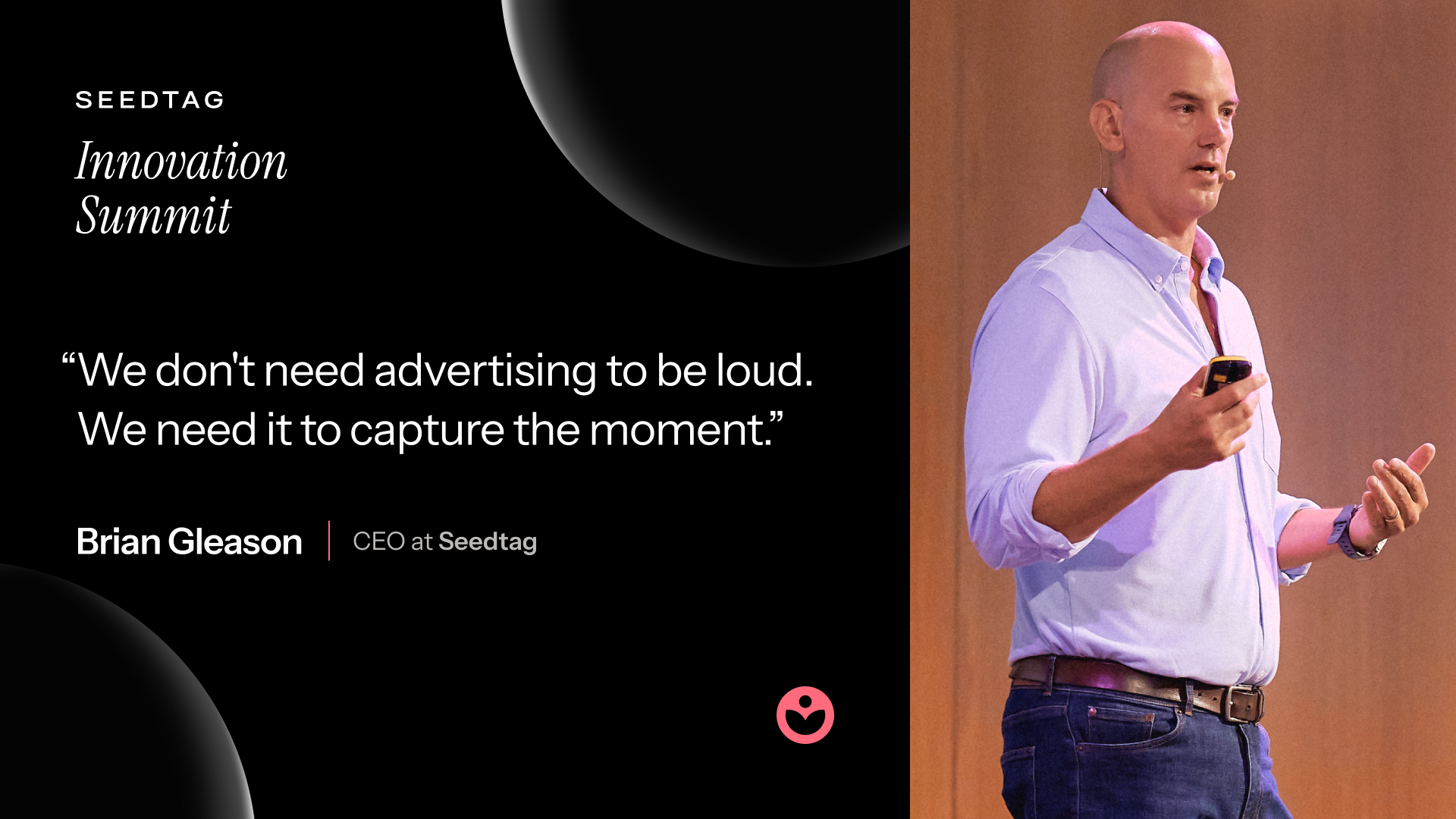
During the Summit, Brian Gleason, our CEO, added another layer: "We're more connected than we've ever been, but we're more distracted than we've ever been." For Brian, finding out how to connect in that moment is the most important thing, whether you're a brand, an agency, or a publisher.
The agenda combined dedicated sessions for the supply side and the demand side with joint sessions that put both in the same room. Topics ranged from the agentic shift and AI search to attention measurement, brand safety, CTV, creative, and life after the traffic. At lunches and dinners, the conversations kept going.
Across all of them, one thing became clear. The challenges facing the adtech ecosystem aren't local. They're global. And they become easier to solve when both sides look at them together.
Key Takeaways
- Consumers are more connected and more distracted than ever, and connecting with them in the moment matters for brands, agencies, and publishers alike.
- The same person makes different decisions in different situations, shaped by signals like time of day, screen, weather, and place.
- Fewer impressions carry identifiers, but audiences haven't gone anywhere, and reaching them requires a new structure.
- Interest, emotion, and intent shape how people process advertising, while viewability alone says nothing about that processing.
- Publishers, agencies, and brands face the same challenges from different perspectives, and the conversation is global, spanning the United States, Latin America, and Europe.
What Are the Biggest Challenges Facing the Digital Advertising Landscape?
Throughout the Summit, Brian Gleason put the consumer at the center of the conversation. For him, it's the one thing the industry doesn't focus on enough. We talk about acronyms, LLMs, and chats, but rarely about what consumers are doing every day or what their world is like.
And that world is full of noise. Attention is fleeting, and capturing it is hard. At the same time, clients are under pressure to grow and differentiate, and Brian raised an open question about what happens to them as products become commoditized in AI chat environments.
Grego Martínez, our Chief Product Officer, pointed to another challenge: media buying itself.
In CTV, most buying happens at the platform level, yet streaming services rarely have exclusive content. To illustrate the point, Grego shared a simple example: in Spain, Harry Potter is available on eight different platforms. So when a brand buys one of them, it's buying the service, not the moment. It learns nothing about the show being watched, the emotion it creates, or the hour and day it's being seen.
Buying through demand side platforms (DSPs) has a similar limitation. Brands and agencies can target IAB categories, keywords, domains, geography, or day part, but combining all of those signals to build moments manually is very complicated. The signals exist, but programmatic fragmentation keeps them apart.
Why the Adtech Ecosystem Is Moving From Understanding the Who to the Moment
For Grego, solving that fragmentation starts with a simple idea: the same person can make very different decisions depending on the situation they're in.
Picture someone commuting to work on a rainy Monday morning, phone in one hand, about to lose connection in five or six minutes. Any message has to be fast. Now picture the same person on a sunny Sunday morning, planning the week ahead with Monday off. They might spend 90 seconds on a powerful long video, one that takes them to the next step.
Nothing about them has changed. Only the moment has.
The same happens with a recipe. On a Tuesday evening after work, someone looking one up wants something fast. On a Saturday morning, with family and friends coming over, they're far more open to a message tied to that interest. The article is exactly the same. The moment is not.
That's why content is only one piece of context. The hour, the day of the week, and the season all matter. So do the type of screen someone is using, the weather, and the place they're in. On their own, these signals won't massively improve advertising. Combined, they create a scenario where advertising works much better.
Moments also change across environments. On mobile, things happen faster. On desktop, people are usually sitting down and paying more attention. CTV is often watched in a group rather than alone.
"We've spent more than 20 years understanding the who. Now, I think the future will be won by those who understand the moment much better," Grego said as he closed his session.
Audiences Were Never Identifiers
Hannes Sieling, our VP of Data & AI, started from programmatic advertising's long reliance on identifiers. They gave data teams structure, plus the reach to find people again. Today, fewer impressions carry them, but the reality hasn't changed. The same people are consuming the same content. And audiences were never identifiers in the first place.
What the industry needs is a new structure, built around the content people consume. That's the idea behind vector-based targeting: grouping similar content together so brands and agencies can find the environments closest to their goals, while balancing reach and precision.
Hannes also pointed to the technology that makes this possible: "Embedders are a little bit the hidden champions, the unsung heroes of the whole rise of large-language models."
The real question is what counts as similar. For him, the answer needs to go beyond clicks or categories and help find the right environment at the right moment. Understanding how people actually process what they see is a key part of that answer.
The Science Behind Attention, Emotion, and Intent
Professor Tino Meitz from the University of Münster explained how people process advertising. Who we are stays fairly stable, but how we feel and what we're focused on can change in milliseconds. When people consume media or advertising, that state of mind matters most.
That's also why viewability isn't enough. It shows that an ad could be seen, but says nothing about whether it was actually processed.
Three contextual signals shape that processing:
- Interest: If people aren't motivated to watch a show, they're unlikely to engage with the advertising within it.
- Emotion and affect: The brain relates new situations to past experiences, so a context that connects to familiar feelings makes new information easier to process.
- Intent: People need to be in the right situation for a message. If you want to buy a mid-sized SUV, you probably won't walk into a Ferrari dealership.
Tino was careful to separate affect from emotion: "Affect is something you can't govern. It's something that's happening, it's also, to a certain extent unconscious. Emotion is an evaluation of your affect afterwards."
How Can Supply and Demand Collaborate Across the Adtech Ecosystem?
Rob Beeler, who led the Two Sides, One Signal working session, explained why collaboration and supply and demand alignment matter. “Both sides are trying to solve the same things. This is a relationship-driven industry, and relationships are built by talking to each other in person. When both sides start working together, he said, they can be more effective for advertisers”, he said.
Kevin Donker, Head of Programmatic & Media Automation at Omnicom Media, brought that same spirit to the agentic conversation. For Kevin, agentic buying is still in its infancy, and the industry will have to come together to adopt protocols that make it reliable. When that happens, the productivity gains from AI should be reinvested in people.
In his view, the winners will be organizations that use AI to boost creativity, leadership, and judgment. The ones left behind will simply put an AI layer on top of an already fragmented workflow.
Brian Gleason echoed that idea in his closing remarks. He pointed to the feedback shared over the three days on different ways of working, ad inventory sources, and ways to measure. He also stressed the importance of trust: when you know you can trust someone, you know they'll do what they say they're going to do.
"There are a lot of pressures and challenges we think about in the world, and the things we shared over the last few days were brilliant. That's what we love to do: share information. It's an ecosystem that works together, and that's what we're trying to create", Brian Gleason.

How Does Neuro-Contextual Advertising Bridge the Gap Between Supply and Demand?
If both sides face the same challenge, they also need a shared way to understand the moment. That's what Neuro-Contextual Advertising offers.
Liz, our Neuro-Contextual AI, reads signals of interest, emotion, and intent to understand the moment behind each impression, without personal data or identifiers. For brands and agencies, that means reaching people when it matters most. For publishers, it means their content is valued for the moments it creates.
And it goes beyond advertising. Bringing value back to the open web helps keep quality content alive, and that's a responsibility the whole industry shares.
From Barcelona to the Next Conversation
Over three days, publishers, agencies, and brands from the United States, Latin America, and Europe approached the same questions from different perspectives. How do we capture attention? How do we reach audiences without identifiers? How do we make sure quality content keeps being found and valued as the way people discover information changes?
For us, at Seedtag, those conversations reinforce the vision behind Neuro-Contextual Advertising: understanding people's interest, emotion, and intent in the moment they're in.
It's not about knowing who. It's about understanding the moment.
Thank you to everyone who joined us in Barcelona. If you'd like to keep the conversation going, our team is here.
.png)
The loudest conversation in advertising right now is about agents: buyer agents who plan campaigns, seller agents who respond to them, and standards that let the two talk. Yet a quieter, more consequential evolution is taking place beneath the noise. The industry is finally agreeing on how agents should describe an audience: as an embedding, a point in a mathematical space where "similar" is a distance you can actually measure.
Media has named the practice vector-based targeting. The IAB Tech Lab has now standardized it as Agentic Audiences. For us, at Seedtag, this isn't a new trend. It’s the exact foundation we’ve been building on for years.
Key Takeaways
- A vector is only as good as the model behind it. Standardizing vectors gives the industry a common language for describing audiences, but it doesn’t standardize what those vectors actually mean. The training behind the model determines what “similar” really means.
- Traditional targeting misses the moment. Behavioral data tells us what someone has done, language tells us what content is about, and taxonomies tell us where content belongs. None fully understands the reader's current state of mind.
- The future of targeting is about finding the right moment, not just the right audience. As agentic advertising develops, shared audience standards will become increasingly important. But the real competitive advantage will come from the quality of the underlying map: understanding an audience’s interests, emotional state, and intent as they unfold in real time.
- Content alone isn't enough either. The same article read at different moments carries different value, which is why moment, not just meaning, has to be built into the map.
A little context before we get to the point. We wrote a full introduction to vector-based targeting and vector embeddings in an earlier post. Put simply, an embedding is how an AI translates content—a webpage, a video scene, a TV show, or a campaign brief—into a position on a map. A map of meaning. The model reads the content and places it so related concepts sit close together, regardless of the exact words used. A pressure-cooker review and a weeknight-stew recipe land near each other; a match preview and a mortgage guide land far apart.
Vector-based targeting is simply buying the impressions that cluster around that map location. You describe what you want as a starting point—the seed—and buy the impressions closest to it. The seed can come from a plain language brief like "home cooks upgrading their kitchen”, or from a brand's first-party data showing what its existing customers are engaging with, landing on the same map as coordinates. Two things follow immediately. Reach becomes flexible: widen the circle around your coordinate, and you expand your scale.
Distance becomes a score: how well does this impression fit this audience? Measure how close it sits. There are no keyword lists to maintain because the geometry does the judging. In fact, the new standard even comes with an open-source scorer that demonstrates this exact embedding-to-audience matching.
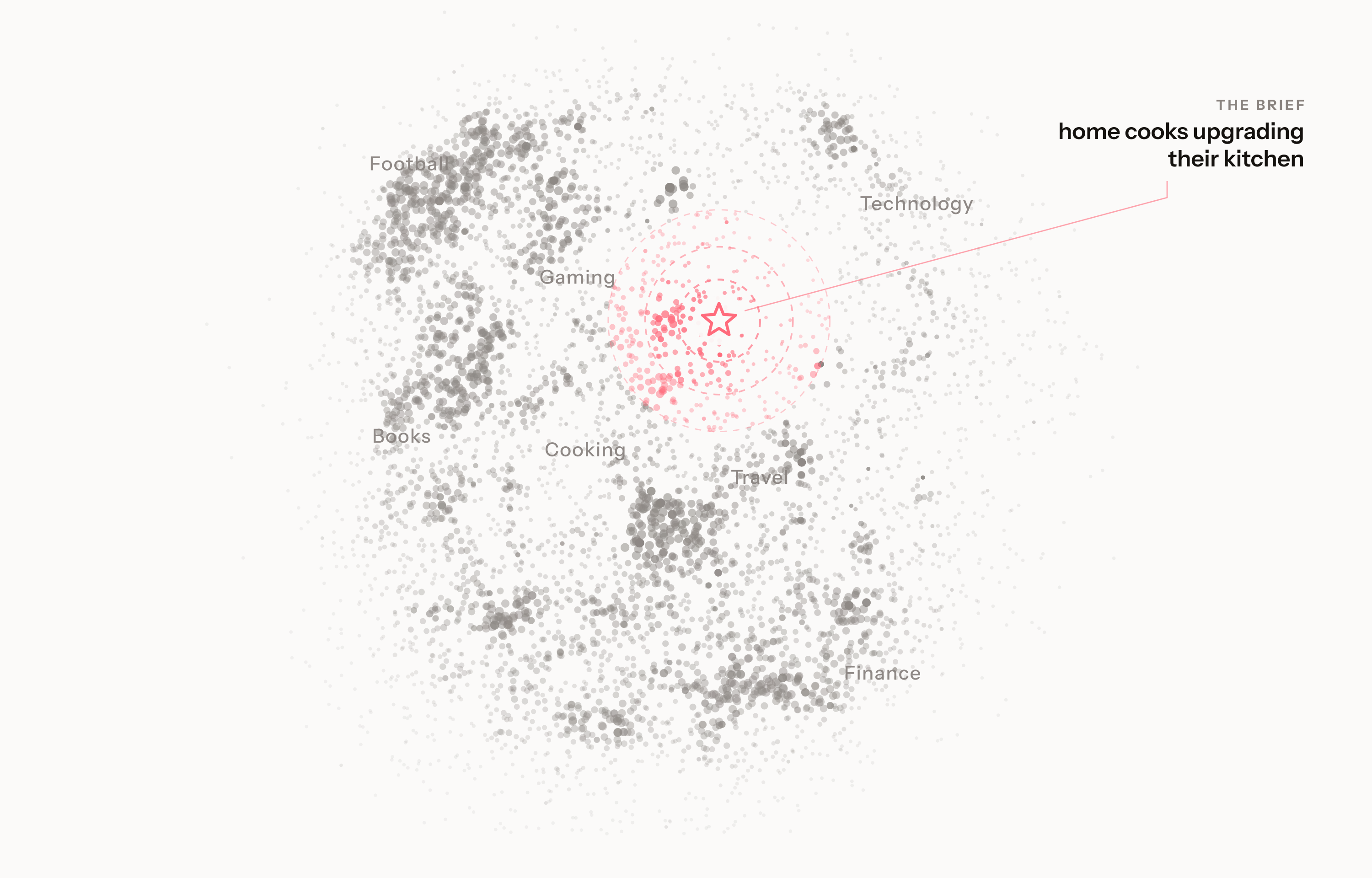
The map of meaning. Every dot represents a page, TV show, or images and video resources mapped purely by context so related topics cluster together. A brand's brief or first-party data lands as the seed point. Targeting captures the content nearby—widen the circle for scale, or measure the distance to judge the fit.
So, is audience targeting solved? Not quite. The IAB standard makes it easy to agree on the benefits of using vectors, but it leaves the real challenge untouched: what those vectors actually mean. It doesn't define how a vector should be trained, nor what makes one location in the map of meaning superior to another. In fact, the standard leaves the real challenge untouched by requiring buyers and sellers to use the exact same model; otherwise, their vectors can't be compared. But meaning lives in the model, not in the envelope. The hard part hasn't been standardized. It has been named.
A Vector Alone Doesn't Solve Targeting
Why is everyone turning to vectors in the first place? To reclaim the reach lost as user IDs disappear. Cookies are fading, and vast parts of the Open Web and CTV are out of reach. But let’s be clear: a vector alone doesn’t magically restore that reach with precision. It simply shifts the core question: reach toward what? Similar to whom, and based on what?
“Close” on a map only means something because of how the map was drawn: items are close because of what the AI model was trained to see as similar. So the critical question to ask any vendor pitching vector-based targeting isn't, “How many dimensions do you use?” It's: “What did you train the model to consider similar, and why does that definition serve my campaign goals?”
Two Ways the Industry Builds Embeddings, and What Both Miss
Embeddings built from behavior. Inside the big, logged-in walled gardens, this is a proven formula: model what users did (clicks, views, purchases) and represent each person by their history. It works in this setting because the platforms see every action of every logged-in user. But this breaks down on the Open Web, where signals are sparse, identities are fragmented, and interests evolve faster than models can adapt. Behavioral models also suffer from a subtle bias: they learn exclusively from audiences a platform has already reached, making them brilliant at finding more of the same while remaining blind to receptive audiences who never happened to log in.
Embeddings built from language. The other route is to build a space from text, and the off-the-shelf embedding models anyone can license do exactly that. To be fair, they're genuinely good at semantics: two pages don't need to share a word to sit close together; modern models understand the underlying meaning. But semantic proximity isn't the metric a media plan relies on. Two pages about the exact same topic can perform completely differently: one crackles with curiosity, the other drips with anger. The meaning of the text isn't the meaning of the moment.
The pre-vector baseline—the traditional taxonomy—isn't even a space; it's just a lookup table. A page matches a category, or it doesn't. There's no concept of "close," and no room to expand.
Here's what all three miss: the moment. Behavior tells you who: that someone once did something similar, not whether now is the moment. Language tells you what the text means, not the emotional impact on the user. A taxonomy tells you which shelf the page sits on. None of them evaluate the reader's current state of mind—the interest, emotion, and intent surrounding an impression. And those signals are present on every single impression, on every device, with no identifier required.
How Our Embeddings Go Further
This is where years of experience matter. Off-the-shelf vector spaces weren't built for media performance, so we trained our own. And it's the training, not the architecture, that takes AI beyond language understanding and gives it a human-like understanding of interest, emotion, and intent.
The Seedtag Neuro-Contextual embeddings model reads three signals from every piece of content: Which interest is it relevant to? What emotion does it trigger? What intent does the reader bring—is it just browsing, actively learning, or ready to buy? Those three signals aren't tags stapled on afterward; they're core coordinates baked directly into the map. Built on more than a decade of contextual inventory, with hundreds of millions of pages and hundreds of thousands of videos and shows analyzed, our space is continuously shaped by real impression performance. So on our map, “close” doesn't mean “uses similar vocabulary.” It means “performs similarly for the same type of campaign brief.”
Two examples show why this matters:
Consider two football articles filed under the exact same taxonomy node: a transfer rumor charged with curiosity and a post-match report heavy with anger. A rigid taxonomy puts them on the same shelf, but our model reads the emotional tone, pushing them far apart on the map where targeting decisions are made. The taxonomy isn't enough; the content reading is what tells these two apart.
Now imagine reading just one of those articles twice: on your phone during the morning commute versus late at night on the sofa. Same words, same inferred interest and emotion, but not the same context—and not the same value to a brand. Reading the content alone isn't enough either. Content × the moment is what really matters.
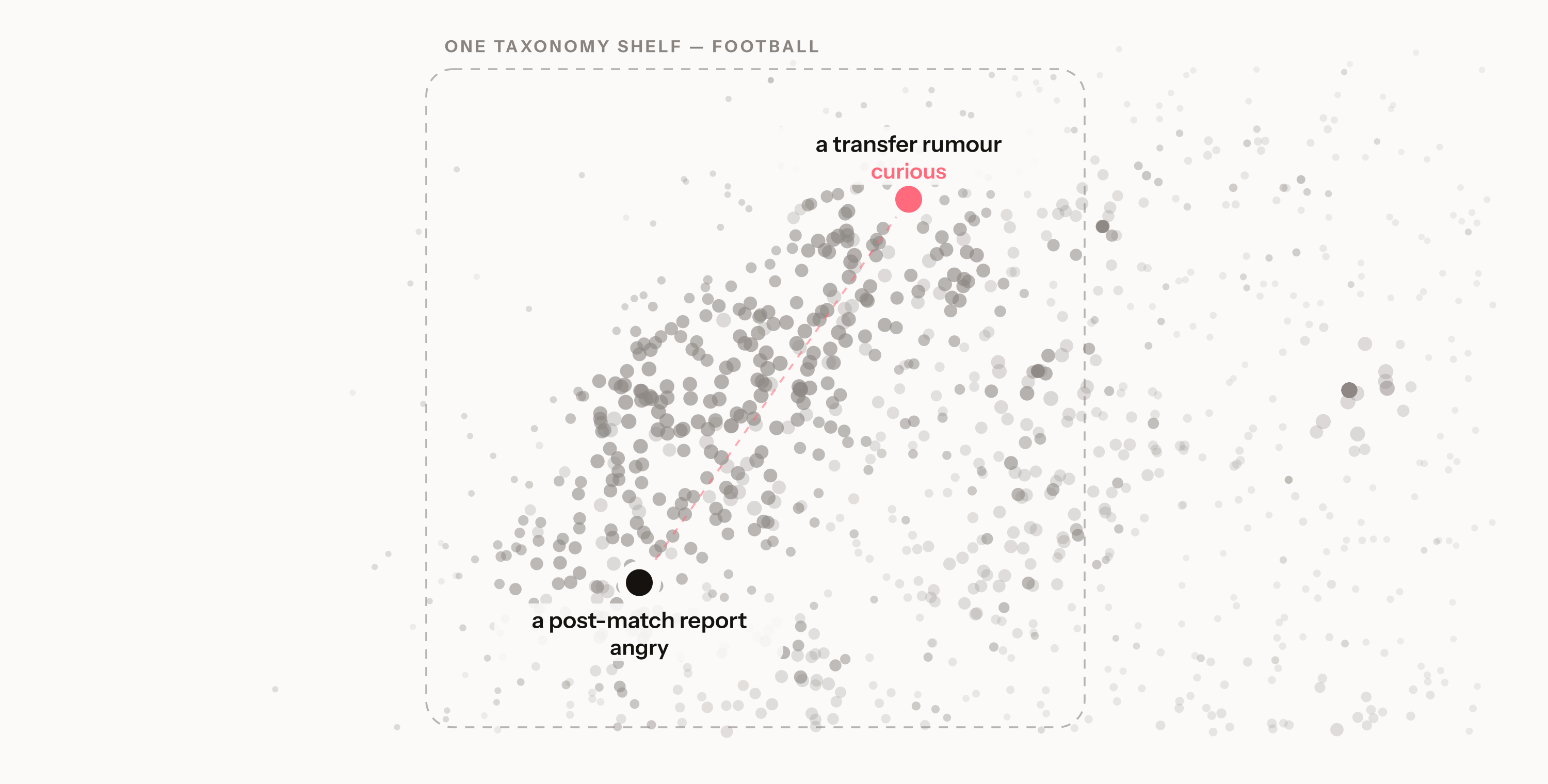
Same taxonomy shelf, different moments. A lookup can't tell the two articles apart; in Seedtag's space, emotion and intent push them far apart—and distance is exactly what targeting acts on.
The same is true for individuals. A single reader experiences a curious morning, a distracted lunch break, and a relaxed evening all in one day. User identifiers flatten this nuanced journey into a single label: “sports fan.” But reaching the same user in different moments requires fundamentally different approaches.
This brings us to the “neuro” in Neuro-Contextual, because precision matters here. We didn’t put neuroscience inside the model: decades of research established which dimensions drive attention, memory, and receptivity (emotional state, motivation, timing), and our models operationalize those constructs at a scale no lab could reach. Whether the model’s interpretation matches human response is testable, and we keep testing it against measured human behavior. Neuroscience identifies what drives human attention; machine learning delivers the scale; real-world testing proves it works.
And because the tech is ours, the same approach can go further. For strategic partners, we can build custom fine-tuned embeddings that continuously adapt the space to their specific domain and its goals. Take travel: a fine-tuned embedding could learn the nuanced differences between audiences interested in luxury resorts, mountain hiking, or city sightseeing, recognizing the distinct interests, contexts, and emotional drivers within each. Over time, it can build a richer, domain-specific embedding space from new insights and real campaign performance, while preserving everything the Seedtag Neuro-Contextual embeddings already understand.
The industry is finally agreeing on how agents should describe an audience. That’s real progress, but it’s a bit like agreeing that everyone will give directions using a map: useful only if the map is any good. Standardizing the coordinates doesn’t make the underlying geography more accurate.
A map drawn from the words on a page will send you to pages that sound alike. A map drawn from what people clicked last month will send you back to the audiences you already reached. A map drawn from how people actually experience those pages sends you somewhere more valuable. What are they interested in? How does the content make them feel? What are they trying to do, and at what moment? Answer those, and you're pointed toward impressions that are more likely to perform. The distinction matters because the industry isn't really trying to find things that are similar. It's trying to find the right opportunities.
Where the Agentic Future Is Headed
Which brings the conversation back to agents. We share the excitement about what agents can do, but we also believe their potential depends on the quality of the models they interact with underneath.
Agents won't act at the level of a single bid request or a single embedding; that layer belongs to smaller, faster models. Agents will plan, negotiate, and activate at the audience level, interacting with models that understand the underlying meaning of content and audiences. Because even the most sophisticated agent won't reach the right destination if the map underneath it doesn't describe the landscape accurately.
That's why the conversation between agents and what they exchange must be about understanding, not bags of numbers. A seller agent should be able to explain what an audience is made of, show its value, and make the case for why it matters. Ours already does: our Liz Agent builds an audience from a plain-language brief and explains every component.
Language in, geometry underneath, explanation out. That’s the agent-to-agent conversation worth standardizing.

Live sports have never attracted bigger audiences, but they have also never been more expensive to deliver. As media rights continue to rise, subscription growth slows, and viewing fragments across multiple digital platforms, sports advertising has become increasingly important to sustaining premium content.
For rights holders, broadcasters, and sports leagues, the challenge is no longer simply selling more ads. It's creating advertising experiences that keep sports fans engaged while generating greater value for advertisers.
In this episode of The Pub Way Podcast, Mike Villalobos and I spoke with Scott Young, Co-Founder and Chief Product Officer at Transmit, about how in-stream advertising is reshaping live sports.
Rather than relying exclusively on traditional commercial breaks, Scott explains how contextual advertising experiences built around real-time moments can create new inventory, improve viewer engagement, and unlock better outcomes for publishers and brands.
Key Takeaways
- Ad-supported streaming is becoming essential as subscription growth slows and media rights become more expensive.
- In-stream advertising creates new, addressable inventory beyond traditional ad pods.
- Contextual ads tied to live moments generate stronger engagement than generic placements.
- Cross-device attribution remains one of the biggest measurement challenges in sports advertising.
- Industry-wide standards will be just as important as new technology to support future innovation.
Why Sports Advertising Is Moving Beyond Traditional Ad Breaks
For decades, sports marketing strategies centered around a familiar model: commercial breaks inserted into natural pauses in the game. But as streaming audiences grow and premium sports rights become more expensive, simply increasing the number of ad slots is no longer enough to support sustainable monetization.
Instead, Scott sees the future in in-stream advertising. Picture-in-picture placements, dynamic overlays, and contextual graphics allow advertisers to engage viewers while the action continues, creating new inventory without disrupting the viewing experience.
Rather than adding more ads, the goal is to create more relevant ones that complement the moment instead of interrupting it.
Why Context Matters More Than Ever
One of the biggest sports marketing trends is the growing importance of real-time relevance.
Transmit's platform identifies key moments during a sporting event, including a touchdown, home run, or game-winning play, and uses them to trigger contextual advertising. That allows brands to respond to what sports fans are experiencing in real time. A fan whose team has just scored might see a celebratory message, while fans on the other side receive different creative.
Scott compared this approach to meeting someone at a conference. The best conversations don't begin with a sales pitch; they begin by understanding what the other person cares about. Advertising works the same way. When brands respond to the moment viewers are already experiencing, advertising becomes part of the experience instead of an interruption.
While live sports provide some of the clearest examples, the same approach applies across FAST channels, news, and entertainment, wherever real-time context can make messaging more relevant.

What Challenges Do Advertisers Face with Cross-Device Attribution?
As live sports continue expanding across connected TVs and other digital platforms, measuring campaign performance has become increasingly complex.
Scott explained that a single connected TV may represent one viewer or an entire household, making it difficult to understand who actually engaged with an ad. Privacy restrictions add another layer of complexity, limiting advertisers' ability to connect exposure on one device with actions taken on another.
Although second-screen experiences offer significant potential, the industry still needs stronger cross-device measurement and greater standardization before advertisers can fully understand campaign performance across multiple devices.
What Results Are Brands Already Seeing?
Despite those challenges, contextual in-stream advertising is already demonstrating measurable impact.
Scott shared research showing ten times greater message recall compared with traditional ad pods. When context, creative, and timing aligned, viewers were also 20% more likely to take action, such as scanning a QR code. Additional studies measuring offline outcomes found that campaigns generated five times the return on ad spend in retail environments.
These results reinforce a broader shift in sports marketing: success depends less on increasing the volume of advertising and more on delivering experiences that feel relevant to viewers in the moment.
Looking Ahead
As premium properties like the Super Bowl, the World Cup, and other major sporting events continue attracting massive audiences, the future of sports advertising will depend on delivering more personalized experiences that respond to what viewers are experiencing in real time.
For Scott, innovation isn't simply about adding new technology. It's about building common standards across platforms so publishers, advertisers, and technology partners can work together more efficiently. Combined with smarter in-stream advertising, that collaboration can help create better experiences for viewers while opening new monetization opportunities for sports teams, media companies, and brands alike.
Watch the full episode of The Pub Way Podcast to hear Scott Young share how contextual, in-stream advertising is reshaping the future of live sports.

Every week, the internet tells you what's trending. It rarely tells you how any of it felt.
Open any trends page, any weekly recap, any "most talked about" list, and the logic is the same. Volume wins. Whatever generated the most clicks, shares, or mentions gets ranked first, regardless of what that attention actually meant. A blockbuster movie premiere and a last-minute playoff upset can sit side by side on the same list, indistinguishable by the metric used to rank them.
But attention and emotion are not the same thing. A story can dominate headlines and still leave people cold. Another can spike quietly in wonder, anger, or admiration without ever cracking the top of a trends page. Volume tells you where people looked. It says nothing about what they felt while looking.
That gap between the content people consume and how they actually feel about it is exactly where Neuro-Contextual advertising begins.
From Signal to Spotlight: Introducing the Seedtag Emotion Quotient
Today, we're putting Liz, our Neuro-Contextual AI, to work with the launch of the Seedtag Emotion Quotient, a weekly ranking of the five cultural moments that generated the strongest measured emotional response, not the ones simply generating the most volume.
Each moment is scored against its own emotional baseline. Take The Odyssey: admiration and anticipation for Nolan's epic were real, but off-screen romance between its stars ended up generating the strongest emotional signal of all, stronger than the film itself. And sometimes, what stands out is how differently the same event can be felt. At this year’s US Open, coverage around Carlos Alcaraz drove admiration to 3.93x its usual baseline, while stories around Novak Djokovic's early exit pushed sadness to 2.37x. Same tournament, same week, but two very different ways of experiencing it. For advertisers, that's an important distinction. Knowing that the US Open is capturing attention is one thing. Understanding whether that attention is being shaped by admiration or sadness gives brands a much more precise read on the moment and how their message can fit within it.
That's the point of the Emotion Quotient. It's the same intelligence behind Liz, our Neuro-Contextual AI, made visible: reading not just what a moment is about, but how it's genuinely felt.
Key Takeaways
- The Seedtag Emotion Quotient turns that same Neuro-Contextual analysis into a public, weekly view of the five cultural moments the internet felt the most.
- Liz, our Neuro-Contextual AI, reads interest, emotion, and intent across content in real time, without relying on personal data.
- Emotional signals rarely appear alone. Liz identifies the multiple emotions layered within a single piece of content.
- Traditional contextual targeting can identify what a piece of content is about. Neuro-Contextual advertising reads why it matters, understanding what sets one piece of content apart from another and how it's likely to land with the person engaging with it.
- Understanding why, not just what, is what makes Neuro-Contextual advertising fully resonant, and it's the foundation of full-funnel outcomes across the open web and CTV.
It's Not About Who Someone Is. It's About What They're Passionate About, In This Moment.
What Is Neuro-Contextual Advertising?
Contextual targeting has been part of digital advertising for years. At its most basic, it matches ads to content using keywords and categories. A travel article gets travel ads. A sports recap gets sports ads. It works, but it reaches its limit there. Classification is as far as it goes.
More advanced systems now use vector embeddings, numerical representations that place related concepts closer together in meaning, even when they share no keywords at all. That's a real improvement in how machines read content. But embeddings alone only summarize meaning. They don't explain why a moment matters to the person reading it.
That's the gap Neuro-Contextual advertising is built to close.
Neuro-Contextual Advertising, our approach at Seedtag, adds a purpose-built layer of business logic on top of that foundation, one built to interpret interest, emotion, and intent within content itself.
Two articles can sit in the exact same category and still mean entirely different things. Someone reading a spoiler-filled recap of a finale and someone reading a spoiler-free review are both talking about the same show, but their intent runs in opposite directions: one wants closure, the other wants to be convinced to watch. Knowing what the content is about can't tell them apart. Understanding why each reader is there can.
The same holds for emotion. A product launch event and a product recall story can both sit under "tech news," yet one carries excitement and anticipation, the other frustration and concern. That same underlying intelligence, reading interest, emotion, and intent together, is what powers everything we build, the Seedtag Emotion Quotient included.
The same logic applies to people, not just pages. Two readers can share every demographic box, same age, same income, same zip code, and still care about completely different things. Demographics describe who someone is on paper. They say nothing about what actually moves that person in the moment. Neuro-Contextual advertising shifts the question from "who is this person?" to "what are they passionate about right now?", and content itself is where that answer shows up first.
The Tech Behind the Ranking
Behind every score in the ranking is Liz, our Neuro-Contextual AI, reading content at scale and in real time. Liz scans more than 100 million URLs every day, with native understanding across 10+ languages and access to inventory from more than 30,000 premium media publishers globally, spanning the open web, video, and CTV.
That scale matters because the Seedtag Emotion Quotient isn't built from isolated pieces of content. Liz understands the connections between content across this broader ecosystem, identifying signals of interest, emotion, and intent as they emerge. The result is a view of cultural moments grounded not in a snapshot, but in what is happening across the content universe around us.
From there, understanding goes deeper than keywords. Liz maps the relationships between topics using vector embeddings grounded in neuroscience, which is how the ranking can isolate the specific terms driving a spike, not just name the general subject behind it.
Because human reactions are rarely singular, Liz reads emotion in layers rather than assigning one flat label. A single moment can carry curiosity and excitement at once, or admiration alongside real tension, and the ranking is built to reflect that complexity.
All of this happens without relying on personal data. Liz reads the content environment itself, not the individual people engaging with it, which is what keeps the ranking privacy-first by design.
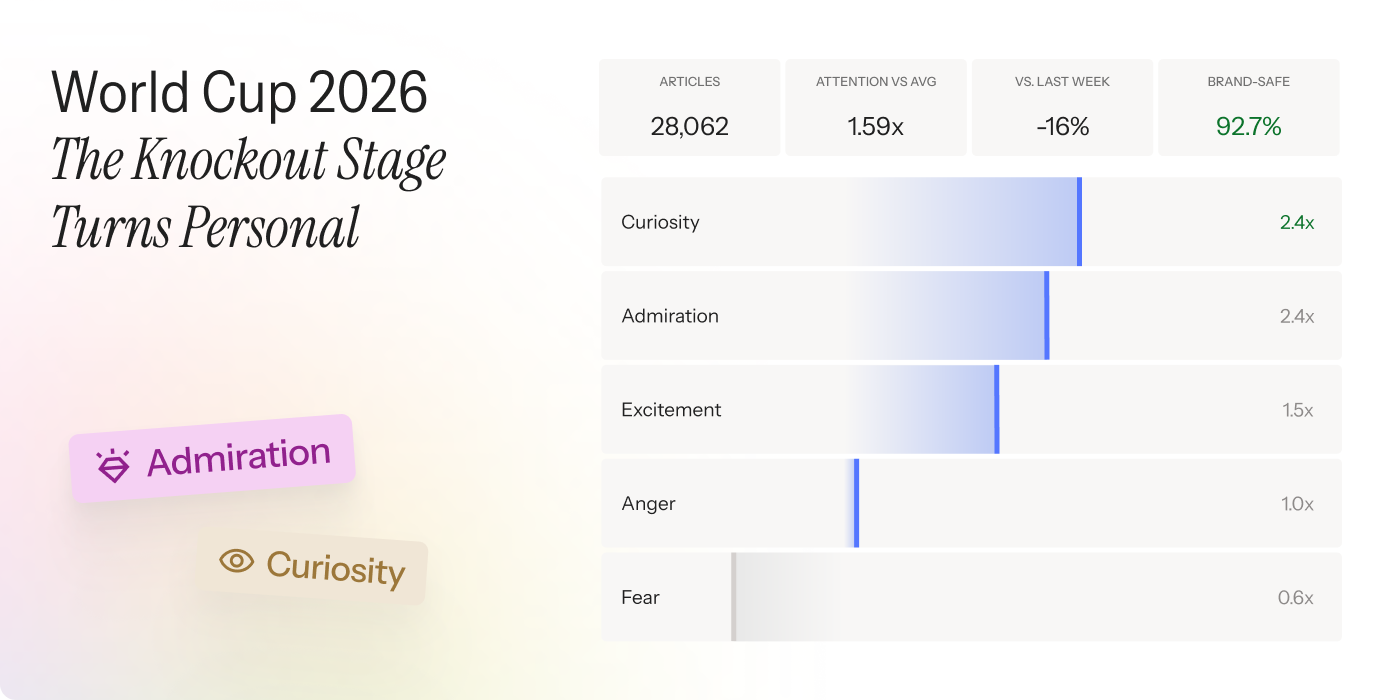
Each week, the Seedtag Emotion Quotient publishes a new read on the five moments that generated the strongest measured emotional response over the week prior. It's built to be explored, not just read: every entry breaks down the specific emotions behind it, the story driving the spike, and how that moment's emotional profile compares to its usual baseline, a starting point for thinking through which emotional signals are worth aligning a campaign with, and when.
Why Does Measuring Emotion Matter for Advertisers?
The Seedtag Emotion Quotient makes something visible that advertisers should care about directly: emotion is measurable, and it predicts performance.
That's not just true for the moments in this ranking. It holds inside real campaigns too.
The same Neuro-Contextual intelligence behind the ranking already drives stronger performance where it counts most: inside live campaigns. Liz, our Neuro-Contextual AI, is the same engine behind Seedtag NeuroX, our Neuro-Contextual Exchange, powering both from the same underlying intelligence. NeuroX connects that intelligence at scale across 30,000+ premium publishers and broadcasters, making every impression understood whether or not identity is present in the bidstream.
Working with Professor Moran Cerf from Columbia University, our neuroscience research measured real-time brain responses and found that Neuro-Contextual ads drive 3.5 times higher neural engagement than non-contextual ads, and a 26% stronger emotional response than standard contextual advertising. Full-funnel outcomes, from awareness to conversion, are consistently stronger when a message aligns with the emotional state of the moment it appears in.
Is Neuro-Contextual advertising the future of targeting? As identity signals keep fragmenting across the open web, understanding the moment becomes the only foundation that holds.
It's not about knowing what content people consume. It's about understanding how that content makes them feel.
The Seedtag Emotion Quotient is live now. Explore this week's ranking.

Our Blog
Publishers, agencies, and brands don't always sit on the same side of the table. But at the end of the day, they're facing the same challenge.
For publishers, the question is how to create content relevant enough that brands and agencies want to advertise within it. For agencies, it's where to place their clients and which environments are truly brand safe. For brands, it's where to invest to build a closer connection with their customers. The perspectives are different, and so are the priorities. But the challenge is shared: as the way people discover information keeps evolving, quality content needs to keep being found, valued, and sustained.
That challenge was one of many conversations we brought to Barcelona. From September 15 to 17, the Seedtag Innovation Summit gathered clients and partners from the United States, Latin America, and Europe, opening at the Joan Miró Foundation.
During the Summit, Brian Gleason, our CEO, added another layer: "We're more connected than we've ever been, but we're more distracted than we've ever been." For Brian, finding out how to connect in that moment is the most important thing, whether you're a brand, an agency, or a publisher.
The agenda combined dedicated sessions for the supply side and the demand side with joint sessions that put both in the same room. Topics ranged from the agentic shift and AI search to attention measurement, brand safety, CTV, creative, and life after the traffic. At lunches and dinners, the conversations kept going.
Across all of them, one thing became clear. The challenges facing the adtech ecosystem aren't local. They're global. And they become easier to solve when both sides look at them together.
Key Takeaways
- Consumers are more connected and more distracted than ever, and connecting with them in the moment matters for brands, agencies, and publishers alike.
- The same person makes different decisions in different situations, shaped by signals like time of day, screen, weather, and place.
- Fewer impressions carry identifiers, but audiences haven't gone anywhere, and reaching them requires a new structure.
- Interest, emotion, and intent shape how people process advertising, while viewability alone says nothing about that processing.
- Publishers, agencies, and brands face the same challenges from different perspectives, and the conversation is global, spanning the United States, Latin America, and Europe.
What Are the Biggest Challenges Facing the Digital Advertising Landscape?
Throughout the Summit, Brian Gleason put the consumer at the center of the conversation. For him, it's the one thing the industry doesn't focus on enough. We talk about acronyms, LLMs, and chats, but rarely about what consumers are doing every day or what their world is like.
And that world is full of noise. Attention is fleeting, and capturing it is hard. At the same time, clients are under pressure to grow and differentiate, and Brian raised an open question about what happens to them as products become commoditized in AI chat environments.
Grego Martínez, our Chief Product Officer, pointed to another challenge: media buying itself.
In CTV, most buying happens at the platform level, yet streaming services rarely have exclusive content. To illustrate the point, Grego shared a simple example: in Spain, Harry Potter is available on eight different platforms. So when a brand buys one of them, it's buying the service, not the moment. It learns nothing about the show being watched, the emotion it creates, or the hour and day it's being seen.
Buying through demand side platforms (DSPs) has a similar limitation. Brands and agencies can target IAB categories, keywords, domains, geography, or day part, but combining all of those signals to build moments manually is very complicated. The signals exist, but programmatic fragmentation keeps them apart.
Why the Adtech Ecosystem Is Moving From Understanding the Who to the Moment
For Grego, solving that fragmentation starts with a simple idea: the same person can make very different decisions depending on the situation they're in.
Picture someone commuting to work on a rainy Monday morning, phone in one hand, about to lose connection in five or six minutes. Any message has to be fast. Now picture the same person on a sunny Sunday morning, planning the week ahead with Monday off. They might spend 90 seconds on a powerful long video, one that takes them to the next step.
Nothing about them has changed. Only the moment has.
The same happens with a recipe. On a Tuesday evening after work, someone looking one up wants something fast. On a Saturday morning, with family and friends coming over, they're far more open to a message tied to that interest. The article is exactly the same. The moment is not.
That's why content is only one piece of context. The hour, the day of the week, and the season all matter. So do the type of screen someone is using, the weather, and the place they're in. On their own, these signals won't massively improve advertising. Combined, they create a scenario where advertising works much better.
Moments also change across environments. On mobile, things happen faster. On desktop, people are usually sitting down and paying more attention. CTV is often watched in a group rather than alone.
"We've spent more than 20 years understanding the who. Now, I think the future will be won by those who understand the moment much better," Grego said as he closed his session.
Audiences Were Never Identifiers
Hannes Sieling, our VP of Data & AI, started from programmatic advertising's long reliance on identifiers. They gave data teams structure, plus the reach to find people again. Today, fewer impressions carry them, but the reality hasn't changed. The same people are consuming the same content. And audiences were never identifiers in the first place.
What the industry needs is a new structure, built around the content people consume. That's the idea behind vector-based targeting: grouping similar content together so brands and agencies can find the environments closest to their goals, while balancing reach and precision.
Hannes also pointed to the technology that makes this possible: "Embedders are a little bit the hidden champions, the unsung heroes of the whole rise of large-language models."
The real question is what counts as similar. For him, the answer needs to go beyond clicks or categories and help find the right environment at the right moment. Understanding how people actually process what they see is a key part of that answer.
The Science Behind Attention, Emotion, and Intent
Professor Tino Meitz from the University of Münster explained how people process advertising. Who we are stays fairly stable, but how we feel and what we're focused on can change in milliseconds. When people consume media or advertising, that state of mind matters most.
That's also why viewability isn't enough. It shows that an ad could be seen, but says nothing about whether it was actually processed.
Three contextual signals shape that processing:
- Interest: If people aren't motivated to watch a show, they're unlikely to engage with the advertising within it.
- Emotion and affect: The brain relates new situations to past experiences, so a context that connects to familiar feelings makes new information easier to process.
- Intent: People need to be in the right situation for a message. If you want to buy a mid-sized SUV, you probably won't walk into a Ferrari dealership.
Tino was careful to separate affect from emotion: "Affect is something you can't govern. It's something that's happening, it's also, to a certain extent unconscious. Emotion is an evaluation of your affect afterwards."
How Can Supply and Demand Collaborate Across the Adtech Ecosystem?
Rob Beeler, who led the Two Sides, One Signal working session, explained why collaboration and supply and demand alignment matter. “Both sides are trying to solve the same things. This is a relationship-driven industry, and relationships are built by talking to each other in person. When both sides start working together, he said, they can be more effective for advertisers”, he said.
Kevin Donker, Head of Programmatic & Media Automation at Omnicom Media, brought that same spirit to the agentic conversation. For Kevin, agentic buying is still in its infancy, and the industry will have to come together to adopt protocols that make it reliable. When that happens, the productivity gains from AI should be reinvested in people.
In his view, the winners will be organizations that use AI to boost creativity, leadership, and judgment. The ones left behind will simply put an AI layer on top of an already fragmented workflow.
Brian Gleason echoed that idea in his closing remarks. He pointed to the feedback shared over the three days on different ways of working, ad inventory sources, and ways to measure. He also stressed the importance of trust: when you know you can trust someone, you know they'll do what they say they're going to do.
"There are a lot of pressures and challenges we think about in the world, and the things we shared over the last few days were brilliant. That's what we love to do: share information. It's an ecosystem that works together, and that's what we're trying to create", Brian Gleason.
How Does Neuro-Contextual Advertising Bridge the Gap Between Supply and Demand?
If both sides face the same challenge, they also need a shared way to understand the moment. That's what Neuro-Contextual Advertising offers.
Liz, our Neuro-Contextual AI, reads signals of interest, emotion, and intent to understand the moment behind each impression, without personal data or identifiers. For brands and agencies, that means reaching people when it matters most. For publishers, it means their content is valued for the moments it creates.
And it goes beyond advertising. Bringing value back to the open web helps keep quality content alive, and that's a responsibility the whole industry shares.
From Barcelona to the Next Conversation
Over three days, publishers, agencies, and brands from the United States, Latin America, and Europe approached the same questions from different perspectives. How do we capture attention? How do we reach audiences without identifiers? How do we make sure quality content keeps being found and valued as the way people discover information changes?
For us, at Seedtag, those conversations reinforce the vision behind Neuro-Contextual Advertising: understanding people's interest, emotion, and intent in the moment they're in.
It's not about knowing who. It's about understanding the moment.
Thank you to everyone who joined us in Barcelona. If you'd like to keep the conversation going, our team is here.
The loudest conversation in advertising right now is about agents: buyer agents who plan campaigns, seller agents who respond to them, and standards that let the two talk. Yet a quieter, more consequential evolution is taking place beneath the noise. The industry is finally agreeing on how agents should describe an audience: as an embedding, a point in a mathematical space where "similar" is a distance you can actually measure.
Media has named the practice vector-based targeting. The IAB Tech Lab has now standardized it as Agentic Audiences. For us, at Seedtag, this isn't a new trend. It’s the exact foundation we’ve been building on for years.
Key Takeaways
- A vector is only as good as the model behind it. Standardizing vectors gives the industry a common language for describing audiences, but it doesn’t standardize what those vectors actually mean. The training behind the model determines what “similar” really means.
- Traditional targeting misses the moment. Behavioral data tells us what someone has done, language tells us what content is about, and taxonomies tell us where content belongs. None fully understands the reader's current state of mind.
- The future of targeting is about finding the right moment, not just the right audience. As agentic advertising develops, shared audience standards will become increasingly important. But the real competitive advantage will come from the quality of the underlying map: understanding an audience’s interests, emotional state, and intent as they unfold in real time.
- Content alone isn't enough either. The same article read at different moments carries different value, which is why moment, not just meaning, has to be built into the map.
A little context before we get to the point. We wrote a full introduction to vector-based targeting and vector embeddings in an earlier post. Put simply, an embedding is how an AI translates content—a webpage, a video scene, a TV show, or a campaign brief—into a position on a map. A map of meaning. The model reads the content and places it so related concepts sit close together, regardless of the exact words used. A pressure-cooker review and a weeknight-stew recipe land near each other; a match preview and a mortgage guide land far apart.
Vector-based targeting is simply buying the impressions that cluster around that map location. You describe what you want as a starting point—the seed—and buy the impressions closest to it. The seed can come from a plain language brief like "home cooks upgrading their kitchen”, or from a brand's first-party data showing what its existing customers are engaging with, landing on the same map as coordinates. Two things follow immediately. Reach becomes flexible: widen the circle around your coordinate, and you expand your scale.
Distance becomes a score: how well does this impression fit this audience? Measure how close it sits. There are no keyword lists to maintain because the geometry does the judging. In fact, the new standard even comes with an open-source scorer that demonstrates this exact embedding-to-audience matching.
The map of meaning. Every dot represents a page, TV show, or images and video resources mapped purely by context so related topics cluster together. A brand's brief or first-party data lands as the seed point. Targeting captures the content nearby—widen the circle for scale, or measure the distance to judge the fit.
So, is audience targeting solved? Not quite. The IAB standard makes it easy to agree on the benefits of using vectors, but it leaves the real challenge untouched: what those vectors actually mean. It doesn't define how a vector should be trained, nor what makes one location in the map of meaning superior to another. In fact, the standard leaves the real challenge untouched by requiring buyers and sellers to use the exact same model; otherwise, their vectors can't be compared. But meaning lives in the model, not in the envelope. The hard part hasn't been standardized. It has been named.
A Vector Alone Doesn't Solve Targeting
Why is everyone turning to vectors in the first place? To reclaim the reach lost as user IDs disappear. Cookies are fading, and vast parts of the Open Web and CTV are out of reach. But let’s be clear: a vector alone doesn’t magically restore that reach with precision. It simply shifts the core question: reach toward what? Similar to whom, and based on what?
“Close” on a map only means something because of how the map was drawn: items are close because of what the AI model was trained to see as similar. So the critical question to ask any vendor pitching vector-based targeting isn't, “How many dimensions do you use?” It's: “What did you train the model to consider similar, and why does that definition serve my campaign goals?”
Two Ways the Industry Builds Embeddings, and What Both Miss
Embeddings built from behavior. Inside the big, logged-in walled gardens, this is a proven formula: model what users did (clicks, views, purchases) and represent each person by their history. It works in this setting because the platforms see every action of every logged-in user. But this breaks down on the Open Web, where signals are sparse, identities are fragmented, and interests evolve faster than models can adapt. Behavioral models also suffer from a subtle bias: they learn exclusively from audiences a platform has already reached, making them brilliant at finding more of the same while remaining blind to receptive audiences who never happened to log in.
Embeddings built from language. The other route is to build a space from text, and the off-the-shelf embedding models anyone can license do exactly that. To be fair, they're genuinely good at semantics: two pages don't need to share a word to sit close together; modern models understand the underlying meaning. But semantic proximity isn't the metric a media plan relies on. Two pages about the exact same topic can perform completely differently: one crackles with curiosity, the other drips with anger. The meaning of the text isn't the meaning of the moment.
The pre-vector baseline—the traditional taxonomy—isn't even a space; it's just a lookup table. A page matches a category, or it doesn't. There's no concept of "close," and no room to expand.
Here's what all three miss: the moment. Behavior tells you who: that someone once did something similar, not whether now is the moment. Language tells you what the text means, not the emotional impact on the user. A taxonomy tells you which shelf the page sits on. None of them evaluate the reader's current state of mind—the interest, emotion, and intent surrounding an impression. And those signals are present on every single impression, on every device, with no identifier required.
How Our Embeddings Go Further
This is where years of experience matter. Off-the-shelf vector spaces weren't built for media performance, so we trained our own. And it's the training, not the architecture, that takes AI beyond language understanding and gives it a human-like understanding of interest, emotion, and intent.
The Seedtag Neuro-Contextual embeddings model reads three signals from every piece of content: Which interest is it relevant to? What emotion does it trigger? What intent does the reader bring—is it just browsing, actively learning, or ready to buy? Those three signals aren't tags stapled on afterward; they're core coordinates baked directly into the map. Built on more than a decade of contextual inventory, with hundreds of millions of pages and hundreds of thousands of videos and shows analyzed, our space is continuously shaped by real impression performance. So on our map, “close” doesn't mean “uses similar vocabulary.” It means “performs similarly for the same type of campaign brief.”
Two examples show why this matters:
Consider two football articles filed under the exact same taxonomy node: a transfer rumor charged with curiosity and a post-match report heavy with anger. A rigid taxonomy puts them on the same shelf, but our model reads the emotional tone, pushing them far apart on the map where targeting decisions are made. The taxonomy isn't enough; the content reading is what tells these two apart.
Now imagine reading just one of those articles twice: on your phone during the morning commute versus late at night on the sofa. Same words, same inferred interest and emotion, but not the same context—and not the same value to a brand. Reading the content alone isn't enough either. Content × the moment is what really matters.
Same taxonomy shelf, different moments. A lookup can't tell the two articles apart; in Seedtag's space, emotion and intent push them far apart—and distance is exactly what targeting acts on.
The same is true for individuals. A single reader experiences a curious morning, a distracted lunch break, and a relaxed evening all in one day. User identifiers flatten this nuanced journey into a single label: “sports fan.” But reaching the same user in different moments requires fundamentally different approaches.
This brings us to the “neuro” in Neuro-Contextual, because precision matters here. We didn’t put neuroscience inside the model: decades of research established which dimensions drive attention, memory, and receptivity (emotional state, motivation, timing), and our models operationalize those constructs at a scale no lab could reach. Whether the model’s interpretation matches human response is testable, and we keep testing it against measured human behavior. Neuroscience identifies what drives human attention; machine learning delivers the scale; real-world testing proves it works.
And because the tech is ours, the same approach can go further. For strategic partners, we can build custom fine-tuned embeddings that continuously adapt the space to their specific domain and its goals. Take travel: a fine-tuned embedding could learn the nuanced differences between audiences interested in luxury resorts, mountain hiking, or city sightseeing, recognizing the distinct interests, contexts, and emotional drivers within each. Over time, it can build a richer, domain-specific embedding space from new insights and real campaign performance, while preserving everything the Seedtag Neuro-Contextual embeddings already understand.
The industry is finally agreeing on how agents should describe an audience. That’s real progress, but it’s a bit like agreeing that everyone will give directions using a map: useful only if the map is any good. Standardizing the coordinates doesn’t make the underlying geography more accurate.
A map drawn from the words on a page will send you to pages that sound alike. A map drawn from what people clicked last month will send you back to the audiences you already reached. A map drawn from how people actually experience those pages sends you somewhere more valuable. What are they interested in? How does the content make them feel? What are they trying to do, and at what moment? Answer those, and you're pointed toward impressions that are more likely to perform. The distinction matters because the industry isn't really trying to find things that are similar. It's trying to find the right opportunities.
Where the Agentic Future Is Headed
Which brings the conversation back to agents. We share the excitement about what agents can do, but we also believe their potential depends on the quality of the models they interact with underneath.
Agents won't act at the level of a single bid request or a single embedding; that layer belongs to smaller, faster models. Agents will plan, negotiate, and activate at the audience level, interacting with models that understand the underlying meaning of content and audiences. Because even the most sophisticated agent won't reach the right destination if the map underneath it doesn't describe the landscape accurately.
That's why the conversation between agents and what they exchange must be about understanding, not bags of numbers. A seller agent should be able to explain what an audience is made of, show its value, and make the case for why it matters. Ours already does: our Liz Agent builds an audience from a plain-language brief and explains every component.
Language in, geometry underneath, explanation out. That’s the agent-to-agent conversation worth standardizing.
Live sports have never attracted bigger audiences, but they have also never been more expensive to deliver. As media rights continue to rise, subscription growth slows, and viewing fragments across multiple digital platforms, sports advertising has become increasingly important to sustaining premium content.
For rights holders, broadcasters, and sports leagues, the challenge is no longer simply selling more ads. It's creating advertising experiences that keep sports fans engaged while generating greater value for advertisers.
In this episode of The Pub Way Podcast, Mike Villalobos and I spoke with Scott Young, Co-Founder and Chief Product Officer at Transmit, about how in-stream advertising is reshaping live sports.
Rather than relying exclusively on traditional commercial breaks, Scott explains how contextual advertising experiences built around real-time moments can create new inventory, improve viewer engagement, and unlock better outcomes for publishers and brands.
Key Takeaways
- Ad-supported streaming is becoming essential as subscription growth slows and media rights become more expensive.
- In-stream advertising creates new, addressable inventory beyond traditional ad pods.
- Contextual ads tied to live moments generate stronger engagement than generic placements.
- Cross-device attribution remains one of the biggest measurement challenges in sports advertising.
- Industry-wide standards will be just as important as new technology to support future innovation.
Why Sports Advertising Is Moving Beyond Traditional Ad Breaks
For decades, sports marketing strategies centered around a familiar model: commercial breaks inserted into natural pauses in the game. But as streaming audiences grow and premium sports rights become more expensive, simply increasing the number of ad slots is no longer enough to support sustainable monetization.
Instead, Scott sees the future in in-stream advertising. Picture-in-picture placements, dynamic overlays, and contextual graphics allow advertisers to engage viewers while the action continues, creating new inventory without disrupting the viewing experience.
Rather than adding more ads, the goal is to create more relevant ones that complement the moment instead of interrupting it.
Why Context Matters More Than Ever
One of the biggest sports marketing trends is the growing importance of real-time relevance.
Transmit's platform identifies key moments during a sporting event, including a touchdown, home run, or game-winning play, and uses them to trigger contextual advertising. That allows brands to respond to what sports fans are experiencing in real time. A fan whose team has just scored might see a celebratory message, while fans on the other side receive different creative.
Scott compared this approach to meeting someone at a conference. The best conversations don't begin with a sales pitch; they begin by understanding what the other person cares about. Advertising works the same way. When brands respond to the moment viewers are already experiencing, advertising becomes part of the experience instead of an interruption.
While live sports provide some of the clearest examples, the same approach applies across FAST channels, news, and entertainment, wherever real-time context can make messaging more relevant.
What Challenges Do Advertisers Face with Cross-Device Attribution?
As live sports continue expanding across connected TVs and other digital platforms, measuring campaign performance has become increasingly complex.
Scott explained that a single connected TV may represent one viewer or an entire household, making it difficult to understand who actually engaged with an ad. Privacy restrictions add another layer of complexity, limiting advertisers' ability to connect exposure on one device with actions taken on another.
Although second-screen experiences offer significant potential, the industry still needs stronger cross-device measurement and greater standardization before advertisers can fully understand campaign performance across multiple devices.
What Results Are Brands Already Seeing?
Despite those challenges, contextual in-stream advertising is already demonstrating measurable impact.
Scott shared research showing ten times greater message recall compared with traditional ad pods. When context, creative, and timing aligned, viewers were also 20% more likely to take action, such as scanning a QR code. Additional studies measuring offline outcomes found that campaigns generated five times the return on ad spend in retail environments.
These results reinforce a broader shift in sports marketing: success depends less on increasing the volume of advertising and more on delivering experiences that feel relevant to viewers in the moment.
Looking Ahead
As premium properties like the Super Bowl, the World Cup, and other major sporting events continue attracting massive audiences, the future of sports advertising will depend on delivering more personalized experiences that respond to what viewers are experiencing in real time.
For Scott, innovation isn't simply about adding new technology. It's about building common standards across platforms so publishers, advertisers, and technology partners can work together more efficiently. Combined with smarter in-stream advertising, that collaboration can help create better experiences for viewers while opening new monetization opportunities for sports teams, media companies, and brands alike.
Watch the full episode of The Pub Way Podcast to hear Scott Young share how contextual, in-stream advertising is reshaping the future of live sports.
Every week, the internet tells you what's trending. It rarely tells you how any of it felt.
Open any trends page, any weekly recap, any "most talked about" list, and the logic is the same. Volume wins. Whatever generated the most clicks, shares, or mentions gets ranked first, regardless of what that attention actually meant. A blockbuster movie premiere and a last-minute playoff upset can sit side by side on the same list, indistinguishable by the metric used to rank them.
But attention and emotion are not the same thing. A story can dominate headlines and still leave people cold. Another can spike quietly in wonder, anger, or admiration without ever cracking the top of a trends page. Volume tells you where people looked. It says nothing about what they felt while looking.
That gap between the content people consume and how they actually feel about it is exactly where Neuro-Contextual advertising begins.
From Signal to Spotlight: Introducing the Seedtag Emotion Quotient
Today, we're putting Liz, our Neuro-Contextual AI, to work with the launch of the Seedtag Emotion Quotient, a weekly ranking of the five cultural moments that generated the strongest measured emotional response, not the ones simply generating the most volume.
Each moment is scored against its own emotional baseline. Take The Odyssey: admiration and anticipation for Nolan's epic were real, but off-screen romance between its stars ended up generating the strongest emotional signal of all, stronger than the film itself. And sometimes, what stands out is how differently the same event can be felt. At this year’s US Open, coverage around Carlos Alcaraz drove admiration to 3.93x its usual baseline, while stories around Novak Djokovic's early exit pushed sadness to 2.37x. Same tournament, same week, but two very different ways of experiencing it. For advertisers, that's an important distinction. Knowing that the US Open is capturing attention is one thing. Understanding whether that attention is being shaped by admiration or sadness gives brands a much more precise read on the moment and how their message can fit within it.
That's the point of the Emotion Quotient. It's the same intelligence behind Liz, our Neuro-Contextual AI, made visible: reading not just what a moment is about, but how it's genuinely felt.
Key Takeaways
- The Seedtag Emotion Quotient turns that same Neuro-Contextual analysis into a public, weekly view of the five cultural moments the internet felt the most.
- Liz, our Neuro-Contextual AI, reads interest, emotion, and intent across content in real time, without relying on personal data.
- Emotional signals rarely appear alone. Liz identifies the multiple emotions layered within a single piece of content.
- Traditional contextual targeting can identify what a piece of content is about. Neuro-Contextual advertising reads why it matters, understanding what sets one piece of content apart from another and how it's likely to land with the person engaging with it.
- Understanding why, not just what, is what makes Neuro-Contextual advertising fully resonant, and it's the foundation of full-funnel outcomes across the open web and CTV.
It's Not About Who Someone Is. It's About What They're Passionate About, In This Moment.
What Is Neuro-Contextual Advertising?
Contextual targeting has been part of digital advertising for years. At its most basic, it matches ads to content using keywords and categories. A travel article gets travel ads. A sports recap gets sports ads. It works, but it reaches its limit there. Classification is as far as it goes.
More advanced systems now use vector embeddings, numerical representations that place related concepts closer together in meaning, even when they share no keywords at all. That's a real improvement in how machines read content. But embeddings alone only summarize meaning. They don't explain why a moment matters to the person reading it.
That's the gap Neuro-Contextual advertising is built to close.
Neuro-Contextual Advertising, our approach at Seedtag, adds a purpose-built layer of business logic on top of that foundation, one built to interpret interest, emotion, and intent within content itself.
Two articles can sit in the exact same category and still mean entirely different things. Someone reading a spoiler-filled recap of a finale and someone reading a spoiler-free review are both talking about the same show, but their intent runs in opposite directions: one wants closure, the other wants to be convinced to watch. Knowing what the content is about can't tell them apart. Understanding why each reader is there can.
The same holds for emotion. A product launch event and a product recall story can both sit under "tech news," yet one carries excitement and anticipation, the other frustration and concern. That same underlying intelligence, reading interest, emotion, and intent together, is what powers everything we build, the Seedtag Emotion Quotient included.
The same logic applies to people, not just pages. Two readers can share every demographic box, same age, same income, same zip code, and still care about completely different things. Demographics describe who someone is on paper. They say nothing about what actually moves that person in the moment. Neuro-Contextual advertising shifts the question from "who is this person?" to "what are they passionate about right now?", and content itself is where that answer shows up first.
The Tech Behind the Ranking
Behind every score in the ranking is Liz, our Neuro-Contextual AI, reading content at scale and in real time. Liz scans more than 100 million URLs every day, with native understanding across 10+ languages and access to inventory from more than 30,000 premium media publishers globally, spanning the open web, video, and CTV.
That scale matters because the Seedtag Emotion Quotient isn't built from isolated pieces of content. Liz understands the connections between content across this broader ecosystem, identifying signals of interest, emotion, and intent as they emerge. The result is a view of cultural moments grounded not in a snapshot, but in what is happening across the content universe around us.
From there, understanding goes deeper than keywords. Liz maps the relationships between topics using vector embeddings grounded in neuroscience, which is how the ranking can isolate the specific terms driving a spike, not just name the general subject behind it.
Because human reactions are rarely singular, Liz reads emotion in layers rather than assigning one flat label. A single moment can carry curiosity and excitement at once, or admiration alongside real tension, and the ranking is built to reflect that complexity.
All of this happens without relying on personal data. Liz reads the content environment itself, not the individual people engaging with it, which is what keeps the ranking privacy-first by design.
Each week, the Seedtag Emotion Quotient publishes a new read on the five moments that generated the strongest measured emotional response over the week prior. It's built to be explored, not just read: every entry breaks down the specific emotions behind it, the story driving the spike, and how that moment's emotional profile compares to its usual baseline, a starting point for thinking through which emotional signals are worth aligning a campaign with, and when.
Why Does Measuring Emotion Matter for Advertisers?
The Seedtag Emotion Quotient makes something visible that advertisers should care about directly: emotion is measurable, and it predicts performance.
That's not just true for the moments in this ranking. It holds inside real campaigns too.
The same Neuro-Contextual intelligence behind the ranking already drives stronger performance where it counts most: inside live campaigns. Liz, our Neuro-Contextual AI, is the same engine behind Seedtag NeuroX, our Neuro-Contextual Exchange, powering both from the same underlying intelligence. NeuroX connects that intelligence at scale across 30,000+ premium publishers and broadcasters, making every impression understood whether or not identity is present in the bidstream.
Working with Professor Moran Cerf from Columbia University, our neuroscience research measured real-time brain responses and found that Neuro-Contextual ads drive 3.5 times higher neural engagement than non-contextual ads, and a 26% stronger emotional response than standard contextual advertising. Full-funnel outcomes, from awareness to conversion, are consistently stronger when a message aligns with the emotional state of the moment it appears in.
Is Neuro-Contextual advertising the future of targeting? As identity signals keep fragmenting across the open web, understanding the moment becomes the only foundation that holds.
It's not about knowing what content people consume. It's about understanding how that content makes them feel.
The Seedtag Emotion Quotient is live now. Explore this week's ranking.
.png)
Every fall, college football arrives right on schedule: cleats hit the field, rankings shift, and social feeds fill with preseason predictions. But that kickoff weekend is only one chapter. A college football marketing plan built around it alone misses most of the season.
The smartest college football marketing strategies stretch across the entire season, from the first kickoff broadcasts in late August through the bowl matchups and playoff chase that carry the sport into the new year.
Fans aren't one audience along the way, either. Some follow every ranking, roster move, and recruiting update from the preseason on, while others tune in only once the championship race heats up.
For marketers, that means college football isn't one moment to buy into. It's a season of shifting audiences and emotional highs, and understanding how they differ is the real key to a college football marketing strategy that resonates, rather than one that simply shows up.
Key Takeaways
- College football marketing spans months, not a single game day, from kickoff hype to bowl season stakes.
- Early season buzz centers on analysts, rankings, and roster storylines. Bowl season shifts the conversation toward championship drama and draft buzz.
- Fan emotion shifts from excitement and anticipation to tension and pride as the stakes rise.
- Premium college football CTV inventory reaches millions of households across more than 100 channels.

What Is College Football Marketing and Why Does It Matter to Brands?
College football marketing means reaching fans wherever the season's conversation is happening. Not just during kickoff broadcasts.
That conversation runs across sports talk, news, entertainment, and lifestyle content. Fans research rankings, debate playoff scenarios, and follow recruiting news well beyond game day.
It matters because the audience is enormous and engaged. Premium college football CTV inventory reaches millions of households across more than 100 channels, including ESPN, Fox Sports, CBS Sports, and Peacock. The emotional register driving that attention, excitement, joy, and tension, gives brands a rare chance to align with how fans feel. Not just what they are watching.
From Kickoff to Bowl Season: How Does Fan Interest Evolve?
Early in the season, fan conversation centers on preseason expectations. Analysts and broadcast personalities frame the storylines. Rankings dominate the discussion. Recruiting news and roster changes shape team narratives before a single game is played.
As the season moves toward its final stretch, the tone naturally shifts. Rivalries sharpen, the championship picture comes into focus, and every remaining game carries more weight than the one before it.
Same sport, different mood. A single college football marketing message rarely works for both stretches of the season.
How Do Brands Market Effectively During College Football Season?
The strongest sports marketing strategies treat college football as a series of aligned moments, not one campaign. That means matching creative and placement to what fans care about right now, whether that is roster buzz in August or championship drama in December.
This is where a Neuro-Contextual approach becomes valuable. Liz, our Neuro-Contextual AI, reads signals of interest, emotion, and intent directly from content, mapping the specific conversations fans move through each week, from analyst takes and ranking debates to recruiting news and roster storylines.
Brands can align with the specific moment a fan is in, whether that is debating a ranking, following a recruit, or watching a bowl game unfold, all without relying on individual tracking.
College football fans do not experience the season as one event, and college football advertising should not either. Brands that read the moment, not just the schedule, are the ones that turn a season of attention into lasting resonance.

The industry has always chased one promise: delivering the right message to the right person at the right time. The surprising part of advertising automation in 2026 is that the creative side of that promise is largely solved. Dynamic creative platforms, modern ad servers, and workflow automation have brought the industry much closer to making personalization at scale a reality.
What hasn't caught up is measurement.
That gap between what advertising automation can execute and what teams can actually measure is where many agencies still struggle. Closing it requires more than adopting another AI tool. It demands smarter workflows, disciplined testing, and connected data that turns execution into measurable business outcomes.
In this episode of AdTech Heroes, I sat down with Lisa Markou, Executive Vice President, Platforms at Publicis Collective, to explore what advertising automation actually looks like inside a modern agency, why measurement remains the industry's biggest challenge, and how leading teams are deciding what to automate first.
Key Takeaways
- Creative automation has made personalized advertising at scale possible, but measurement and attribution have yet to keep pace.
- Advertising automation in 2026 is less about adding new AI tools and more about simplifying technology stacks and eliminating inefficient workflows.
- The biggest advertising automation benefits often come from workflow automation, replacing manual processes that slow teams down and introduce errors.
- The most successful automation strategies begin with small, focused tests before expanding across larger marketing campaigns.
- Connected data—not disconnected platforms—is what allows automation to deliver meaningful business outcomes.
Creative Automation Has Solved What Measurement Still Can't
Creative technology has advanced rapidly over the past few years. According to Markou, the technology behind creative automation, including dynamic creative platforms and modern ad-serving capabilities, has finally reached a point where that vision is achievable.
Measurement, however, remains the missing piece.
Connecting metadata, taxonomy, creative assets, and media signals across multiple platforms continues to be one of advertising's biggest operational challenges. While renewed attention on brand metrics and engagement signals can help marketers understand campaign performance sooner, accurately attributing business outcomes still requires significant work behind the scenes.
For marketers, this means the next competitive advantage won't come from delivering more personalized creative alone. It will come from proving which creative actually drives results.

What Is Advertising Automation, and How Are Agencies Using It in 2026?
Ask five people to define advertising automation, and you'll probably get five different answers. For Markou, the definition extends far beyond AI or generative tools.
Her teams apply workflow automation to the tasks that historically consumed the most time, from dashboard creation and reporting to media planning and operational processes that once relied on manual spreadsheets. The objective isn't simply greater efficiency. It's freeing the marketing team to focus on strategy instead of repetitive work.
At the same time, not every legacy system needs replacing. Sometimes a manual workaround is more effective than forcing a new marketing automation platform into an existing workflow. The real challenge is knowing when consolidation genuinely improves performance, and when it simply adds complexity.
Rather than asking, "What new tool should we adopt?", agencies are increasingly asking, "Which process no longer deserves to exist?"
The Best Way to Test AI-Driven Automation Before Scaling
One of the biggest mistakes organizations make is trying to automate everything at once.
Markou advocates for a different approach: start small. Whether it's a single campaign, a tentpole event, or one portion of the media budget, focused testing allows teams to understand the trade-offs before investing in a broader rollout.
Just as importantly, every test needs a clear objective. Without defining what success looks like upfront, even promising automation pilots generate little actionable learning.
Breaking automation into smaller experiments reduces risk, builds internal confidence, and gives leadership the evidence needed to scale successful initiatives across future marketing campaigns.

The Biggest Advertising Automation Benefits Start With Better Workflows
Throughout the conversation, one theme kept resurfacing: agencies often overcomplicate automation by focusing on what new technology to add rather than what unnecessary process they can remove.
Markou described how outdated spreadsheets, redundant platforms, and legacy approvals frequently remain in place simply because replacing them feels disruptive. Yet the long-term cost of maintaining inefficient processes often outweighs the temporary effort required to redesign them.
The biggest advertising automation benefits rarely come from the newest AI feature. They come from reducing manual work, improving collaboration, and building automated workflows that help teams move faster with fewer errors.
Connected Data Is the Foundation of Modern Advertising Automation
Even the most sophisticated automation depends on one thing: connected data.
Markou explained that aligning taxonomy, naming conventions, customer data, and measurement across vendors and platforms remains one of the industry's most complex challenges. Add evolving privacy regulations, regional differences in first-party data onboarding, and increasingly fragmented marketing channels, and it's easy to see why automation alone isn't enough.
As the saying goes: good data in leads to good decisions out. Without a strong data foundation, even the most advanced marketing automation software struggles to deliver meaningful results.
For marketers, success increasingly depends on connecting systems, not simply adding more of them.
Where Advertising Automation Goes From Here
Advertising automation is no longer a side experiment. It is quickly becoming the operating standard for modern media organizations.
The agencies moving ahead aren't necessarily the ones adopting every new AI capability first. They're the ones willing to rethink outdated workflows, test new approaches deliberately, and build connected systems that turn data into better decisions.
As automation continues to evolve, competitive advantage won't come from adding more technology. It will come from understanding which processes to simplify, which experiments to scale, and how to connect every part of the marketing process into a more measurable, efficient whole.
For a deeper look at how leading agencies are approaching automation, connected data, and modern media operations, watch the full conversation with Lisa Markou in AdTech Heroes, Episode 60.

Every summer, the back-to-school season sneaks up faster than expected. Families start planning while the last day of school is still weeks away, and by the time September arrives, most of the shopping decisions have already been made.
For marketers, this creates a familiar challenge: the back-to-school marketing window opens earlier every year, and audiences are far more layered than a simple parent-buying-supplies narrative suggests.
This season is no longer just about pencils and backpacks. It stretches across education, food, community, technology, and fashion, often overlapping in ways brands don't expect. Understanding that complexity is the real key to a stronger back-to-school ad strategy.
Below, we break down the trends, timing, and audience behaviors shaping back-to-school marketing this year, along with what these shifts mean for seasonal marketing overall.
Key Takeaways
- Back-to-school marketing now spans far more than school supplies, touching food, technology, sports, and fashion content.
- Education-related content leads the conversation, with food and lunch prep following close behind.
- Liz, our Neuro-Contextual AI, uncovered 14 distinct contextual neighborhoods within the season, each reflecting a different shopper motivation.
- Shoppers fall into distinct interest groups, from test prep researchers to homeschooling parents to sports families.
- Some of the most valuable back-to-school trends this year come from unexpected overlaps between categories.
What Are the Key Back-to-School Marketing Trends for This Year?
One of the clearest back-to-school trends this year is just how education-driven the season has become. Education leads the back-to-school content universe at 67% of mentions, covering everything from test prep to classroom learning tools.
Food and drink content follows as the second biggest driver, with a strong focus on lunchbox packaging and baking. This shows how deeply back-to-school planning is tied to daily routines rather than a single shopping trip.
Beyond these two leading categories, Liz, our Neuro-Contextual AI, uncovered 14 custom contextual neighborhoods within the back-to-school content universe, connecting topics like homeschooling, online learning, athletics, and craft making.
This fragmentation is exactly why generic back-to-school advertising ideas tend to underperform. The audience isn't one shopper. It's many shoppers with very different needs happening at the same time.

When Should Brands Start Their Back-to-School Marketing Campaign?
Timing is one of the most common questions marketers ask heading into the school season.
Back-to-school planning clearly starts well before the first day of class: the interest clusters we identified span everything from early supply shopping to major sales moments, with events like Black Friday, Cyber, and Prime Day appearing within the same shopping conversations.
This overlap between back-to-school shopping and broader seasonal discount periods suggests that families are planning and comparing prices across an extended window, not making a single last-minute purchase. School marketing campaigns built around one moment risk missing the earlier stages of that planning process.
Who Are Today's Back-to-School Shoppers?
Back-to-school shoppers are not a single audience. The season breaks into six core interest areas, each shaped by different motivations and content habits:
- Books and Study: Families researching test prep (ACT, PSAT, college admission), elementary reading tools, and classic books and authors.
- Supplies and Shopping: Parents focused on preschool learning materials, seasonal crafts, classroom tools, and teacher appreciation gifts.
- Snacking and Food: Households planning lunchbox staples, homemade cookie recipes, and weekly grocery prep tied to the new routine.
- Community: Families engaging with school sports, school trips and events, and school support topics like PTA and staffing.
- Technology: Shoppers exploring online learning tools, college and career paths, teacher digital resources, and homeschooling programs.
- Gear and Fashion: Consumers shopping for school day essentials, trusted clothing brands, and smart shopping strategies around sales.
This range shows why a single back-to-school marketing message rarely works across the board. School shoppers move between these interest areas depending on their household needs.
What Surprising Behaviors Are Shaping Back-to-School Shopping?
Some of the most interesting back-to-school trends come from where these categories unexpectedly connect. Within the Books and Study neighborhood, we identified conversations blending literature curriculum mapping with classic authors like Jane Austen, meaning academic test prep and nostalgic reading discussions live side by side.
Homeschooling shows a similar pattern. A neighborhood cluster where homeschooling intersects directly with technology interests, particularly among parents sharing digital learning resources with one another.
Within the Community pillar, school sports conversations sit closely alongside smaller school milestones like book fairs, showing that the same emotional energy fueling student athletics also extends to everyday school events.
These overlaps matter because they reveal opportunities that a single-category campaign would miss entirely.
Back-to-School Marketing Tips for Brands
Based on these patterns, a few principles stand out for building a stronger school marketing campaign this year:
Speak to more than one interest area at once. Since families move fluidly between categories like Books and Study, Snacking and Food, and Gear and Fashion, campaigns that reflect more than one of these moments tend to feel more relevant than single-category messaging.
Recognize that back-to-school shopping overlaps with sales culture. Because gear and fashion conversations already connect with major discount periods, back-to-school promotions can align naturally with broader seasonal sale moments rather than competing against them.
Don't overlook homeschooling and technology audiences. This growing segment blends digital learning tools with community-driven resource sharing, representing a distinct content environment from traditional classroom shopping.
Match tone to the moment within each pillar, whether that's the practical urgency of school supplies, the routine-driven nature of lunch planning, or the community spirit around school events and sports.

From Supplies to Sentiment: Why Context Matters More Than Ever
As back-to-school shopping spreads across six distinct interest areas and 14 contextual neighborhoods, relevance becomes harder to achieve through guesswork alone.
This is where our Neuro-Contextual approach becomes valuable. Liz, Seedtag’s proprietary Neuro-Contextual AI, reads signals of interest, emotion, and intent within content itself, identifying these clusters by both definitional meaning and how topics naturally occur together on the page.
Rather than targeting a generic "parent" profile, this approach allows advertising to align with the specific moment a shopper is in, whether that's researching test prep, planning lunches, or browsing backpacks ahead of a sale. And it does this without relying on individual tracking, keeping the experience privacy-first while still feeling personal.
The Bigger Opportunity for Back-to-School Marketing
Back-to-school marketing isn't about reaching one type of shopper. It's about understanding the many overlapping moments that make up the season, from test prep stress to lunchbox planning to Friday night games.
Brands that recognize these connections, rather than treating back-to-school as a single retail event, are better positioned to build campaigns that feel relevant at every stage of the school season.
Want to see the full range of interests, content clusters, and behaviors shaping this year's back-to-school season? Download our Back-to-School Insights report to explore the data behind these trends.

Publisher monetization has entered a new phase. As streaming consumption officially surpasses linear television, advertising budgets are following audience attention into Connected TV (CTV), FAST channels, mobile apps, and other emerging digital environments. That shift is reshaping where publishers generate revenue and how they build sustainable monetization strategies.
For publishers, this is one of the biggest stories in publisher ad revenue news today. Revenue growth no longer depends on expanding inventory alone. It depends on creating advertising experiences that are transparent, measurable, and connected across multiple channels.
At Cannes Lions 2026, Mike and I sat down with Chandra Cirulnick, VP of Global Supply Partnerships at Yahoo DSP, for The Pub Way Podcast to explore what this evolution means for publisher ad management. Our conversation covered everything from CTV and FAST channel monetization to in-app growth, programmatic advertising, and the increasing importance of omnichannel strategies.
While we discussed several emerging formats, one idea connected them all. Publishers that diversify their revenue streams while giving advertisers greater transparency into performance are building stronger foundations for long-term publisher monetization.
Key Takeaways
- Streaming has overtaken linear TV, shifting publisher ad revenue toward CTV and FAST channels.
- New programmatic advertising formats are expanding monetization beyond traditional commercial breaks.
- CTV and FAST support different publisher monetization strategies, each serving unique advertiser needs.
- Transparency around inventory and campaign performance is becoming a competitive advantage.
- Omnichannel ad revenue strategies for digital publishers are creating stronger, more sustainable revenue growth.

How Are Publishers Monetizing CTV and FAST Channels in 2026?
Streaming has fundamentally expanded the number of ways publishers can generate advertising revenue. Instead of relying solely on traditional commercial breaks, publishers now have access to a growing mix of premium formats that can be packaged for different buyers, campaign objectives, and budgets.
Pause ads, home screen placements, shoppable experiences, and live sports sponsorships have all become available through programmatic advertising over the past year. These formats create new opportunities for publishers to diversify revenue streams while giving advertisers more flexible ways to reach audiences.
This evolution is also changing how inventory is sold.
Historically, television advertising centered around large upfront commitments, where buyers purchased broad audience reach months in advance. While those agreements remain important, they now exist alongside a growing programmatic marketplace that allows advertisers to buy inventory with far greater precision.
Instead of purchasing an entire market, brands can target audiences based on household counts and campaign objectives. That means advertisers that may not have the budgets for traditional national television campaigns can now reach highly relevant audiences through CTV, making premium inventory accessible to a much broader range of buyers.
For publishers, this creates far greater flexibility in publisher ad management.
Rather than relying on a single sales model, they can package premium inventory for large brand advertisers while simultaneously making additional inventory available through programmatic channels. This balance allows publishers to maximize advertising revenue without sacrificing the premium value of their content.
More importantly, it reflects a broader shift taking place across the industry.
Publisher monetization is no longer built around individual channels. It is increasingly built around connected audience experiences, where CTV, FAST channels, mobile apps, and other digital environments work together to create more valuable opportunities for both publishers and advertisers.
The Difference Between CTV and FAST Channel Monetization
Although they are often grouped together, CTV and FAST channel monetization solve different challenges for publishers.
Connected TV, particularly across premium streaming services, is typically valued for its broad reach, premium content, and household-level addressability. Advertisers use CTV to build large-scale awareness while benefiting from more precise targeting and measurement than traditional television has historically offered.
FAST channels, on the other hand, create value in a different way.
Rather than competing on audience size alone, they allow publishers to build highly engaged communities around specific interests, genres, or cultural moments. Whether it's motorsports, entertainment, news, or lifestyle programming, FAST channels give advertisers the opportunity to reach audiences who have intentionally chosen that content.
During our conversation, Formula 1 emerged as a great example of this shift. While traditional broadcast inventory around the sport may be limited, dedicated FAST programming creates entirely new opportunities for publishers to monetize highly engaged viewers who are actively seeking that content.
That distinction matters.
CTV often delivers scale and premium reach. FAST channels deliver contextual relevance and deeper audience engagement. Together, they give publishers more flexibility to package inventory based on different advertiser objectives instead of relying on a single monetization model.
As streaming ecosystems continue to evolve, understanding the difference between CTV and FAST channel monetization will become increasingly important for publishers looking to diversify advertising revenue while maximizing the value of every impression.

Why Transparency Is the New Currency of Ad Revenue Growth
As new inventory becomes available, advertisers are asking for something beyond scale. They want transparency.
Today, publishers are expected to answer two fundamental questions before media budgets are committed:
- Where will my ads appear?
- How did the campaign actually perform?
The first question is about content transparency. Buyers want to understand the environments where their ads will run before activation, whether that's a premium streaming service, a specific FAST channel, or a curated portfolio of content.
The second is about performance transparency. Advertisers increasingly expect clear measurement that demonstrates how campaigns contributed to business outcomes, not simply how many impressions were delivered.
Publishers are responding by offering different levels of transparency based on campaign objectives.
Portfolio-based or genre-based packages provide advertisers with greater flexibility and broader reach, often at more accessible price points. Show-level sponsorships, live events, and premium programming offer greater certainty around placement, allowing publishers to command higher premiums for inventory that delivers stronger contextual alignment.
This approach creates opportunities across multiple buyer types.
Brands focused on efficiency can access quality inventory through broader packages, while advertisers seeking highly controlled environments can invest in premium placements with full visibility into where their campaigns appear.
For publisher ad management teams, transparency is no longer simply a reporting feature. It has become an important driver of publisher monetization, helping strengthen advertiser confidence while supporting long-term revenue growth.
Omnichannel Ad Revenue Strategies for Digital Publishers
Perhaps the biggest takeaway from our conversation was that publisher monetization is no longer defined by individual channels.
The next stage of growth is being built around connected audience experiences.
Instead of viewing CTV, FAST, mobile apps, podcasts, and streaming as separate revenue opportunities, publishers are beginning to package them as complementary environments that reflect how audiences actually consume media throughout the day.
These omnichannel ad revenue strategies for digital publishers create more consistent experiences for advertisers while opening additional revenue streams for publishers.
Mobile apps are a good example.
For years, app advertising was largely associated with gaming. Today, non-gaming publishers are increasingly extending their brands into mobile experiences, creating new inventory that keeps audiences engaged beyond the browser while attracting advertisers looking to diversify their media-buying strategies.
Audio is evolving in much the same way.
Dynamic ad insertion has transformed podcast advertising from a largely manual process into a scalable programmatic channel. At the same time, advances in contextual intelligence allow campaigns to align with individual episode topics instead of entire shows, giving advertisers greater flexibility without sacrificing relevance.
The boundaries between formats are also becoming less defined.
Streaming platforms continue to experiment with video-first podcasts, while traditional audio content increasingly incorporates visual elements. Rather than thinking about video, audio, or mobile as separate channels, publishers are beginning to organize inventory around audience attention and content consumption.
This shift reflects a broader evolution across digital advertising.
Successful publisher monetization no longer depends on maximizing one channel at a time. It depends on creating connected advertising experiences that allow advertisers to engage audiences wherever they choose to consume content.

Understanding the Moment Behind Every Ad Dollar
One theme kept resurfacing throughout our conversation with Chandra.
The future of publisher monetization isn't being shaped by new channels alone. It's being shaped by a better understanding of audience attention.
Whether someone is watching a live sporting event on CTV, exploring a niche FAST channel, listening to a podcast during their commute, or engaging with content in a mobile app, the opportunity isn't simply to place another ad. It's to understand what that person is interested in at that specific moment and deliver advertising that complements the experience.
As media consumption becomes increasingly fragmented, context becomes the common thread connecting every environment. Publishers that understand not only where audiences are spending time, but also the interests, emotions, and intent behind that attention, are better positioned to create advertising experiences that feel relevant for consumers and valuable for advertisers.
This is where AI is beginning to play an increasingly important role.
Rather than relying solely on historical performance or broad audience segments, AI-powered contextual intelligence helps identify the environments where audiences are most receptive to a brand's message. That creates opportunities for publishers to strengthen monetization while helping advertisers make more informed media-buying decisions across multiple channels.
At Seedtag, this philosophy sits at the core of our Neuro-Contextual approach.
Powered by Liz, our proprietary AI built on more than a decade of content understanding at scale, Neuro-Contextual intelligence interprets signals of interest, emotion, and intent directly from content. Instead of relying on personal identifiers, it helps advertisers understand when audiences are most receptive to a message, creating more relevant advertising experiences across CTV, premium publisher environments, mobile, and other emerging formats.
As omnichannel strategies continue to evolve, this deeper understanding of context will become increasingly valuable for both publishers and advertisers looking to build sustainable, privacy-first revenue growth.
The Next Chapter of Publisher Monetization
Publisher ad revenue is no longer being shaped by a single channel or a single transaction. It's being built across connected experiences.
CTV continues to expand premium video opportunities. FAST channels are creating new ways to engage highly passionate communities. Mobile apps and digital audio are opening additional revenue streams that complement traditional web inventory. Together, these environments are transforming how publishers package, measure, and monetize advertising.
The publishers that succeed won't simply add more inventory. They'll create connected strategies that reflect how audiences actually consume media, while giving advertisers greater transparency, stronger measurement, and more meaningful ways to engage consumers across every touchpoint.
For advertisers, that means moving beyond isolated media buys and embracing omnichannel planning that prioritizes relevance alongside reach.
For publishers, it means recognizing that the future of publisher monetization isn't about choosing between CTV, FAST, mobile, or audio. It's about connecting those environments into a strategy that delivers long-term value for both buyers and audiences.
As attention continues to shift, the publishers that thrive will be the ones that understand not just where audiences are, but what captures their attention in the moments that matter most.
If you're exploring new ways to grow publisher ad revenue across CTV, FAST channels, mobile, and other digital environments, our conversation with Chandra Cirulnick offers valuable perspectives on where the industry is heading.
Listen to the full episode of The Pub Way Podcast for the complete discussion.

For years, targeting relied on keywords and categories. A travel site was tagged "travel." A sports article was tagged "sports." Ads simply followed the tag.
That approach has served the industry well. But it is starting to show its limits.
Modern AI models are learning to read content differently, less like a rulebook, more like a person. They pick up on nuance, tone, and the quiet connections between ideas that never share a single keyword. The technology behind that shift has a name: vector embeddings.
Understanding what vector embeddings are, and how they work, is a useful starting point for anyone trying to make sense of where advertising targeting is headed next.
Key Takeaways
- Vector embeddings translate words, images, or entire documents into numerical representations that capture meaning, not just labels.
- Word embeddings, sentence embeddings, document embeddings, and image embeddings each serve different purposes, from natural language processing to image search.
- Vector databases make it possible to store and retrieve these vector representations at scale.
- Advertisers are exploring vector-based targeting as a way to move beyond rigid categories toward richer, multidimensional signals.
- Embeddings alone only summarize meaning. Seedtag's Neuro-Contextual intelligence links that meaning to a purpose-built layer of business logic, including brand safety, topic classification, emotion, and intention.
What Are Vector Embeddings?
A vector embedding is a numerical representation of an element, a word, a sentence, an image, or a whole document, expressed as a list of numbers.
That distinction matters.
Instead of treating "hiking" and "camping" as two unrelated tags, an embedding model places them close together in a high-dimensional vector space, because they tend to appear in similar contexts. The distance between two vectors becomes a proxy for how related their meanings are. This is what allows a machine learning system to recognize that a hiking article and a camping article speak to the same underlying interest, even without a shared keyword.

How Vector Embeddings Work
Building a vector embedding starts with a model trained on huge volumes of text, images, or both. Through repeated exposure, it learns patterns: which words tend to appear together, which images share visual features, which sentences carry similar intent. Those patterns get encoded into numerical vectors.
Natural language processing techniques typically handle text. Convolutional neural networks, or CNNs, have historically been used for image embeddings, learning to detect edges, shapes, and textures before assembling them into higher-level concepts.
The output, either way, is the same. A set of numbers captures meaning well enough that similar things land near each other in vector space, and dissimilar things land far apart.
Types of Vector Embeddings
Not all embeddings represent the same kind of information.
Word embeddings capture the meaning of individual words based on the contexts in which they typically appear. Sentence embeddings and document embeddings extend that same logic to larger chunks of text, capturing the meaning of a full passage rather than one word at a time. Image embeddings apply similar thinking to visual content, powering everything from image search to product recommendation.
Machine translation systems rely on embeddings too. A model needs a shared representation of meaning to move a sentence from one language to another without simply swapping words one for one.
Each type of vector embedding solves a different problem. All of them share the same underlying goal: representing complex information as numerical vectors that a machine can compare, cluster, and reason about.
From Embeddings to Vector-Based Targeting
This same logic is now finding its way into media planning.
Rather than targeting on a single data point, some media buyers are experimenting with vector-based targeting: combining multiple signals, such as location, viewing history, or purchase intent, into a single vector embedding that a computer model can read.
The appeal is real. A vector can encode far more nuance than one tag or identifier ever could, and it can do so efficiently enough to build hundreds of precise audience segments rather than a few broad ones.
It also raises a real question. When a model decides which signals belong together, it isn't always obvious why. That opacity has a name in the industry: the black box problem.
.png)
From Embeddings to Understanding: Seedtag's Neuro-Contextual Approach
That gap between summarizing meaning and acting on it is exactly where Seedtag's approach begins.
An embedding can summarize a piece of content's meaning, but it doesn't answer any business questions by itself. Turning that meaning into something advertisers can act on requires another layer entirely.
This is where Neuro-Contextual Advertising comes in. Liz, our proprietary AI, uses embeddings as a foundation, then links that embedded meaning to a purpose-built layer of business logic: brand safety, topic classification, interest, intention, and emotion.
That combination is what allows Liz to build highly specific audiences, identifying, for example, people drawn to luxury cars based on how closely a given page sits to that target within the vector space, rather than relying on a broad category like "automotive."
That understanding now powers Seedtag NeuroX, our Neuro-Contextual Exchange, embedding this layer directly into the bidstream so every impression is understood before it's traded. With Seedtag NeuroX Curation, agencies get a transparent view into what a given audience actually contains, through Audience Cards that lay out context, composition, and scale, rather than a segment they simply have to trust.
The results speak for themselves. Seedtag's Neuro-Contextual ads drive 3.5x higher neural engagement than non-contextual ads, and a 26% stronger emotional response than standard contextual ads.
Looking Ahead
The industry is putting a name to where targeting is headed.
Vector embeddings are the technology making richer, more nuanced targeting possible, whether that means recognizing that a hiking article and a road trip video speak to the same mindset, or understanding the emotional tone of a scene on CTV.
The question worth asking next isn't whether embeddings matter. It's what gets built on top of them, and whether that layer can be explained as clearly as it can be activated.

Programmatic curation has quickly become one of the biggest conversations in digital advertising. As advertisers look for more transparent and efficient ways to activate media and their data, almost every company now offers a curation platform.
But while the interfaces may look similar, the technology behind them often tells a different story.
Many curated deals still rely on third-party audience data layered over aggregated supply, creating distance between the intelligence used to build a deal and the signals that ultimately determine how impressions are delivered. The workflow feels more streamlined, but the underlying architecture has changed very little.
For media buyers, that distinction matters. The value of programmatic curation comes down to the quality of the intelligence behind it and the confidence teams have in explaining why a deal should perform.
So what should programmatic curation actually deliver?
Let's take a closer look.
Key Takeaways
- Programmatic curation is transforming media buying by helping advertisers build more transparent and relevant curated deals.
- Successful curation depends on three factors: the intelligence behind the audience, the quality of the supply path, and the relevance of the curated inventory.
- Seedtag NeuroX Curation gives media buyers direct access to the same Neuro-Contextual intelligence that powers campaign delivery across the NeuroX Exchange.
- Audience Cards make every curated deal explainable before activation by surfacing audience composition, estimated scale, and historical performance.
- A single workflow enables advertisers to activate contextual strategies across Web and CTV using standard Deal IDs and direct premium supply.
What Is Programmatic Curation and Why Does It Matter?
Programmatic curation refers to the strategic selection of inventory before it enters the open auction. Rather than buying broad pools of impressions, advertisers build curated deals around signals that better reflect campaign objectives.
This shift reflects a broader evolution in media buying platforms. Advertisers increasingly want to understand not only where their campaigns appear, but also why a particular audience or environment is relevant.
That demand is reshaping the relationship between buyers and sellers across the programmatic ecosystem. Instead of relying exclusively on broad marketplace inventory, curated programmatic approaches give advertisers greater control over the supply path and the quality of the inventory they activate.
Many media buying platforms continue to layer licensed audience data on top of aggregated inventory collected through multiple supply-side platforms (SSPs). While the user experience may appear modern, the intelligence behind the deal often remains borrowed from third parties, creating additional distance between planning and execution.
As a result, many curated deals become difficult to explain when questions about performance arise.
.png)
How Media Buying Platforms Get Curation Wrong
Many media buying platforms were designed to move impressions efficiently, not necessarily to understand them. As long as identity signals remained stable, that model worked well. But today's advertising landscape demands something different.
Successful curation depends on three critical questions:
- Where does the audience intelligence come from?
- How direct is the supply path?
- And how closely does the curated audience align with the campaign objective?
The first question often determines the answer to the other two.
When audience data is licensed from third parties, the intelligence used to build a curated deal is separate from the intelligence that ultimately powers delivery. Every additional layer introduces translation between strategy and activation. Over time, those layers make campaigns harder to optimize.
This is also where traditional contextual approaches reach their limits. Classifying a page by topic doesn't necessarily explain why someone is engaged with that content, what interests brought them there, or what signals they are demonstrating in that moment.
Understanding those deeper signals is what separates inventory packaging from intelligent curation.
Why Intelligence Is the Real Differentiator
The difference between successful curation and inventory packaging comes down to one thing: intelligence.
Most curated programmatic solutions rely on audience signals collected elsewhere and applied later. The intelligence used to build the deal is often separate from the intelligence used to deliver it. As a result, planning and activation operate on different layers of the advertising stack.
That separation creates friction. It introduces assumptions, reduces transparency, and makes it harder for teams to understand why a campaign performs the way it does.
We built NeuroX differently.
Since 2018, every Seedtag campaign has been powered by NeuroX, our Neuro-Contextual Exchange. At its core is Liz, Seedtag's proprietary AI, which analyzes content in real time to understand signals of interest, emotion, and intent before an impression enters the auction.
The intelligence isn't layered onto inventory after the fact. It is native to the exchange itself.
This distinction matters because the intelligence used during curation is the same intelligence used during delivery. There is no translation layer between media planning and activation. No borrowed audience signals. No reliance on personally identifiable information (PII) or legacy identifiers.
Seedtag NeuroX Curation gives activation teams direct access to that intelligence through a self-serve workflow.
Rather than building deals on top of third-party signals, media buyers can operate with the same intelligence that powers campaign delivery across the exchange. Planning and activation remain aligned from start to finish.
As identity-based signals continue to weaken, this creates a more future-proof approach to programmatic advertising, one built on understanding rather than assumptions.
What Transparency Looks Like Before You Spend
One of the biggest challenges in media buying is explainability.
Media buyers are often asked to justify audience selections before a campaign launches, not after it finishes. Yet many curated deals provide limited visibility into what sits behind the segment itself.
Audience Cards were designed to change that.
Within Seedtag NeuroX Curation, every audience surfaces as an Audience Card that includes a narrative description of the audience, its composition, indicative scale, and historical performance benchmarks.
Instead of activating a segment based on a label alone, teams can understand what defines the audience, where the opportunity comes from, and why the audience is relevant to the campaign objective.
Before activation begins, teams can answer:
- Who are we reaching?
- Why does this audience fit the brief?
- What makes this audience different from a standard contextual segment?
The result is greater confidence in every curated deal and greater visibility into the intelligence driving campaign decisions.

One Strategy Across Web and CTV
The fragmentation of attention has made activation more complex.
Consumers move continuously between premium publisher environments, streaming platforms, connected TV, and video experiences throughout the day. Yet many buying workflows still require teams to plan and activate these channels separately.
With Seedtag NeuroX Curation, a single contextual strategy can be activated across both Web and CTV using the same intelligence and the same workflow.
Campaigns begin with a written brief. The platform's agent interprets the objective, proposes audience opportunities, and explains the reasoning behind its recommendations. Teams review, refine, and approve the strategy before pushing deals directly into major DSPs through a standard Deal ID.
Nothing in the existing buying stack needs to change.
What changes is the consistency between strategy and activation.
Rather than rebuilding audiences across different environments, media buyers can activate a unified approach across premium Web and CTV inventory while maintaining the same contextual logic throughout the campaign.
That consistency creates operational efficiency, but more importantly, it helps preserve the original intent of the brief from planning through execution.
What This Means for Media Buyers
Programmatic curation is changing the way media buyers think about inventory, but the biggest shift isn't operational. It's strategic.
For years, success in programmatic advertising was largely measured by scale, efficiency, and access to inventory. Today, those expectations are expanding. Media buyers also need confidence that the intelligence used to build a campaign is the same intelligence guiding delivery.
That's becoming increasingly important as the industry moves beyond legacy identifiers and identity-based targeting. Access to inventory is table stakes. The future of media buying will be defined by who understands that inventory best.
When intelligence is native to the exchange rather than licensed from third parties, planning and activation remain connected. Audience strategies become easier to explain, and teams gain greater confidence in the decisions they make before a campaign goes live.
For planners, that means strategies that carry their original intent from the brief through reporting. For traders, it means curated deals they can confidently defend with clients. And for activation teams, it means scaling Neuro-Contextual campaigns across Web and CTV without adding unnecessary complexity or managed service dependencies.
Programmatic curation delivers its greatest value when the intelligence behind it is something your team can actually operate, not simply inherit.
The Future of Programmatic Curation Starts With Intelligence
Programmatic curation is becoming an increasingly important part of modern media buying. But as more platforms introduce curated deals, the conversation is shifting from whether curation matters to what makes one approach more effective than another.
The real differentiator is intelligence - not more inventory, another interface, or another audience segment built on borrowed signals.
My prediction: within a year, buyers will be putting those three questions - intelligence, supply path, fit - to every curator in their stack, and the independents will get there well ahead of the holdcos. When that sorting happens, curation built on rented signals gets repriced fast.
That's the standard Seedtag NeuroX Curation was built to deliver.
Not simply a new way to package inventory, but a more transparent, explainable, and intelligent approach to programmatic curation.
Request access to Seedtag NeuroX Curation and discover how Neuro-Contextual intelligence can help your team build smarter curated deals across Web and CTV.

For decades, marketers have relied on demographics to understand their audiences. Age, income, location, and other familiar signals have helped shape campaigns, media plans, and customer segmentation. But as people's identities become increasingly influenced by the communities they belong to, the content they consume, and the cultural moments they share, those traditional indicators tell only part of the story.
Today's consumers move fluidly between online and offline experiences, discovering new interests through social media, creators, and conversations that evolve in real time. Understanding consumer behavior now requires looking beyond who people are on paper to understand what captures their attention, shapes their decisions, and influences how they connect with brands.
In this episode of AdTech Heroes, I sat down with Alyssa Collier, Performance Marketing Manager, Paid Social & Display at Etsy, to explore how cultural identity is reshaping brand connection, where AI fits into that evolution, and why the future of marketing depends on understanding behavior through a more human lens.
Below are the biggest takeaways from our conversation, along with practical insights for marketers looking to build stronger, more authentic relationships with their audiences.
Key Takeaways
- Consumer behavior is increasingly shaped by culture, shared experiences, and communities rather than demographics alone.
- AI for digital marketing helps marketers uncover emerging consumer behavior insights, but human interpretation remains essential for understanding why those patterns matter.
- Authentic brands earn stronger connections by participating in culture naturally instead of chasing every trend.
- The consumer journey no longer follows a linear path, as online and offline experiences continuously influence purchase decisions.
- Long-term marketing strategies are built by combining data-driven analysis with curiosity, creativity, and a deeper understanding of consumer behavior.
Why Consumer Behavior Can No Longer Be Explained by Demographics Alone
The way people discover brands, engage with content, and make decisions has become far more complex. Audiences are increasingly shaped by their interests, communities, experiences, and the cultural moments that influence their everyday lives.
As Alyssa explained during our conversation, marketers need to move beyond demographic assumptions and focus on the behaviors that reveal what truly matters to people.
She shared a great example: comparing someone like Ozzy Osbourne with King Charles. On paper, they may share several demographic similarities. But their identities, lifestyles, and cultural influences are completely different. A campaign built only around those characteristics would struggle to create a meaningful connection with either audience.
The opportunity is moving from asking "Who is this person?" to understanding "What matters to this person?" Because relevance is created by understanding the context behind the individual.
How AI for Digital Marketing Helps Uncover Consumer Behavior Insights
As cultural conversations move faster, marketers need new ways to identify patterns and understand what audiences are responding to. This is where AI for digital marketing can create meaningful opportunities.
But as Alyssa highlighted, AI should not replace human thinking. Its role is to help marketers uncover signals, identify emerging opportunities, and better understand the questions they should be asking.
Through consumer behavior analysis, AI models can reveal shifts in interests, emerging trends, and changes in demand that may be difficult to detect manually. For brands with broad product categories, this can help uncover the moments, motivations, and cultural signals that influence purchase decisions.
However, data alone does not create understanding. The most effective marketing strategies combine AI-driven analysis with human interpretation. AI can show marketers what is happening, but it is still up to them to understand why it matters and how to respond authentically.
The future of AI for digital marketing is not about removing the human element from marketing. It is about helping brands better understand people and create more relevant connections.
Trends in Consumer Behavior Are Blurring Online and Offline Experiences
One of the biggest shifts in consumer behavior is that the customer journey is no longer linear.
People discover products, explore interests, and make purchase decisions across multiple environments. A conversation on social media can influence an offline purchase. A creator recommendation can shape brand perception before someone ever visits a website.
As Alyssa explained, the strongest opportunities come from understanding where people are naturally spending their time and what communities they are already participating in. Instead of telling audiences what they should care about, brands need to pay attention to what their audiences already value.
This is particularly important as social media and creators continue to influence discovery and decision-making. But participating in culture is not about reacting to every trend. It is about understanding the context behind conversations and identifying where a brand can genuinely add value.
Some of the strongest cultural connections can come from smaller, everyday moments rather than only major events. Niche interests, shared experiences, and emerging communities often reveal meaningful opportunities for brands to connect.
For marketers, this means moving beyond simply finding audiences and focusing on understanding them. The brands that create lasting connections are the ones that recognize the behaviors, interests, and cultural signals shaping decisions.
The Future of Brand Connection Starts With Understanding People
Technology will continue to change how marketers analyze audiences, optimize campaigns, and discover opportunities. But the foundation of effective marketing remains the same: understanding people.
The strongest consumer behavior insights do not come from data alone. They come from combining data with curiosity, context, and a deeper understanding of what motivates audiences.
AI can help marketers identify patterns, uncover emerging interests, and surface actionable insights. But marketers still need to interpret those signals and understand the human stories behind them.
As consumer behavior continues to evolve, brands that rely only on historical data or predefined audience categories risk missing the moments that create genuine connection.
The marketers who succeed will be the ones who use AI to explore what is changing while relying on human understanding to decide what those changes mean.
As Alyssa shared during our conversation, brands should let their audiences reveal what matters to them instead of assuming they already know.
The future of brand connection is not about knowing more about consumers. It is about understanding them better.
Watch the Full Episode
For a deeper look at consumer behavior insights, cultural identity, AI for digital marketing, and how brands can build stronger connections with their audiences, watch the full conversation with Alyssa Collier on AdTech Heroes, Episode 58.

Building brand awareness has never been simply about reaching more people. It's about creating memorable connections that influence future decisions.
For B2B marketers, that challenge is becoming increasingly complex. Buying journeys involve multiple stakeholders, media consumption is more fragmented than ever, and attention moves constantly across premium publishers, CTV, newsletters, podcasts, professional communities, and social media. In this environment, generating reach alone is no longer enough to build lasting brand recognition.
Instead, marketers are increasingly asking a different question: how can brands create meaningful interactions that audiences actually remember?
Lenovo explored that question through a global campaign developed with Seedtag around the FIFA World Cup 2026. Designed as a controlled test, the campaign compared our Neuro-Contextual approach with standard contextual targeting across the same flight period. Rather than matching ads to relevant content alone, the campaign adopted our Neuro-Contextual approach to align advertising with moments of genuine interest, emotion, and intent.
The results demonstrated how a modern brand awareness strategy for B2B can strengthen brand impact through relevance rather than reach alone. Most notably, Excitement drove a 94% lift in Top of Mind Awareness among enterprise audiences, while generating valuable insights for future campaigns.
Key Takeaways
- Brand awareness strategies are evolving beyond reach to prioritize meaningful engagement.
- Modern B2B marketers must build brand awareness across increasingly fragmented media environments.
- Understanding the context surrounding attention helps brands create more memorable advertising experiences.
- Lenovo adopted our Neuro-Contextual approach to align advertising with moments of genuine interest, emotion, and intent.
- The campaign delivered a 94% lift in Top of Mind Awareness for excitement, demonstrating the impact of that emotional alignment and context-driven brand building.

Why Brand Awareness Looks Different Today
Brand awareness has always been one of the foundations of a successful marketing strategy. Before people consider a product or service, compare solutions, or speak with a sales team, they first need to recognize and remember the brand itself.
That principle hasn't changed. What has changed is how brand awareness is built.
Today's B2B buying journeys are longer, involve multiple decision-makers, and unfold across weeks or even months. Throughout that process, buyers encounter countless messages across premium publishers, CTV, industry publications, newsletters, podcasts, professional communities, and social media, making it increasingly difficult for brands to create memorable interactions through reach alone.
Unlike performance campaigns, brand awareness campaigns are designed to influence future decisions rather than immediate actions. Success depends on building familiarity, trust, and positive associations long before purchase intent becomes explicit.
Every interaction contributes to brand perception. Whether it happens through content marketing, premium editorial environments, CTV, or social media, each touchpoint helps shape how buyers perceive a company over time.
But consistency alone doesn't guarantee effectiveness.
People respond differently to advertising depending on the context surrounding the message. A campaign that feels relevant while someone is actively exploring industry trends can create a much stronger impression than the exact same creative shown in a disconnected environment.
This is where many traditional brand awareness strategies begin to lose effectiveness. Media buying has historically prioritized maximizing reach across broad audience segments. While that approach can generate scale, it doesn't always account for the interests, emotions, or motivations that influence how advertising is experienced.
As competition for attention continues to increase, marketers are asking a different question.
Instead of simply reaching more people, how can brands build awareness in ways that people actually remember?
That question is driving the next evolution of brand awareness strategy.
Why Context Shapes Brand Awareness
Building brand awareness has never been about exposure alone.
People rarely remember every advertisement they encounter throughout the day. They remember the messages that feel relevant to what they're reading, watching, or thinking about in that moment.
Context shapes how advertising is experienced.
The same creative can generate very different outcomes depending on the environment where it appears. When advertising aligns with a person's interests and the surrounding content, it is more likely to capture attention, strengthen recall, and leave a lasting impression.
This is where our Neuro-Contextual approach creates a meaningful advantage.
Rather than relying only on broad audience characteristics, it helps marketers understand the context surrounding attention by identifying signals of interest, emotion, and intent. That deeper understanding allows brands to engage audiences when they are naturally more receptive to their message.
For B2B marketers, where buying decisions often involve multiple stakeholders and longer consideration cycles, those moments become even more valuable. Building brand awareness is not simply about increasing visibility. It is about creating meaningful interactions that influence future consideration.
Lenovo's campaign demonstrates what this looks like in practice.
How Lenovo Put Neuro-Contextual Into Practice
As FIFA's Global Technology Partner, Lenovo saw the FIFA World Cup 2026 as far more than a sponsorship opportunity. The tournament offered a global storytelling platform to reinforce the company's positioning around innovation, AI, and technology leadership among IT decision-makers and C-level audiences.
The objective extended beyond awareness alone. Lenovo wanted to strengthen message association and support consideration across the buying journey, using one of the world's biggest sporting events to build deeper connections with enterprise audiences.
Reaching those audiences, however, presented a familiar challenge. Enterprise decision-makers are notoriously difficult to engage, and traditional targeting methods often struggle to identify when they are genuinely receptive to a brand's message.
Instead of treating the campaign as a standard media activation, Lenovo treated it as an opportunity to test and learn. Working closely with us, the team set out to explore how Seedtag’s Neuro-Contextual approach could uncover new opportunities for engaging business audiences in a privacy-first environment.
Instead of asking only where advertising should appear, the campaign sought to understand when audiences would be most open to messages about innovation, growth, and technology leadership.
That shift changed the role of context.
Traditional contextual advertising helps brands align messaging with relevant content. Lenovo wanted to go a step further by understanding the emotional environment surrounding attention. By incorporating emotional signals such as curiosity, excitement, and optimism alongside contextual relevance, the campaign focused on identifying moments when business audiences were naturally more receptive to its messaging.
Rather than treating every impression equally, Lenovo prioritized environments where those signals were already present, allowing advertising to complement the experience rather than interrupt it.
The campaign also became an opportunity to generate insights that could shape future planning. Beyond campaign performance, Lenovo wanted to better understand which contextual environments and emotional signals created the strongest connection with its audiences, helping inform future media strategies.

From Strategy to Activation
To bring that strategy to life, Lenovo activated our Neuro-Contextual approach across premium digital environments, aligning creative with moments of genuine interest, emotion, and intent.
Instead of relying solely on broad audience characteristics, the campaign identified contextual environments where business audiences were already engaging with themes related to innovation, technology, ambition, and growth. This allowed Lenovo to deliver messaging in moments that felt naturally relevant to the surrounding content and the audience's interests.
The strategy also reflected a broader evolution in how marketers approach brand awareness.
The goal wasn't simply to maximize reach. It was to maximize relevance. Every impression became an opportunity to reinforce the brand within environments that supported its message, helping create stronger and more memorable interactions throughout the customer journey.
For B2B marketers, where purchase decisions often involve multiple stakeholders and extended consideration cycles, this approach demonstrates how contextual intelligence can strengthen brand-building efforts by creating more meaningful connections with the right audiences at the right moments.
The Results: A Brand Awareness Strategy That Delivered
The campaign demonstrated how aligning advertising with context can strengthen brand-building outcomes.
Among the most significant findings, Excitement drove a 94% lift in Top of Mind Awareness among enterprise audiences, demonstrating the impact of connecting with business audiences in moments of genuine relevance. The campaign also delivered meaningful improvements across Brand Lift metrics, reinforcing the relationship between contextual relevance and stronger brand perception.
Beyond the performance metrics, the campaign also generated valuable strategic insights. The controlled comparison between standard contextual targeting and our Neuro-Contextual approach provided a clearer understanding of how advanced contextual intelligence influenced campaign performance. By analyzing how different contextual environments and emotional signals influenced engagement, Lenovo gained learnings that will help inform future media planning and campaign development.
Rather than optimizing for impressions, Lenovo focused on creating interactions that contributed to long-term brand growth. The results illustrate how a modern brand awareness strategy centered on understanding audience context can strengthen awareness while supporting broader marketing objectives.
For marketers looking to build stronger brands in increasingly fragmented media environments, the campaign offers an important lesson: relevance is not simply a media optimization tactic. It is a strategic advantage.
Watch the Conversation with Lenovo
Want to hear the story behind the results? In the conversation below, Barbara Falanga, Europe & META, Media Center of Excellence Director at Lenovo, shares how the team approached the campaign, why Lenovo adopted our Neuro-Contextual approach, and the key insights that will help shape future brand-building initiatives.

Most brands still treat a cultural moment like a single event. A topic trends, a campaign gets built around the headline, and by the time it launches, the conversation has already moved on.
Taylor Swift and Travis Kelce's wedding is a perfect example, not because of the ceremony itself, but because of everything that happened around it. Long before any official details were confirmed, the internet had already transformed it into dozens of interconnected conversations spanning fashion, sports, celebrity media, luxury, and fandom.
That gap between how brands plan and how culture actually moves is one of the most overlooked trends in advertising today.
To better understand it, Seedtag’s LAB Insights team mapped the online conversation using Liz, our proprietary Neuro-Contextual AI. What emerged went far beyond one couple or one weekend. It revealed how cultural moments evolve across connected interests, emotions, and intent, and why real-time marketing built around a single keyword rarely captures the full opportunity.
The timing couldn't be more relevant. As brands continue to invest in video ads, generative AI, and short-form content, the race to respond to cultural moments is only accelerating. But speed alone doesn't solve the core challenge. Most campaigns built around viral moments still capture only a fraction of the conversation because they're not designed to follow where attention actually goes.
Key Takeaways
- Cultural moments rarely unfold as a single story. They spread across interconnected clusters of interest, emotion, and intent.
- Speculation often generates more sustained engagement than the confirmed event itself, making anticipation a marketing opportunity in its own right.
- Audiences move fluidly between fashion, sports, entertainment, and lifestyle, while many marketing strategies still treat these as separate categories.
- Brand mentions and fashion signals emerge early, creating valuable windows for brand recognition long before mainstream coverage catches up.
- Understanding conversations at the cluster level, rather than the headline level, turns viral moments into smarter, data-driven marketing strategies.
What Hidden Advertising Trends Do Brands Miss When a Cultural Moment Goes Viral?
Most marketing teams still approach cultural moments as a single spike in attention. A story breaks, interest rises, then fades, and campaigns are built to capture that one wave.
Taylor Swift and Travis Kelce's wedding shows why that model leaves value on the table.
Using Liz, we identified more than 2,160 topic nodes grouped into seven distinct contextual clusters. This wasn't one conversation. It was seven overlapping narratives, each with its own audience, emotional tone, and commercial relevance.
Two of those clusters, Swiftie Speculations and Entertainment Press, each represented roughly 30% of the entire graph. Long before the ceremony took place, conversations around celebrity NDAs, venue rumors, family connections, and media speculation were already driving enormous engagement.
The biggest marketing opportunity isn't the cultural moment itself. It's everything happening before, around, and beyond it.
The build-up consistently attracts more sustained attention than the event itself, and it expands across categories that have little to do with the obvious topic. A wedding quickly becomes a conversation about fashion, sports, music, luxury, celebrity media, and fandom, each creating its own emotional context and commercial opportunity.

Why Do Traditional Marketers Fail to Catch Emerging Advertising Trends Related to Internet Subcultures?
One of today's fastest-moving advertising trends is the growing influence of internet subcultures on mainstream conversations. Yet traditional marketing strategy still plans around categories like sports, entertainment, and fashion as if audiences move between them in predictable ways.
They don't. Internet communities connect topics organically, creating conversations that cross industries, audiences, and platforms.
Swifties are a perfect example.
Throughout the weeks leading up to the wedding, fans treated every rumor, clue, and unconfirmed detail as meaningful. Liz's contextual graph surfaced clusters filled with themes like superfans, theories, itineraries, and speculation, sitting alongside entertainment journalism and celebrity news coverage.
The conversation wasn't driven by confirmed information. It was driven by curiosity.
Brands focused exclusively on official news coverage would have missed where engagement was actually happening.
A second cluster told a parallel story.
Taylor Swift's music career and Travis Kelce's NFL season evolved side by side, connecting music, sports, celebrity culture, and personal relationships into a single narrative. Rather than one audience absorbing the other, two powerful communities expanded the conversation together.
For marketers, that's the real lesson. Consumer behavior doesn't follow category boundaries. It follows relevance.
Understanding those connections requires data-driven marketing strategies capable of following conversations as they evolve, rather than waiting for headlines to define them.
One Moment, Many Conversations
This is where many marketing strategies fall short.
Marketers often build campaigns around the trending keyword, assuming audiences experience culture through a single topic.
They don't.
People move naturally between interests, emotions, and intent, following whichever thread feels most relevant in the moment.
Fashion became one of the earliest signals in this example.
Before most official details emerged, guest photos, designer speculation, and luxury brand mentions had already formed one of the densest contextual clusters within Liz's graph.
Dior quickly became associated with the wedding dress, while Artifex attracted attention for the engagement ring. Rather than supporting the main story, these brands became part of it, generating their own conversations driven by admiration, aspiration, and curiosity.
This is real-time marketing at its best.
Fashion isn't simply an extension of a cultural moment. It's often one of the first places where brand recognition accelerates because audiences are already emotionally invested.
Secrecy became another conversation entirely.
Once speculation focused on Madison Square Garden, discussions around guest lists, venue security, the 34th Street shutdown, and celebrity NDAs exploded across media and social platforms.
Much of the engagement wasn't fueled by confirmed information. It was fueled by anticipation.
That anticipation spread especially well through short-form video, where audiences actively searched for updates, theories, and behind-the-scenes clues rather than polished explanations.
More importantly, it demonstrates a broader advertising trend.
People don't wait for the headline. They engage with everything leading up to it.

Why Marketers Miss These Connected Conversations
Traditional media planning still tends to organize campaigns by category. Sports content is bought as sports. Entertainment is bought as entertainment. Fashion is treated as its own world.
But audiences don't experience culture that way.
They move seamlessly between conversations, following the stories, emotions, and communities that matter most to them.
Taylor Swift and Travis Kelce's wedding showed exactly that.
Swifties didn't simply overlap with NFL fans. Together, they created an entirely new conversation that neither audience could have generated alone. Music, sports, celebrity culture, and lifestyle became part of the same cultural moment, creating fresh opportunities for brands that understood how those interests connected.
The emotional signals driving that conversation were equally revealing.
Admiration, anticipation, excitement, and joy weren't attached to one topic. They flowed naturally across multiple contextual clusters as audiences followed every new development.
That's why campaigns built around a single category often miss the moment when engagement is at its highest.
Audience intent doesn't follow media plans. It follows connected conversations.
And understanding those conversations is becoming one of the defining advertising trends shaping modern marketing strategy.
The Marketing Lesson: Understanding Before Reacting
Reacting quickly to a cultural moment is no longer enough.
The real advantage comes from understanding how that moment evolves before, during, and after it captures mainstream attention.
This is where Neuro-Contextual Intelligence changes the equation.
Rather than relying on personal data or assumptions about who audiences are, our Neuro-Contextual AI, Liz, interprets signals of interest, emotion, and intent directly from the content people are engaging with across the open web.
Applied to Taylor Swift and Travis Kelce's wedding, Liz identified more than 2,160 topic nodes connected across seven contextual clusters, revealing not just where attention existed, but how it moved between fashion, sports, entertainment, luxury, fandom, and celebrity media.
Instead of reducing the event to a single headline or keyword, the graph exposed an ecosystem of interconnected conversations.
That's the principle behind Neuro-Contextual Advertising.
Rather than treating a cultural moment as a single media opportunity, it enables brands to understand the wider context surrounding it, helping them align with the emotions, interests, and intent driving engagement in real time.
Because understanding audiences means understanding how conversations evolve, not simply what they're talking about at any given moment.
What This Means for Marketing Strategy
The pace of digital culture continues to accelerate.
Marketers are investing more in generative AI, content creation, short-form video, and social media campaigns to respond faster to emerging trends. Those investments matter.
But speed alone isn't enough.
The brands that create meaningful connections won't necessarily be the ones publishing first.
They'll be the ones who understand where attention is moving before everyone else does.
That requires looking beyond headlines and trending keywords to see the broader patterns shaping consumer behavior.
Cultural moments don't belong to a single audience, a single platform, or a single category.
They're built from dozens of interconnected conversations unfolding simultaneously across the open web.
Understanding those connections is quickly becoming one of the most important competitive advantages in modern marketing.
The Advertising Trend That Actually Matters
The next defining cultural moment won't belong to the brands that react the fastest. It'll belong to the brands that understand how conversations spread.
Taylor Swift and Travis Kelce's wedding is simply one example.
Tomorrow's defining moment could be the Super Bowl, the Oscars, a World Cup final, or an unexpected viral trend. The event will change, but the pattern won't.
Cultural moments don't unfold through a single conversation. They spread across interconnected interests, emotions, and behaviors.
For marketers, that's the advertising trend that matters most. The brands that learn to understand those connections won't just keep up with culture. They'll be ready to move with it.

Before Cannes Lions 2026 began, we outlined the trends we believed would shape the industry's biggest conversations. A week later, those predictions felt less like forecasts and more like confirmation.
Across keynote stages, private meetings, and conversations along the Croisette, the same themes kept resurfacing. AI is moving beyond automation. Programmatic curation is becoming a strategic advantage. Premium media continues to gain value. And understanding people through context, interest, emotion, and intent is replacing assumptions built on identity alone.
Looking back at the biggest Cannes Lions news, one thing is clear: advertising is entering a new phase where intelligence is becoming the foundation of relevance.
Key Takeaways
- Cannes Lions 2026 confirmed the industry's shift from demographic targeting toward understanding people's interests, emotions, and intent.
- AI conversations evolved beyond automation to focus on intelligence, explainability, and better decision-making.
- Programmatic curation emerged as a strategic priority, with marketers emphasizing transparency, premium media, and contextual quality.
- As audiences divide their attention across publishers, streaming platforms, CTV, podcasts, and creator ecosystems, context is becoming a stronger signal than identity.
- The biggest Cannes Lions advertising conversations showed that understanding the moment is becoming the industry's next competitive advantage.
Guesswork Is Giving Way to Understanding
One of the clearest themes across Cannes Lions 2026 was the growing recognition that demographic targeting alone is no longer enough.
Across the festival, marketers challenged the industry's long-standing reliance on audience profiles and highlighted the importance of understanding what people are interested in, how they feel, and when they are genuinely receptive to a message.
That same perspective shaped Seedtag's session, The End of Guesswork, where our CEO Brian Gleason joined Professor Tino Meitz from the University of Münster to explore how real-time signals of emotion, interest, and intent can provide a stronger foundation for advertising than demographic assumptions alone.
The takeaway extended well beyond a single session. Relevance is no longer defined by who people are. It is increasingly defined by the context surrounding their attention.

AI Is Becoming an Operational Partner
Artificial intelligence remained one of the defining topics across Cannes Lions advertising conversations, but the industry's expectations have changed.
The conversation has shifted from asking what AI can create to exploring how it can improve decision-making across media planning, activation, and optimization.
Marketers are increasingly looking for AI that can interpret campaign objectives, recommend strategies, explain its reasoning, and help teams move faster without sacrificing transparency or control.
The future of AI in advertising is becoming less about automation for its own sake and more about helping people make better decisions.
Programmatic Curation Is Raising the Standard
Programmatic curation emerged as one of the festival's most important media conversations.
As curated deals become more common, marketers are looking beyond packaged inventory to understand the intelligence behind every recommendation. Where does the inventory come from? What signals define each audience? Why is one environment more relevant than another?
These questions are raising expectations across the industry.
During Cannes, Seedtag joined partners to discuss how Neuro-Contextual intelligence enables programmatic curation built on transparent, explainable contextual signals, giving advertisers greater confidence in every deal they activate.

Trust Is Becoming a Competitive Advantage
As AI becomes more deeply integrated into advertising, trust is emerging as one of the industry's most valuable differentiators.
Across discussions on AI, curation, publisher monetization, and media quality, marketers consistently emphasized the importance of understanding how decisions are made, not simply accepting the output.
Transparency, explainability, and premium media quality are becoming essential components of modern advertising strategies. Advertisers increasingly want to know why an audience has been recommended, how inventory has been selected, and what intelligence supports every campaign.
As advertising grows more intelligent, trust is becoming just as important as performance.
Attention Keeps Moving, Context Has to Keep Up
Consumers no longer spend their time in a handful of predictable places.
Throughout the day, they move between premium publishers, connected TV, streaming platforms, podcasts, social media, and creator ecosystems. The growing role of creators was another recurring theme throughout Cannes Lions 2026, reflecting how quickly media consumption continues to evolve.
For advertisers, this fragmentation makes understanding context even more important. While channels continue to multiply, the need to understand what captures attention, why people engage, and how different environments shape advertising effectiveness remains constant.
As attention becomes more dynamic, context becomes one of the few signals capable of creating relevance across every touchpoint.

Looking Beyond Cannes
Cannes Lions has always offered a glimpse into where advertising is heading. This year, many of those future conversations felt remarkably present.
The industry's priorities are evolving. AI is becoming a decision-making partner. Programmatic curation is becoming more transparent. Trust is becoming a competitive advantage. And understanding people through context is becoming more valuable than relying on identity alone.
For us, at Seedtag, these conversations reinforce the vision behind Neuro-Contextual Advertising. Understanding people's interests, emotions, and intent is no longer an emerging idea. It is becoming the direction the industry is moving toward.
Want a closer look at the conversations shaping advertising?
Watch our team and a special guest break down the biggest Cannes Lions 2026 trends.

Every year, the Cannes Lions Festival offers a glimpse into where advertising is heading next. But Cannes Lions 2026 arrives at a moment when the industry feels fundamentally different.
Across the Croisette, inside the Palais des Festivals, and throughout Cannes France, this year, one theme is expected to shape many of the biggest conversations: relevance is becoming intelligence-driven.
The advertising industry is entering a new phase. For years, digital media optimized around identity resolution, automation, and user-level targeting. But today’s environment looks far more fragmented. Attention moves constantly between streaming platforms, creator ecosystems, connected TV, mobile experiences, and AI-generated content environments. Privacy expectations continue to rise. Identity signals continue to weaken. And consumers are exposed to more content than ever before.
In this landscape, scale alone no longer creates advantage.
The brands, publishers, and platforms expected to stand out in this year’s Cannes Lions advertising conversations are likely to focus on something deeper: understanding context, attention, and mindset in real time.
That shift is expected to define many of the most important advertising trends discussed across Cannes Lions 2026.
Key Takeaways
- Cannes Lions 2026 conversations are expected to focus heavily on AI, contextual relevance, and attention-based advertising.
- The advertising industry is continuing to shift from identity targeting toward understanding moments, interests, intent, and emotion.
- Premium media environments are likely to become even more valuable as AI-generated content saturation increases.
- Publishers are expected to prioritize AI solutions that improve monetization without relying on identity-based targeting.
- Creativity and context are becoming increasingly interconnected across Cannes Lions Festival discussions.
The Industry Is Moving Beyond Identity
One of the clearest trends expected to emerge from Cannes Lions 2026 is the growing shift away from identity-based advertising models.
For over a decade, digital advertising optimized around audience profiles, identity signals, and user-level targeting. But the effectiveness of those systems is becoming harder to sustain in a privacy-first environment shaped by fragmented media consumption and signal loss.
At the same time, consumer attention itself has become more dynamic.
People move fluidly between premium editorial content, streaming platforms, live sports, creator ecosystems, and mobile experiences throughout the day. The emotional and cognitive environment surrounding attention changes constantly depending on context.
This is reshaping how marketers think about relevance.
The future of advertising is no longer about collecting the most data on consumers. It is increasingly about understanding the moment people are in when they engage with content.
That includes:
- emotional alignment,
- contextual relevance,
- audience mindset,
- and real-time intent.
Across Cannes Lions Festival conversations, this shift is expected to become increasingly visible. The industry is moving from targeting users toward understanding environments where attention naturally concentrates.
Context is no longer simply a targeting tactic. It is becoming the intelligence layer behind modern advertising.

AI Is Becoming About Quality, Not Just Automation
Artificial intelligence is expected to remain one of the dominant themes across Cannes Lions 2026. But compared to previous years, the conversation around AI is likely to feel far more mature.
Earlier industry discussions focused heavily on automation, scale, and content generation. This year, marketers are expected to ask more advanced questions about quality, adaptability, and human understanding.
As AI-generated content rapidly expands across the open web, abundance is creating noise. Consumers are being exposed to more information, more ads, and more media experiences than ever before. As a result, premium environments and contextual relevance are becoming increasingly valuable.
This tension is expected to shape many of the Cannes Lions advertising conversations happening across Cannes this year.
AI alone is no longer the competitive advantage. Intelligent relevance is.
Marketers are increasingly exploring how AI can improve contextual understanding, strengthen creative performance, and help advertising feel more aligned with the surrounding moment rather than simply optimizing delivery.
This shift is expected to make contextual AI more important across modern advertising infrastructure.
Not as a replacement for creativity, but as the intelligence layer that allows creativity to perform better.
Publishers Want Sustainable Monetization
Another major trend expected to shape Cannes Lions 2026 is the growing focus on sustainable publisher monetization.
For publishers, AI conversations are no longer theoretical. They are operational.
Premium media companies are navigating:
- rising privacy expectations,
- evolving monetization pressures,
- fragmented identity signals,
- and increasing competition for advertiser attention.
Publishers are expected to look for technologies capable of connecting premium content with meaningful advertiser demand without relying on identity-based targeting or outdated assumptions about audiences.
This conversation is expected to become especially important across connected TV and premium video environments, where attention remains highly engaged but identity-based targeting has become increasingly inconsistent.
As CTV budgets continue to grow, publishers are also looking for better ways to communicate the value of their streaming inventory beyond traditional reach and frequency metrics. Increasingly, the focus is shifting toward content-level relevance, viewer attention, and contextual signals that provide a deeper understanding of audience engagement.
For both publishers and agencies, this represents an opportunity to rethink how premium video environments are bought, sold, and measured. Rather than relying exclusively on household-level targeting, the industry is beginning to explore approaches that align advertising with the content being consumed, helping brands connect with audiences in more meaningful ways.
Across Cannes, many discussions are likely to focus on how publishers can monetize premium content more intelligently while maintaining trust, quality, and long-term sustainability.
The broader shift is becoming increasingly clear.
The future of monetization is moving away from surveillance-driven personalization and toward smarter contextual understanding capable of interpreting nuance, emotional tone, and audience mindset more effectively.
.png)
Creativity Still Depends on Context
Cannes Lions has always celebrated creativity. But one of the strongest themes expected to define Cannes Lions 2026 is the growing relationship between creativity and context.
Even exceptional creative can fail when it appears in the wrong environment or disconnected from the surrounding moment.
People respond differently depending on what they are reading, watching, feeling, and experiencing at a given time. A message that resonates during a live sports moment may feel completely disconnected inside a financial news environment later in the day.
Context shapes attention.
That idea is expected to become central to many of the conversations happening across Cannes this year. Marketers are increasingly exploring how advertising can become more adaptive, emotionally aligned, and responsive to audience mindset across fragmented media environments.
This is especially relevant across streaming, connected TV, and mobile ecosystems, where traditional identity targeting models have become less reliable.
For many industry leaders, that challenge is also becoming an opportunity.
The opportunity is to build advertising systems designed around understanding moments rather than tracking users.
The Future of Advertising Is Intelligent Relevance
Looking ahead, Cannes Lions 2026 is expected to reflect a broader transformation happening across the advertising industry itself.
AI is becoming more intelligent. Context is becoming more dynamic. Creativity is becoming more connected to emotion and attention. And advertising is becoming increasingly human-aware.
The conversations expected to shape Cannes Lions this year suggest the industry is moving toward a new model built around intelligent relevance at scale.
Not surveillance-driven personalization. Not static audience assumptions. Not automation for its own sake.
But advertising capable of understanding the emotional and cognitive environments surrounding attention itself.
Because the future of advertising will belong to the brands that understand the moment best.
Get the latest AdTech news and insights straight to your inbox